wayground logo

Free Printable Worksheets

NEW

Font size

S
M
L
XL
Worksheets

Characteristics of Viruses and Organisms

Total questions: 50

Worksheet time: 25mins

Name
Class
Date
1.
After learning about viruses in Biology class, Sam decides to have his cat vaccinated against feline leukemia virus.
According to cell theory, are viruses, such as feline leukemia, considered living things?
a)
Yes, because they can reproduce
b)
Yes, because they are composed of cells
c)
No, because they cannot adapt to their environment
d)
No, because they are not composed of cells.
2.
Viruses are intracellular obligate parasites, which means that they cannot reproduce or express their genes without…
a)
Enzymes 
b)
A Host Cell 
c)
Another Virus 
d)
A Cell Wal
3.
Which of the following is NOT a characteristic of all living things
a)
Growth & Development
b)
Ability to Reproduce 
c)
Ability to Move  
d)
Response to the Environmnet
4.
The protein coat that envelopes the viral genetic material is known as a __________.
a)
Viron
b)
Case
c)
Viroid
d)
Capsid
5.
What is a virus that infects a bacterium called?
a)
Virophage
b)
Bacteriophage
c)
T Cell 
d)
B C
6.

Viruses have structures that allow them to inject their genetic material directly into the DNA of the host cell. This strategy benefits the virus in that –

a)

the host cell is turned into a virus.

b)

mutations are introduced into the host cell.

c)

it is able to transform into a host cell.

d)

the virus uses the host’s machinery to replicate.

7.

Viruses use two different cycles of replication, the lytic cycle and the lysogenic cycle. In what way is the lysogenic cycle different from the lytic cycle?

a)

The virus recognizes and attaches to host cell.

b)

The host cell is not destroyed immediately.

c)

Viral DNA is replicated along with host DNA.

d)

The virus injects its DNA into the host cell..

8.

A bacteriophage is a type of virus that infects only a bacterial host cell. A bacteriophage can’t cause disease in humans because it –

a)

does not have the correct surface proteins.

b)

can only use bacterial DNA to replicate.

c)

gets destroyed in the human digestive tract.

d)

is able to reproduce without a host cell.

9.

A bacteriophage virus causes infection in bacteria by injecting which of the following?

a)

DNA

b)

Hormones

c)

Proteins

d)

Lipids

10.

Which of the following characteristics is shared by viruses and living cells? Both viruses and living cells –

a)

have a nucleus, as well as a cell wall.

b)

contain nucleic acids such as DNA or RNA.

c)

can replicate independently of a host cell.

d)

use organelles to perform life functions.

11.

In which of the following types of infection will the infected host cell burst?

a)

lysogenic infection

b)

prophage infection

c)

provirus infection

d)

lytic infection

12.

One difference between bacteria and viruses is-

a)

bacteria respond to stimuli; viruses do not

b)

bacteria are living organisms; viruses are not.

c)

bacteria require a host cell to reproduce; viruses do not.

d)

viruses are composed of cells; bacteria are not

13.

AIDS, influenza, and Ebola are examples of diseases caused by microbes called–

a)

viruses

b)

parasites

c)

bacteria

d)

fungi

14.

Which statement is true about viruses?

a)

Viruses can eat and metabolize food.

b)

Viruses can reproduce only using a host cell.

c)

Viruses can reproduce on their own at any time.

d)

Viruses contain DNA, so they are alive.

15.

Why are viruses like parasites?

a)

They make their own food

b)

They use their own energy to develop

c)

They multiply

d)

They harm the cells they enter

16.
All living organisms use energy. They also grow and reproduce. What is another characteristic of all living organisms?
a)
All living organisms are composed of one or more cells.
b)
All living organisms must consume food in order to acquire nutrition.
c)
All living organisms consist of many cells with specialized organelles.
d)
All living organisms can produce glucose through photosynthesis.
17.
Cells have particular structures that perform specific jobs. These structures are known as _______.
a)
organelles
b)
organs
c)
systems
d)
tissues
18.
Viruses have all the characteristics of a living organism.
a)
true
b)
false
19.

An amoeba eating a paramecium would be an example of which characteristic of life?

a)

ability to reproduce

b)

adapt to environment

c)

cells need energy

d)

organization

20.

When a daphnia (water flea) gives birth to offspring, which characteristic of life is being shown?

a)

ability to reproduce

b)

adapt to environment

c)

cells need energy

d)

organization

21.

When a plant starts to grow towards the bright sunlight that is shining through the side of a window, which characteristic of life is being shown?

a)

ability to reproduce

b)

adapt to environment

c)

organization

d)

none of the above

22.
Which of the following is true for ALL living things? 
a)
All living things can move independently.
b)
All living things need insulin to survive.
c)
All living things have brain cells.
d)
All living things grow.
23.
Which of the following is true for ALL living things? 
a)
All living things eat other organisms to survive.
b)
All living things have muscle fibers.
c)
All living things need oxygen.
d)
All living things reproduce.
24.
What is a host?
a)
Organism that lives on the cell and causes it harm 
b)
Something that causes harm to the cell 
c)
Cell that the virus invades and takes over
25.
What is the first step of the virus reproduction cycle?
a)
The viruses genetic material (DNA) starts to take over the functions of the cell
b)
The host cell bursts open, releasing the new viruses
c)
The virus injects its genetic material into the cell
d)
A virus attaches to the surface of a host cell
26.
What is the last step in the viral reproduction cycle?
a)
A virus attaches to the surface of a host cell
b)
The proteins and genetic material start to assemble in the cell
c)
The host cell bursts open, releasing the new viruses
d)
The virus injects its genetic material into the cell
27.
Which is bigger, a bacteria or a virus?
a)
Bacteria
b)
Virus
28.
Where do viruses reproduce?
a)
Outside of a cell
b)
Inside of a cell
c)
They do not reproduce
29.
Antibiotics kill viruses
a)
True
b)
False
30.
Viruses are larger than bacteria
a)
True
b)
False
31.
A(n) _____ is a virus that enters a bacterial cell.
a)
endospore
b)
decomposer
c)
plasmid
d)
bacteriophage
32.
What part of the phage is the DNA?
a)
A
b)
B
c)
C
d)
D
33.
What part of a virus is the protein capsule that houses the genetic material (DNA/RNA)?
a)
tail
b)
nucleus
c)
capsid
d)
glycoprotein
34.
Which viral life cycle allows viral genetic material to lay dormant while the host cell reproduces?
a)
lytic
b)
mitosis
c)
lysogenic
d)
S phase
35.
Why do doctors suggest people get a flu vaccine every year?
a)
Flu viruses replicate more rapidly over time
b)
Flu viruses can mutate from year to year
c)
Vaccines are absorbed by the body after a year
d)
Vaccines get stronger over time
36.
Which of the following occurs after a virus attaches to a host cell
a)
The host cell dies
b)
The virus dies
c)
The virus inserts its genetic information into the host cell
d)
the virus eats the cell
37.
Viruses are _______.
a)
producers
b)
consumers
c)
parasites
d)
decomposers
38.
What do viruses have in common with living cells? They both...
a)
store genetic information
b)
have chloroplasts
c)
use glucose for cellular respiration
d)
have endoplasmic reticulum
39.
Viruses are cells. 
a)
True 
b)
False
40.
What part of the virus is number 3?
a)
Capsid
b)
DNA
c)
Surface Markers
d)
Envelope
41.
Which of the following can be helpful in treating bacterial diseases but NOT viral diseases?
a)
vaccines
b)
antibiotics
c)
antiviral drugs
d)
aspirin
42.
You have a cold, but your doctor will not give you an antibiotic, because
a)
antibiotics do not kill viruses.
b)
colds are not infectious.
c)
antibiotics make colds worse.
d)
antibiotics provide bacteria with food.
43.
Lysis is 
a)
rupture of a cell membrane
b)
replication of a virus
c)
bacterial reproduction
d)
a process that rarely happens
44.
The ingredient in a vaccine that stimulates the immune system to develop antibodies is
a)
egg protein
b)
tobacco plant protein
c)
a dead or weakened form of the virus
d)
bacteriophages
45.
Herd immunity is most effective at protecting infants and others who cannot have vaccines when
a)
everyone under 18 is vaccinated
b)
a high proportion of all people are vaccinated
c)
factory farming is outlawed
d)
antibiotic are used to treat viral infections
46.
What happens in the lytic cyle?
a)
Virus goes in and leaves the host cell
b)
Virus quickly kills the host cell
c)
Virus sleeps inside of the host cell
d)
Virus stay dormant for a long time
47.
What happens in the lysogenic cycle? 
a)
Virus goes in and leaves the host cell
b)
Virus quickly kills the host cell
c)
Virus inject the nucleic acid into the host cell, and the nucleic acid integrates into the host cell DNA, and stay dormant for a long time
d)
Bacteria injects DNA into a host cell
48.
The lytic cycle takes the longest out of the two viral reproductive cycles. 
a)
True
b)
False
49.
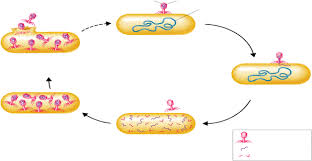
What process is this?
a)
phagocytosis
b)
lytic cycle
c)
lysogenic cycle
d)
formation of antibodies
50.
What is shown here?
a)
Lysogenic Cycle
b)
Lytic Cycle
c)
Binary Fission
d)
Conjugation