

wayground logo

Free Printable Worksheets

NEW

Font size

S
M
L
XL
Worksheets

8th Grade Science Pre/Post Growth Assessment

Total questions: 54

Worksheet time: 2hrs 49mins

Name
Class
Date
1.

Which subatomic particle has a positive charge?

a)

proton

b)

neutron

c)

electron

d)

midichlorian

2.

Which subatomic particle has a negative charge?

a)

proton

b)

neutron

c)

electron

d)

cybertron

3.

Which subatomic particle as no charge, also known as a neutral charge?

a)

proton

b)

neutron

c)

electron

d)

chakra

4.

What is the center of an atom called?

a)

The headquarters

b)

The centrometer

c)

The hypothesis

d)

The nucleus

5.

Which subatomic particle does the RED(+) circle represent?

a)

proton

b)

neutron

c)

electron

d)

nucleus

6.

Which subatomic particle does the YELLOW(-) circle represent?

a)

proton

b)

neutron

c)

electron

d)

nucleus

7.

Which subatomic particle does the GREEN( ) circle represent?

a)

proton

b)

neutron

c)

electron

d)

nucleus

8.
What is the tiniest particle in the entire universe?
a)
cells
b)
gases
c)
atoms
d)
liquids
9.
What is the name of a single type of atom?
a)
cell
b)
proton
c)
element
d)
atom
10.
What is the term for combining 2 or more atoms together?
a)
atoms
b)
elements
c)
molecules
d)
compounds
11.
What is the term for combining 2 or more DIFFERENT atoms together?
a)
atoms
b)
elements
c)
molecules
d)
compounds
12.
What is the mass number defined as?
a)
the number of protons
b)
the number of protons and neutrons
c)
the number of neutrons
d)
the number of protons and electrons
13.

What is the atomic number?

a)

the number of protons

b)

the number of protons and neutrons combined

c)

the number of neutrons

d)

the number of protons and electrons combined
14.
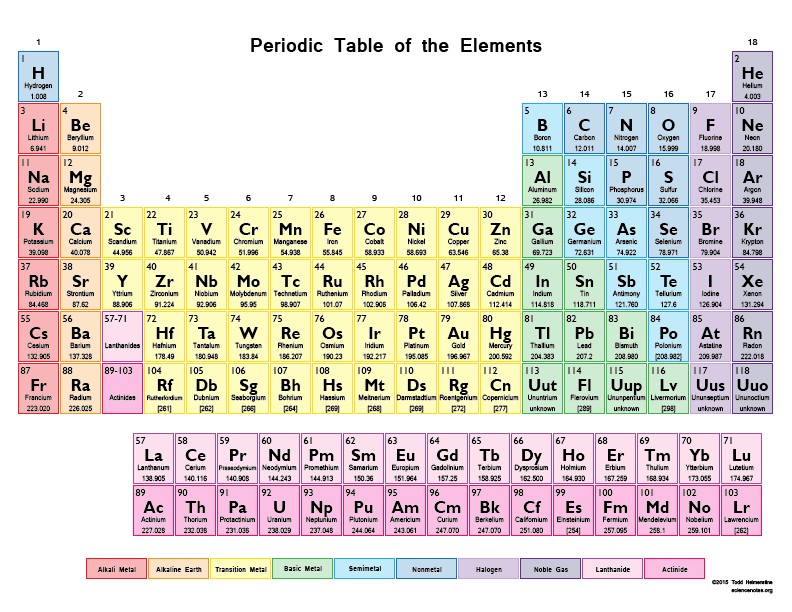
How many protons are in a sodium atom? (tap to enlarge the periodic table)
a)
Sodium has 1 proton.
b)
Sodium has 3 protons.
c)
Sodium has 11 protons
15.
If an atom has 10 electrons, how many protons does it have?
a)
0
b)
1
c)
10
d)
5
16.
An element with a mass number of 11 and an atomic number of 5 has how many neutrons?
a)
11
b)
5
c)
6
d)
16
17.

The number in Kr-84 represents what about Krypton?

a)

The number of electrons

b)

The number of protons

c)

The mass number

18.

The atomic number of an atom is equivalent to which of the following?

a)

the number of electrons outside the nucleus

b)

the number of protons plus the number of neutrons in the nucleus

c)

the number of protons in the nucleus

d)

the number of neutrons in the nucleus

19.

How many protons are in an atom of nitrogen?

a)

7

b)

15

c)

14.007

d)

2

20.

An atom of silicon has 14 protons and 15 neutrons. What is the mass number of this atom of silicon?

a)

14

b)

15

c)

29

d)

28.085

21.

The ability to burn is known as---

a)

Flammability

b)

Combustion

c)

Density

d)

Exploding

22.

Ductility, the ability to be stretched into thin wires, is a --- property.

a)

Chemical

b)

Physical

23.

Combustion or exploding, is a --- property.

a)

Chemical

b)

Physical

24.

When metal comes in contact with oxygen and water, it creates ---- through a chemical reaction.

a)

Rust (tarnish)

b)

Mold

c)

Decomposition

d)

Copper

25.

Digestion, the process of the body breaking down food for nutrients, is a --- property.

a)

Chemcial

b)

Physical

26.

Decay or rotting of a substance is a ---- property.

a)

Chemical

b)

Physical

27.
Melting Point: Chemical or Physical Property
a)
Chemical Property
b)
Physical Property
28.
Which of the following is evidence that a chemical change has taken place? 
a)
change in color
b)
change in size
c)
change in shape
d)
change in energy
29.
When dry ice (solid carbon dioxide) sublimes it goes directly from a solid to a gas. What type of change is occurring? 
a)
Chemical change
b)
Physical change
c)
None of the above 
30.
Why must we balance chemical equations? 
a)
Our teacher said so
b)
to abide by the law of conservation of energy
c)
to abide by the law of conservation of mass
31.
What is changed in a chemical reaction like this one? 
NaOH + HCl   
  NaCl + H2O
a)
the number of atoms is changed
b)
molecules and compounds are changed 
c)
atoms are changed
d)
elements are changed 
32.
 Fill in the blank to balance the chemical equation. 
2KI  +  ____Cl  2KCl  +  I2
a)
1
b)
2
c)
3
d)
4
33.
What coefficient should go in the blank space to balance the chemical equation? 
2Al  +____  HCl   →    2AlCl3  +  3H2
a)
2
b)
4
c)
3
d)
6
34.
Why is the increase of Greenhouse gasses a big issue?
a)
It causes climate change and increase in the global temerature 
b)
It can lead to a major increase in Greenhouses 
c)
It leads to more factories
d)
It causes a major decrease in people
35.
The gradual increase in the temperature of the atmosphere is known as ________________.
a)
Greenhouse Effect
b)
Global Warming
c)
Carbon Dioxide Gases
d)
Methane
36.
Which of the following is the most troubling greenhouse gas being produced by humans?
a)
Water Vapor
b)
Carbon Dioxide
c)
Methane
d)
Nitrous Oxide
37.
The two main factors that determine the climate of a region are _____________ and ______________.
a)
altitude and pressure
b)
pressure and temperature
c)
temperature and precipitation
d)
altitude and pressure
38.
Earth's ozone layer is _____________________________.
a)
has been thickening over the past several years
b)
filters harmful ultraviolet radiation from the sun
c)
exists only over Antarctica
d)
traps carbon dioxide in the stratosphere
39.
Water from rain or snow that flows over the surface of the land into streams, rivers, and lakes is called...
a)
accumulation
b)
runoff
c)
ground water
d)
surface water
40.
After liquid water turns into water vapor, it goes into the air where it becomes a...
a)
glacier
b)
cloud
c)
surface water
d)
ground water
41.
Any form of water that falls from clouds and reaches Earth's surface as rain, snow, sleet, or hail is called...
a)
surface water
b)
precipitation 
c)
ground water
d)
runoff
42.
The energy that drives the water cycle comes from the...
a)
Sun
b)
Moon
c)
Clouds
43.
Evaporation occurs when the sun heats up water in rivers, lakes, or the ocean, and turns it into...
a)
snow
b)
water vapor
c)
rain
d)
sleet
44.
The water cycle plays a key role in _______ around the world.
a)
weather
b)
climate
45.
Which human activity would preserve nonrenewable resources?
a)
deforestation
b)
removing carnivores from a forest 
c)
recycling
d)
heating homes with fossil fuels  
46.
Increased industrialization will most likely
a)
decrease available habitats 
b)
increase environmental carrying capacity 
c)
increase the stability of ecosystems 
d)
decrease global warming
47.
Which human activity is correctly paired with its likely future consequence?
a)
overfishing in the Atlantic — increase in supply of flounder and salmon as food for people 
b)
development of electric cars or hybrid vehicles — increased rate of global warming 
c)
use of fossil fuels — depletion of underground coal, oil, and natural gas supplies 
d)
genetically engineering animals — less food available to feed the world’s population
48.
Which human activity would most likely deplete nonrenewable resources?
a)
use of natural enemies to eliminate insect pests
b)
development of wildlife refuges 
c)
governmental restriction of industrial pollution 
d)
increased use of fossil fuels
49.
Approximately 75 percent of the Earth's surface is covered in water. So why is water considered such a precious resource?
a)
The greenhouse effect is causing most of the world's freshwater to be trapped in the atmosphere
b)
Only a small fraction of the Earth's water is freshwater available for drinking and irrigation
c)
Each year, more freshwater is being trapped in icecaps located at the North and South Poles
d)
Global warming caused by greenhouse gas emissions will likely cause Earth's oceans to evaporate
50.
Many common products, such as wooden furniture, paper, and books, are made from trees. Which of the following is a likely consequence of humans cutting down a forest in order to make use of the natural resources there? 
a)
the decrease of chemical runoff into the oceans
b)
increased acid rain
c)
the increase of light pollution in cities
d)
the destruction of habitats
51.
Which of the following historical events most likely triggered the largest increase in the human population? 
a)
the Black Death plague, which occurred in the mid-1300s
b)
the domestication of wheat crops, which began around 8000 B.C
c)
the fall of the Roman Empire, which occurred around A.D. 800
d)
the Industrial Revolution, which began in the late 1700s
52.
What causes smog?
a)
The burning of particulates
b)
The formation of ozone
c)
Acid Rain
d)
the interaction of sunlight with pollutants produced by fossil fuels
53.
What are renewable resources?
a)
Resources that are used faster than they form
b)
a.       Resources that can replenish themselves over time
c)
a.       Resources that exist only in urban areas
d)
Resources that exist only in rural areas
54.
Global warming has been linked to a decrease in 
a)
the size of the polar ice caps 
b)
the temperature of Earth 
c)
the rate of species extinction 
d)
the rate of carbon dioxide production
