wayground logo

Free Printable Worksheets

Font size

S
M
L
XL
Worksheets

Yr 11 Biology - Meiosis v Mitosis FA

Total questions: 36

Worksheet time: 21mins

Name
Class
Date
1.

How many chromosomes does a human have?

a)

10

b)

23

c)

46

d)

92

2.

the results of mitosis is

a)

2 identical daughter cells

b)

2 different daughter cells

c)

4 identical daughter cells

d)

4 different daughter cells

3.

The result of meiosis is

a)

2 identical daughter cells

b)

2 different daughter cells

c)

4 identical daughter cells

d)

4 different daughter cells

4.

the 4 phases of mitosis in order are

a)

prophase, anaphase, metaphase, telophase

b)

telophase, metphase, metaphase, anaphase

c)

prophase, metaphase, anaphase, telophase

d)

telophase, metaphase, anaphase, prophase

5.

The process that produces sex cells is called

a)

photosynthesis

b)

meiosis

c)

mitosis

d)

respiration

6.

The process by which the number of chromosomes is reduced by half to form sperm and eggs is called

a)

mitosis

b)

cells

c)

meiosis

d)

photosynthesis

7.

The 2 halves of a chromosome are

a)

chromosomes

b)

brother chromatids

c)

sister chromatids

d)

chromatids

8.

how many chromosomes do we get from each parent?

a)

23

b)

46

c)

92

d)

20

9.

Chromosomes move to the middle of the spindle during what phase?

a)

anaphase

b)

telophase

c)

metaphase

d)

prophase

10.
In mitosis, the two resulting cells are
a)
different from the starting cell and identical to each other.
b)
different from the starting cell and different from each other.
c)
identical to the starting cell and different from each other.
d)
identical to the starting cell and identical to each other.
11.
After meiosis is complete, the new cells:
a)
are all identical
b)
are all different
c)
are half identical and half different
d)
are all stretched out
12.
How many daughter cells are produced from meiosis ?
a)
10
b)
6
c)
4
d)
2
13.
The female sex cell is called
a)
zygote
b)
sperm
c)
fertilization
d)
egg
14.
The male sex cell is called
a)
egg
b)
zygote
c)
sperm
d)
mitosis
15.
Most of the cells in the human body are produced by
a)
mitosis
b)
meiosis
16.

Most of the life of any cell is spent is this phase

a)

interphase

b)

prophae

c)

metaphase

d)

anaphase

e)

telophase

17.

Each human blood cell has ________ chromosomes

a)

23

b)

46

18.

Human sex cells have __________ chromosomes

a)

23

b)

46

19.

makes cells with 1/2 the number of chromosomes as the parent cell

a)

mitosis

b)

meiosis

20.
a)

prophase

b)

metaphase

c)

anaphase

d)

telophase

21.
a)

prophase

b)

metaphase

c)

anaphase

d)

telophase

22.
a)

prophase

b)

metaphase

c)

anaphase

d)

telophase

23.
a)

prophase

b)

metaphase

c)

anaphase

d)

telophase

24.
What kind of cells are made in MEIOSIS?
a)
Haploid cells
b)
Diploid Cells
c)
Skin Cells
d)
Liver Cells
25.
What causes genetic variation in meiosis?
a)
chromosomes lining up
b)
crossing over of chromosomes
c)
separation of chromosomes
d)
chromosomes pulling apart
26.
Diploid Cells are represented by
a)
2n
b)
n
c)
4n
d)
1/2 n
27.
If the Diploid number of Carrots is 18, the haploid number is
a)
18
b)
9
c)
27
d)
36
28.
The process of crossing over occurs in what phase of meiosis?
a)
anaphase 1
b)
prophase 1
c)
prophase 2
d)
telophase 1
29.
The chromosomes that pair up during meiosis, are called __________ chromosomes.  
a)
homozygous 
b)
asexual
c)
homologous
d)
genes
30.
Crossing over creates
a)
male genotype
b)
genetic variation (differences)
c)
DNA replication
d)
mitosis
31.
What phase is represented?
a)
metaphase 1
b)
metaphase 2
c)
anaphase 1
d)
anaphase 2
32.
What phase is  shown in the picture?
a)
metaphase 2
b)
anaphase 2
c)
metaphase 1
d)
telophase 1
33.
Identify the phase.
a)
Metaphase I
b)
Metaphase II
c)
Anaphase I
d)
Anaphase II
34.
Identify the phase.
a)
Telophase I
b)
Telophase II
c)
Metaphase I
d)
Metaphase II
35.
In meiosis, Prophase 1 is when chromosomes...
a)
cross over
b)
mutate
c)
hybridize
d)
fertilize
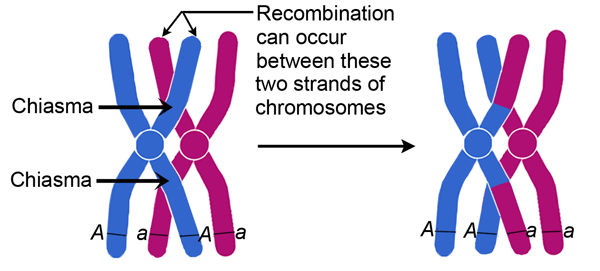
36.
This image shows chromosomes during Prophase 1. Which of the following correctly describes the process shown?
a)
segregation of sister chromatids
b)
condensation and segregation of alleles
c)
mutationin which the DNA content of the gene is altered
d)
crossing - over in which alleles are exchanged