wayground logo

Free Printable Worksheets

Font size

S
M
L
XL
Worksheets

Yr 10 - Evolution

Total questions: 62

Worksheet time: 1hrs 27mins

Name
Class
Date
1.
The law of superposition states
a)
the oldest rock layer is on the top, the younger rock layer is on the bottom
b)
rock layers are always in sequence from oldest to youngest
c)
the youngest rock layer is on the bottom and the oldest is on the top
d)
the oldest layer is on the bottom and the youngest is on the top when it is undisturbed
2.
What can help a scientist know the approximate age of bones?
a)
the soil it is found in
b)
the index fossils in the area
c)
the type of rock it is formed in
d)
absolute dating
3.
Scientist find dinosaur fossils in the bottom of a cliff and mammals fossils in the middle layer, what can be inferred?
a)
dinosaurs ate plants
b)
dinosaurs were eaten by the mammals
c)
they lived at the same time
d)
dinosaurs lived before the mammals
4.
Ostrich wings are examples of
a)
homologous structures
b)
vestigial structures
c)
adaptations
d)
traits
5.
Dolphins have the same arm structure as wolfs, what type of evidence for evolution does this represent?
a)
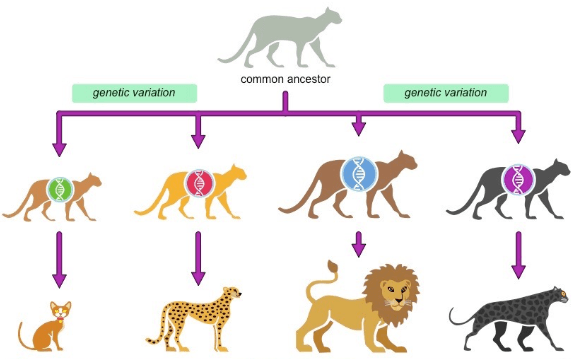
DNA
b)
vestigial structures
c)
homologous structures
d)
embryology
6.
Why do embryologist study embryos?
a)
to see if they are related
b)
to understand adaptations
c)
to determine the age
d)
to learn what parents are vestigial
7.
What would indicate that a series of fossils represent evolution?
a)
the fossils were identical
b)
the fossils were found in the same layers of rock
c)
the fossils show similarities
d)
the fossils were completely different
8.
What animal is Darwin known for studying?
a)
dinosaurs
b)
tunicates
c)
finches
d)
horses
9.
This makes an organism more suited to its enviornment
a)
species
b)
lifespan
c)
adaptation
d)
mutation
10.
The tree of life is a metaphor for what idea?
a)
we came from a common ancestor
b)
we need water and sunlight to survive
c)
we have multiple species
d)
we are old
11.
Who was Charles Darwin?
a)
A naturalist who came up with the theory of evolution
b)
A scientist who studied plants
c)
A geologist who looked at rocks and fossils
d)
A paleontologist who studied dinosaurs
12.
Which of the following is not a piece of evidence for evolution?
a)
Homologous structures
b)
embryology
c)
fossil age
d)
vestigial structures
13.
Relative dating
a)
gives the exact age of rocks and fossils
b)
is when you date your cousin
c)
gives the approximate age of rocks
d)
tells us who to trust
14.
Which of the following is a term for a group of similar organisms that can reproduce fertile offspring?
a)
individual
b)
population
c)
species
d)
fossil
15.
If an organism has a vestigial structure, that structure likely once had a function in a(n)
a)
close relative
b)
early ancestor
c)
unrelated organism
d)
embryological stage
16.
Extinction can occur because of which of the following?
a)
All can be causes of extinction.
b)
Increased competition with other species
c)
New predators within the environment
d)
Loss of habitat and/or catastrophes
17.
Finches on the Galapagos Islands had different beaks in order to help them do what?
a)
Build nests
b)
Fight off predators
c)
Collect food sources
d)
Compete with rivals
18.
Inherited trait that helps an organism survive is a(n) __________.
a)
Fossil
b)
Adaptation
c)
Ancestor
d)
Natural selection
19.
Survival of the fittest or when favorable adaptations reproduce faster is called what?
a)
Evolution
b)
Adaptation
c)
Natural selection
d)
Fossilization
20.
This occurs when no more of a species is living.
a)
Fossilization
b)
Adaptation
c)
Extinction
d)
Natural selection
21.
Magda is a tall, 11 year old drummer. She has a scar on her right cheek. She is good at swimming. Which of her traits did Magda most likely inherit?
a)
height
b)
the scar
c)
ability to swim
d)
ability to play drums
22.
According to the diagram, which organism is older?
a)
ammonite
b)
coral
c)
gastropod
d)
trilobite
23.
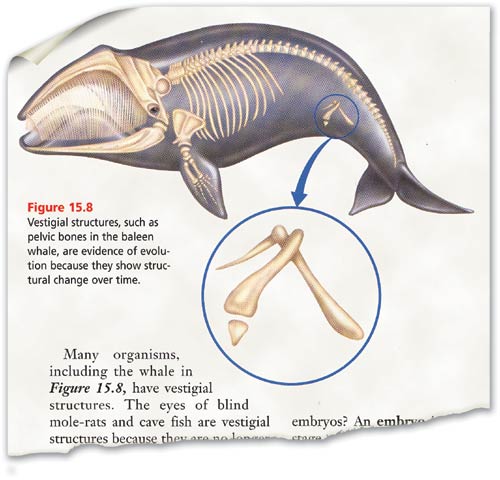
Which of the following is an example of a vestigial structure?
a)
the wings of a red-tailed hawk
b)
the hind limbs of a house cat
c)
the fins of sharks
d)
the tailbone of a human
24.
The ability of an organism to survive and reproduce in its specific environment 
a)
diversity.
b)
evolution
c)
adaptation
d)
 fitness
25.
Why are advantageous traits more likely to be passed onto offspring?
a)
Because they are more likely to survive and reproduce.
b)
Because they come from dominant alleles.
c)
Because they come from recessive alleles.
d)
Because the trait is an acquired phenotype.
26.
Farmers breed cows to produce high amounts of milk. This is an example of...
a)
Natural Selection 
b)
Variations in a species 
c)
Selective Breeding 
d)
inbreeding
27.
Darwin wrote that organisms with traits that are best suited to the environment will ________________
a)
increase in number
b)
become extinct
28.
Which of the following is NOT an example of natural selection? 
a)
People selectively breeding hamsters.
b)
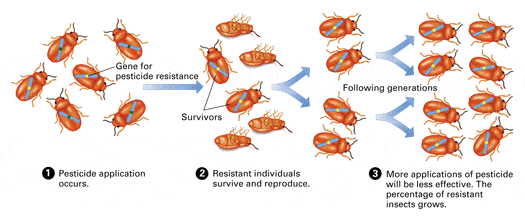
Insect populations developing resistance to certain pesticides.
c)
Bacteria becoming resistant to antibiotics.
d)
Male birds of certain species developing colorful feathers to attract female mates.
29.
Which term refers to the process by which individuals that are better suited to the environment survive and reproduce therefore passing down their genes to their offspring? 
a)
Evolution 
b)
Variation 
c)
Adaptation
d)
Natural Selection 
30.
The separation of a group of individuals from the rest of the population is referred to as 
a)
genetic drift
b)
natural selection
c)
geographic isolation
d)
survival of the fittest
31.
Two organisms that are closely related would have
a)
very similar DNA sequence
b)
exactly the same DNA sequences
c)
no proteins in common
d)
completely different DNA sequence
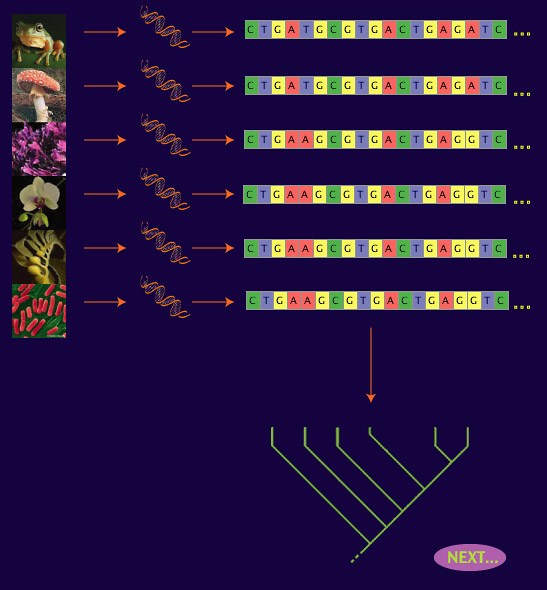
32.

What type of evidence is shown in the image above?

a)

Fossils

b)

Vestigial structures

c)

Homologous Structures

d)

DNA

33.

What type of evidence are shown in the picture above?

a)

Fossils

b)

Embryology

c)

Homologous Structures

d)

Vestigial Structures

34.

Adaptations are:

a)

physical or behavioral tendencies.

b)

physical or behavioral characteristics that help an organisms survive and reproduce.

c)

physical or behavioral characteristics that do not help the organism in any way.

d)

genetic mutations that have gone wrong.

35.
The similarities of the bones in the diagram provide evidence that---
a)
The organisms shown lived in the same natural envionrment
b)
The organisms shown may have developed from a common ancestor
c)
The organisms shown have the same genetic diseases
d)
All vertebrate species have identical forelimbs
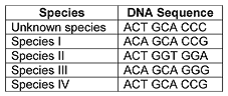
36.
According to this data, the unknown bacterial species is most closely related to: 
a)
Species I
b)
Species II
c)
Species III
d)
Species IV
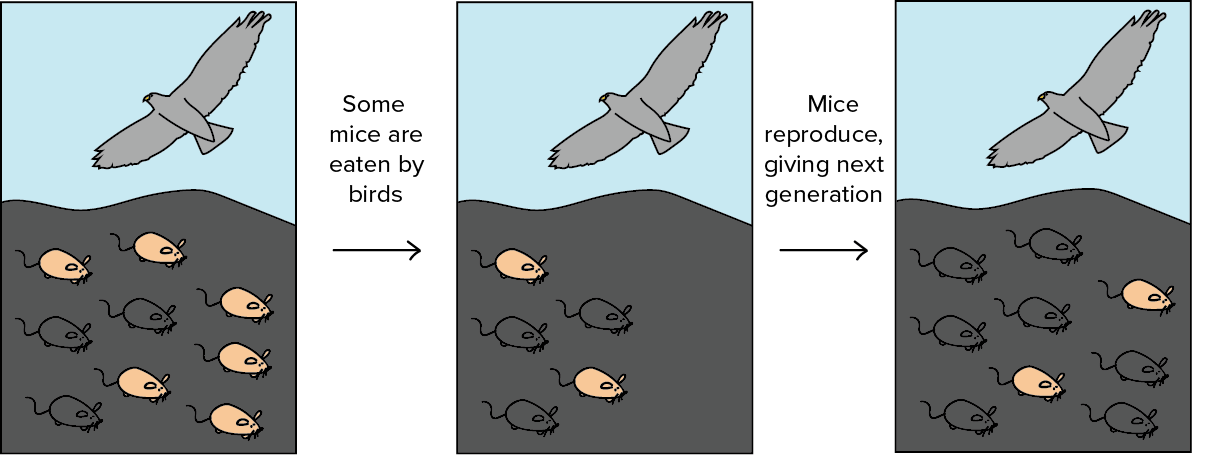
37.
What process is being shown in this image?
a)
Variation
b)
Natural Selection
c)
Selective Breeding
d)
Homeostasis
38.
Why is the mouse population changing over time?
a)
The light mice can reproduce more successfully than the dark mice
b)
The hawks eat more dark mice than light mice because the dark mice taste better
c)
The hawks eat more light mice than dark mice because they can see the light mice more easily
d)
The hawks eat more dark mice than light mice because they can see the dark mice more easily
39.

The process by which two populations of the same species become so different that they can no longer interbreed.

a)

natural selection

b)

artificial selection

c)

speciation

d)

fossilization

40.

Overproduction, Genetic Variation, Struggle to Survive, and Successful Reproduction are the 4 parts of:

a)

Natural Selection

b)

Speciation

c)

Artificial Selection

d)

Fossilization

41.

A species is defined as:

a)

a group of organisms that are extremely different.

b)

a group of organisms that have similar characteristics and always live in the same place.

c)

a group of organisms with similar characteristics and can reproduce to make fertile offspring.

d)

any two organisms to make a hybrid.

42.

What statement is true regarding why natural selection can be easily seen in insects and bacteria?

a)

Natural selection only occurs in prokaryotic cells

b)

Insects and bacteria can reproduce faster than more complex organisms and pass on selected traits quicker

c)

Insects were the first multi-cellular organism to live on land

d)

Bacteria have directly evolved from insect traits.

43.

Which of the following is true about the picture above?

a)

Camels are highly adapted to cold climates.

b)

There are no benefits to using a camel vs. a horse in the desert.

c)

Camels have directly evolved from whales.

d)

A camels long large intestine, long eyelashes and wide feet allow it to be very adapted to the desert.

44.

Which of the following is true regarding the evidence of evolution

a)

Vestigial structures are not real evidence of evolution.

b)

Homologous structures and fossils are the most dependable forms of evidence.

c)

Comparing DNA is the most definitive and accurate method to show evolutionary relationships.

d)

Embryology and Homologous structures do not support the theory of evolution.

45.
Starting in 1954, commercial fishers in the northwest Pacific were paid by weight, rather than by the individual fish, for pink salmon. The fishers increased the use of a type of net that selectively catches larger fish.  Which of the following effects did this change in fishing technique most likely have on the salmon population over the next 20 years?
a)
The average body size of the salmon population decreased significantly.
b)
The average body size of the salmon population increased significantly.
c)
The average body size of the males in the salmon population increased, and the females stayed the same.
46.
European rabbits were introduced to Australia in 1859. The rabbits reproduced rapidly in their new habitat, displaced other animals, and overgrazed vegetation. In an attempt to reduce the rabbit population, a virus was introduced in 1951. This virus is usually deadly to European rabbits. When the virus was first introduced, the rabbits died in large numbers, but the death rate decreased over time. Which of the following best explains the decrease in the rabbit death rate? 
a)
Young rabbits learned to avoid being infected with the virus.
b)
The lifespan of the virus was too short to affect rabbits over a long period of time.
c)
Natural selection favored rabbits that were resistant to the virus. 
d)
No correct choices.
47.
Which of the following statements gives the most likely explanation for the presence of two very similar species of squirrels living on opposite sides of the Grand Canyon?
a)
One squirrel traveled across the canyon and started a new population on the other side.
b)
One squirrel traveled across the canyon and interbred with a different population on the other side.
c)
Members of one single squirrel species were geographically separated by the formation of the canyon.
d)
Members of two different squirrel species migrated from two different places to opposite sides of the canyon. 
48.
The Asian shore crab invaded parts of the eastern coast of the United States about 15 years ago. The Asian shore crab preys on blue mussels. In the time since the Asian shore crab arrived, the average shell thickness of the blue mussel population has increased. Which of the following is the most likely reason that this increase in shell thickness has occurred? 
a)
Blue mussels with thick shells attract more crabs that mussels without thick shells.
b)
Blue mussels with thick shells grow in larger colonies than mussels without thick shells.
c)
Blue mussels with thick shells catch more food per day than mussels without thick shells.
d)
Blue mussels with thick shells survive and reproduce more successfully than mussels without thick shells.
49.
Some willow trees alter the chemical composition of their leaves when attacked by caterpillars. Compared to normal leaves, the chemically altered leaves are less nutritious and more difficult for caterpillars to digest.
 Which of the following is a likely effect of this ability to alter leaf composition?
a)
Willow trees with this ability will attract more caterpillars than other willow trees.
b)
Willow trees with this ability have a survival advantage over other willow trees. 
c)
More butterflies will lay their eggs on willow trees with this ability than other willow trees. 
d)
None are correct
50.
Comparing human hemoglobin of chimpanzees, horses, kangaroos, and chickens, reveal that humans have the fewest amino acid differences with 
a)
Kangaroos
b)
Horses
c)
chickens
d)
chimpanzees
51.
In Darwin's theory of evolution, he uses his idea of _________________ to explain evolution.
a)
decent by modification
b)
species dying out
c)
when species use new traits
52.
a bird that can easily outcompete other birds for food and that can produce many eggs has a high
a)
sexuality
b)
mutation rate
c)
fitness
d)
adaptability
53.
What is the process in which humans breed organisms for certain traits?
a)
natural selection
b)
inheritance
c)
artificial selection
d)
descent without modification
54.

What type of structures are shown?

a)

Homologous

b)

Analogous

c)

Vestigial

d)

Heterologous

55.

All dogs have the common ancestor the wolf. This is an example of -

a)

divergent evolution

b)

convergent evolution

56.
Darwin’s finches is an example of this type of evolution.
a)
Divergent
b)
Coevolution
c)
Convergent
d)
Artificial
57.

What does it mean when organisms share a common ancestor?

a)

They evolved from 1 species that lived in the past

b)

They are the same species

c)

The organisms have exactly the same traits

d)

The organisms are very different from one another

58.

Evolution is a gradual process. What does "Gradual" mean?

a)

Quick

b)

Slow

c)

Round

d)

Graded

59.

Which of these are true about Extinct Species? (multiple answers)

a)

All members of the species are dead.

b)

The species had no successful traits for the environment.

c)

They won't be found in the fossil record after their extinction.

d)

Only some of the members are still alive.

60.

A mistake or change in the DNA is called a...

a)

Mutation

b)

Mutilation

c)

Fossil

d)

Species

61.
Vertebrate embryos pass through similar stages of development is evidence for
a)
use and disuse
b)
homologous structures
c)
common ancestry
d)
acquired characteristics
62.
Individuals that are well adapted to their environment will survive and produce
a)
better traits
b)
stronger genes
c)
more offspring
d)
fewer mutations