wayground logo

Free Printable Worksheets

Font size

S
M
L
XL
Worksheets

Test review for Physical properties

Total questions: 60

Worksheet time: 2hrs 6mins

Name
Class
Date
1.
Molecules spread out and move FAST!
a)
solid
b)
gas
c)
liquid
2.
Mass, relative density, solubility, color, texture, state of matter, conductivity, etc.
a)
Physical state
b)
Insulators
c)
Physical Properties 
d)
Inferences
3.
Molecules are tightly packed together
a)
solid
b)
liquid
c)
gas
4.
If an ice cube is left out in  room it will change from one state of matter to another.  Which is the correct order of State of Matter that the ice cube will go through?
a)
Gas, Solid, Liquid
b)
Liquid, Solid, Gas
c)
Liquid, Gas, Solid
d)
Solid, Liquid, Gas
5.
Which box has a higher density?  
a)
Box A
b)
Box B
c)
cannot be determined
d)
they are the same
6.
True or False: You can create and destroy matter
a)
True
b)
False
7.
What is the definition of Solid
a)
definite shape and size
b)
the ability of a substance to dissolve in another substance, such as sugar dissolving in water
c)
a type of mixture in which the particles of one or more substances are dissolved (uniformly dispersed throughout) in another substance
d)
the forms matter can take, such as solid, liquid, and gas; sometimes called phases of matter
e)
energy related to the temperature of an object or a substance
8.

Mass divided by volume is the formula for calculating----

a)

Mass

b)

Volume

c)

Density

d)

Matter

9.

Photosynthesis is the process in which plants make sugar(glucose) and oxygen. It is a ---- property.

a)

Chemical

b)

Physical

10.

Solubility, the ability to dissolve, is a --- property.

a)

Chemical

b)

Physical

11.

When metal comes in contact with oxygen and water, it creates ---- through a chemical reaction.

a)

Rust (tarnish)

b)

Mold

c)

Decomposition

d)

Copper

12.

Digestion, the process of the body breaking down food for nutrients, is a --- property.

a)

Chemcial

b)

Physical

13.

Malleability, the ability to be flattened into thin sheets, is a ---property.

a)

Physical

b)

Chemical

14.

Decay or rotting of a substance is a ---- property.

a)

Chemical

b)

Physical

15.

Solubility, the ability to dissolve, is a --- property.

a)

Chemcial

b)

Physical

16.

Color change like in a drop of food coloring in water, is a --- change.

a)

Physical

b)

Chemical

17.

Bubbles produced as in the yeast and peroxide demonstration is an example of a --- property.

a)

Chemical

b)

Physical

18.
A pure substance that cannot be separated into simpler substances by chemical or physical means.  
a)
Element
b)
Compound
c)
Mixture
d)
Chemical
19.
Carbon Dioxide is a ______ 
a)
compound 
b)
element 
c)
mixtures 
d)
Battle of Bunker Hill 
20.
Which of the following represents an element?
a)
H2O
b)
H2
c)
NaCl
d)
CaCO3
21.
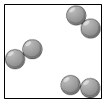
This picture represents which of the following?
a)
element
b)
compound
c)
mixture of elements
d)
mixture of compounds
22.
When elements form mixtures, the elements keep their original properties. 
a)
True
b)
False
23.
The air is a _________. 
a)
element 
b)
mixture 
c)
compound 
d)
energy 
24.
The things in a mixture always retain their........
a)
smell properties 
b)
physical and chemical properties 
c)
shape 
d)
color 
25.
Elements can be broken down into simpler substances. 
a)
false 
b)
true 
c)
sometimes 
26.
These must be separated chemically. 
a)
elements 
b)
compounds 
c)
mixtures 
d)
homogeneous mixtures 
27.
This can be separated physically. 
a)
mixture 
b)
element 
c)
compound 
28.
Which of the following is an element?
a)
Sugar
b)
Salt
c)
Water
d)
Oxygen
29.
Glucose (C6H12O6) contains atoms of carbon, hydrogen, and oxygen that are chemically bonded together.  What type of matter is glucose?
a)
Glucose is an element
b)
Glucose is a compound 
c)
Glucose is a mixture
d)
Glucose is a metal
30.
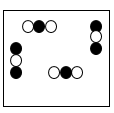
What does the diagram show?
a)
A mixture of two elements
b)
A pure compound
c)
A mixture of two compounds
d)
A mixture of a compound & element
31.
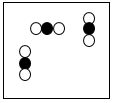
What does the diagram show?
a)
A mixture of two elements
b)
A pure compound
c)
A mixture of two compounds
d)
A mixture of a compound & element
32.
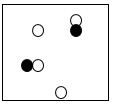
What does the diagram show?
a)
A mixture of two elements
b)
A pure compound
c)
A mixture of two compounds
d)
A mixture of a compound & element
33.
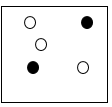
What does the diagram show?
a)
A mixture of two elements
b)
A pure compound
c)
A mixture of two compounds
d)
A mixture of a compound & element
34.
Which description below is a true statement about the diagram?
a)
The diagram can be classified as an element and a molecule
b)
The diagram can be classified as a compound
c)
The diagram can be classified as a mixture of two compounds
d)
The diagram can be classified as a mixture of two elements
35.
Which statement below is TRUE about compounds?
a)
The properties of compounds are totally different than the properties of the elements that form them
b)
All compounds are listed on the Periodic Table of Elements
c)
A compound is a pure substance that is made from one type of atom
d)
The properties of compounds are the same as the properties of the elements that form them
36.
Classify glucose (C6H12O6as an element or compound.
a)
Element
b)
Compound
37.
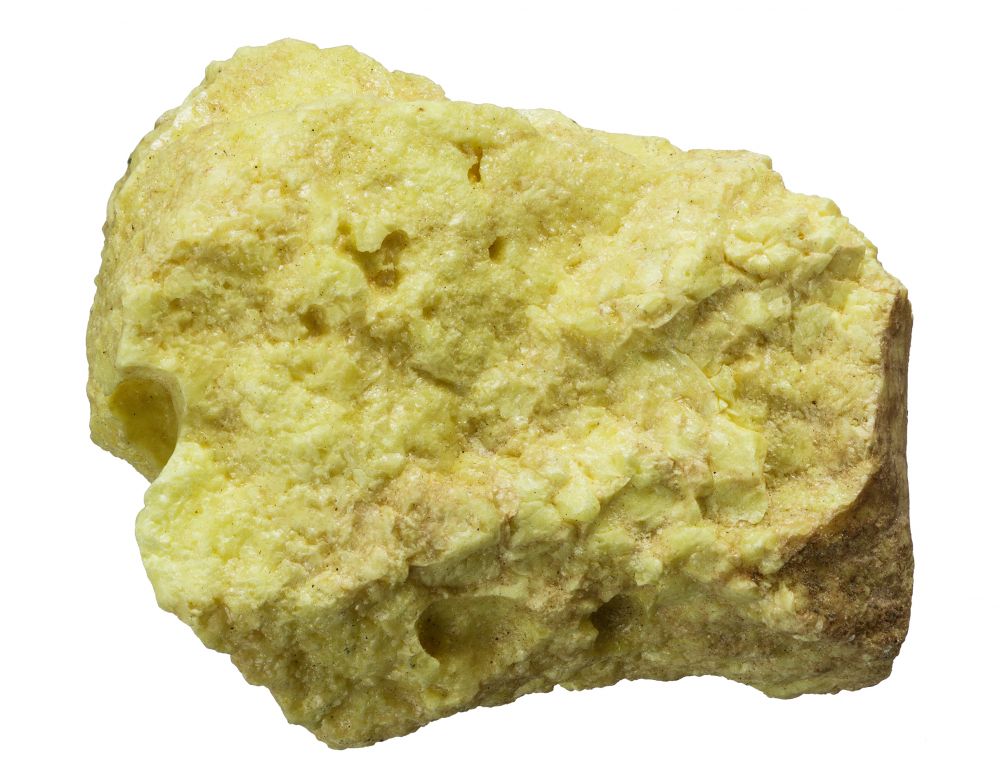
Classify Sulfur (S) as an element or compound.
a)
Element
b)
Compound
38.
TRUE OR FALSE:
Water is an element.
a)
True
b)
False
39.
This picture represents which of the following?
a)
element
b)
compound
c)
mixture
40.
This picture represents which of the following?
a)
element
b)
compound
c)
mixture
41.
Are these molecules also compounds?
a)
YES
b)
NO
42.

In this diagram, X represents...

a)

A compound

b)

A mixture

c)

An atom

d)

An element

43.
A copper penny turning greenish after a few years is an example of ...
a)
Chemical Change
b)
Physical Change
44.
A change in which NEW substances are formed.
a)
Chemical change
b)
Physical change
c)
Casual change
d)
Formal change
45.
Which of the following is NOT an example of a physical change?
a)
crumpled paper
b)
pencil sharpening
c)
shrunken clothing
d)
sour milk
46.
Which of the following IS a physical change?
a)
Getting a haircut
b)
Rusty metal
c)
sour milk
d)
A compound
47.
Is melting butter for popcorn a chemical or physical change?
a)
chemical
b)
physical
48.
Is a rusting bicycle a chemical or physical change?
a)
chemcial
b)
physical
49.
A(n) ______ is a substance with a pH less than 7
a)
Acid
b)
Alkaline
c)
Base
d)
Buffer
50.
What is the only substance with a neutral pH of 7?
a)
Milk
b)
Orange Juice
c)
Water
d)
Blood
51.
A solution with a pH of 3.6 would be...
a)
Acid
b)
Base
c)
Neutral
d)
Acid and Base
52.
Tastes Sour
a)
Acids
b)
Bases
c)
Salts
d)
All
53.
According to the pH range which substance is more acidic than lemon juice
a)
Hydrochloric acid
b)
cabbage
c)
milk
54.
Bleach is a strong base, what is the pH level of bleach?
a)
13
b)
14
c)
1
d)
2
55.
Law of conservation of mass states that 
a)
matter is created
b)
matter is destroyed
c)
matter is neither created nor destroyed
d)
matter does not change
56.
True or false.  Law of conservation of mass means that the number of atoms of the products is more than the number of atoms in the reactants. 
a)
True
b)
False
57.
Can matter be created or destroyed?
a)
Yes, it can be created.
b)
Yes, it can be destroyed.
c)
No, matter is always conserved
d)
None of these
58.
The mass after a physical change, such as ice melting into water, stays the same
a)
True
b)
False
59.
The total amount of matter (atoms) before and after a chemical reaction (change), remains the same.
a)
True
b)
False
60.
What is the law of conservation of mass?
a)
Matter changes when reacted or changed.
b)
The mass of all reactants are changed during a physical or chemical change
c)
The mass of the reactants is the same as the mass of the products
d)
The mass of the products is different than the mass of the reactants.