
 Worksheets
Unit 1- Biomolecules and Enzymes Test Review
Total questions: 54
Worksheet time: 2hrs 31mins
Name
Class
Date
1.
Proteins are composed of what smaller subunits?
a)
amino acids
b)
nucleic acids
c)
fatty acids
d)
nucleotides
2.
What are the monomers of DNA?
a)
glycerols
b)
amino acids
c)
fatty acids
d)
nucleotides
3.
What is the monomer of a carbohydrate?
a)
Monosaccharides
b)
Amino Acids
c)
Fatty Acids
d)
Nucleotides
4.
What are lipids composed of?
a)
Monosaccharides
b)
Amino Acids
c)
Fatty Acids
d)
Nucleotides
5.
Monomers combine to form ________ through the process of ________.
a)
polymers; hydrolysis
b)
polymers; dehydration synthesis
c)
monomers; hydrolysis
d)
monomers; dehydration synthesis
6.
Polymer's split apart to form ________, by __________.
a)
monomers, hydrolysis
b)
monomers, dehydration synthesis
c)
amino acids, hydrolysis
d)
amino acids, dehydration synthesis
7.
a single unit or molecule
a)
polymer
b)
dimer
c)
monomer
d)
macromolecule
8.

How many monomers are shown here?
a)
1
b)
3
c)
5
d)
7
9.

Large molecules made up of smaller molecules.
a)
monomer
b)
polymer
c)
hydrocarbon
d)
plastic
10.
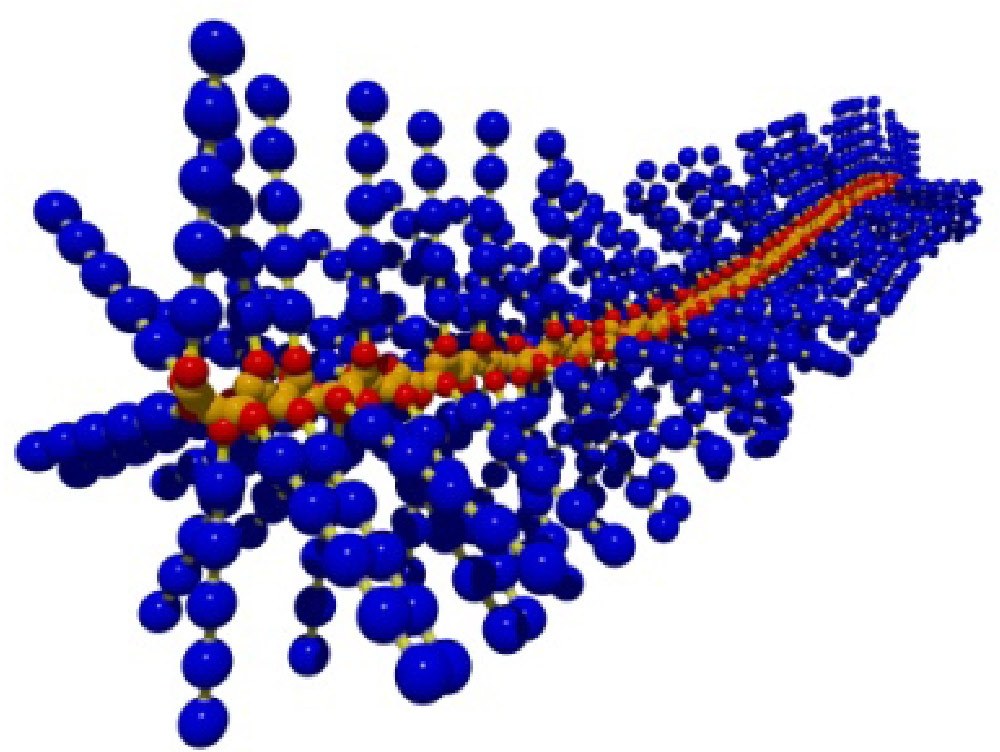
What is a polymer?
a)
a group of atoms
b)
a long chain molecule with identical group of atoms
c)
a long chain of molecules
d)
a long chain of different atoms
11.
Which biomolecule contains pastas and breads?
a)
Lipid
b)
Protein
c)
Nucleic Acid
d)
Carbohydrate
12.
Which biomolecule contains fats, oils, and waxes?
a)
Proteins
b)
Nucleic Acid
c)
Lipids
d)
Carbohydrate
13.
Which of the following is NOT a biomolecule?
a)
Water
b)
Nucleic Acid
c)
Protein
d)
Lipid
14.
The process that builds molecules by removing water to bind them together is
a)
Hydrolysis
b)
Protein Synthesis
c)
Dehydration Synthesis
d)
Lysis
15.
The process of adding water in order to break bonds within a polymer....
a)
Dehydration Synthesis
b)
Hydrolysis
16.

What is the following molecule?
a)
Monosaccharide
b)
Disaccharide
c)
Trisaccharide
d)
Polysaccharide
17.

What is the following molecule?
a)
Carbohydrate
b)
Lipid
c)
Protein
d)
Nucleic Acid
18.

What is the following molecule?
a)
Carbohydrate
b)
Lipid
c)
Protein
d)
Nuclelic Acid
19.

What is the following molecule?
a)
Monosaccharide
b)
Disaccharide
c)
Trisaccharide
d)
Polysaccharide
20.
Which biomolecule has sugars and starches?
a)
Lipids
b)
Proteins
c)
Carbohydrates
d)
Nucleic Acid
21.
Which biomolecule is made of amino acids?
a)
Nucleic Acid
b)
Carbohydrate
c)
Protein
d)
Lipid
22.
Which biomolecule contains fats, oils, and waxes?
a)
Proteins
b)
Nucleic Acid
c)
Lipids
d)
Carbohydrate
23.
Which elements are present in nucleic acid?
a)
CHON
b)
CHO
c)
CHONP
24.
Which elements are present in a carbohydrate?
a)
CHONP
b)
CHON
c)
CHO
25.
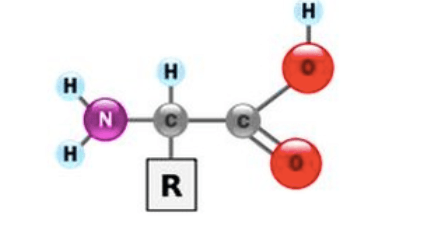
Which biomolecule is this a picture of?
a)
Protein
b)
Nucleic Acid
c)
Lipid
d)
Carbohydrate
26.
Which elements are present in a lipids?
a)
CHONP
b)
CHON
c)
CHO
27.
Which elements are present in a protiens?
a)
CHONP
b)
CHON
c)
CHO
28.
Which biomolecule contains pastas and breads?
a)
Lipid
b)
Protein
c)
Nucleic Acid
d)
Carbohydrate
29.
Which biomolecule is made of nucleotides and contain you DNA?
a)
Carbohydrate
b)
Lipids
c)
Protein
d)
Nucleic Acid
30.
Which biomolecule helps form muscles?
a)
Nucleic Acid
b)
Carbohydrate
c)
Protein
d)
Lipids
31.
Which biomolecule is responsible for insulation and energy storage?
a)
Protein
b)
Nucleic Acid
c)
Lipid
d)
Carbohydrate
32.
Which biomolecule has sugars and starches?
a)
Lipids
b)
Proteins
c)
Carbohydrates
d)
Nucleic Acid
33.
Which biomolecule contain your genetics?
a)
Carbohydrate
b)
Lipid
c)
Nucleic Acid
d)
Protein
34.
Which biomolecule is made of amino acids?
a)
Nucleic Acid
b)
Carbohydrate
c)
Protein
d)
Lipid
35.
Which biomolecule is made of amino acids?
a)
Nucleic Acid
b)
Carbohydrate
c)
Protein
d)
Lipid
36.
Which biomolecule is your main source of energy?
a)
Nucleic Acid
b)
Protein
c)
Lipid
d)
Carbohydrate
37.
What do monomers do?
a)
Bonds to make a Polymer
b)
Creates Protiens
c)
Stores energy
d)
Splits to make more cells
38.
Which foods are high in protein?
a)
Meats, cheeses, milk, eggs
b)
Breads, pasta, grains
c)
Butter, oil, lard
d)
Apples, Bananas, Grapes
39.
What is the function of a nucleic acid?
a)
Stores genetic information
b)
Stores energy
c)
Quick source of energy
d)
Builds structures
40.
Enzymes are considered to be
a)
Lipids
b)
Carbohydrate
c)
Protein
d)
Nucleic Acid
41.
What is the purpose of an enzyme?
a)
give permission for the reaction
b)
raise activation energy
c)
speed up reactions
d)
control how many reactions occur
42.
Enzymes are capable of increasing the rate of a chemical reaction within a living cell. Enzymes accomplish this through which of the following means?
a)
reducing the number of products
b)
reducing the activation energy
c)
increasing the temperature of the cell
d)
increasing the concentration of reactants
43.

What is structure A?
a)
Substrate
b)
Active site
c)
Enzyme
d)
Products
44.

What is structure D?
a)
Substrate
b)
Active site
c)
Enzyme
d)
Products
45.

What is structure C?
a)
Substrate
b)
Active site
c)
Enzyme
d)
Products
46.

What is structure E, F, G?
a)
Substrate
b)
Active site
c)
Enzyme
d)
Products
47.

Which of the following conclusions can be drawn from this graph?
a)
The optimum pH of the enzyme is 6.6.
b)
The optimum pH of the enzyme is 5.8
c)
The enzyme’s activity increases as pH increases 5.0 to 9.0
d)
The enzyme’s activity is greater around pH of 8.0 .
48.
The "lock and key hypothesis" attempts to explain the mechanism of?
a)
Vacuole formation
b)
Pinocytosis
c)
Sharing of electrons
d)
Enzyme specificity
49.
After the enzyme and substrate bind together and perform the reaction, what does the substrate become?
a)
a substrate
b)
an enzyme
c)
a product
d)
an active site
50.
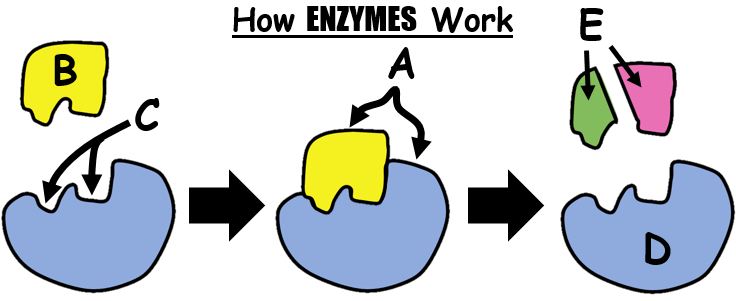
In the diagram, what is letter A?
a)
product
b)
substrate
c)
enzyme-substrate complex
d)
active site
51.
An enzyme speeds up a chemical reaction in the cell but can only be used once. True or False?
a)
true
b)
false
52.
What happens when enzymes are heated to a high temperature?
a)
The enzymes die.
b)
The shapes of the enzyme are altered denature
c)
The enzymes' amino acid sequence changes.
d)
The enzymes remain the same
53.
The pH at which an enzyme is most efficient is called the _________ pH of an enzyme.
a)
neutral
b)
optimum
c)
minimum
d)
experimental
54.
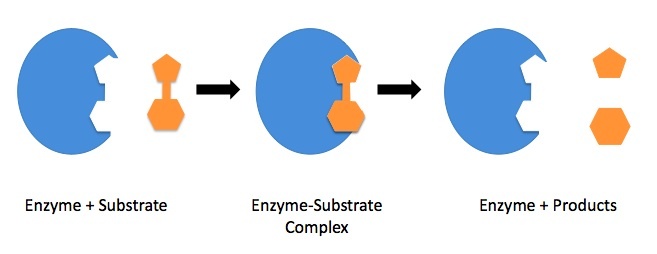
When a molecule can occupy the same active site as the substrate, a situation called __________________ can result
a)
Competitive lnhibition
b)
Allosteric Regulation
c)
Non-Competitive Inhibition
d)
Feedback Inhibition
100 %

