wayground logo

Free Printable Worksheets

NEW

Font size

S
M
L
XL
Worksheets

AP Biology Cells and Homeostasis REVIEW CHALLENGE

Total questions: 40

Worksheet time: 39mins
Name
Class
Date
1.
Homeostasis
a)
allows for a wildly fluctuating internal environment
b)
is impossible in vertebrates
c)
is the maintenance of a relatively stable internal environment and often incorporates a form of feedback regulation
d)
is the maintenance of a relatively stable external environment and often incorporates a form of feedback regulation
2.
If the environment gets cold, we will often shiver in order to:
a)
keep body temperature the same as the external temperature
b)
decrease body temperature
c)
increase body temperature
d)
regulate blood pressure
3.
Homeostasis in the human body is often maintained by a: 
a)
neutral feedback loop 
b)
solar feedback loop
c)
positive feedback loop
d)
negative feedback loop
4.
The "cause" for something to happen is the
a)
response
b)
effect
c)
stimulus
d)
homeostasis
5.
The "effect" of a given stimulus is the...
a)
response
b)
stimulus
c)
cause
d)
result
6.
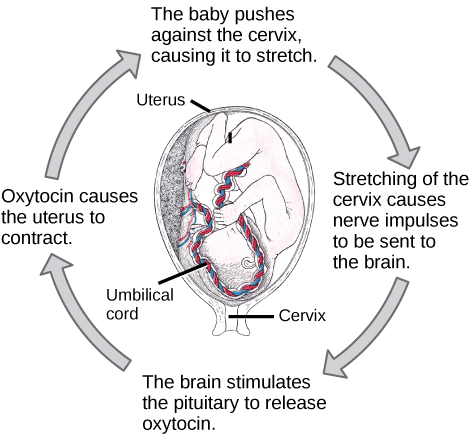
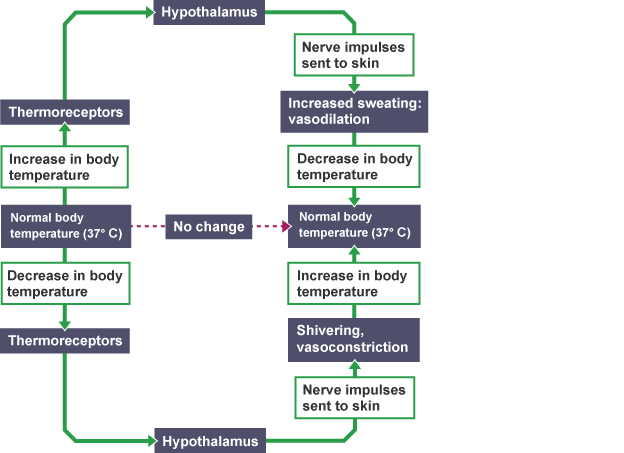
What type of feedback loop is shown?
a)
Positive
b)
Neutral
c)
Negative
7.
What type of feedback loop is shown?
a)
negative
b)
neutral 
c)
positive
8.
Failure to maintain homeostasis could result in:
a)
lack of internal balance
b)
eventual death
c)
difficulty carrying on metabolism 
d)
all three
9.
Negative Feedback Loops:
a)
amplify processes
b)
prevent small changes from getting larger
c)
are initiated during childbirth
d)
are found only in plants
10.
The two types of feedback systems that help organisms maintain homeostasis are:
a)
positive and negative 
b)
receptor and effector
c)
static and dynamic
d)
minor and major
11.
Maintaining body temperature is an example of a:
a)
negative feedback loop
b)
positive feedback loop
12.
The process of childbirth is an example of:
a)
negative feedback loop
b)
positive feedback loop
13.
Humans have ___ for body temperature, blood glucose concentrations, electrolyte concentrations, pH levels, tendon tension and variables.
a)
positive feedback mechanisms
b)
set points
c)
a wide internal range
d)
no regulation
14.
The name for a chemical made by glands that tell cells to make something or respond in some way.
a)
acid
b)
enzyme
c)
perspiration
d)
hormone
15.
When you get cut, your skin cells release hormones that signal platelets to come and stop the bleeding. Platelets then release more hormones that signal even more platelets to help stop bleeding. The hormone signals continue until the cut is closed.
a)
Positive Feedback Response
b)
Negative Feedback Loop 
16.
When glucose levels in the blood rise, your brain sends a signal to your pancreas. The pancreas releases insulin, which opens channels in cell membranes to allow glucose to enter the cell, lowering blood sugar levels. 
a)
Positive Feedback Response
b)
Negative Feedback Loop 
17.
Rapid growth during puberty causes your body to release more and more growth hormones. As you grow, more and more growth hormones are released until puberty is reached, and then the hormones stop.
a)
Positive Feedback Response
b)
Negative Feedback Loop 
18.
If the calcium in your blood decreases below homeostasis levels, a gland in the brain will sense the decrease and send a chemical message to your bones. Your bones will release calcium into the blood, bringing blood calcium levels back up.
a)
Positive Feedback Response
b)
Negative Feedback Loop 
19.
As you get dehydrated, your blood becomes thicker and harder to pump. Your kidneys will respond by stopping urine production, sending the water from urine into your bloodstream to thin your blood back to normal level.
a)
Positive Feedback Response
b)
Negative Feedback Loop 
20.
What is another word that can be used to describe "homeostasis"?
a)
STABLE
b)
EQUAL
c)
COMPLETE
d)
CORRECT
21.

What surrounds ALL cells?

a)

Cell Membrane

b)

Mitochondria

c)

Chloroplast

d)

Golgi Apparatus

22.
Acts like a gatekeeper- allowing some materials to pass through it, but not others. 
a)
cytoplasm
b)
cell membrane
c)
mitochondria
d)
vacuoles
23.
What structure is in  plant cells but not animal cells. 
a)
cell membrane
b)
mitochondria
c)
cell wall
d)
vacuole
24.
Which organelle is responsible for releasing the stored energy within the plant and animal cell. 
a)
Lysosomes
b)
mitochondria
c)
chloroplasts 
d)
vacuoles
25.
A gel-like fluid it takes up most of the space inside the cell. 
a)
cytoplasm
b)
cell membrane
c)
vacuoles
d)
golgi body
26.
What is the job of mitochondria in a cell.
a)
make ribosomes
b)
control the cell
c)
produce energy
d)
make protien
27.
This organelle is in both plants and animals. It is a barrier between the cell and the environment.  It controls what goes in and out of a cell.
a)
cell wall
b)
cell membrane
c)
cell organelles
d)
mitochondria
28.
Tiny cell structures that carry out specific functions within the cell.
a)
membranes
b)
nucleus
c)
organelles
d)
animalicules
29.
What shape are most plant cells?
a)
round / irregular
b)
rectangular
30.
What shape are most animal cells?
a)
round / irregular
b)
rectangular
31.

______ are the basic unit of structure and function in living things.

a)

enzymes

b)

cells

c)

Hooke

d)

humans

32.

What is the function of a cell wall?

a)

To protect and support the cell

b)

To perform functions inside the cell

c)

To stop water movement

d)

To stop oxygen movement

33.

Plant cells use chloroplasts to

a)

convert sunlight to energy

b)

take in proteins

c)

push water out of the cell

d)

store water and minerals

34.
What is the fluid inside a cell called that is like jello? 
a)
Endoplasimic Reticulum
b)
Orange Juice
c)
Water
d)
Cytoplasm
35.
Plant and animal cells are the exact same. 
a)
True
b)
False
36.

A plant cell has a _______ which is not found in animal cells.

a)

ribosome

b)

nucleus

c)

cell wall

d)

cell membrane

37.

Holds the genetic information for a cell.

a)

nucleus

b)

ribosome

c)

cell wall

d)

golgi apparatus

38.

Small structures in the cytoplasm that do specialized jobs

a)

ribosomes

b)

vacuoles

c)

organelles

39.

Structure in a plant cell that contains chlorophyll

a)

plasma

b)

mitochondria

c)

endoplasmic reticulum

d)

chloroplast

40.

The function of the cell wall is to..

a)

control the cells activities

b)

support and protect the cell

c)

make food for the organism

d)

hold the cell in place