
 Worksheets
A.P Biology Biochemistry Chapter 4 and 5
Total questions: 101
Worksheet time: 3hrs 17mins


1. Makes up the cell membrane
2. Has a polar, hydrophilic head
3. Has 2 non-polar, hydrophobic tails


What is this molecule called?
nucleotide
fatty acid
amino acid
monosaccharide
glycerol

Which colored box highlights the amino group?
Blue (left)
Turquoise (top)
Orange
Red
Purple

Which colored box is different for every amino acid?
Blue (left)
Turquoise (top)
Orange
Red
Purple

Which colored box is the reason this is an organic molecule?
Blue (left)
Turquoise (top)
Orange
Red
Violet

Which colored box highlights the carboxyl?
Blue (left)
Turquoise (top)
Orange
Red
Purple
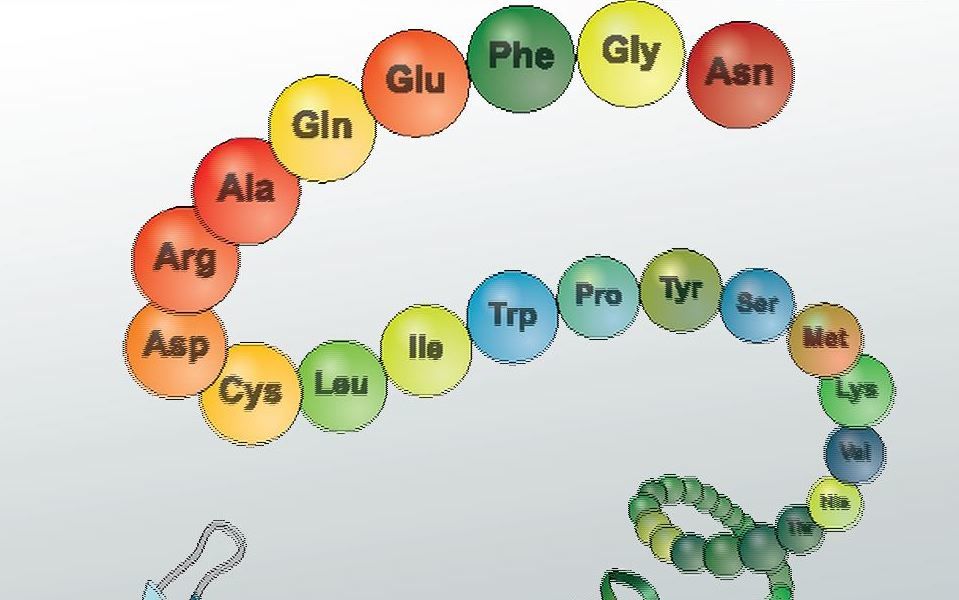
What is a long chain of amino acids called?
Polysaccharide
Lipid
Carbohydrate
Polypeptide
Nucleic acid
Two amino acids will bond together as the result of _______.
Dehydration synthesis
Hydrolysis
pHolysis
Rehydration synthesis
Enzymes belong to which category of organic molecule?
Proteins
Lipids
Carbohydrates
Nucleic acids
Which statement about enzymes is FALSE?
They are made from amino acids
They can be used multiple times
They lower the energy needed for reactions
A single enzyme has many different functions
What happens when an enzyme is placed outside it's normal environment?
It functions normally
It functions better
It's function ceases

Nitrogen Bases for DNA:
Adenine, Guanine, Cytosine, and Uracil
Adenine, Guanine, Cytosine, and Phosphate
Adenine, Guanine, Cytosine, and Thymine
Adenine, Guanine, Cytosine, and Sulfur
Nitrogen bases for RNA:
Adenine, Guanine, Cytosine, and Uracil
Adenine Guanine, Cytosine, and Sulfur
Adenine, Guanine, Cytosine, and Thymine
Adenine, Guanine, Cytosine, and Phosphate
Steps or rungs of ladder, are made up of:
Nitrogen containing bases that connect in center by weak hydrogen bonds.
Nitrogen containing bases that connect in the center by carbohydrate bonds
Nitrogen containing bases that connect in the center by weak phosphate bonds
Nitrogen containing bases that connect in the center by strong phosphate bonds
Purines:
Double ringed structures
Single ringed structures
Pyrimidines:
Double ringed structure
Single ringed structure
Sides or backbones of DNA molecules are made up of?
Alternating sugars-phosphates
Nitrogen and Phosphate
Alternating sugar-sulfur
Carbon and Hydrogen
What was Rosalind Franklin's role in the discovery of the structure of DNA?
She discovered that DNA is made of nucleotides
She carried out X-ray diffraction experiments leading to the determination that DNA is a double helix.
She carried out X-ray diffraction experiments and concluded that DNA strands run in opposite directions.
She produced the three-dimensional molecular model of DNA to show that it is a double helix.
Nucleotides are:
monomers of proteins
polymers of DNA
DNA base pairs
monomers of DNA

Which statement is correct?
A is a nitrogen containing base
A, B, and C form an amino acid
B is deoxyribose
C is a phosphate group
The element not found in DNA is:
carbon
nitrogen
phosphorus
sulfur

The special bond connects the nucleotides as seen in this image, are ____ bonds.
peptide
phoshodiester
ionic
glycosidic
ALL bonds of organic molecules are:
covalent
ionic
polar
hydrogen
In every organic molecule you will find
C & O
C & H
C & N
C, O, and H
Which one of the following is a function of RNA?
made of protein
encodes genetic information
is a component of ribosomes
reverses hydrolysis in macromolecules

The difference between deoxyribose and ribose is that deoxyribose has:
an extra oxygen
an extra carbon
one less hydrogen
one less oxygen


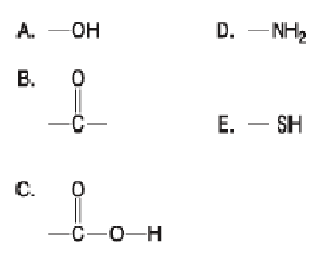
What is a functional group?
Group of atoms that give specific characteristics to a molecule
Group of molecules that give specific characteristics to an atom
Group of molecules that make up a group of atoms
Group of atoms that give specific characteristics to an element
What functional group is -HC=O
Carbonyl Aldehyde
Carbonyl Ketone
Carboxyl
Methyl
What functional group is -OH
Hydroxyl
Carboxyl
Amino
Carbonyl Ketone

What functional group(s) is/are present on the molecule? (check all that apply)
Hydroxyl
Carboxyl
Methyl
Carbonyl Aldehyde

Classify the compound based on the functional group present.
ketone
ester
carboxylic acid


Name the compound based on the functional group present.
methanol
aldehyde
ethanol




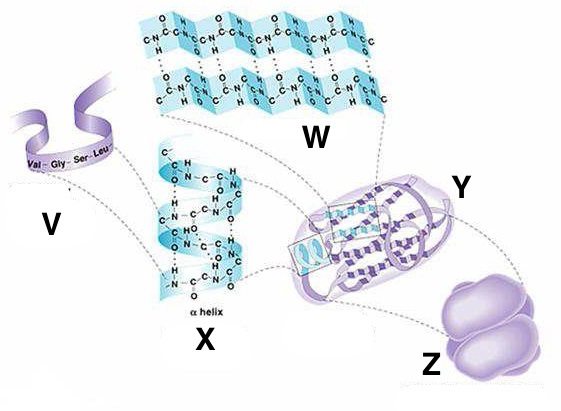
Which of the following bond(s) do(es) NOT exist in a secondary structure?
Peptide bond
Hydrogen bond
Disulphide bond
Ionic bond
The difference between tertiary and quartenary structure is:
Tertiary structure has double bond whereas quartenary structure does not have double bond
Tertiary structure consists of one polypeptide chain whereas quartenary structure consists of more than one polypeptide chains
Tertiary structure is fibrous whereas quartenary structure is globular
Tertiary structure is water-soluble whereas quartenary structure is lipid soluble



