Worksheets
Properties of and Changes to Matter, Classifying Matter
Total questions: 79
Worksheet time: 1hrs 4mins
A crayon has a mass of 10g and volume of 5 mL. What is its density?
30 g/mL
15 g/mL
1 g/mL
2 g/mL
Name the states of matter
solid, liquid, gas
mass, volume, density
hardness, odor, taste
texture, color, sound
Explain what density is.
it measures the weight of matter
it measures the size of matter
it measures how tightly packed the matter is
it measures the hardness of matter

A gas
has a definite shape but no definite volume
has a definite volume but no definite shape
has fast-moving particles

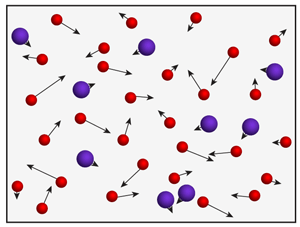
The particles in the picture are tightly held together with little movement. They have shape and energy. Therefore, the picture represents _________.
solid
liquid
gas
plasma
Molecules in a hotter sample will....
have more kinetic energy
be moving faster
be moving slower
be red in color
When hot and cold air make contact with each other...
the hot air will lose kinetic energy
cold air will lose kinetic energy
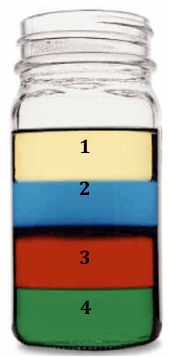
Put the liquids in order from most dense to least dense.
4, 3, 2, 1
1, 2, 3, 4
3, 4, 2, 1,
4, 3, 1, 2
We use density to discover if gold is real because
Substances have their own unique densities
Substances can change densities depending on their size

I have two objects with the same volume but different masses. Which object will be more dense?
The object with less weight.
The object with more weight.
The object with more mass.
The object with less mass.
cutting a piece of paper in half
a sliced banana turns brown after sitting out for a while
sugar is dissolved into hot tea
the ability of a substance to carry heat from one area to another
When a solid changes to a liquid as temperature increases, this is known as which phase change?
Vaporization
Condensation
Freezing
Melting

Which phase change is being represented in the particle diagram?
melting
evaporation
condensation
freezing

Letter "B" represents which phase change on the phase change diagram shown.
melting
freezing
boiling (vaporization)
condensation
During science class, while studying mixtures, you mix together table sugar and dirt. Your teacher challenges you to separate the sugar from the dirt. What property could you use and how would you use it?
particle size; Pour the mixture through a paper filter to separate the two
color; Pick out one of the two solids by using color to guide you
solubility; Add water to the mixture and dissolve the sugar
density; The two will form two layers. Scoop out the top layer
Mrs. Smith is demonstrating a chemical change for her class. She places 15 grams of baking soda into a beaker. Next she adds 15 grams of vinegar to the same beaker. When the two compounds make contact, they bubble and fizz a great deal. She places the beaker on the balance and notes that the mass of the solution in the beaker is less than the expected 30 grams.
Why is the mass of the solution in the beaker less than 30 grams?
The balance was not working correctly.
The gas that was released changed the mass.
Mass is always lost in a chemical reaction
The new products have less mass than the original reactants.
Why does an increase in temperature result in an increase in reaction rate?
An increase in temperature raises the activation energy which increases the reaction rate.
An increase in temperature causes the molecules to increase in size which increases reaction rate
An increase in temperature decreases the concentration of reactants which increases reaction rate.
An increase in temperature causes an increases the number of collisions which increases reaction rates.
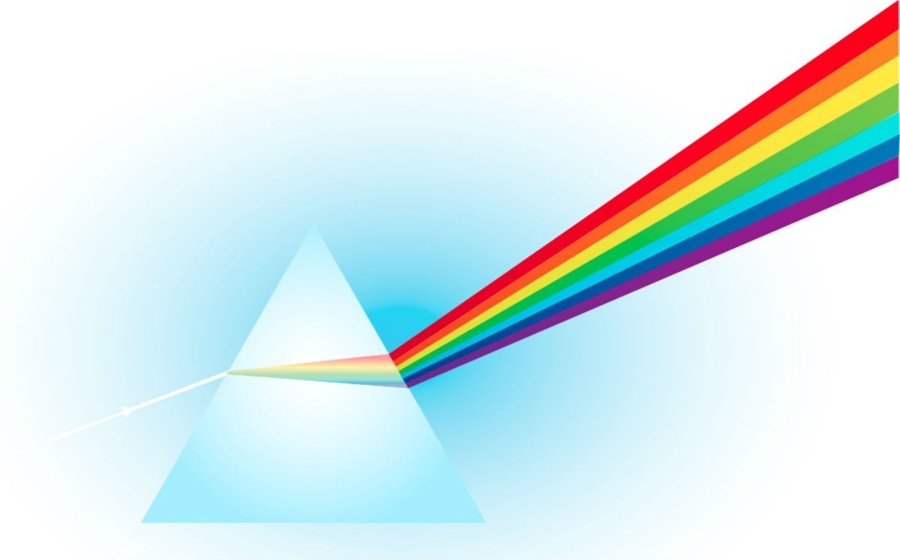
Color is what type of property?
Physical
Chemical
Reactivity is what type of property?
Physical
Chemical
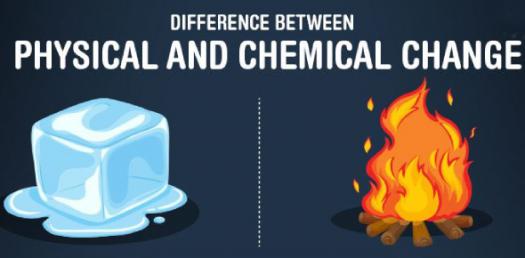
What is a sign of a physical change?
Bubbles forming
Color changing
Stretching
Producing heat

What is a sign of a chemical change?
Stretching
Tearing
Compressing
Bubbles
What happens to the atoms of a substance in a physical change?
Atoms get bigger
Atoms change their arrangement and motion
Atoms get smaller
Atoms bond together differently
What happens to the atoms of a substance in a chemical change?
Atoms get bigger
Atoms change their arrangement and motion
Atoms get smaller
Atoms bond together differently
Which of the following changes is a physical change of matter?
water evaporating
paper burning
a nail rusting
a silver spoon tarnishing
Which of these observations would likely be an indication of a chemical change?
A change in odor when two substances are mixed
A change in temperature when a hot substance is left standing in air
A change in volume as a substance is heated
The disappearance of a liquid as it boils

You mixed two liquids and a precipitate formed, what kind of change occured?
Physical
Chemical
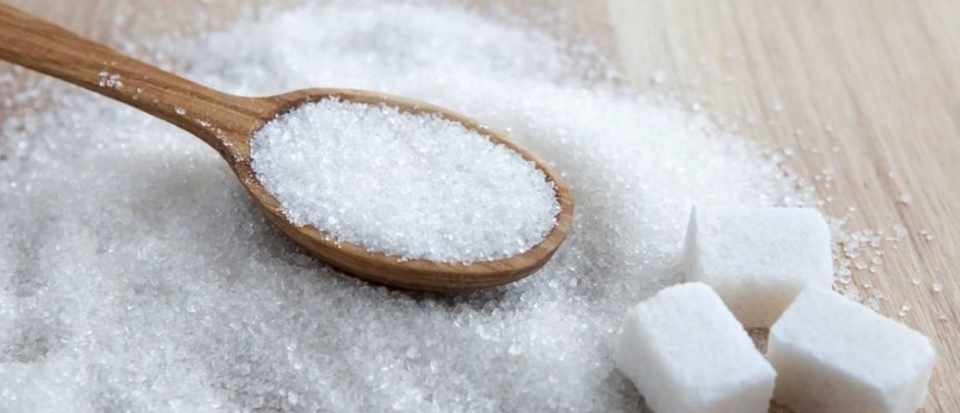
What happens when sugar dissolves in water?
Physical change because a new substance is formed
Chemical change because a new substance is formed
Physical change because the sugar is just getting mixed in
Chemical change because the sugar is just getting mixed in
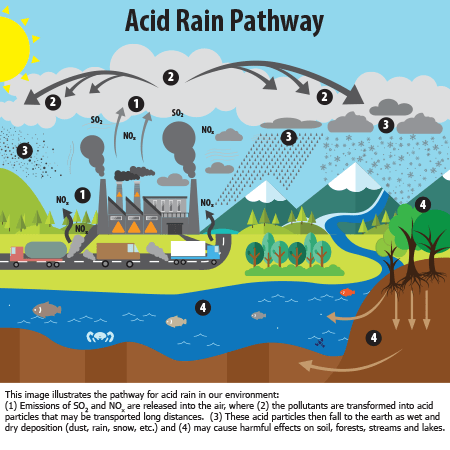
Acid Rain
Physical Change
Chemical Change
A student mixes 125 grams of sugar, 250 grams of water and 5 grams of flavoring. The solution weighs...
250 grams
380 grams
375 grams
400 grams
According to the Law of Conservation of Mass, what happens to the wood and oxygen when it is burned?
The wood disappears.
It stays the same chemically.
The atoms in the wood and oxygen rearrange and form smoke and ash.
Nothing.
The law of conservation of mass states that ________
the total mass of reactants is more than the total mass of products
the mass of a chemical reaction is not constant
the mass of a chemical reaction remains constant
the total mass of reactants is less than the total mass of products

What is this?
Atoms of an element
Mixture
Compound
Molecules

What is this?
Atoms of an element
Compounds
Molecules of an element
Mixture

What are these?
Molecules of compounds
Elements
An atom
Mixture

This is a
Pure Substance
Molecule
Compound
Mixture
An element is
made of more than one type of atom.
made of only one type of atom.
made of compounds.
made of mixtures of molecules.

What is this?
A compound
A mixture
An atom
An element


A mixture in which different materials are easily identified is a _________.
homogeneous mixture
heterogeneous mixture
A ______________ mixture is one that does not have a uniform composition.
heterogeneous
homogenous
pure substance
A _________________ mixture is one where the substances are evenly spread throughout.
heterogeneous
homogeneous
pure substance
Tea and air are examples of ________________.
solutions
suspensions
colloids
Coffee, mouthwash, and vinegar are examples of __________________ mixtures.
heterogeneous
homogeneous
pure
Which of these is an element?
Salt (NaCl)
Water (H20)
Oxygen (O)
Carbon Dioxide (CO2)
Which of these is a compound?
Aluminium (Al)
Carbon Dioxide (CO2)
Nitrogen (N)
Sand
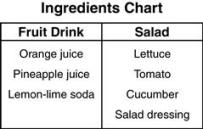
Using the information in the chart, which statement is the BEST description of the drink and salad?
The number of protons in the nucleus of an atom is called the --
atom
proton
atomic mass number
atomic number
A subatomic particle that has a negative charge is called --
a proton
a neutron
an electron
the nucleus
A neutron is ---
a subatomic particle with a negative charge.
a subatomic particle with a neutral charge.
the center of the atom where subatomic particles are found.
a subatomic particle with a positive charge.
An arrangement of elements in order of their atomic numbers such that elements with similar properties fall in the same column or group.
Atomic Number
Electron Cloud
Periodic Table
Nucleus
A region around the nucleus of an atom where electrons are found.
Electron Nucleus
Electron Cloud
Cloud of Electrons
Electron
An atom's central region, which is made up of protons and neutrons is called--
Electron Cloud
Nucleolus
Nucleus
Atomic Number
a unique number for each element that equals the number of protons in an atom of that element
element name
element symbol
atomic number
atomic mass
a grouping of elements based on similar properties, arranged by columns in the periodic table; also known as a group
family
period
row
isotope
a row on the Periodic Table of Elements
family
period
row
isotope