wayground logo

Free Printable Worksheets

Font size

S
M
L
XL
Worksheets

States and Changes in Matter (Chemical and Physical)

Total questions: 53

Worksheet time: 27mins

Name
Class
Date
1.
Is burning wood a chemical or physical change?
a)
chemical
b)
physical
2.

Is glass breaking a chemical or physical change?

a)

chemical

b)

physical

3.
Is hammering wood together to build a house a chemical or physical change?
a)
chemical
b)
physical
4.

What is the density of a 100 gram cube that has a volume of 2 cm3?

a)

.02 g/cm3

b)

.20 g/cm3

c)

50 g/cm3

d)

200 g/cm3

5.

Boiling water is a

a)

physical change

b)

chemical change

6.

True/False: Digestion of food is both a chemical and a physical change.

a)

True

b)

False

7.

A student mixes 50 g of baking soda with 50 grams of vinegar in a closed container. Based on the Law of Conservation of Matter, what represents the total mass of the products after the experiment?

a)

0 grams

b)

50 grams

c)

100 grams

d)

2500 grams

8.

Which object placed in this beaker has the least density?

a)

A

b)

B

c)

C

d)

D

9.

If cold medicine tablets are placed in water, which of the following could be evidence of a chemical change?

a)

The tablets dissolve

b)

The water gets cloudy

c)

The water level increases a little

d)

A gas is produced

10.
In chemical reactions, the law of conservation of mass is......
a)
disobeyed
b)
not true
c)
obeyed
d)
used sometime
11.
Exothermic reactions...
a)
Absorb energy
b)
Release energy
c)
Release Color
d)
Absorb Color
12.
In the equation,          2Mg + O2 ---> 2MgO, which are the reactants?
a)
Mg and O
b)
MgO
c)
Mg and MgO
d)
O and MgO
13.
Which of the following IS a chemical change
a)
using chalk
b)
water freezing
c)
slicing cheese
d)
digestion
14.
Which of the following IS a physical change?
a)
Getting a haircut
b)
Rusty metal
c)
sour milk
d)
A compound
15.
Which of the following is NOT an example of chemical change?
a)
sour milk
b)
burning wood
c)
breaking a pencil
d)
rust
16.

A change in which NEW substances are formed.

a)

Chemical change

b)

Physical change

c)

Chemical Property

d)

Physical Property

17.
Which of the following is NOT an example of chemical change?
a)
sour milk
b)
burning wood
c)
breaking a pencil
d)
rust
18.
Which of the following is NOT an example of a physical change?
a)
crumpled paper
b)
pencil sharpening
c)
shrunken clothing
d)
sour milk
19.
Baking a cake by mixing flour, sugar, chocolate powder, eggs, and milk, and then heating them in the oven.
a)
Chemical Change
b)
Physical Change
20.

A change in the size, shape, or state of matter.

a)

chemical change

b)

physical change

c)

chemical property

d)

physical property

21.
Green bananas turning yellow on their own as they ripen.
a)
Chemical Change
b)
Physical Change
22.

Using dye to change the color of a shirt to green.

a)

Chemical Change

b)

Physical Change

23.

A copper penny turns greenish after a few years.

a)

Chemical Change

b)

Physical Change

24.

A gel ice pack gets cold after you put it in the freezer for an hour.

a)

Chemical Change

b)

Physical Change

25.
Is moldy cheese a chemical or physical change?
a)
chemical
b)
physical
26.
Is making salt water to gargle with a physical or chemical change?
a)
physical
b)
chemical
27.
Is corroding metal a chemical or physical change?
a)
physical
b)
chemical
28.
Is bleaching your hair a physical or chemical change?
a)
physical
b)
chemical
29.
Is spoiling food a physical or chemical change?
a)
phyiscal
b)
chemical
30.
Is melting butter for popcorn a chemical or physical change?
a)
chemical
b)
physical
31.
Is a a rusting bicycle a chemical or physical change?
a)
chemcial
b)
physical
32.

Which form of matter has a definite shape and definite volume?

a)

liquid

b)

solid

c)

gas

d)

Plasma

33.

Which form of matter take the shape of a container?

a)

liquid

b)

solid

c)

plasma

d)

gas

34.

Which state of matter fills the space like it has in the balloon?

a)

liquid

b)

plasma

c)

solid

d)

gas

35.
The milk in the glass has volume and takes the shape of its container. Therefore, it is assumed that milk is a ______________.
a)
solid
b)
liquid
c)
gas
d)
plasma
36.
The molecules in the picture are tightly held together with little movement. They have shape and energy.  Therefore, the picture represents _________.
a)
solid
b)
liquid
c)
gas
d)
plasma
37.
Molecules move quickest in which state of matter
a)
solid
b)
liquid
c)
gas
d)
solid, liquid and gas
38.
When the temperature of matter decreases the particles ...
a)
speed up and move farther apart
b)
speed up and move closer together
c)
slow down and move farther apart
d)
slow down and move closer together
39.
When the temperature of matter increases the particles...
a)
speed up and move closer
b)
speed up and move farther apart
c)
slow down and move closer together
d)
slow down and move farther apart
40.

Water can be a solid, liquid, and a gas.

a)

True

b)

False

41.

Molecules are farthest apart in a

a)

Solid

b)

Liquid

c)

Gas

42.
If the tops were removed from the cylinders, the following would happen:
a)
The solid would fly out of the container
b)
The liquid would fly out of the container.
c)
The gas would fly out of the container.
d)
They ALL would fly out of the container.
43.
What does this picture represent? 
a)
solid
b)
liquid
c)
gas
d)
plasma
44.
What does this picture represent? 
a)
solid
b)
liquid 
c)
gas
d)
plasma
45.
Which of the following statements is NOT true of all different types of matter?
a)
They are made of atoms and molecules
b)
The particles are always in motion
c)
The particles always move at the same speed
d)
They are made of particles that are too small to see
46.

Which state of matter is shown in Model 1?

a)

solid

b)

liquid

c)

gas

d)

plasma

47.

Is the substance gaining or losing energy?

a)

Gaining

b)

Losing

48.

Are the particles moving faster or slower as time goes on?

a)

Faster

b)

Slower

49.

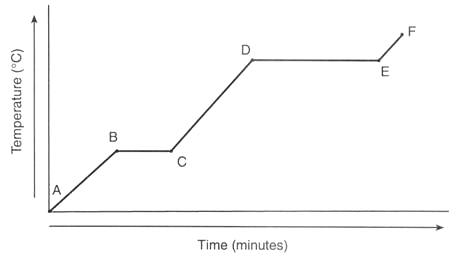
What state/phase is the object likely from points A to B?

a)

Solid

b)

Liquid

c)

Gas

d)

Plasma

50.

What is happening to the particles in the substance between points A and B?

a)

Melting

b)

Freezing

c)

Speeding Up

d)

Slowing Down

51.

What is happening to the particles in the substance between points D and E?

a)

Melting

b)

Freezing

c)

Vaporizing

d)

Sublimating

52.

Is the substance gaining or losing energy?

a)

Gaining

b)

Losing

53.

Where on the graph are phase changes taking place?

a)

1

b)

2

c)

3

d)

4

e)

5