Wayground logo

Free Printable Worksheets

Font size

S
M
L
XL
Worksheets

CH 2 Review H

Total questions: 45

Worksheet time: 23mins

Name
Class
Date
1.
This is one job proteins do NOT have in the body
a)
storing genetic information
b)
structure
c)
speeding up chemical reactions
d)
transporting oxygen
2.
What is being represented by the letter A in the image?
a)
Substrate
b)
Enzyme
c)
Product
d)
Complex
3.
The structure of proteins can be changed by environmental factors such as temperature or pH.
a)
True
b)
False
4.
When a protein unfolds, it is
a)
Denatured
b)
Complete
c)
Adding amino acids
d)
Making food
5.
Which of the following conclusions can be drawn from this graph?
a)
The optimum pH of the enzyme is 6.6.
b)
The optimum pH of the enzyme is 5.0
c)
The enzyme’s activity increases as pH increases 5.0 to 9.0
d)
The enzyme’s activity is greatest around pH 8.0 .
6.
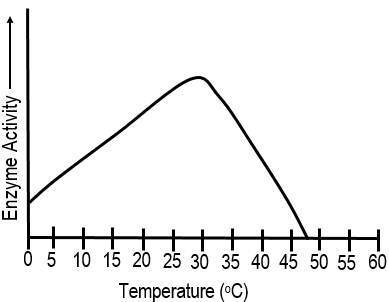
Based on the graph, at what temperature does this enzyme work best? 
a)
15 C
b)
40 C
c)
30 C
d)
0 C
7.
What happens when enzymes are heated to a high temperature?
a)
The enzymes die
b)
The shapes of the enzyme are altered 
c)
The enzymes' amino acid sequence changes
d)
The enzymes remain the same
8.
Enzymes speed up a reaction by
a)
lowering activation energy
b)
increasing temperature
c)
creating more reactants
d)
increasing activation energy
9.
Which is an example of a protein?
a)
Strawberries
b)
Bread
c)
Pasta
d)
Steak
10.
Which analogy best describes the role enzymes play in cells?
a)
Like walls in buildings, enzymes provide structural support for the cell
b)
Like the person who helps you bag your groceries, enzymes speed up processes in cells
c)
Like books in libraries, enzymes store information that can be used by the cell when needed
d)
Like the fence around a yard, enzymes act as a barrier preventing entry to the cell.
11.
Enzymes are
a)
proteins
b)
carbohydrates
c)
lipids
d)
nucleic acids
12.
Which is an example of protein?
a)
Hair
b)
Nails
c)
Muscles
d)
All of these
13.
Where do substrates bind on an enzyme?
a)
voltage-gated channels
b)
surface receptor
c)
calcium channels
d)
active site
14.
What 3 letters do enzymes typically end in?
a)
-ose
b)
-ase
c)
-ese
d)
-tic
15.
Which of these is NOT true?
a)
Enzymes can denature when the temperature gets too high.
b)
Enzymes can only be used once in a chemical reaction. 
c)
Extreme pH can denature enzymes.
d)
Enzymes speed up chemical reactions. 
16.
Enzymes can be recycled/reused.
a)
True
b)
False
17.
Which of the following is considered "acidic" on the pH scale?
a)
2
b)
7
c)
8
d)
14
18.

Sucrase has an optimum temperature of 37 C and an optimum pH of 6.2. What would happen if sucrase was placed in an environment with a pH of 4?

a)

the reaction would be unchanged

b)

the reaction would speed up

c)

the reaction would slow down or stop

d)

sucrase would be converted to lactase

19.
Which has a pH below 7?
a)
Acid
b)
Base
20.
Human blood has a pH between 7.35 and 7.45. Which of the following best describes human blood?
a)
strongly acidic
b)
slightly acidic
c)
strongly basic
d)
slightly basic
21.
The pH of a solution is tested, and it is found to be a basic solution. Of the following choices, what could the pH have been?
a)
3
b)
9
c)
7
d)
5
22.

What kind of energy is represented in the picture?

a)

radiant

b)

chemical

c)

electrical

d)

mechanical

23.

The ability to do work is

a)

power

b)

energy

c)

mass

d)

kinetic

24.
In which type of bond are electrons shared unequally?
a)
Non-polar covalent bond
b)
Polar covalent bond
c)
Ionic bond
d)
Hydrogen bond
25.
Which of the following substances would have the greatest concentration of H+ ions?
a)
Ammonia with
pH 13
b)
Water with 
pH 7
c)
Milk with 
pH 5
d)
Lemon juice with 
pH 2
26.

What type of substance regulates the pH of the body by releasing and capturing H+ ions?

a)

Alkalines

b)

Buffers

c)

Neutralizers

d)

Acids

27.

What type of bond forms between the oppositely charged ends of two different water molecules?

a)

Non-polar Covalent Bonds

b)

Polar Covalent Bonds

c)

Ionic Bonds

d)

Hydrogen Bonds

28.

Because of hydrogen bonds, water

a)

cools us quickly

b)

changes temperature slowly

c)

is the universal solvent

29.

Which is the weakest acid?

a)

pH 1

b)

pH 4

c)

pH 8

d)

pH 5

30.

How much more basic is a solution with a pH of 11 than a solution with a pH of 7?

a)

40,000 times more basic

b)

4 times more basic

c)

10,000 times more basic

d)

1,000 times more basic

31.

How much more acidic is a solution with a pH of 1 than a solution with a pH of 7?

a)

100,000 times more acidic

b)

6 times more acidic

c)

6,000,000 times more acidic

d)

1,000,000 times more acidic

32.

Which of the following solutions has the greatest amount of hydroxide ions (OH-)?

a)

Glass cleaner (pH 11.5)

b)

Water (pH 7.0)

c)

Vinegar (pH 2.0)

d)

Apple juice (pH 4.0)

33.

All of the following are examples demonstrating mechanical energy except -

a)

a fire roasting marshmallows

b)

a student throwing a paper airplane

c)

a girl kicking a ball across the yard

d)

a boy writing with a pen

34.

The Law of Conservation of Energy states that...

a)

energy can be destroyed

b)

energy can not be created or destroyed

c)

energy can only be destroyed using the force

d)

energy takes up space and can be measured

35.

When plants convert the sun's energy into food, which is the correct transformation of energy?

a)

electrical to chemical

b)

radiant to chemical

c)

chemical to mechanical

d)

chemical to radiant

36.
Enzymes are capable of increasing the rate of a chemical reaction within a living cell.  Enzymes accomplish this by
a)
reducing the number of products   
b)
reducing the activation energy
c)
increasing the temperature of the cell
d)
increasing the concentration of reactants 
37.
What is the substrate for the enzyme catalase?
a)
Glucose
b)
Water
c)
Oxygen 
d)
Hydrogen Peroxide
38.
Enzymes will make a reaction go _______ and use ______ energy.
a)
faster, less
b)
faster, more
c)
slower, less
d)
slower, more
39.
What do you call the energy that is needed to get the reaction started?
a)
chemical energy.
b)
thermal energy.
c)
activation energy.
d)
electrical energy.
40.

Which of the following is a structural protein?

a)

Hormones

b)

Collagen

c)

Enzymes

d)

Antibodies

41.

Which concentration of catalase has the fastest reaction rate?

a)

5%

b)

10%

c)

15%

d)

20%

42.

Compound formed when an acid combines with a base

a)

catalyst

b)

substrate

c)

indicator

d)

salt

43.

Which of the following is true about acids and bases?

a)

The lower the pH, the stronger the acid

b)

the higher the pH, the stronger the acid

c)

The lower the pH, the more neutral the acid

d)

The higher the pH, the weaker the base

44.

Match the following compounds as one of the macromolecules

a)

Starch

1.

Carbohydrates

b)

Enzyme

2.

Protein

c)

Fatty Acids

3.

lipid

d)

DNA

4.

nucleic acid

45.

Which is the advantage of water being a good solvent?

a)

It maintains temperature

b)

it lets us get nutrients from food

c)

It helps organisms float in the water

d)

It enables organisms to live under glaciers