wayground logo

Free Printable Worksheets

Font size

S
M
L
XL
Worksheets

Digestion Test Review

Total questions: 90

Worksheet time: 1hrs 5mins

Name
Class
Date
1.
Tube that carries swallowed food to the stomach
a)
esophagus
b)
liver
c)
pancreas
d)
rectum
2.
Food is broken down to supply energy for your body in the ____________
a)
digestive system
b)
endocrine system
c)
excretory system
d)
reproductive system
3.
What happens when the food goes to the small intestine?
a)
nutrients gets into the blood
b)
the food keeps on going
c)
nothing
4.
Breaking food down with the use of enzymes is known as:
a)
Chemical Digestion
b)
Physical Digestion
5.
The part of the digestive system which is highlighted represents:
a)
Esophagus
b)
Small intestine
c)
Stomach
d)
Trachea
6.
Saliva contains this enzyme to start the digestive process.
a)
spit
b)
amylase
c)
hydrochloric acid
d)
sodium bicarbonate
7.
The acid in your stomach used for digestion.
a)
sodium bicarbonate
b)
insulin
c)
hydrochloric
d)
amylase
8.
The main purpose of the large intestine.
a)
absorb hormones
b)
absorb protein
c)
absorb nutrients
d)
absorb water
9.
The organ that stores bile.
a)
gall bladder
b)
stomach
c)
liver
d)
appendix
10.
Bile is made by which digestive organ?
a)
Gallbladder
b)
Stomach
c)
Rectum
d)
Liver
11.
Which of these stages of digestion includes a chemical change?
a)
peristalsis
b)
chewing
c)
saliva
d)
large intestine
12.
What is the name of the molecule in saliva that chemically digests food?
a)
bile
b)
stomach acid
c)
enzymes
d)
chyme
13.
Where digestion begins, teeth and tongue help break food into smaller pieces.
a)
mouth
b)
pharynx
c)
esophagus
d)
salivary glands
14.
Which organ holds the waste left over from food?
a)
stomach
b)
large intestines
c)
liver
d)
small intestines
15.
What does the stomach do to your food?
a)
Pulls the vitamins and minerals out.
b)
Helps move food to the back of your throat.
c)
Turns it into a liquid mixture.
d)
Collects the waste.
16.
Which part uses saliva to help break down your food?
a)
teeth
b)
mouth
c)
esophagus
d)
large intestine
17.
Where does the stomach empty into?
a)
Small intestine
b)
Large intestine
c)
Pancreas
d)
Liver
18.
Which organ releases digestive chemicals into the small intestine to help with digestion?
a)
gallbladder
b)
stomach
c)
liver
d)
pancreas
19.
Which organ pulls out the vitamins and minerals from the food you've eaten?
a)
large intestines
b)
small intestines
c)
stomach
d)
pancreas
20.
Which of the following is NOT a job of the stomach?
a)
empty the liquid mixture of food into the small intestines
b)
to store food you've eaten
c)
to pull vitamins and minerals
d)
to break food down into a liquid mixture
21.
Which organ produces bile?
a)
pancreas
b)
stomach
c)
liver
d)
gallbladder
22.
This muscular tube moves food down to the stomach.
a)
Large Intestine
b)
Urethra
c)
Small Intestine
d)
Esophagus
23.
A 20 foot long organ that absorbs the nutrients in your food.
a)
Large Intestine
b)
Small Intestine
c)
Bladder
d)
Ureters
24.
This organ does not actually touch the food but it produces bile to help break down fats.
a)
Stomach
b)
Gallbladder
c)
Pancreas
d)
Liver
25.
This organ stores bile that was produced by the Liver
a)
Liver 
b)
Pancreas
c)
Gallbladder
d)
Stomach
26.
This organ does not actually touch the food but it secretes enzymes to help break down foods.
a)
Liver
b)
Pancreas
c)
Stomach
d)
Gallbladder
27.
The lining of the small intestine that absorbs the nutrients from digested foods.
a)
Ureters
b)
Villi
c)
Gallbladder
d)
Pancreas
28.
Used to cut and grind food into smaller pieces.
a)
Small Intestine
b)
Villi
c)
Teeth
d)
Pancreas
29.
This substance helps break down fat.
a)
Villi
b)
Bobo
c)
Bile
d)
Ureters
30.
The part of the food that is not digested.
a)
Bobo
b)
Urethra
c)
Waste
d)
Yuckies
31.
A slippery liquid that helps break down food and makes food easier to swallow.
a)
Bile
b)
Bobo
c)
Saliva
d)
Villi
32.
Digestion begins here.
a)
Mouth
b)
Stomach
c)
Small Intestine
d)
Esophagus
33.
Which stage of digestion removes water?
a)
large intestine
b)
small intestine
c)
mouth
d)
stomach
34.
Where would you expect to find hydrochloric acid?
a)
stomach
b)
small intestine
c)
liver
d)
large intestine
35.
Chewing food is an example of _____________.
a)
chemical digestion
b)
physical digestion
36.
Where nutrients go after the small intestine has absorbed them.
a)
bloodstream
b)
stomach
c)
esophagus
d)
kidneys
37.
Where does chemical digestion begin?
a)
mouth
b)
esophagus
c)
stomach
d)
small intestine
38.
What is the function of the digestive system?
a)
to break down and absorb nutrients
b)
to support and protect our bodies
c)
to produce vitamin D
d)
to help us move
39.
The role of the villi is to _________________________________ from the small intestine
a)
produce saliva
b)
Water absorption
c)
waste secretion
d)
send nutrients into bloodstream
40.
_______ allow nutrients to be absorbed by the blood and taken through the body.
a)
salivary glands
b)
villi
c)
small intestine
41.
Solution that shows the presence of certain substances
a)
Benedicts
b)
Lugols
c)
Indicator
d)
Solution
42.

Iodine and glucose test strips are examples of

a)

Indicators

b)

Equilibriums

c)

Starches

d)

Sugars

43.
An indicator will ______________ when it is in contact with an acid or base
a)
Bubble
b)
Form a new substance
c)
Change color
d)
Stay the same color
44.
The pH of a strong acid would be:
a)
1-2
b)
5-6
c)
8-9
d)
12-13
45.
The pH of a strong base would be:
a)
1-2
b)
5-6
c)
8-9
d)
13-14
46.
The pH of a weak base would be:
a)
1-2
b)
5-6
c)
8-9
d)
12-13
47.
The pH of a weak acid would be:
a)
1-2
b)
5-6
c)
8-9
d)
12-13
48.

What is the major site of digestion?

a)

Small Intestine

b)

Large Intestine

c)

Stomach

d)

Mouth

49.

List the order food passes through the digestive system.

a)

Mouth → Esophagus → Stomach → Small Intestine →Large Intestine → Anus

b)

Mouth → Esophagus → Stomach → Large Intestine →Small Intestine → Anus

c)

Mouth → Stomach → Esophagus → Small Intestine →Large Intestine → Anus

d)

Mouth → Anus → Stomach → Small Intestine →Large Intestine → Esophagus

50.

Enzymes in saliva breakdown starch into ______________.

a)

Carbohydrates

b)

Salt

c)

Glucose (sugar)

d)

Bile

51.

Why are bacteria in the large intestine necessary for survival?

a)

They breakdown plant fibers

b)

They produce B and K vitamins

c)

They help us absorb water

d)

All of these are correct

52.

Which organ secretes enzymes to neutralize stomach acid and breakdown starches and proteins?

a)

Stomach

b)

Pancreas

c)

Liver

d)

Large Intestine

53.

Which substance helps kill disease-causing organisms in the stomach?

a)

Bacteria

b)

Mucus

c)

Enzymes

d)

Hydrochloric Acid

54.

What is the basic unit of all living things?

a)

Enzymes

b)

Tissue

c)

Cell

d)

Organ

55.

Which is smaller - a cell or tissue?

a)

Cell

b)

Tissue

56.

Which is larger - organ system or organism?

a)

Organ System

b)

Organism

57.

Which is larger - tissue or organ?

a)

Tissue

b)

Organ

58.

Which is smaller - organ or organ system?

a)

Organ

b)

Organ System

59.
These kind of observation use your senses to observe results.
a)
Qualitative
b)
Quantitative
c)
Scientific
60.
These kind of observations are made using instruments such as rulers, balances and thermometers.
a)
Qualitative
b)
Quantitative
c)
Scientific
61.
It feels smooth.
a)
Qualitative 
b)
Quantitative
62.
It tastes sweet.
a)
Qualitative
b)
Quantitative
63.
The leaf is 5mm wide.
a)
Qualitative
b)
Quantitative
64.
It makes a loud crackling sound.
a)
Qualitative
b)
Quantitative
65.
The mass of the chocolate cake is 250 g.
a)
Qualitative
b)
Quantitative
66.
The flower has 6 petals.
a)
Qualitative
b)
Quantitative
67.
Where does digestion begin?
a)
In the small intestine
b)
In the mouth
c)
In the throat
d)
In the stomach
68.

Saliva breaking down carbohydrates into sugars is...

a)

physical digestion

b)

chemical digestion

69.

Chewing and tearing apart food into smaller pieces is...

a)

physical digestion

b)

chemical digestion

70.

Hydrochloric acid in the stomach breaking down food is...

a)

physical digestion

b)

chemical digestion

71.

The stomach pushing and churning food is...

a)

physical digestion

b)

chemical digestion

72.

Enzymes, secretions, and converting into other substances are examples of:

a)

physical digestion

b)

chemical digestion

73.

Bile breaking down fat into smaller droplet is:

a)

physical digestion

b)

chemical digestion

74.

Which substance coats the inside of your stomach and protects it from hydrochloric acid?

a)

Pancreatic Fluid

b)

Mucus

c)

Bile

d)

Enzymes

75.

The last part of the digestive system, where water is absorbed and waste removed.

a)

epiglottis

b)

ureters

c)

small intestine

d)

large intestine

76.

The part of the digestive system where most of the nutrients are absorbed through villi.

a)

small intestine

b)

large intestine

c)

peristalsis

d)

nephrons

77.

Muscle contraction that keep food moving along in one direction through the digestive system.

a)

epiglottis

b)

nephrons

c)

peristalsis

d)

enzymes

78.

How many protons are in Carbon (C)?

a)

6

b)

12

c)

1

d)

18

79.

How many electrons does Copper (Cu) have?

a)

29

b)

64

c)

35

d)

58

80.

How many electrons does Barium (Ba) have?

a)

56

b)

81

c)

137

d)

218

81.

How many neutrons does Sodium (Na) have?

a)

11

b)

23

c)

34

d)

12

82.

What is the atomic mass of Fluorine?

a)

9

b)

18

c)

17

d)

19

83.

UP and DOWN columns on the periodic table are

a)

groups

b)

periods

84.

SIDE TO SIDE rows on the periodic table are

a)

groups

b)

periods

85.

Which elements have properties in common?

a)

elements in a group

b)

elements in a period

86.

The period number tells you the number of

a)

protons

b)

energy levels

c)

valence electrons

87.
What is the volume of the liquid in this graduated cylinder?
a)
19 mL 
b)
35 mL 
c)
24 mL 
d)
1.9 mL
88.
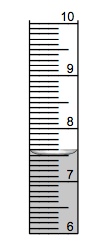
What is the volume of the liquid in this graduated cylinder?
a)
8.5 mL 
b)
7.5 mL 
c)
8 mL 
d)
.1 mL
89.
What is the volume of the liquid in this graduated cylinder?
a)
43 mL 
b)
30.7 mL 
c)
37 mL 
d)
38 mL
90.
What is the volume of the liquid in this graduated cylinder?
a)
44 mL 
b)
30.6 mL 
c)
37 mL 
d)
36 mL