wayground logo

Free Printable Worksheets

Font size

S
M
L
XL
Worksheets

First 9 weeks exam

Total questions: 135

Worksheet time: 2hrs 58mins

Name
Class
Date
1.
True or False: The wearing of flip flops and other open toed shoes are acceptable during a laboratory investigation during the hot summer months.
a)
True
b)
False
2.
If you spill or break something during an experiment, what is the FIRST thing you should do?
a)
Tell the teacher.
b)
Clean it up. 
c)
Cover it with a paper towel.
d)
Leave it for someone else.
3.
The lab equipment seen in the image should be worn during a lab investigation when...
a)
using glassware.
b)
using chemicals.
c)
using heat/fire.
d)
using any of the above.
4.
Identify the primary function of the lab equipment seen in the image.
a)
Transfer small amounts of liquid
b)
Transfer large amounts of liquid
c)
Measure liquid volume
d)
Mixing liquid chemicals
5.
Identify the piece of lab equipment seen in the image.
a)
Pipets
b)
Test Tubes
c)
Forceps
d)
Scoopulas
6.
Which of the following should NOT be worn during a lab investigation?
a)
Flip flops
b)
Loose, long hair
c)
Dangling jewelry
d)
All of the above
7.
You should never ______ chemicals in the lab. 
a)
taste
b)
touch
c)
smell
d)
all of the above
8.
If you are not sure what to do during a lab activity:
a)
guess
b)
change lab partners
c)
ask a teacher
d)
just sit quietly and do nothing
9.
Keeping your work area neat and clean is important because:
a)
My teacher is a neat-freak
b)
I won't lose my supplies in the clutter.
c)
It keeps the room from looking messy.
d)
It helps prevent accidents.
10.
What is the CORRECT procedure for students to follow if a chemical is spilled?
a)
Stand back and advise the teacher of the spill.
b)
Run madly out of the room.
c)
Splash large amounts of water onto the spill.
d)
Immediately ask to go to the restroom.
11.
Helping to clean up the lab or classroom is the job of
a)
old students.
b)
transfer students.
c)
each and every student.
d)
only the teacher.
12.
When should you look over the experiment instructions? 
a)
After starting the lab
b)
When your teacher tells you to
c)
Before starting the lab
d)
It doesn't really matter.  Instructions are silly!
13.
Identify the equipment shown here:
a)
measuring cylinder
b)
conical flask
c)
beaker
d)
volumetric flask
14.

Identify the equipment shown here:

a)

beakers

b)

flasks

c)

decanters

d)

graduated cylinders

15.
Name this item
a)
Pipette
b)
Stirring rod 
c)
Test tube
d)
Test tube holder
16.
What is used to hold test tubes?
a)
Test tube rack
b)
Magnifying glass
c)
Petri dish
d)
Funnel
17.
This is a...
a)
weighing thingy
b)
besselheim plate
c)
electronic balance
d)
scales
18.
Your goggles fog up you should
a)
Move to an area away from the lab and vent them to clear them up.
b)
Take them off and wipe them out.
c)
Vent them immediately.
d)
Work through it.
19.
Which is an example of a mixture?
a)
iron filings
b)
copper wire
c)
bronze pipe
d)
titanium plate
20.
What phase of matter has a definite shape and definite volume?
a)
solid
b)
liquid
c)
gas
d)
plasma
21.
What kind of properties can only be observed when a substance changes into a different substance?
a)
physical properties
b)
chemical properties
22.
Which type of property is the ability to conduct electricity?
a)
physical property
b)
chemical property
23.
Example of a physical property
a)
magnetism
b)
reactivity with oxygen
c)
flammability
d)
non-reactive
24.
Name an extensive properties
a)
color
b)
mass
c)
luster
d)
odor
25.
Which of the following is a chemical property?
a)
how something tastes
b)
ability to explode
c)
ability to float in water
d)
size of an object
26.
Which is NOT a physical property?
a)
odor
b)
reacts with acid
c)
sinks in water
d)
density
27.
What is an extensive property?
a)
a property that always stays the same
b)
a property that changes when the size of the speciman changes
c)
is a physical property of a system that does not depend on the system size or the amount of material in the system
d)
orange juice
28.
What properties that do not depend on the amount of the matter present
a)
density
b)
extensive
c)
intensive
d)
volume
29.
what is an intensive property
a)
butterscotch cookies
b)
a property that changes when the size of the specimen changes
c)
something a smart guy said a long long time ago
d)
is a physical property of a system that does not depend on the system size or the amount of material in the system
30.
2. A change of state from a liquid to a solid is called....
a)
Melting
b)
Freezing
c)
Evaporation
31.
5. What is it called when a solid turns directly into a gas?
a)
Sublimation
b)
Condensation
c)
Liquid
32.
Change from Gas to Solid is called........
a)
Sublimation
b)
Deposition
c)
Fusion
d)
condensation
33.
Change from gas to liquid...
a)
condensation
b)
evaporation
c)
expansion
d)
movement
34.
Change from Liquid to Solid is call......
a)
fusion
b)
Freezing
c)
sublimation
d)
evaporation
35.
change from liquid to gas is called....
a)
expansion
b)
evaporation
c)
condensation
d)
sublimation
36.
What is deposition?
a)
Phase change from gas to solid
b)
phase change from liquid to solid
c)
Phase change from solid to gas
d)
Phase change from liquid to gas
37.
What is sublimation?
a)
phase change between solid and liquid
b)
pahse change from gas to solid
c)
phase change from solid to gas
d)
phase change from solid to solid
38.
Which of the following are made from a combination of 2 or more elements?
a)
Molecules
b)
Pure Substances
c)
Compounds
d)
Elements
39.
A mixture that is NOT evenly distributed is called ....
a)
Compounded
b)
Homogenous
c)
Heterogenous
d)
Salty
40.
A substance that consists solely of atoms that are all alike is a(n).....
a)
element
b)
compound
c)
homogeneous mixture
d)
heterogeneous mixture
41.
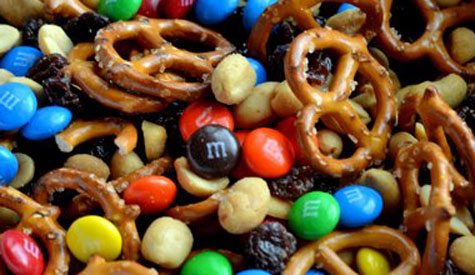
What type of mixture is this?
a)
homogenous mixture
b)
chemical
c)
heterogeneous mixture 
d)
solid mix
42.
What do you call a mixture that is so evenly mixed you can't see the parts, such as Kool-Aid or Lemonade?
a)
Homogeneous Mixture
b)
Heterogeneous Mixture
c)
Pure Substance
43.
Which one of these pictures represents a pure substance? 
a)
1 and 2
b)
1 and 3
c)
2 and 3
d)
1, 2 and 3
44.
What state of matter?
a)
solid
b)
liquid
c)
gas
45.

The density of aluminum is 2.70 g/cm3. The volume of a solid piece of aluminum is 1.50 cm3. Find its mass.

a)

a. 1.50 g

b)

b. 1.80 g

c)

c. 2.70 g

d)

d. 4.05 g

46.

The mass of a 5.00 cm3 sample of gold is 96.5 g. The density of gold is

a)

a. 0.0518 g/cm3

b)

b. 19.3 g/cm3

c)

c. 101.5 g/cm3

d)

d. 483 g/cm3

47.

The density of pure diamond is 3.5 g/cm3. The mass of a diamond is 0.25 g. Find its volume.

a)

a. 0.071 cm3

b)

b. 0.875 cm3

c)

c. 3.5 cm3

d)

d. 14 cm3

48.

100 milliliters is equivalent to

a)

a. 1 hectoliter

b)

b. 1 microliter

c)

c. 1 centiliter

d)

d. 1 deciliter

49.

0.01 meter is the same as

a)

a. 1 hectometer

b)

b. 10 millimeters

c)

c. 0.1 centimeter

d)

d. 1000 micrometers

50.

0.25 g is equivalent to

a)

a. 250 kg

b)

b. 250 mg

c)

c. 0.025 mg

d)

d. 0.025 kg

51.

Written in scientific notation, the measurement 0.000065 cm is . . .

a)

a. 65 X 10^–4 cm

b)

b. 6.5 X 10^–5 cm

c)

c. 6.5 X 10^–6 cm

d)

d. 6.5 X 10^–4 cm

52.

The average distance between the Earth and the moon is 386 000 km. Expressed in scientific notation, this distance is

a)

a. 386 x 10^3 km

b)

b. 38 x 10^4 km

c)

c. 3.8 x 10^5 km

d)

d. 3.86 x 10^5 km

53.

What is a qualitative observation?

a)

Qualitative- data, descriptive, non-numerical

b)

Qualitative- numerical

54.

What is a quantitative observation?

a)

Quantitative- data descriptive, non-numerical

b)

Quantitative- numerical

55.

Which best describes mass?

a)

an amount of matter

b)

depends on Earth's gravitational attraction

56.

Which best describes weight?

a)

an amount of matter

b)

depends on Earth's gravitational attraction

57.

Which accurately defines precision?

a)

how close a set of measurements of the same quantity

b)

how close a measurement to the true value

58.

Which best describes accuracy?

a)

how close a measurement is to true value

b)

how close a set of measurements of the same quantity

59.

What are the SI units for length, time, mass, volume, etc.?

a)

length- second, time-kilogram, mass- m^3, volume- K, temp.- meter

b)

length- meter, time- second, mass- kilogram, volume- m^3, temp.- K

c)

length- K, time- m^3, mass- second, volume- meter, temp.- kilogram

60.

When are two variables considered directly proportional?

a)

when they are together

b)

when they are divided

61.

What type of graph will a direct proportion yield?

a)

curve

b)

scattered

c)

diagonal

d)

straight line

62.

When are two variables considered inversely proportional?

a)

when multiplied

b)

when divided

c)

when added

d)

when subtracted

63.

What type of graph will an inverse relationship yield?

a)

straight line

b)

hyperbola

64.

While doing a density lab, you calculated the density of your substance to be 1.24 g/mL. The known value for your substance was 1.30 g/mL. What is your percent error?

a)

6.4%

b)

5.7%

c)

4.6%

d)

8.3%

65.
What is the independent variable in this bar graph?
a)
Amount of Sugar
b)
Type of Food
66.
What is the dependent variable?
a)
The United States
b)
Population
c)
Year
67.
A set of data are all close to each other, but they are not close to the actual value.  This set of data can be described as...
a)
accurate
b)
precise
c)
both precise and accurate
68.
A set of data are not close to each other, but the average of the data is very close to the actual value.  This set of data can be described as...
a)
accurate
b)
precise
c)
both precise and accurate
69.
Write the answer in scientific notation.
4.1 x 10⁵ +   5.5 x 106  =

a)
5.91 x 10⁶
b)
9.6 x 10⁵
c)
9.6 x 10¹¹
d)
4.65 x 10⁵
70.
Subtract the within the scientific notation. 
(2 x 10³) - (1.9 x 10²)
a)
1.81 x 10⁵
b)
1.81 x 10³
c)
1.81 x 10⁶
d)
1.81 x 10⁴
71.
Multiply:
(3.4 x 10⁵)(1.2 x 10⁻³)
a)
4.08 x 10⁻⁸
b)
4.8 x 10²
c)
4.08 x 10²
d)
4.08 x 10⁻¹⁵
72.
Divide:
(6.9 x 10⁷) / (2.3 x 10⁻³)
a)
3 x 10¹⁰
b)
3 x 10⁴
c)
3 x 10⁻⁴
d)
3 x 10-11
73.
On what axis should the independent variable always be?
a)
X
b)
Y
74.
A student wants to test the effects of type of exercise on heart rate.  What is the dependent variable?
a)
heart rate
b)
type of exercise
c)
amount of exercise
d)
time of day exercise occurs
75.
Which particle has a positive charge?
a)
electron
b)
orbital
c)
proton
d)
neutron
76.
Choose the particle that has no charge.
a)
nucleus
b)
neutron
c)
proton
d)
electron
77.
An electron has a _____ charge.
a)
negative
b)
positive
c)
neutral
78.
Which particles make up the nucleus of an atom?
a)
protons and neutrons
b)
electrons and protons
c)
electrons, protons, and neutrons
d)
electrons and neutrons
79.
The particles of the atom you can find by knowing the atomic number.
a)
neutrons
b)
protons and electrons
c)
protons and neutrons
d)
atomic mass
80.
The subatomic particle that determines the identity of an element.
a)
neutron
b)
proton
c)
electron
d)
outer shell
81.
What is the mass number and name of an element with 8 protons and 8 neutrons?
a)
16 - Carbon
b)
16 - Oxygen
c)
24 - Oxygen
d)
8 - Neon
82.
An element with a mass number of 10 and an atomic number of 6 has how many protons?
a)
5
b)
8
c)
6
d)
10
83.
An element with a mass number of 11 and an atomic number of 5 has how many neutrons?
a)
11
b)
5
c)
6
d)
16
84.
How many neutrons are in an atom of Beryllium?
a)
4
b)
9
c)
9.01
d)
5
85.
How many protons does this isotope of titanium have?
a)
48
b)
22
c)
26
d)
70
86.
Isotopes have different numbers of
a)
protons
b)
neutrons
c)
electron
d)
properties
87.

An ion has 7 protons and 10 electrons, what is the charge of the ion?

a)

+

b)

-

c)

-3

d)

+3

88.

An ion has 20 protons and 18 electrons, what is the charge of the ion

a)

+

b)

-

c)

+2

d)

-2

89.
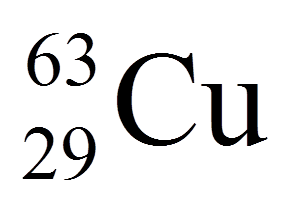
The top number in this isotope notation is
a)
the mass number
b)
the atomic number
c)
the atomic mass
d)
the neutron number
90.
The bottom number in this isotope notation is
a)
the mass number
b)
the atomic number
c)
the atomic mass
d)
the neutron number
91.

Group 1 on the periodic table

a)

Alkaline earth metals

b)

Halogens

c)

Noble Gases

d)

Alkali metals

92.

Group 2 on the periodic table

a)

alkaline earth metals

b)

halogens

c)

noble gases

d)

alkali metals

93.

Group 17 on the periodic table

a)

alkaline earth metals

b)

halogens

c)

noble gases

d)

alkali metals

94.

Group 18 on the periodic table

a)

alkaline earth metals

b)

halogens

c)

noble gases

d)

alkali metals

95.

Semiconductor of electricity and heat

a)

Metals

b)

Metalloids

c)

Nonmetals

96.

Good conductor of heat and electricity

a)

Metals

b)

Metalloids

c)

Nonmetals

97.

Poor conductor of heat and electricity

a)

Metals

b)

Metalloids

c)

Nonmetals

98.

Malleable and ductile

a)

metals

b)

metalloids

c)

nonmetals

99.

Found to the left of the staircase

a)

Metals

b)

Metalloids

c)

Nonmetals

100.

Found to the right of the staircase

a)

Metals

b)

Metalloids

c)

Nonmetals

101.

Composes the staircase

a)

Metals

b)

Metalloids

c)

Nonmetals

102.

Groups 3-12 on the periodic table

a)

Alkaline earth metals

b)

Lanthanides

c)

Actinides

d)

Transition Metals

103.

Elements 58-71

a)

Alkaline earth metals

b)

Lanthanides

c)

Actinides

d)

Transition Metals

104.

Elements 90-103

a)

Alkaline earth metals

b)

Lanthanides

c)

Actinides

d)

Transition Metals

105.

2 more protons than electrons

a)

+2

b)

-2

c)

no charge

106.

3 more electrons than protons

a)

+3

b)

-3

c)

neutral

107.

4 more protons than electrons

a)

+4

b)

-4

c)

neutral

108.
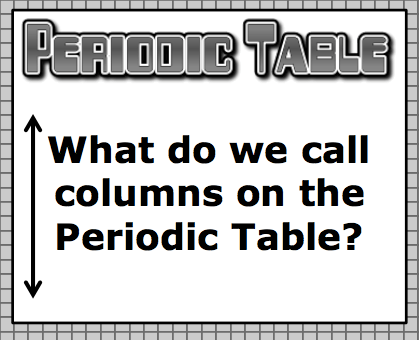
a)
Periods
b)
Groups
109.
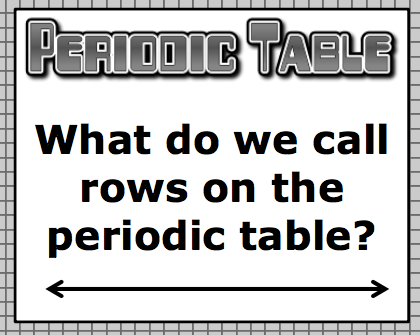
a)
Periods
b)
Groups
110.
a)
energy levels
b)
valence electrons
c)
protons
d)
neutrons
111.
a)
Same group
b)
Same period
112.
What is an isotope? 
a)
A charged atom
b)
An atom with different amounts of neutrons
c)
An atom with different amounts of protons
d)
A neutral atom
113.
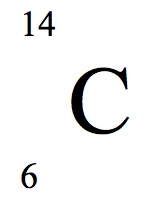
The photo above shows the isotopic notation for which isotope?
a)
Carbon 12
b)
Carbon 13
c)
Carbon 14
d)
Carbon 15
114.

Naturally occurring chlorine that is put in pools is 75.53% 35Cl (mass=34.969 amu) and 24.47% 37Cl (mass= 36.966 amu). Calculate the average atomic mass.

a)

35.458

b)

35.97

c)

35.45

d)

35.453

115.

If an atom has an different number of protons and electrons, it is considered an

a)

neutral atom

b)

isotope

c)

ion

d)

unstable atom

116.
How many valence electrons does Hydrogen have?
a)
1
b)
2
c)
3
d)
4
117.
How many valence electrons does magnesium have?
a)
1
b)
2
c)
12
d)
24
118.
How many valence electrons does Carbon have?
a)
4
b)
12
c)
6
d)
14
119.
How many valence electrons does Phosphorus have?
a)
31
b)
5
c)
15
d)
4
120.
How many valence electrons does Neon have?
a)
18
b)
8
c)
10
d)
2
121.
How many valence electrons does Sulfur
a)
16
b)
32
c)
6
d)
3
122.
Calcium has three different isotopes. One has a mass of 35.00 amu; another has a mass of 41.00 amu; and another has a mass of 40.00 amu. Which isotope is the most abundant of the three?
a)
40.00 amu
b)
41.00 amu
c)
35.00 amu
d)
impossible to tell
123.
An atom becomes _______ when it loses electrons.
a)
Positive
b)
Negative
c)
Neutral
d)
Invinsible
124.
A Silicon atom wants...
a)
3 more electrons
b)
3 less electrons
c)
4 more or less electrons
d)
2 more electrons
125.
A Radium atom wants...
a)
One more electron
b)
One less electron
c)
Two more electrons
d)
Two less electrons
126.

Potassium wants to (gain/lose) ___ valence electrons

a)

gain 1

b)

lose 1

c)

gain 19

d)

lose 19

127.

According to the Octet Rule, atoms of elements react with each other in order to attain ____ electrons in their outermost energy level or shell.

a)

2

b)

4

c)

6

d)

8

e)

10

128.

Which of the following elements LOSES 2 electrons in order to attain an octet?

a)

lithium

b)

magnesium

c)

helium

d)

sulfur

e)

bromine

129.

Which of the following elements GAINS 2 electrons in order to attain an octet?

a)

cesium

b)

magnesium

c)

phosphorus

d)

sulfur

e)

iodine

130.

Identify the block in the area labeled B

a)

s block

b)

d block

c)

p block

d)

f block

131.

Identify the block in the area labeled A

a)

s block

b)

d block

c)

p block

d)

f block

132.

Identify the block in the area labeled C

a)

s block

b)

d block

c)

p block

d)

f block

133.

Identify the block in the area labeled D

a)

s block

b)

d block

c)

p block

d)

f block

134.

What charge will cesium (#55) have when it satisfies the octet rule?

a)

+2

b)

-2

c)

+1

d)

-1

135.

What charge will phosphorus (#15) have when it satisfies the octet rule?

a)

+15

b)

-15

c)

-3

d)

+3