wayground logo

Free Printable Worksheets

Font size

S
M
L
XL
Worksheets

Exam 2 Review

Total questions: 131

Worksheet time: 11hrs 55mins

Name
Class
Date
1.
Discovered the electron within the atom
a)
Thomson
b)
Chadwick 
c)
Schrodinger & Heisenberg
d)
Dalton
2.

What scientist is best known for his "Plum Pudding" model of the atom?

a)

J.J. Thomson

b)

Ernest Rutherford

c)

John Dalton

d)

Democritus

3.
Rutherford's gold foil experiment provided evidence that...
a)
negative and positive charges are spread evenly throughout the atom.
b)
alpha particles have a positive charge.
c)
gold is not a dense as previously thought.
d)
there is a dense positively charged nucleus at the center of an atom.
4.
True or False: The majority of an atom is made up of empty space
a)
True
b)
False
5.
What type of particles exist within an atomic nucleus?
a)
Protons and Neutrons
b)
Neutrons and electrons
c)
Neutrons and Atoms
d)
Elements and Atoms
6.

What can be found outside the nucleus? MULTI-SELECT!

a)

electrons

b)

negative charge

c)

orbitals

d)

positive charge

e)

protons

7.

Which scientist proposed a model of the atom in which the electrons are orbiting at different energy levels?

a)

Niels Bohr

b)

James Chadwick

c)

John Dalton

d)

Ernest Rutherford

8.
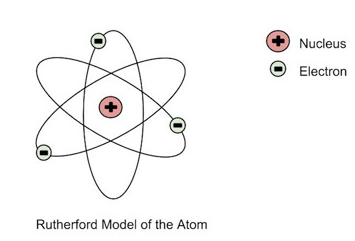
Whose model of the atom is pictured here?
a)
Bohr
b)
Thomson
c)
Rutherford
d)
Schrodinger
9.
Whose model of the atom is pictured here?
a)
Bohr
b)
Rutherford
c)
Thomson
d)
Schrodinger
10.
What is an ion?
a)
A neutral atom
b)
An atom with a different number of electrons
c)
An atom with a different number of neutrons
d)
An atom with a different number of protons
11.
What is an isotope?
a)
A neutral atom
b)
An atom with a different number of protons
c)
An atom with a different number of neutrons
d)
An atom with a different number of electrons
12.
An atom's mass number = 
a)
# protons + # neutrons
b)
# protons + # electrons
c)
# neutrons + # electrons
d)
# protons only
13.
An atom's atomic number = 
a)
# protons + # neutrons
b)
# protons only
c)
# neutrons only
d)
# electrons only
14.
How many electrons is an an oxygen atom if it's atomic number is 8 and its charge is -2?
a)
6
b)
8
c)
10
d)
12
15.
How many neutrons are in an isotope of carbon if its atomic number is 6 and its mass number is 14?
a)
6
b)
8
c)
20
16.
Where are electrons of an atom found?
a)
Nucleus
b)
Electron Cloud
c)
Some are in the nucleus and some in the electron cloud.
d)
They are moving everywhere.
17.
Which of the following is a positively charged subatomic particle found in the nucleus of an atom?
a)
Electron
b)
Proton
c)
Neutron
d)
Quark
18.

An atom has an atomic number of 15 and a mass number of 31. How many protons are there in the atom?

a)

15

b)

31

c)

16

d)

47

19.
What carries no charge 
a)
Neutrons
b)
Electrons
c)
Protons
20.
What is the Atomic Mass?
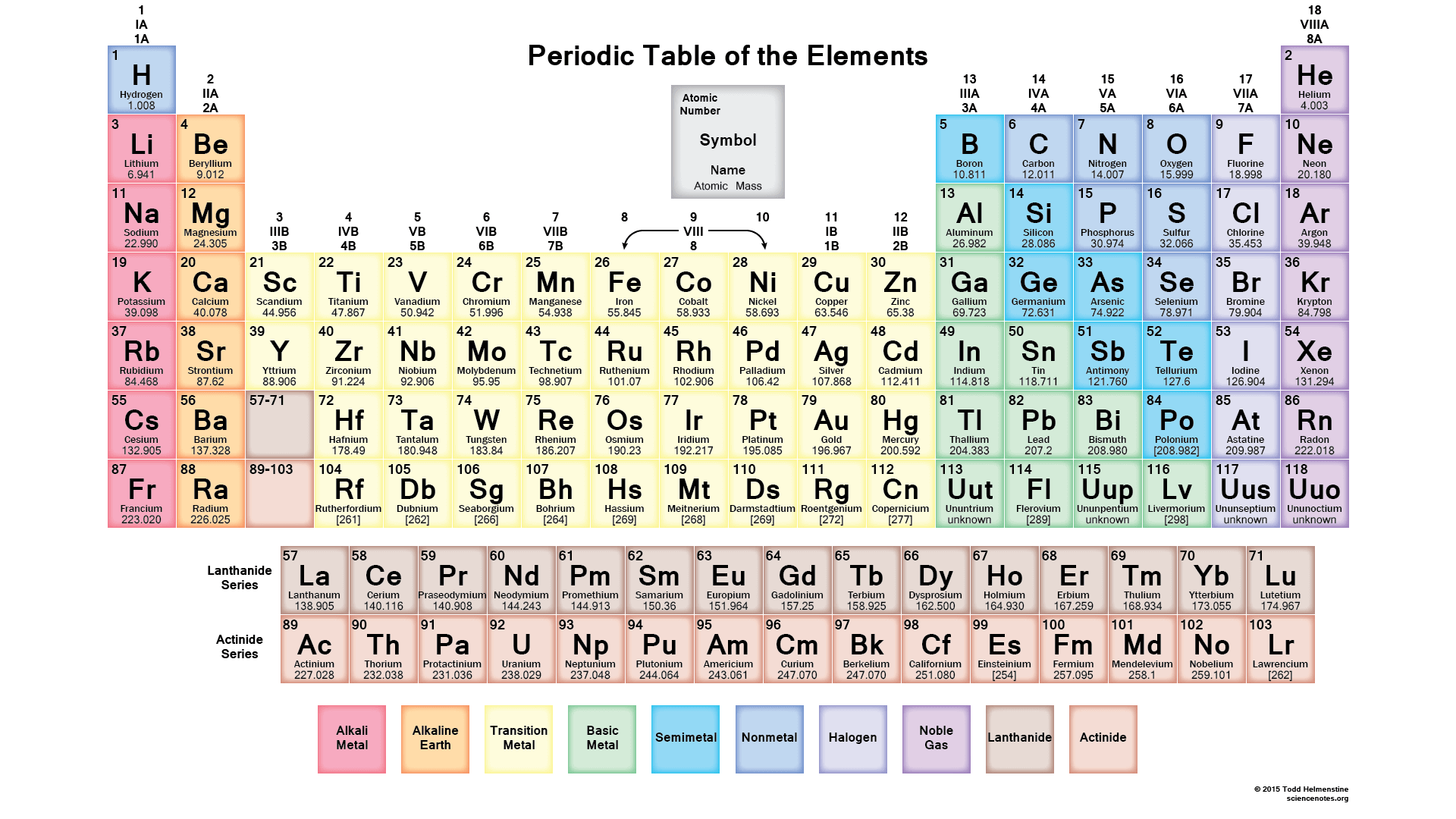
a)
6.941
b)
7
c)
3
d)
6
21.
How many Protons are in one atom of Lithium?
a)
3
b)
6
c)
7
d)
6.941
22.
Which is the smallest?
a)
electron
b)
proton
c)
atom
d)
neutron 
23.
An atom has 5 protons and 7 neutrons. What is the mass number of the atom?
a)
5
b)
7
c)
2
d)
12
24.
An atom has an atomic number of 19 and a mass number of 29. How many neutrons are in the atom?
a)
30
b)
19
c)
10
d)
38
25.
24.1% of all the isotopes of a an element have a mass of 75.23 amu, 48.7% have a mass of 74.61 amu, and 27.2% have a mass of 75.20 amu.
What is the average mass of this element?

a)
74.92 amu
b)
24.97 amu
c)
75.01 amu
d)
74.51 amu
26.
4.35% of all X atoms have a mass of 39.946 amu. 83.79% have a mass of 41.941 amu, 9.50% have a mass of 42.941 amu, and 2.36% have a mass of 43.939 amu. What is the average atomic mass of atom X?
a)
41.97 amu
b)
42.19 amu
c)
10.43 amu
d)
40.04 amu
27.
An isotope has three forms.  30% have a mass of 4 amu, 20% have a mass of 5 amu and 50% have a mass of 3 amu.  Average atomic mass will be closest to
a)
2 amu
b)
3 amu
c)
4 amu
d)
5 amu
28.
Calculate the average atomic mass of silver.
a)
106.38649amu
b)
111.91896amu
c)
107.8677amu
d)
121
29.
An element has two naturally occurring isotopes. One is 10.013 amu and is 19.9% abundant. The other is 11.01 amu and is 80.1% abundant. What is the average atomic mass? What element is it?
a)
9.012, Beryllium
b)
12.011, Carbon
c)
6.941, Lithium
d)
10.812, Boron
30.
Atom 1 has Mass=12  Protons=6
Atom 2 has Mass= 14 Electrons=6
Are these atoms isotopes of each other or different elements?
a)
Different Elements - Mg & Si
b)
Different Elements - Ar & Ca
c)
Isotopes of Carbon
d)
Isotopes of Magnesium
31.
What is the name of the atom pictured here?
a)
Nitrogen
b)
Nitrogen-15
c)
Nitrogen-7
d)
Nitrogen-8
32.
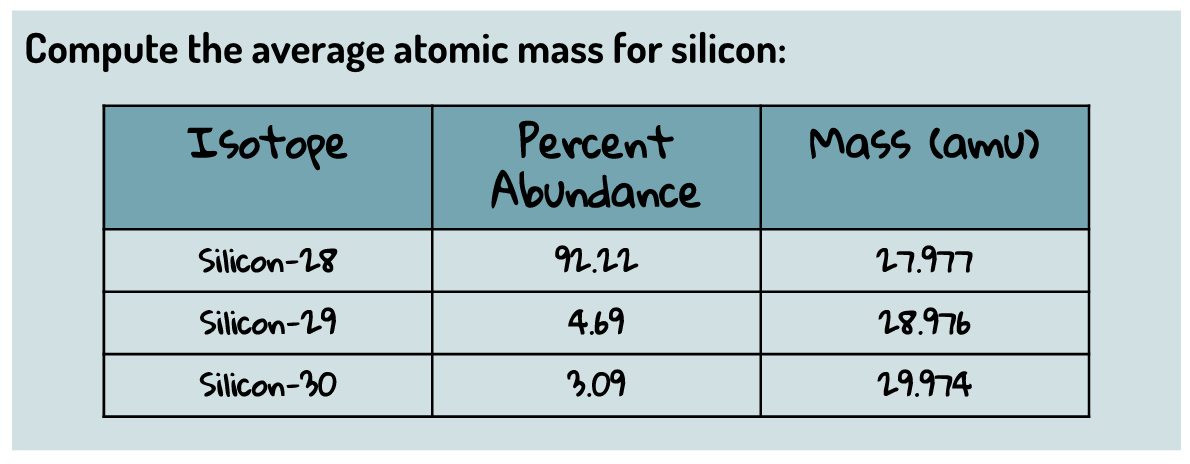
Compute the average atomic mass for silicon:
a)
27.977
b)
28.09
c)
28.976
d)
The average mass cannot be determined from provided information.
33.
If X is the symbol for an element, which of the following two symbols represent    isotopes of the same element?  
I. 7735X  II. 7733X  III. 8137X  IV. 8135 X
a)
I and II
b)
III and IV
c)
I and IV
d)
I and III
34.
What is an ion?
a)
A Charged Atom
b)
A Large Atom
c)
A Small Atom
d)
A Cute Atom
35.
Why are ions formed?
a)
To make our lives difficult
b)
Because atoms want 8 valence electrons
c)
Because atoms have the same number of protons and electrons
d)
Because atoms gained neutrons
36.
Cations are...
a)
Positive
b)
Negative
c)
Neutral
d)
Purring
37.
Anions are...
a)
Positive
b)
Negative
c)
Neutral
d)
Crying
38.
An atom becomes _________ when it gains electrons.
a)
Positive
b)
Negative
c)
Neutral
d)
Invinsible
39.
An atom becomes _______ when it loses electrons.
a)
Positive
b)
Negative
c)
Neutral
d)
Invinsible
40.
Which particles change the charge in atoms when ions are formed?
a)
Protons
b)
Electrons
c)
Neutrons
d)
Kittens
41.
Valence electrons are: 
a)
Electrons farthest away from the nucleus
b)
Electrons closest to the nucleus
c)
Electrons that just come and go - they don't stay with the atom
42.
Ions are: 
a)
atoms with a positive or negative charge
b)
atoms with no charge
c)
atoms with ONLY a positive charge
d)
atoms with ONLY a negative charge
43.
When an atom loses a valence electron, it becomes a(n) _____________ ion.
a)
positive
b)
negative
c)
neutral
d)
polyatomic
44.
Negative ions form when atoms _________ valence electrons.
a)
lose
b)
gain
c)
share
45.
an atom with atomic number 6 would have how many protons 
a)
6
b)
12
c)
3
d)
cannot be determined 
46.
What is the electron configuration of sodium?
a)
2.8
b)
2.8.2
c)
2.8.1
d)
11
47.
What is the electron configuration of calcium?
a)
2.8.8.2
b)
2.8.10
c)
20
d)
2.18.2
48.
Which element has an electron configuration of 2.5?
a)
Oxygen
b)
Nitrogen
c)
Phosphorus
d)
Carbon
49.
Which element has an electron configuration of 2.8.8?
a)
Lead
b)
Flourine
c)
Neon
d)
Argon
50.
How many electrons can the first energy level hold?
a)
1
b)
2
c)
8
d)
0
51.
How many valence electrons does phosphorus have?
a)
5
b)
2
c)
8
d)
15
52.
How many valence electrons does Chlorine have?
a)
5
b)
2
c)
7
d)
5
53.
Identify the element in Period 5 that has 1 valence electron?
a)
Rb
b)
Nb
c)
Ag
d)
Sb
54.
What element in Period 4 has 5 valence electrons?
a)
Zr
b)
As
c)
V
d)
Sb
55.
What is the charge of an atom that has gained one electron?
a)
-1
b)
-2
c)
+1
d)
+2
56.

What is the electron configuration of a sulfur atom in the ground state?

a)

2-4

b)

2-6

c)

2-8-4

d)

2-8-6

57.

Which change occurs when an atom in an excited state returns to the ground state?

a)

Energy is emitted

b)

Energy is absorbed

c)

The number of electrons decreases

d)

The number of electrons increases

58.
Which of the following type of electromagnetic radiation has the most energy
a)
infrared
b)
ultraviolet
c)
microwaves
d)
radiowaves
59.
Emission of light from an atom occurs when an electron
a)
drops from a higher to a lower energy level.
b)
   jumps from a lower to a higher energy level.   
c)
   moves within its atomic orbital.
d)
falls into the nucleus.
60.
Which drawing represents the process by which an emission line is formed?
a)
A
b)
B
c)
C
d)
D
61.
The ground state is the highest energy state of an atom.
a)
True
b)
False
62.
For an electron to change from ground state to an excited stated it must...
a)
Absorb energy
b)
Release energy
63.
When talking about energy levels in an atom, what is an "excited state"?
a)
The highest energy state of an atom.
b)
Any level higher than the ground state.
c)
The lowest energy state of an atom.
d)
When an atom loses an electron
64.
Why are line emission spectra of elements called "atomic fingerprints"?
a)
They are all the same
b)
They are all unique
c)
They are all similar
d)
They all contain colored light
65.

A line spectrum is produced when an electron moves from one energy level

a)

into the nucleus

b)

to a higher energy level

c)

to another position in the same sublevel

d)

to a lower energy level

66.

If an electron moves from n=4 to n=2 it ____

a)

absorbs energy

b)

releases energy

67.

Name the element

a)

Boron

b)

Carbon

c)

Nitrogen

d)

Oxygen

68.
The only element with no neutrons in its nucleus.
a)
Oxygen
b)
Helium 
c)
Hydrogen
d)
Lithium
69.
What is an Ion?
a)
an atom with a charge
b)
a neutral atom
c)
an aNion
d)
a Cation
70.
Which is an example of an iron atom that has lost 2 electrons?
a)
Fe-2
b)
Fe+2
c)
Ir-2
d)
Ir+2
71.
What is the number of valence electrons of Chlorine?
a)
7
b)
8
c)
2
d)
10
72.
What is the electron configuration of Magnesium?
a)
2-6
b)
2-6-2
c)
2-8-18
d)
2-8-2
73.
Which electron configuration is in the excited state?
a)
2-8-17-6
b)
2-8-18-8
c)
2-8-8-2
d)
2-1
74.
which electron configuration is in the ground state?
a)
2-8-17-6
b)
2-8-18-8
c)
2-0-1
d)
2-7
75.
Electrons release energy in the form of...
a)
heat
b)
water
c)
light
d)
electricity
76.
Before electrons absorb energy they are...
a)
in the excited state
b)
They do not change
c)
smaller
d)
in the ground state
77.
What did Rutherford's Gold Foil experiment prove?
a)
the atom is mostly space
b)
the atom is dense
c)
atoms don't exist
d)
atoms only consist of protons and electrons
78.
The mass number of an atom is equal to...
a)
the number of electrons and neutrons
b)
the number of neutrons
c)
the number of protons
d)
the number of protons and neutrons
79.
The excited state of electrons...
a)
is stable
b)
does not exist
c)
is permanent
d)
is temporary
80.

What is the state when electrons move to a higher energy level upon absorption of energy?

a)

active

b)

inactive

c)

excited

d)

ground

81.

What is significant about ROY G BIV?

a)

He discovered atoms.

b)

It gives the orders of the colors

c)

He discovered electrons

d)

It helps you figure out the charge on an atom

82.

How do electrons become excited?

a)

Emitting light/energy

b)

Absorbing light/energy

c)

Going down an orbital/energy level

d)

Going up an orbital/energy level

83.

What form of energy is emitted when an excited electron returns to the ground state?

a)

Photon (light)

b)

Heat

c)

Kinetic

d)

Potential

84.
The parallel lines represents...
a)
energy levels of the atom
b)
energy levels of the electrons
c)
energy levels of the photons
d)
energy levels of the nucleus
85.
Light is emitted when electrons ...
a)
jump from high to low 
b)
jump from low to high 
c)
either of these
d)
none of these
86.

Consider the spectrum for the hydrogen atom. in which situation will light be produced?

a)

electrons absorb energy as they move to an excited state

b)

electrons release energy as they move to an excited state

c)

electrons absorb energy as they return to the ground state

d)

electrons release energy as they return to the ground state

87.

When a photon hits an atom

a)

electrons absorb energy

b)

electrons release energy

88.

When an electron emits a photon

a)

it absorbs energy

b)

it releases energy

89.

An atom absorbing energy will have its electron/s

a)

moving up energy levels

b)

going down energy levels

c)

stay in the same energy levels

90.

All photons have the same wavelength.

a)

True

b)

False

91.

Which carries the highest energy?

a)
b)
c)
92.
Every element has its own unique atomic spectra.
a)
True
b)
False
93.
Spectra occur because electrons emit and absorb photons with only certain ______.
a)
wavelengths
b)
ions
c)
emissions
d)
functions
94.
Which color has the least amount of energy?
a)
red
b)
orange
c)
green
d)
blue
95.

The vertical (up and down) columns in the Periodic Table are called

a)

groups

b)

towers

c)

periods

d)

atomic numbers

96.
The Modern Periodic Table of Elements is arranged by
a)
atomic mass
b)
atomic number
c)
valence electrons
d)
number of isotopes
97.
Sodium (Na) is found in period 
a)
3
b)
2
c)
4
d)
1
98.
Sodium (Na) is found in group 
a)
1
b)
2
c)
3
d)
4
99.
The atomic number tells you what?  READ THE ANSWERS CAREFULLY
a)
only the number of electrons
b)
 only the number of protons
c)
only the number of neutrons
d)
the number of both electrons and protons in an atom.
100.
What does the atomic mass tell you? 
a)
Basically,the number of electrons and protons
b)
The number of neutrons
c)
Basically, the number of protons and neutrons
d)
The number of protons.
101.
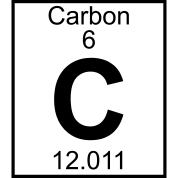
What does the 6 represent?
a)
atomic mass
b)
atomic number
c)
element name
d)
chemical symbol 
102.

What is the name of the family that is highlighted?

a)

Alkali Metal Family

b)

Halogen Family

c)

Noble Gas Family

d)

Transition Metal Family

103.
Which of the following will have a higher electronegativity than arsenic (As)?
a)
Carbon (C)
b)
Neon (Ne)
c)
Antimony (Sb)
d)
Germanium (Ge)
104.
Which of the following will have a lower ionization energy than Scandium (Sc)?
a)
Helium (He)
b)
Titanium (Ti)
c)
Calcium (Ca)
d)
Magnesium (Mg)
105.
As atoms of elements in group 16 are considered in order from top to bottom, the electronegativity of each successive element....
a)
decreases
b)
increases
c)
remains the same
d)
none of the above
106.
As you move down the periodic table atoms get bigger.  This is because ____________.
a)
The atoms have more mass.
b)
The atoms have more protons.
c)
The atoms have more energy levels
d)
The atoms have more neutrons
107.
As you move across the periodic table atoms tend to get smaller because, ______________.
a)
the atoms have more mass.
b)
the atoms have less mass
c)
the atoms have more protons.
d)
the atoms have less electrons.
108.
Electronegativity is...
a)
the ability of an atom to attract/ accept electrons
b)
the ability of an atom to lose electrons
c)
the energy required to remove an electron from a specific atom
d)
how easy it is to make friends. 
109.
Ionization energy is...
a)
the energy required to add an electron to a specific atom
b)
how much energy it takes to remove an electron from an atom
c)
the energy required to shield the outer electrons from the nucleus
d)
a measure of the ability of an atom to attract electrons
110.
The atom with the largest atomic radius in Group 18 is - 
a)
Ar
b)
He
c)
Kr
d)
Rn
111.
Metals have the largest - 
a)
atomic radius and electronegativity
b)
electronegativity and ionization energy
c)
atomic radius only
d)
ionization energy and atomic radius
112.
Which statement correctly and completely identifies a trend?
a)
Atomic radius decreases across a period and increases down a group.
b)
Electronegativity decreases across a period and decreases down a group.
c)
Ionization energy increases across a period and increases down a group.
d)
Ionic radius increases across a period and increases down a group.
113.
Atomic radius generally increases as we move __________.  
a)
down a group and from right to left across a period 
b)
up a group and from left to right across a period 
c)
down a group and from left to right across a period 
d)
up a group and from right to left across a period 
114.
Electronegativity __________ from left to right within a period and __________ from top to bottom within a group.
a)
decreases, increases 
b)
increases, increases
c)
increases, decreases 
d)
stays the same, increases
115.
The chart scientists use to organize and classify all the known elements
a)
elements chart
b)
the chart
c)
Periodic Table of the Elements
d)
Period table
116.
Vertical columns of elements (families) on the periodic table with similar  properties
a)
groups
b)
periods
c)
quadrants
d)
rows
117.
Which of these elements has the greatest atomic radius? 
a)
H
b)
N
c)
Cl
d)
Cs
118.
Sodium (Na) and potassium (K) are in the same group on the periodic table. Based on their locations, which statement about sodium and potassium is true?
a)
Sodium is less electronegative than potassium. 
b)
Sodium has fewer energy levels than potassium. 
c)
Sodium has a larger ionic radius than potassium. 
d)
Sodium has lower ionization energy than potassium. 
119.
Based on their locations in the periodic table, which element has chemical properties most similar to those of calcium, Ca?
a)
beryllium, Be
b)
potassium, K
c)
titanium, Ti
d)
yttrium, Y
120.
Which atom has the largest atomic radius?
a)
potassium
b)
rubidium 
c)
francium
d)
cesium
121.
Which of the following will have a larger radius than Zinc?
a)
Gallium
b)
Aluminum
c)
Magnesium
d)
Strontium
122.
As you move down the periodic table atoms get bigger.  This is because ____________.
a)
The atoms have more mass.
b)
The atoms have more protons.
c)
The atoms have more energy levels
d)
The atoms have more neutrons
123.

As you move down a group on the periodic table, the number of valence electrons....

a)

Increases

b)

Decreases

c)

Remains the same

124.

Which of the following is the term for a substance in which all the atoms have the same number of protons

a)

a compound

b)

An element

c)

a molecule

d)

a solid

e)

a gas

125.

Which of the following reasons explains why there is a decimal for most atomic masses?

a)

The mass of one atom can have a fraction.

b)

Since electrons are very small mass they only add a little bit, usually only a decimals worth.

c)

It is the average mass of all the potential isotopes of an atom.

d)

Neutrons have a mass of 1.1 meaning that fractions are common.

126.
As you move down the periodic table atoms get bigger.  This is because ____________.
a)
The atoms have more mass.
b)
The atoms have more protons.
c)
The atoms have more energy levels
d)
The atoms have more nuetrons
127.
Which periodic group has the smallest atomic radius?
a)
Alkali metals
b)
Halogens
c)
Noble Gases
d)
Transition metals
128.
Which of the following will have a lower ionization energy than Scandium (Sc)?
a)
Helium (He)
b)
Titanium (Ti)
c)
Calcium (Ca)
d)
Magnesium (Mg)
129.
Which of the following will have a higher ionization energy than arsenic (As)?
a)
Gallium (Ga)
b)
Neon (Ne)
c)
Antimony (Sb)
d)
Germanium (Ge)
130.
The electronegativity of Cl is the highest in Period 2.  Why?
a)
Cl is the largest and has the greatest effective nuclear charge
b)
Cl is the smallest and has the lowest effective nuclear charge
c)
Cl is the largest and has the lowest effective nuclear charge
d)
Cl is the smallest and has the greatest effective nuclear charge
131.
What term is used to describe "an atom's tendency to attract electrons to itself when is is chemically combined with another element"
a)
electronation
b)
electron affinity
c)
electronegativity
d)
electrolysis