wayground logo

Free Printable Worksheets

Font size

S
M
L
XL
Worksheets

Honors Chemistry Unit 3 Exam Review

Total questions: 140

Worksheet time: 2hrs 18mins

Name
Class
Date
1.
What atom matches this electron configuration?
1s22s22p63s23p64s23d10
a)
Zinc
b)
Copper
c)
Nickel
d)
Germanium
2.
What atom matches this electron configuration?
1s22s22p63s2
a)
Neon
b)
Magnesium
c)
Aluminum
d)
Potassium
3.
How many electrons does Si contain? (click to see image)
a)
14
b)
28
c)
2
d)
4
4.
How many electrons can the first energy level hold?
a)
1
b)
2
c)
8
d)
0
5.
Which electron configuration belongs to Chlorine (Cl)?
a)
1s2s2p3s3p5
b)
1s2s2p3s3p6
c)
1s2s2p3s3p7
6.
There are 4 different types of subshells s,p,d,f
a)
true
b)
false
7.
Electrons occupy orbitals of lowest energy first is part of what electron configuration rule?
a)
Hund’s Rule
b)
Aufbau Principle
c)
Pauli Exclusion Principle
8.
Electron arrangement that uses arrows
a)
Electron configuration
b)
Shorthand configuration
c)
Lewis dot structure
d)
Orbital diagram
9.
What is the shorthand electron configuration for Sulfur atom?
a)
[Ar] 3p4
b)
[He] 3s23p4
c)
[Ne] 3s23p4
d)
[Na] 3s23p3
10.
Which of the following is a p block element?
a)
Ca
b)
Ar
c)
Re
d)
Au
11.
What electron configuration matches an oxygen atom?
a)
1s22s22p63s2, 3p64s23d104p5
b)
1s22s22p4
c)
1s22s22p6
d)
1s22s22p63s23p64s23d1
12.
What is the electron configuration of Ag?
a)
1s2 2s2 2p6 3s2 3p6 4s2 3d10 4p6 5s1 4d10
b)
[Kr] 5s2 4d9
c)
1s2 2s2 2p6 3s2 3p6 4s2 4p6 5s2 4d9
d)
1s2 2s2 2p6 3s2 3p6 3d10 4s2 4d10 4p6 5d10 5s2 4d9
13.
Identify the Electron Configuration for Aluminum (Al)
a)
1s2s2p3s3p1
b)
1s2s2p3s3p3
c)
1s2s2p3s4p1
14.
An orbital can at most hold how many electrons?
a)
1 electron
b)
2 electrons
c)
3 electrons
d)
4 electrons
15.

What element has an electron configuration of 1s22s22p63s23p1?

a)

Mg

b)

Al

c)

Si

d)

P

16.

What element has an electron configuration of 1s22s22p63s23p64s23d5?

a)

Mn

b)

Cr

c)

Fe

d)

v

17.

What element has an electron configuration of [Kr] 5s24d3?

a)

Y

b)

Zr

c)

Nb

d)

Mo

18.

What element has the electron configuration [Ar] 4s23d104p5?

a)

Zn

b)

As

c)

Se

d)

Br

19.

What shape of space does "s" represent in the electron configuration for an atom?

a)

sphere

b)

peanut

c)

clover

d)

flower

20.
What is the total number of energy levels used by an atom of aluminum
(Al, atomic #13) in the ground state?
a)
3
b)
7
c)
13
d)
0
21.

How many orbitals are available to hold electrons in the 6th energy level (n=6)?

a)

9

b)

16

c)

26

d)

36

22.
This "rule" of Quantum Chemistry states that it is impossible to know both the position and velocity of an electron at the same time.
a)
Hund's Rule
b)
Heisenberg Uncertainty Principle
c)
Aufbau Principle
d)
Pauli Exclusion Principle
23.
According to the Aufbau Principle, which sublevel should starting filling with electrons after 5s?
a)
6s
b)
5p
c)
4d
d)
3f
24.
Identify the following element:
1s22s22p63s23p64s23d10
a)
nickel
b)
copper
c)
zinc
d)
gallium
25.
The second energy level (n=2) contains a total of 5 electrons...how many more electrons can fit in the 2nd energy level?
a)
0
b)
3
c)
5
d)
7
26.
Identify the element whose electron configurations ends with 5p3
a)
As
b)
Te
c)
Sb
d)
Sn
27.
This "rule" of Quantum Chemistry states that no 2 electrons in an atom can be in the exact same state...each electron in an atom can be described by a unique set of quantum numbers.
a)
Hund's Rule
b)
Heisenberg Uncertainty Principle
c)
Aufbau Principle
d)
Pauli Exclusion Principle
28.
According to the Aufbau Principle, which sublevel should starting filling with electrons before the 3p sublevel?
a)
3s
b)
2p
c)
4s
d)
4p
29.
How many valence electrons are in an atom of sulfur?
a)
2
b)
4
c)
6
d)
8
30.
What atom matches this electron configuration?
1s22s22p63s23p64s23d10
a)
Zinc
b)
Copper
c)
Nickel
d)
Germanium
31.
What electron configuration matches an oxygen atom?
a)
1s22s22p63s2, 3p64s23d104p5
b)
1s22s22p4
c)
1s22s22p6
d)
1s22s22p63s23p64s23d1
32.
The electron configuration of an atom is 1s22s22p6.  The number of electrons in the atom is 
a)
3
b)
6
c)
8
d)
10
33.
Which electron configuration belongs to Chlorine (Cl)?
a)
1s2s2p3s3p5
b)
1s2s2p3s3p6
c)
1s2s2p3s3p7
34.
Electrons occupy orbitals of lowest energy first is part of what electron configuration rule?
a)
Hund’s Rule
b)
Aufbau Principle
c)
Pauli Exclusion Principle
35.

What does Pauli exclusion principle state ?

a)

states that each electron occupies the lowest energy orbital available

b)

states that -no two electrons in the same orbital can have the same spin

c)

states that single electrons electrons with the same spin must occupy each-energy orbital before additional electrons with opposite spins can occupy the same orbitals

36.
What atom matches this electron configuration?
1s2s2p3s2
a)
Neon
b)
Magnesium
c)
Aluminum
d)
Potassium
37.

What is the maximum number of electrons that an S orbital can have?

a)

1 electron

b)

2 electrons

c)

3 electrons

d)

4 electrons

38.
How many valence electrons are represented here?
a)
7
b)
5
c)
2
d)
8
39.

How many electrons can the d sublevel(orbital) hold?

a)

8

b)

10

c)

2

d)

4

40.

What is this element?

1s22s22p63s23p64s23d104p6

a)

Argon

b)

Krypton

c)

Selenium

d)

Bromide

41.
How many valence electrons does Chlorine have?
a)
5
b)
2
c)
7
d)
5
42.

Which electron configuration belongs to Copper (Cu)?

a)

1s2 2s2 2p6 3s2 3p6 4s2 3d8

b)

1s2 2s2 2p6 3s2 3p6 4s1 3d10

c)

1s2 2s2 2p6 3s2 3p6 4s2 3d9

43.
What atom matches this electron configuration?
1s22s22p63s23p64s23d10
a)
Zinc
b)
Copper
c)
Nickel
d)
Germanium
44.
What electron configuration matches an oxygen atom?
a)
1s22s22p63s2, 3p64s23d104p5
b)
1s22s22p4
c)
1s22s22p6
d)
1s22s22p63s23p64s23d1
45.
What is the shorthand electron configuration for Sulfur atom?
a)
[Ar] 3p4
b)
[He] 3s23p4
c)
[Ne] 3s23p4
d)
[Na] 3s23p3
46.
How many electrons can the first energy level hold?
a)
1
b)
2
c)
8
d)
0
47.
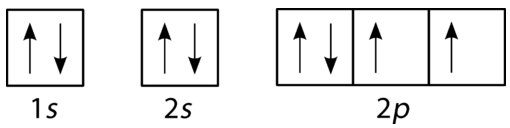
This orbital diagram represents:  
a)
C
b)
B
c)
N
d)
O
48.
This orbital diagram represents:  
a)
C
b)
B
c)
N
d)
O
49.
What is incorrect about this orbital diagram?
a)
Both arrows in the 2p box should be pointing up
b)
There is nothing incorrect with this diagram
c)
In the there should only be 1 orbital in the first 2p box and one in the 2nd 2p box
d)
All the arrows should be pointing up.
50.
Which element is pictured?
a)
neon
b)
fluorine
c)
magnesium
d)
argon
51.
Which is associated with more energy? 
a)
2p
b)
2s
c)
3p
d)
1s
52.
Which element is pictured?
a)
neon
b)
fluorine
c)
magnesium
d)
argon
53.

What element has this orbital notation?

a)

lithium

b)

beryllium

c)

boron

d)

carbon

54.

Which element is represented by this orbital notation?

a)

carbon

b)

nitrogen

c)

oxygen

d)

fluorine

55.

Which element is represented by this orbital notation?

a)

neon

b)

sodium

c)

magnesium

d)

aluminum

56.

Which of the following is the electron configuration for neon?

a)
b)
c)
d)
57.

Which of the following is the electron configuration for Fluorine

a)
b)
c)
d)
58.

Which of the following is the electron configuration for silicon?

a)
b)
c)
d)
59.

Which of the following is the orbital notation for oxygen?

a)
b)
c)
d)
60.
An electron occupies the lowest energy orbital that can receive it.
a)
Hund’s rule
b)
Pauli exclusion principle
c)
Bohr model of the atom
d)
Aufbau principle
61.
All orbitals of equal energy are occupied by one electron before any single orbital is occupied by a second electron.
a)
Aufbau principle
b)
Pauli exclusion principle
c)
Hund’s rule
d)
Core Notation
62.
No two electrons in the same atom can have the same four quantum numbers.
a)
Aufbau principle
b)
Pauli exclusion principle
c)
Hund’s rule
d)
Noble gas notation
63.
Which guideline, Hund’s rule or the Pauli exclusion principle, is violated in the following orbital diagrams?
a)
Hund's
b)
Aufbau's
c)
Pauli's Exclusive
64.
Which guideline, Hund’s rule or the Pauli exclusion principle, is violated in the following orbital diagrams?
a)
Aufbau's
b)
Hund's
c)
Pauli exclusive
65.
Electrons are paired based on their spin directions, clockwise and counterclockwise, is what electron configuration rule?
a)
Hund’s Rule
b)
Aufbau Principle
c)
Pauli Exclusion Principle
66.

What is the element?

a)

Neon

b)

Chlorine

c)

Aluminum

d)

Argon

67.

All alkaline earth metals have the following number of valence electrons:

a)

1

b)

3

c)

6

d)

2

e)

none of these

68.

Ti has __________ in its d orbital.

a)

one electrton

b)

two electrons

c)

three electrons

d)

four electrons

e)

none of these

69.

Order the elements S, Cl, and F in terms of increasing ionization energy.

a)

S, Cl, F

b)

Cl, F, S

c)

F, S, Cl

d)

F, Cl, S

e)

S, F, Cl

70.

Order the elements S, Cl, and F in terms of increasing atomic radii.

a)

S, Cl, F

b)

Cl, F, S

c)

F, S, Cl

d)

F, Cl, S

e)

S, F, Cl

71.

Choose the element with the highest ionization energy.

a)

Na

b)

Mg

c)

Al

d)

P

e)

S

72.

Which has the lower Electronegativity:

N or C?

a)

C

b)

N

73.

Which has the greater Electronegativity:

H or F?

a)

H

b)

F

74.

Which of the following will have a larger atomic radius than Zinc?

a)

Gallium

b)

Aluminum

c)

Magnesium

d)

Strontium

75.
Which of the following will have a higher electronegativity than arsenic (As)?
a)
Carbon (C)
b)
Neon (Ne)
c)
Antimony (Sb)
d)
Germanium (Ge)
76.
Which of the following will have a lower ionization energy than Scandium (Sc)?
a)
Helium (He)
b)
Titanium (Ti)
c)
Calcium (Ca)
d)
Magnesium (Mg)
77.
Which atom has the largest atomic radius?
a)
potassium
b)
rubidium 
c)
francium
d)
cesium
78.

As you move down the periodic table from top to bottom, atoms get _______. This is because ____________.

a)

smaller: The atoms have more mass.

b)

smaller: The atoms have more protons.

c)

bigger: The atoms have more energy levels

d)

bigger: The atoms have more neutrons

79.

As you move across the periodic table from left to right, atoms tend to get _________. This is because ______________.

a)

larger: the atoms have more mass.

b)

smaller: the atoms have less mass

c)

smaller: the atoms have more protons.

d)

larger: the atoms have less electrons.

80.

Atoms that have a high electronegativity, _______________.

a)

give up their electrons more easily.

b)

hold on to their electrons more tightly.

c)

have more electron shells.

d)

have more electrons

81.
Ionization energy is...
a)
the energy required to add an electron to a specific atom
b)
how much energy it takes to remove an electron from an atom
c)
the energy required to shield the outer electrons from the nucleus
d)
a measure of the ability of an atom to attract electrons
82.
The atom with the largest atomic radius in Group 18 is - 
a)
Ar
b)
He
c)
Kr
d)
Rn
83.
Which statement correctly and completely identifies a trend?
a)
Atomic radius decreases across a period and increases down a group.
b)
Electronegativity decreases across a period and decreases down a group.
c)
Ionization energy increases across a period and increases down a group.
d)
Ionic radius increases across a period and increases down a group.
84.

Atomic radius generally _____________ as we move __________.

a)

increases: down a group and from right to left across a period

b)

increases: up a group and from left to right across a period

c)

decreases: up a group and from left to right across a period

d)

decreases: down a group and from left to right across a period

85.
As you move down a group, atomic radius increases because - 
a)
you add more and more neutrons
b)
you add more and more protons
c)
you add more and more shells (energy levels)
d)
you add more atomic mass
86.
As you move across the periodic table from left to right, the atomic radius decreases.  This is because - 
a)
the number of protons increases, so attraction to electrons increases
b)
the number of energy levels increases
c)
the number of electrons increases
d)
the atomic mass increases
87.
Francium (Fr) has the lowest ionization energy in Group 1 because - 
a)
it has the smallest number of valence electrons
b)
it has the greatest atomic mass
c)
it has the greatest number of protons, so it attracts its electrons the strongest
d)
its 1 valence electron is very far from the nucleus, so little energy is needed to remove it
88.
As you move across the periodic table atoms tend to get smaller because, ______________.
a)
the atoms have more mass.
b)
the atoms have less mass
c)
the atoms have more protons.
d)
the atoms have less electrons.
89.
What is the name of family I
a)
Alkaline Earth Metals
b)
Boron Family
c)
Alkali Metals
d)
Halogen Family
90.
Group B is known as the:
a)
Inner Metals
b)
Transition Metals
c)
Weirdos
d)
Changelings 
91.
Families all have similar 
a)
Names
b)
atomic numbers
c)
atomic masses
d)
properties
92.
Atomic Radius is...
a)
the relative size of the atom's nucleus
b)
the relative size of the atom's electron cloud
c)
the energy required to shield the outer electrons from the nucleus
d)
a measure of the ability of an atom to attract electrons
93.
As you move down the periodic table atoms get bigger.  This is because ____________.
a)
The atoms have more mass.
b)
The atoms have more protons.
c)
The atoms have more energy levels
d)
The atoms have more nuetrons
94.
What Periodic Table family is represented by the Lewis dot diagram?
a)
Halogens
b)
Alkali Metals
c)
Transition Metals
d)
Noble Gases
95.

How are elements organized in the periodic table ?

a)

Alphabetically

b)

Based on physical and chemical properties

c)

Increasing number of electrons

d)

Most reactive to least reactive

96.

Most elements on the periodic table are classified as ____________.

a)

Gases

b)

Metalloids

c)

Metals

d)

Nonmetals

97.

A substance with characteristics of metals and nonmetals.

a)

metalloid

b)

element

c)

compound

d)

atom

98.

A row on the periodic table that represents the number of energy levels an element's atoms have.

a)

period

b)

group

c)

element

d)

chemical formula

99.

Elements in a group have the same number of ___________.

a)

valence electrons

b)

protons

c)

neutrons

d)

energy levels

100.

Elements in a period have the same number of ___________.

a)

valence electrons

b)

protons

c)

neutrons

d)

energy levels

101.
Elements in a ..................have similar chemical properties.  
a)
period
b)
group
c)
row
102.
In the modern periodic table elements are arranged by:
a)
atomic mass
b)
atomic number
c)
valence electrons
d)
number of isotopes
103.
The yellow atoms are called 
a)
metals
b)
nonmetals
c)
metalloids
d)
noble gases
104.
The majority of elements on the periodic table are
a)
man made.
b)
nonmetals.
c)
metals.
d)
gases.
105.

Vertical columns on the periodic table are called ___?

a)

groups

b)

periods

c)

rows

d)

families

106.

Which color on the image of the periodic table corresponds with the halogens.

a)

red

b)

black

c)

blue

d)

orange

107.

Which color on the image of the periodic table corresponds with the lanthanides.

a)

red

b)

black

c)

blue

d)

orange

108.

Which color on the image of the periodic table corresponds with the noble gases.

a)

red

b)

black

c)

blue

d)

orange

109.

Which color on the image of the periodic table corresponds with the transition metals.

a)

red

b)

black

c)

blue

d)

orange

110.

Which color on the image of the periodic table corresponds with the metalloids.

a)

bright yellow

b)

gold

c)

teal

d)

light blue

111.

Which color on the image of the periodic table corresponds with the alkaline earth metals.

a)

yellow

b)

dark yellow

c)

blue/green

d)

teal

112.

Which two families of elements are soft and silvery and have low densities? Choose two.

a)

alkali metals

b)

alkaline earth metals

c)

lanthanides

d)

actanides

e)

transition metals

113.

Which family of elements does not combine with other elements unless under special conditions in a laboratory?

a)

Noble gases

b)

Halogens

c)

Metalloids

d)

Alkaline earth metals

e)

Actinides

114.

An engineer is building a sun reflector which must withstand storms, large winds, and reflect sunlight well, what would suggest they use?

a)

Alkali metal

b)

Alkaline earth metal

c)

Transition metal

d)

Metalloid

e)

Lanthanide

115.

who discovered the first scientific and systematic periodic table

a)

Henry Mosley

b)

Dmitri Mendeleev

c)

John Dalton

d)

sir Isaac Newton

116.

Which one is correct about mendeleev's periodic law

a)

Properties of elements are periodic function of their atomic mass

b)

the physical and chemical properties of elements are periodic function of their atomic number.

c)

physical properties of elements are periodic function of their atomic weight.

d)

chemical properties of elements are periodic function of their atomic number.

117.

how many groups are there in modern periodic table

a)

8

b)

9

c)

18

d)

17

118.

alkali metals are kept in ........

a)

IIA

b)

IIIA

c)

IA

d)

0

119.

Number of valence electrons in halogens is ..........

a)

1

b)

4

c)

3

d)

7

120.

D block elements are known as .............

a)

Actinides

b)

Transition elements

c)

Lanthanides

d)

Noble gases

121.

how many electrons can d orbital accommodate? (keep)

a)

2

b)

6

c)

10

d)

14

122.

which group has the strong electronegative character

a)

alkali metal

b)

lanthanides

c)

inert gases

d)

halogens

123.

choose the metalloid element

a)

Alumunium

b)

Germanium

c)

Silver

d)

Helium

124.

Sulphur is........

a)

Non metal

b)

Metal

c)

Metalloid

d)

Inert gases

125.

what happens when we move from top to bottom in group

a)

valency decreases

b)

atomic radius increases

c)

atomic radius decreases

d)

valence electrons increases

126.

What is the name of group number 1?

a)

halogens

b)

noble gases

c)

alkali metals

d)

alkaline earth metals

127.

What is the name of group number 2?

a)

transition metals

b)

halogens

c)

metaloids

d)

alkaline earth metals

128.

What group number are the halogens found?

a)

18 (8A)

b)

1

c)

2

d)

17 (7A)

129.

Periodic law states that the elements are arranged according to their atomic ________ so that elements with similar chemical properties are in the same ________ and properties repeat periodically.

a)

numbers, rows

b)

masses, rows

c)

masses, column

d)

numbers, column

130.
__________ would have some characteristics of metals and some characteristics of nonmetals.
a)
Gold
b)
Sodium
c)
Arsenic
d)
Bismuth
131.

Metals (select all that apply)

a)

are found on the right side of the periodic table.

b)

are found on the left side of the periodic table.

c)

are good conductors of heat and electricity.

d)

are brittle.

e)

are malleable and ductile.

132.

Nonmetals (select all that apply)

a)

are found on the right side of the periodic table.

b)

are found on the left side of the periodic table.

c)

are good conductors of heat and electricity.

d)

are brittle.

e)

can be solid, liquids, or gases at room temperature.

133.

Which element is found in group 2, period 6?

a)

Oxygen (O)

b)

Barium (Ba)

c)

Selenium (Se)

d)

Carbon (C)

134.

Which element has similar chemical properties as sodium but has 7 energy levels?

a)

Francium (Fr)

b)

Cesium (Cs)

c)

Rubidium (Rb)

d)

Potassium (K)

135.

What are valence electrons?

a)

Any of an atom's electrons

b)

Electrons located on the first energy level

c)

Electrons not attached to any atom

d)

electrons located on the outer energy level

136.

What period is Lead (Pb) in?

a)

6

b)

4

c)

Metals

d)

4A

137.

What group or family is lead in?

a)

6

b)

4

c)

Metal

d)

4A

138.

What category is silicon (Si) a part of?

a)

Metal

b)

Nonmetal

c)

Metalloid

d)

Halogens

139.

How many electrons does a Strontium (Sr) ION have?

a)

38

b)

10

c)

8

d)

36

140.

Which element conducts electricity the best?

a)

Silicon

b)

Fluorine

c)

silver

d)

Arsenic