Wayground logo

Free Printable Worksheets

Font size

S
M
L
XL
Worksheets

(Home) PAP-Review for Atoms and electron configuration test

Total questions: 132

Worksheet time: 5hrs 35mins

Name
Class
Date
1.
What atom matches this electron configuration?
1s2 2s2 2p6 3s2
a)
Neon
b)
Magnesium
c)
Aluminum
d)
Potassium
2.
Which is the electron configuration for an oxygen atom?
a)
1s22s22p63s23p64s2
b)
1s22s22p4
c)
1s22s22p6
d)
1s22s22p63s23p6
3.
What is the maximum number of electrons that an orbital can have?
a)
1 electron
b)
2 electrons
c)
3 electrons
d)
4 electrons
4.
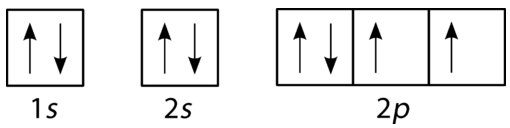
How many valence electrons are represented here?
a)
7
b)
5
c)
2
d)
8
5.
How many d orbitals are there in a given sublevel?
a)
1
b)
3
c)
5
d)
7
6.
How many p orbitals are there in a sublevel?
a)
2
b)
1
c)
4
d)
3
7.
How many electrons can the d sublevel hold?
a)
8
b)
10
c)
2
d)
4
8.
What is this element? 
1s22s22p63s23p6
4s23d104p6
a)
Argon
b)
Krypton
c)
Selenium
d)
Bromide
9.
What atom matches this electron configuration?
[Xe] 6s2 4f14 5d9
a)
Mercury
b)
Gold
c)
Platinum
d)
Thallium
10.
What is the shorthand electron configuration for Sulfur atom?
a)
[Ar] 3p4
b)
[He] 3s23p4
c)
[Ne] 3s23p4
d)
[Na] 3s23p3
11.
How many electrons can the first energy level hold?
a)
1
b)
2
c)
8
d)
0
12.
How many valence electrons does Chlorine have?
a)
5
b)
2
c)
7
d)
5
13.
How many valence electrons does phosphorus have?
a)
5
b)
2
c)
8
d)
15
14.
What element has the valence shell configuration
3s2 3p2
a)
Al
b)
B
c)
Si
d)
Ga
15.
Which element is pictured?
a)
neon
b)
fluorine
c)
magnesium
d)
argon
16.
Identify the element in Period 5 that has 1 valence electron?
a)
Rb
b)
Nb
c)
Ag
d)
Sb
17.
What noble gas should be used to write the shorthand configuration for Te?
a)
Ar
b)
Kr
c)
Xe
d)
Sb
18.
Which of the following is a p block element?
a)
Ca
b)
Ar
c)
Re
d)
Au
19.
Electron arrangement that uses arrows
a)
Electron configuration
b)
Shorthand configuration
c)
Lewis dot structure
d)
Orbital diagram
20.
What atom matches this electron configuration?
1s22s22p63s23p64s23d10
a)
Zinc
b)
Copper
c)
Nickel
d)
Germanium
21.
How many electrons does Si contain? (click to see image)
a)
14
b)
28
c)
2
d)
4
22.
There are 4 different types of subshells s,p,d,f
a)
true
b)
false
23.
Which electron configuration belongs to Copper (Cu)?
a)
1s2 2s2 2p6 3s2 3p6 4s2 3d8
b)
1s2 2s2 2p6 3s2 3p6 4s2 3d9
c)
1s2 2s2 2p6 3s2 3p6 4s2 3d10
24.
If an atom has 12 protons, how many valence electrons will that atom have? 
a)
2
b)
10
c)
8
d)
6
25.
Which atom is it who has 3 energy levels and 4 valence electrons? 
a)
Carbon
b)
Lithium
c)
Silicon
d)
Aluminum
26.
How many energy levels does Hafnium have?
a)
4
b)
72
c)
6
d)
cannot determine
27.
How many valence electrons does Calcium have? How many energy levels does Calcium have?
a)
2 valence: 4 energy levels 
b)
20 valence:  4 energy levels 
c)
4 valence: 2 energy levels 
d)
2 valence: 3 energy levels 
28.
If an atom has 4 protons, how many valence electrons will it have?
a)
4
b)
6
c)
2
d)
0
29.
Which element is depicted from this orbital diagram
a)
Fluorine
b)
Neon
c)
Chlorine
d)
Argon
30.
Which is associated with more energy? 
a)
2p
b)
2s
c)
3p
d)
1s
31.
What is the charge of an atom that has lost one electron?
a)
-1
b)
-2
c)
+1
d)
+2
32.
What is the charge of an atom that has gained one electron?
a)
-1
b)
-2
c)
+1
d)
+2
33.
Anions are _______ that form ____________ ions and __________ electrons.
a)
nonmetals, positive, lose
b)
nonmetals, negative, gain
c)
metals, positive, gain
d)
metals, positive, lose
34.
Which element is pictured?
a)
neon
b)
fluorine
c)
magnesium
d)
argon
35.
How many electron can be found in a s orbital?
a)
2
b)
3
c)
4
d)
1
36.
How many electron can be found in a p orbital?
a)
2
b)
3
c)
4
d)
6
37.
This orbital diagram represents:  
a)
C
b)
B
c)
N
d)
O
38.
What is incorrect about this orbital diagram?
a)
Both arrows in the 2p box should be pointing up
b)
There is nothing incorrect with this diagram
c)
In the there should only be 1 orbital in the first 2p box and one in the 2nd 2p box
d)
All the arrows should be pointing up.
39.
How many electrons can the d sublevel hold?
a)
14
b)
10
c)
2
d)
6
40.
How many electrons can the p sublevel hold?
a)
14
b)
10
c)
2
d)
6
41.

There are __ energy levels

a)

1

b)

2

c)

7

d)

8

42.
How many atomic orbitals are there in the p sublevel?
a)
2
b)
3
c)
4
d)
5
43.
Electrons occupy orbitals of lowest energy first is part of what electron configuration rule?
a)
Hund’s Rule
b)
Aufbau Principle
c)
Pauli Exclusion Principle
44.
What is the noble gas configuration for phosphorus?
a)
[Ar] 3p5
b)
[He] 3s2 3p5
c)
[Ne] 3s2 3p3
d)
[Na] 3s2 3p5
45.
What does Pauli exclusion principle state ?
a)
states that each electron occupies the lowest energy orbital available
b)
states that a maximum of two electrons can occupy a single atomic orbital, but if only if the electros have opposite spins
c)
states that single electrons electrons with the same spin must occupy each-energy orbital before additional electrons with opposite spins can occupy the same orbitals
46.
What does Hund's rule states ?
a)
states that single electrons electrons with the same spin must occupy each-energy orbital before additional electrons with opposite spins can occupy the same orbitals
b)
states that each electron occupies the lowest energy orbital available
c)
states that a maximum of two electrons can occupy a single atomic orbital, but if only if the electros have opposite spins
47.
What does an atom's electron-dot structure consist of ? 
a)
the elements atomic number and mass number which represents the number of protons and neutrons
b)
the element's symbol, which represents the atomic nuclues and inner-level electrons,surrounded by dots representing all of the atom's valence electrons
48.
What is the shape of a p orbital?
a)
sphere
b)
it's just too complex to think about it
c)
dumbbell
d)
I don't know this stuff.
49.
How many total electrons can the f orbitals in a sublevel hold?
a)
2
b)
14
c)
6
d)
10
50.
An orbital can at most hold how many electrons?
a)
1 electron
b)
2 electrons
c)
3 electrons
d)
4 electrons
51.
Electrons are paired based on their spin directions, clockwise and counterclockwise, is what electron configuration rule?
a)
Hund’s Rule
b)
Aufbau Principle
c)
Pauli Exclusion Principle
52.
What is this element?
[Xe] 6s24f145d9
a)
Mercury
b)
Gold
c)
Platinum
d)
Thallium
53.
Why do we use the three electron configuration rules: Hund's Rule, Aufbau Principle, and Pauli Exclusion Principle?
a)
to know where electrons are located
b)
to know how electrons are oriented in space
c)
to know how electrons are used in chemical reactions
d)
all of these
54.
Which orbital shows a violation of Hund's Rule?
a)
A
b)
B
c)
C
d)
D
55.
Which orbital shows a violation of the Pauli Exclusion Principle?
a)
A
b)
B
c)
C
d)
D
56.
Which orbital shows a violation of the Aufbau Principle?
a)
A
b)
B
c)
C
d)
D
57.

Subatomic particles with a negative charge

a)

Electrons

b)

Neutrons

c)

Protons

d)

Quarks

58.
subatomic particles found on the outermost shell & responsible for the atom's reactivity
a)
neutrons
b)
valence electrons
c)
isotopes
d)
ions
59.
Subatomic particles with a positive charge
a)
neutrons
b)
atomic mass
c)
protons
d)
isotopes
60.
Value representing the number of protons in an element
a)
Atomic Mass
b)
Mass Number
c)
Valence Electrons
d)
Atomic Number
61.
Subatomic particles that are neutral in charge
a)
Neutrons
b)
Protons
c)
Nucleus 
d)
Electrons
62.
Atoms of the same element with a different number of neutrons
a)
Ion
b)
Gluons
c)
Isotope
d)
Quarks
63.
Where electrons are likely to be found as they travel around the nucleus
a)
Nucleus
b)
Electron Cloud
c)
Within a Proton
d)
Within a Neutron
64.
A tiny but very dense, positively charged portion of the atom that holds most of the atomic mass
a)
Electron Shells
b)
Orbitals
c)
Electron Cloud
d)
Nucleus
65.
Discovered the nucleus of the atom through the Gold Foil Experiment
a)
Rutherford
b)
Chadwick
c)
Thomson
d)
Dalton
66.
Proposed the Modern Electron Cloud Model of the atom
a)
Schrodinger & Heisenberg
b)
Dalton
c)
Chadwick
d)
Rutherford
67.
Discovered the electron within the atom
a)
Thomson
b)
Chadwick 
c)
Schrodinger & Heisenberg
d)
Dalton
68.
Created the Planetary Model of the atom
a)
Bohr
b)
Dalton
c)
Rutherford
d)
Chadwick
69.
Discovered the neutron within the atom
a)
Democritus
b)
Thomson
c)
Rutherford
d)
Chadwick
70.
Believed that atoms of the same element are identical to each other
a)
Bohr
b)
Rutherford
c)
Dalton
d)
Thomson
71.
The only element with no neutrons in its nucleus.
a)
Oxygen
b)
Helium 
c)
Hydrogen
d)
Lithium
72.
JJ Thomson's theory was nicknamed _______.
a)
Billiard Ball Theory
b)
Solar System Theory
c)
Electron Cloud
d)
Plum Pudding
73.
Which scientist developed the atomic theory?
a)
JJ Thomson
b)
Ernest Rutherford
c)
John Dalton
d)
James Chadwick
74.
Electron cloud is based on
a)
Quantum Mechanics
b)
Gold Foil Experiment
c)
Matter is made up of small particles called atoms
d)
Nuclear Theory
75.
Who discovered the proton?
a)
Thomson
b)
Dalton
c)
Bohr
d)
Rutherford
76.
James Chadwick discovered the ________.
a)
proton
b)
neutron
c)
electron
d)
nucleus
77.
What did Thomson discover?
a)
electron
b)
proton
c)
neutron
d)
electron cloud
78.
This scientist believed that electrons orbit the nucleus.
a)
Dalton
b)
Bohr
c)
Rutherford
d)
Chadwick
79.
The Gold Foil experiment was done by __________.
a)
Chadwick
b)
Bohr
c)
Rutherford
d)
Thomson
80.
What scientist first developed 4 rules for atomic theory, and helped kick start modern chemistry?
a)
Thomson
b)
Rutherford
c)
Dalton
d)
Democritus
81.
This scientist performed the Cathode Ray Tube experiment and proposed the Plum Pudding Model of the atom
a)
Dalton
b)
Chadwick
c)
Thomson
d)
Democritus
82.
The word atom comes from a Greek word "atomos" that means
a)
Invisible
b)
Indivisible
c)
Undivided
d)
Indestructable 
83.
This particle is found in the nucleus and has no charge
a)
Neutron
b)
Proton
c)
Electron
d)
Orbital
84.
This particle is found in the nucleus and has a positive charge
a)
Electron
b)
Proton
c)
Neutron
d)
Neutral
85.
This is a negatively charged particle found outside the nucleus
a)
Electron
b)
Proton
c)
Neutron
d)
Orbital
86.
The first person to propose a theory about an atom was
a)
Democritus
b)
Rutherford
c)
Dalton
d)
Aristotle
87.
Rutherford's gold foil experiment provided evidence that...
a)
Negative and positive charges are spread evenly throughout the atom.
b)
Alpha particles have a positive charge.
c)
Gold is not a dense as previously thought.
d)
There is a dense positively charged nucleus at the center of an atom.
88.
True or False: The majority of an atom is made up of empty space
a)
True
b)
False
89.
The central region of an atom where its neutrons and protons are is its 
a)
Nucleus 
b)
Electron Cloud
c)
Core 
d)
Center 
90.
Which is the correct sequence of the scientists who made major changes in the model of the atom?
1-JJ Thomson
2-Erwin Schrodinger
3-John Dalton
4-Niels Bohr
5-Ernest Rutherford
a)
2, 1, 4, 3, 5
b)
3, 1, 5, 4, 2
c)
5, 3, 2, 1, 4
d)
4, 3, 2, 1, 5
91.
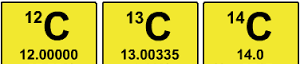
What do these isotopes of carbon all have in common?
a)
neutrons & mass number
b)
atomic number and neutrons
c)
atomic number and electrons
d)
protons, atomic number, and mass number
92.

Isotopes are atoms of the same element with different #’s of __________ & therefore different __________.

a)

neutrons ; atomic numbers

b)

protons ; atomic numbers

c)

electrons ; mass numbers

d)

neutrons ; mass number

93.
How many neutrons does an atom of the isotope Neon-22 have?
a)
12
b)
10
c)
22
d)
20
94.
Two isotopes of carbon are carbon-12 and carbon-14.  These isotopes differ from one another by two protons.
a)
true
b)
false
95.
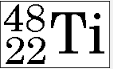
How many protons does this isotope of titanium have?
a)
48
b)
22
c)
26
d)
70
96.
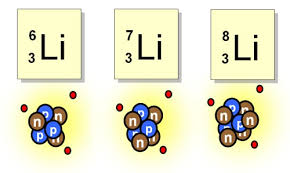
How many neutrons does the isotope of lithium have?
a)
8
b)
3
c)
4
d)
5
97.

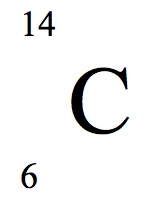
The photo above shows the isotopic notation for which isotope?

a)

Carbon 12

b)

Carbon 13

c)

Carbon 14

d)

Carbon 15

98.
How many neutrons does a Calcium 48 isotope have?
a)
16
b)
20
c)
28
d)
12
99.
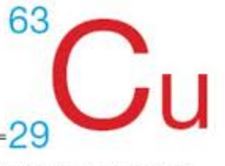
What is the name of the pictured isotope?
a)
Copper-29
b)
Copper-63
c)
Copper-34
d)
CopperWopperHopperBopper
100.
How many electrons does a Copper atom have?
a)
63
b)
29
c)
92
d)
34
101.
An element is defined by its number of 
a)
protons
b)
electrons
c)
neutrons
d)
protons + electrons
102.
Which of the subatomic particles is the lightest
a)
all have the same mass
b)
protons 
c)
neutrons 
d)
electrons
103.
Which of the subatomic particles is the heaviest?
a)
electrons 
b)
protons 
c)
neutrons 
d)
protons and neutrons have equal mass
104.
The relative mass of a proton/neutron is.....
a)
0
b)
1
c)
2
d)
3
105.
An atom with atomic number 6 would have how many protons?
a)
6
b)
12
c)
3
d)
cannot be determined 
106.
Most of an atom's mass is found in the
a)
electrons.
b)
nucleus.
107.
What do these isotopes of carbon all have in common?
a)
neutrons & mass number
b)
atomic number and neutrons
c)
atomic number and electrons
d)
protons, atomic number, and mass number
108.
In a correctly written symbol what would be located in the "A" position?
a)
number of neutrons
b)
atomic number
c)
number of electrons 
d)
mass number
109.
which atom has  4 neutrons?
a)
Li-6
b)
Li-7
c)
Li-8
d)
they have the same # of neutrons
110.
If X is the symbol for an element, which of the following two symbols represent    isotopes of the same element?     I. 7735X  II. 7733X  III. 8137X  IV. 8135 X
a)
I and II
b)
III and IV
c)
I and IV
d)
I and III
111.
Four isotopes of lead include lead-204, lead-206, lead-207, and lead-208.  The average atomic mass of lead is 207.2.  Which isotope of lead is likely to be the most abundant.
a)
204
b)
206
c)
207
d)
208
112.
Ions are: 
a)
atoms with a positive or negative charge
b)
atoms with no charge
c)
atoms with ONLY a positive charge
d)
atoms with ONLY a negative charge
113.
What is the name of the pictured isotope?
a)
Chlorine-Schmorine
b)
Chlorine-17
c)
Chlorine-35
d)
Chlorine-18
114.
What is the name of the pictured isotope?
a)
Copper-29
b)
Copper-63
c)
Copper-34
d)
CopperWopperHopperBopper
115.
If an atom gains an electron it is a(n)
a)
Positive ion
b)
Negative ion
c)
Isotope
d)
Neutral Atom
116.
If an atom loses an electron it is a(n)
a)
Positive ion
b)
Negative ion
c)
Isotope
d)
Neutral Atom
117.
Ca+ is an example of a(n)
a)
Positive ion
b)
Negative ion
c)
Isotope
d)
Neutral Atom
118.
Which answer choice describes the subatomic particles and their respective charges?
a)
p-    e+    n
b)
p+    e     n-
c)
p+    e-    n
d)
p-     e+    n
119.
Cations are...
a)
Positive
b)
Negative
c)
Neutral
d)
Purring
120.
Anions are...
a)
Positive
b)
Negative
c)
Neutral
d)
Crying
121.
An atom becomes _________ when it gains electrons.
a)
Positive
b)
Negative
c)
Neutral
d)
Invinsible
122.
An atom becomes _______ when it loses electrons.
a)
Positive
b)
Negative
c)
Neutral
d)
Invinsible
123.
Which particles change the charge in atoms when ions are formed?
a)
Protons
b)
Electrons
c)
Neutrons
d)
Kittens
124.
How many total electrons does O-2 (an oxide ion) have?
a)
8
b)
10
c)
6
d)
18
125.
How many total electrons does Mg+2 (a magnesium ion) have?
a)
10
b)
12
c)
14
d)
22
126.
How many total electrons does Na+1 (a sodium ion) have?
a)
10
b)
11
c)
12
d)
22
127.
24.1% of all the isotopes of a an element have a mass of 75.23 amu, 48.7% have a mass of 74.61 amu, and 27.2% have a mass of 75.20 amu.
What is the average mass of this element?
a)
74.92 amu
b)
24.97 amu
c)
75.01 amu
d)
74.51 amu
128.
Calcium has three different isotopes. One has a mass of 35.00 amu; another has a mass of 41.00 amu; and another has a mass of 40.00 amu. Which isotope is the most abundant of the three?
a)
40.00 amu
b)
41.00 amu
c)
35.00 amu
d)
impossible to tell
129.
An isotope has three forms.  30% have a mass of 4 amu, 20% have a mass of 5 amu and 50% have a mass of 3 amu.  Average atomic mass will be closest to
a)
2 amu
b)
3 amu
c)
4 amu
d)
5 amu
130.

The atomic mass of an element is the ___.

a)

average of the mass number and the atomic number for the element

b)

weighted average of the masses of the isotopes of the element

c)

total mass of the isotopes of the element

d)

total number of subatomic particles in the nucleus

131.

Calculate the average atomic mass of the element iron (Fe) using the following data:

[Isotope / % abundance]

[Iron 54 / 6% ] [Iron 56 / 92% ] [ Iron 57 / 2% ]

a)

53.7 amu

b)

54.9 amu

c)

5592.0 amu

d)

55.9 amu

132.

What are the steps for finding the Average Atomic Mass?

a)

1) write given mass, 2) write given %, 3) % to decimal, 4) Mass x abundance decimal 5) Add

b)

1) % to decimal, 2) write given %, 3)write given mass, 4) Mass x abundance decimal 5) Add

c)

1) write given mass, 2) write given %, 3) % to decimal, 4) Mass divided by abundance decimal 5) Add

d)

1) write given mass, 2) write given %, 3) % to decimal, 4) Mass x abundance decimal 5) Subtract