wayground logo

Free Printable Worksheets

Font size

S
M
L
XL
Worksheets

Bio III - Review for Unit 1 Test

Total questions: 70

Worksheet time: 1hrs 10mins

Name
Class
Date
1.
Name the phase:
a)
Anaphase
b)
Telophase
c)
Metaphase
d)
Prophase
2.
Name the phase:
a)
Prophase
b)
Metaphase
c)
Anaphase
d)
Telophase
3.
Name the phase:
a)
Prophase
b)
Metaphase
c)
Anaphase
d)
Telophase
4.
The stages of mitosis in order
a)
Metaphase, Anaphase, Prophase, Telophase
b)
Prophase, Anaphase, Metaphase, Telophase
c)
Prophase, Metaphase, Anaphase, Telophase
d)
Anaphase, Prophase, Telophase, Metaphase
5.

Identify the phase:

a)

Prophase

b)

Interphase

c)

Anaphase

d)

Telophase

6.
The phase in mitosis where chromosomes move away and are pulled apart by spindles to opposite sides of the cell.
a)
prophase
b)
anaphase
c)
metaphase
d)
telephase
7.
Why would it be important to replicate DNA before a cell divides in mitosis or meiosis?
a)
In order for genetic information to be transferred into daughter cells.
b)
In order for the cell to be able to increase in size.
c)
In order for the DNA to be contained in the nucleus.
d)
In order for the cell to re-order the DNA sequencing in the new cells.
8.
In mitosis, the two resulting cells are
a)
different from the starting cell and identical to each other.
b)
different from the starting cell and different from each other.
c)
identical to the starting cell and different from each other.
d)
identical to the starting cell and identical to each other.
9.
The time between cell divisions in the life cycle of the cell is called
a)
anaphase
b)
interphase
c)
prophase
d)
metaphase
10.
Where does a cell contain it's genetic material?
a)
nucleus
b)
nucleolus
c)
cytoskeleton
d)
golgi
11.

Identify the phase:

a)

Anaphase

b)

Cytonkinesis

c)

Interphase

d)

Prophase

12.
a)
Cytokinesis
b)
Anaphase
c)
Telophase
d)
Prophase
13.
Which of these lists presents the stages of the cell cycle in the correct order?
a)
interphase, mitosis, cytokinesis
b)
cytokinesis, mitosis, interphase
c)
mitosis, interphase, cytokinesis
d)
interphase, cytokinesis, mitosis
14.
DNA is replicated during the ______ phase of the cell cycle.
a)
G1
b)
Synthesis
c)
G2
d)
G0
15.

What is cancer?

a)

Uncontrolled cell growth

b)

Controlled cell growth

c)

Semi-regulated cell growth

d)

A pain

16.

Cancer forms when damaged cells do not go through _____________.

a)

mitosis

b)

meiosis

c)

interphase

d)

apoptosis

17.

A lump of cancerous cells is called _________.

a)

tumor

b)

melanoma

c)

scaroma

d)

mitosis

18.

Select all the things that are true about Eukaryotes

a)

They are single celled organisms

b)

They are multi-celled organisms

c)

An example is bacteria

d)

An example is animals and plants

19.

Select all the things that are true about Prokaryotes

a)

They are single celled organisms

b)

They are multi-celled organisms

c)

An example is bacteria

d)

An example is animals and plants

20.

In prophase, the DNA is the form of

a)

chromosomes

b)

chromatin

c)

chromatid

d)

chromosatin

21.

In anaphase, the DNA is the form of

a)

chromosomes

b)

chromatin

c)

chromatid

d)

chromosatin

22.

Centrioles are organelles that assist with

a)

Cell division

b)

DNA replication

c)

Growth

23.

What kind of cells are made in MEIOSIS?

a)

Haploid Gametes

b)

Diploid Somatic Cells

c)

Skin Cells

d)

Liver Cells

24.

A human body (somatic) cell usually has how many chromosomes?

a)

6

b)

22

c)

4

d)

46

25.
When an area of a chromatid is exchanged with the matching area on a chromatid of its homologous chromosome, _________________ occurs
a)
crossing over
b)
mutagenesis
c)
hybridization
d)
fertilization
26.
If the Diploid number of Carrots is 18, the haploid number is
a)
18
b)
9
c)
27
d)
36
27.
The process of crossing over occurs in what phase of meiosis?
a)
anaphase 1
b)
prophase 1
c)
prophase 2
d)
telophase 1
28.
The cells produced via meiosis are called:
a)
sex cells
b)
somatic cells
c)
body cells
d)
skin cells
29.
Why do we need meiosis?
a)
To double the number of chromosomes going into sex cells
b)
To halve the number of chromosomes going into sex cells
c)
To triple the number of chromosomes going into sex cells
d)
To not change the number of chromosomes going into sex cells
30.
The result of meiosis is:
a)
two diploid cells
b)
two haploid cells
c)
four diploid cells
d)
four haploid cells
31.
What causes genetic variation in meiosis?
a)
chromosomes lining up
b)
crossing over of chromosomes
c)
separation of chromosomes
d)
chromosomes pulling apart
32.

The chromosomes that pair up during meiosis, are called __________ chromosomes.

a)

heterozygous

b)

asexual

c)

homologous pairs

d)

genes

33.
Which of the following is NOT a gamete (sex cell)?
a)
egg
b)
sperm
c)
skin cell
d)
all of the above are gametes
34.
Meiosis makes sperm and egg cells. In humans, sperm and egg cells each have _____ chromosomes. Therefore a fertilized human egg cell (sperm and egg cell combined) would create a cell with _____ chromosomes.
a)
23, 46
b)
46, 23
c)
2, 4
d)
50, 100
35.
Diploid Cells are represented by
a)
2n
b)
n
c)
4n
d)
1/2 n
36.
Goes through P.M.A.T two rounds 
a)
Mitosis
b)
Meiosis
c)
Osmosis
d)
Transcription
37.
Which process and type of resulting cells are represented?
a)
mitosis, gametes
b)
mitosis, body cells
c)
meiosis, gametes
d)
meiosis, body cells
38.

How does mitosis help maintain complex organisms? Select three.

a)

creates new cells to add to tissue layers

b)

builds proteins that are critical for body functions

c)

provides new cells for growth and development

d)

creates genetically unique cells for sexual reproduction

e)

replaces old or damaged cells with identical new ones

39.

Rylee is a six-month old infant. In the next year, she will probably gain at least 7 pounds and grow at least 6 inches. For this type of growth to occur, Rylee will need to add additional skin cells, muscle cells, bone cells and other cells to her body.

Which statement names and describes the process responsible for this type of growth?

a)

mitosis because it allows cells to grow and divide to form new cells

b)

meiosis because it creates four daughter cells each time cell division occurs

c)

mitosis because all the cells that are required for Rylee to grow come from a single stem cell

d)

meiosis because when babies are born, all the cells they will ever have are in their bodies and these cells simply enlarge as the baby grows

40.

What is the end result when crossing over occurs between homologous chromosomes?

a)

New genetic combinations are created, resulting in more genetic variation in offspring.

b)

Offspring fail to create the proper proteins that are required for the expression of specific traits.

c)

Fewer genetic combinations are found in the gametes, resulting in less genetic variation in offspring.

d)

Offspring fail to receive a complete set of either maternal or paternal DNA, so they are born with genetic disorders.

41.

Hana created this diagram to show how mitosis occurs in multicellular organisms.

Which statement is true regarding this diagram?

a)

Each daughter cell receives either a full set of maternal DNA or a full set of paternal DNA.

b)

Each daughter cell has twice as much DNA as the parent cell because DNA doubles during prophase.

c)

The parent cell passes identical genetic material to both daughter cells that are produced after telophase.

d)

The chromosomes divide in half during anaphase, so each daughter cell receives only half of the parent cell's DNA.

42.
The two strands of a DNA molecule are held together by ________ bonds between their base pairs.
a)
covalent
b)
hydrogen
c)
ionic
d)
peptide
43.
Which of the following is not a base found in DNA?
a)
adenine
b)
thymine
c)
cytosine
d)
uracil
44.
What part of a nucleotide accounts for the genetic variation between individuals?
a)
phosphate
b)
nitrogenous base
c)
deoxyribose
d)
sugar
45.
If a segment of double-stranded DNA has 40 percent A, how much of it is C?
a)
40
b)
10
c)
15
d)
20
46.
If one strand of DNA has the sequence TTACCG, the sequence of the other strand of the same molecule will be
a)
AATGGC
b)
TTACCG
c)
AACGGC
d)
AATGGG
47.
Once replication in a DNA molecule is complete, each new DNA molecule contains 
a)
two new strands.
b)
3 exact copies of strands.
c)
one new strand and one old.
d)
two old strands.
48.
Which of the following will NOT generally cause mutations?
a)
radiation
b)
DNA replication
c)
chemicals
d)
viruses
49.
Which enzyme copies DNA?
a)
DNA polymerase
b)
DNA helicase
c)
RNA polymerase
d)
RNA helicase
50.
What are the functions of genes?
a)
instructions for producing proteins
b)
instructions for producing DNA
c)
instructions for producing lipids
d)
they have no function
51.
What does mRNA do?
a)
provides information from DNA to ribosomes
b)
transfers amino acids to the ribosomes
c)
makes up ribosomes
d)
builds proteins
52.
What does rRNA do?
a)
provides information from DNA to ribosomes
b)
transfers amino acids to the ribosomes
c)
makes up ribosomes
d)
builds proteins
53.
What does tRNA do?
a)
provides information from DNA to ribosomes
b)
transfers amino acids to the ribosomes
c)
makes up ribosomes
d)
builds proteins
54.
What is the process that copies information from DNA into RNA?
a)
protein synthesis
b)
transcription
c)
translation
d)
DNA Polymerase
55.
What is the process that copies information from DNA into RNA?
a)
protein synthesis
b)
transcription
c)
translation
d)
DNA Polymerase
56.
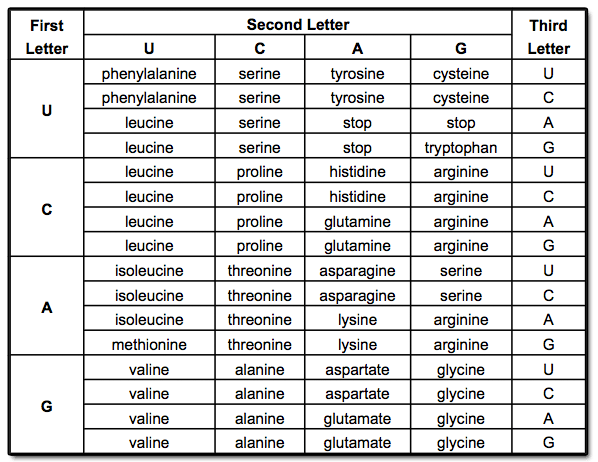
What will be the resulting mRNA from this DNA sequence:
GAT-TAC-AGA-TTA-CAT?
a)
CTA-ATG-TCT-AAT-GTA
b)
GAU-UAG-UGA-UUA-GUT
c)
CUA-AUG-UCU-AAU-GUA
d)
CAT-ACA-TAC-ATA-TAG
57.
What is the correct amino acid sequence for the mRNA code AUGCCAGUAUGA
a)
Met-Pro-Ala-Val
b)
Met-Pro-Val
c)
Tyr-Gly-His
d)
Tyr-Gly-Arg-His
58.
Every three letters (example: ATC) in DNA codes for what??
a)
Amino Acid
b)
Nucleotide
c)
Lipid
d)
Carbohydrate
59.
The anti-codon 
a)
contains a sequence the same as the codon
b)
contains a sequence complementary to the codon 
c)
contains the base thymine
60.
tRNA is involved in
a)
carrying amino acids 
b)
carrying ribosomes
c)
carrying glucose
d)
carrying lipids
61.
Which of the following best describes a DNA molecule?
a)
double helix
b)
contains ribose
c)
made of amino acids
d)
contains Uracil
62.
In a molecule of double-stranded DNA, the amount of Adenine present is always equal to the amount of
a)
cytosine
b)
guanine
c)
thymine
d)
uracil
63.
Adenine bonds with ______________.
a)
Guanine
b)
Thymine
c)
Cytosine
d)
Adenine
64.
Guanine bonds with ______________.
a)
Adenine
b)
Guanine
c)
Cytosine
d)
Thymine
65.

What is the name for the process above? Select two.

a)

Protein Synthesis

b)

RNA Transportation

c)

Molecule Construction

d)

The Central Dogma of Biology

66.

In mitosis the DNA changes shape. Select the answer that has the DNA changing shape in the right sequence.

a)
  1. chromatin
  2. chromosomes
  3. chromatids
  4. chromatin
b)
  1. chromosomes
  2. chromatin
  3. chromatids
  4. chromosomes
c)
  1. chromatids
  2. chromosomes
  3. chromatin
  4. chromosomes
d)
  1. chromatin
  2. chromatids
  3. chromosomes
  4. chromatids
67.

What mutation has occurred here?

Orginial: TGA CCA ACT

Mutated: TGA GCA ACT

a)

Substitution

b)

Deletion

c)

Insertion

d)

Frameshift

68.

What mutation has occurred here?

Orginial: TTA CGC AAG

Mutated: TTA GCA AG

a)

Substitution

b)

Deletion

c)

Insertion

d)

Inversion

69.

What mutation has occurred here?

Orginial: TTA CGC AAG ACT

Mutated: TTA GGC GAA GAC T

a)

Substitution

b)

Deletion

c)

Insertion

d)

Inversion

70.

Mutations are...

(select all that are correct)

a)

changes that occur in the DNA or RNA

b)

helpful

c)

harmful

d)

neutral