
 Worksheets
Chemical Equations
Total questions: 40
Worksheet time: 26mins
Name
Class
Date
1.
Which of the following is evidence that a chemical change has taken place?
a)
change in color
b)
change in size
c)
change in shape
d)
change in energy
2.
When dry ice (solid carbon dioxide) sublimes it goes directly from a solid to a gas. What type of change is occurring?
a)
Chemical change
b)
Physical change
c)
None of the above
3.
How many oxygen atoms are present in the following?
4Ca(OH)2
4Ca(OH)2
a)
4
b)
6
c)
8
d)
1
4.
Why must we balance chemical equations?
a)
Our teacher said so
b)
to abide by the law of conservation of energy
c)
to abide by the law of conservation of mass
5.
What is changed in a chemical reaction like this one?
NaOH + HCl → NaCl + H2O
NaOH + HCl → NaCl + H2O
a)
the number of atoms is changed
b)
molecules and compounds are changed
c)
atoms are changed
d)
elements are changed
6.

Which of the following is true?
a)
Na is a gas
b)
Cl combusts when put in water
c)
NaCl is very different than Na and Cl
d)
Cl is a metal
7.
How many E atoms are there in this silly formula?
2E2Fg3Hi4
2E2Fg3Hi4
a)
4
b)
2
c)
1
d)
3
8.
Which of the following can be broken apart in a chemical reaction?
a)
Noble gases
b)
Molecules and compounds
c)
only molecules
d)
only compounds
9.
The substances listed on the right side of a chemical equation are the
a)
Yields
b)
Reactants
c)
Products
d)
Precipitates
10.
CaCO3 represents a chemical
a)
Symbol
b)
Formula
c)
Subscript
d)
Reaction
11.
The substances listed on the left side of a chemical equation are the
a)
Products
b)
Coefficients
c)
Precipitates
d)
Reactants
12.
In chemical reactions, what does the principle of conservation of mass mean?
a)
Matter is not created or destroyed.
b)
The total mass of the reactants is greater than the total mass of the products.
c)
The total mass of the reactants is less than the total mass of the products.
d)
Matter is not changed.
13.
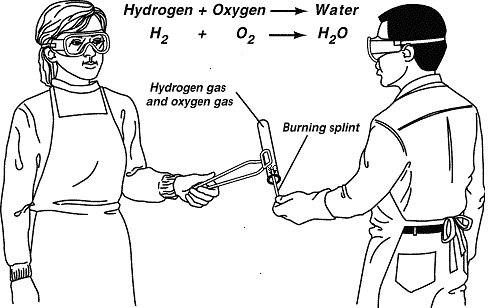
Identify the reactant(s) and product(s) of the reaction.
a)
All three are reactants and none are products.
b)
Hydrogen and water are the reactants, and oxygen is the product.
c)
Water and oxygen are the reactants, and hydrogen is the product.
d)
Hydrogen and oxygen are the reactants, and water is the product.
14.
How many Oxygen (O) atoms are in 2C2HO8Cl2
a)
2
b)
16
c)
8
d)
5
15.
How many Hydrogen (H) atoms are in NH3O5
a)
3
b)
4
c)
5
d)
1
16.
A molecule is________
a)
a glob of gelatinous goo
b)
smaller than an atom
c)
filled with raisons
d)
more than one atom bonded together
17.
Which is the Law of Conservation of Matter?
a)
matter cannot be created or destroyed, it only changes form
b)
matter can be created but it cannot be destroyed, it never changes form
c)
matter can be destroyed but it cannot be created, it usually just changes form
d)
matter is an unproven theory created by Hans Geiger
18.
How many molecules of Carbon are in the following formula? 3C2H6
a)
3
b)
6
c)
12
d)
18
19.
How many elements are in C6H12O6?
a)
1
b)
2
c)
3
d)
4
20.
How many Sodium (Na) are in 6NaCl?
a)
1
b)
12
c)
6
21.
How many Aluminum are in Al2O3?
a)
3
b)
2
c)
5
22.
True or False
In a chemical reaction, no new atoms are created, and no atoms are destroyed.
In a chemical reaction, no new atoms are created, and no atoms are destroyed.
a)
true
b)
false
23.
A chemical change is different than a physical change because in a chemical change
a)
Chemicals are used
b)
Molecules do not physically touch
c)
A new substance is formed and in a physical change no new substance is formed
d)
The change can be seen but in a physical change it cannot
24.
Which statement is not a description of a chemical reaction?
a)
A solid is dropped into a beaker of liquid and a gas is released.
b)
Two liquids are mixed in a beaker and a solid forms at the bottom of the beaker.
c)
A solid is dropped into a beaker of liquid and an explosion occurs.
d)
A liquid is heated in the sun and half of it evaporates.
25.
A number in front of a chemical formula in an equation that indicates how many molecules or atoms of each reactant and product are involved in a reaction.
a)
Coefficient
b)
reactant
c)
subscript
d)
product
26.
A chemical reaction that absorbs heat
a)
Single replacement
b)
Exothermic
c)
Endothermic
d)
Decomposition
27.
Which of the following is NOT a sign of a chemical reaction?
a)
Color changes
b)
Cutting into fourths
c)
Light is produced
d)
Gas is formed
28.
In a chemical reaction
a)
The atoms of the reactants always stay together to form the products
b)
The atoms of the reactants unbond, rearrange, and then rebond to form the products
c)
New atoms are formed which combine to make the products
d)
Some atoms disappear while others multiply to form the products
29.
CaCO3 represents a chemical
a)
Symbol
b)
Formula
c)
Subscript
d)
Reaction
30.
Which of the following examples shows that a chemical reaction has occurred?
a)
A rock breaks into smaller pieces when it is struck with a hammer.
b)
Rust forms on a hammer that has been left outside to long.
c)
A cup of water turns pink when a few drops of red food coloring are added.
d)
A solid is formed when heat is removed from a sample of water.
31.
A student places a piece of a potato into a container of hydrogen peroxide. One observation the student makes is that bubbles form around the potato. The presence of bubbles might indicate the formation of a new substance because bubbles -
a)
could show that a gas is forming
b)
always rise to the top of a liquid.
c)
are almost always perfectly spherical.
d)
usually burst after a few minutes.
32.

Four students performed four different investigations by combining different substances. Their results are shown in the table provided. In which experiment are new substances being formed?
a)
Experiment 1
b)
Experiment 2
c)
Experiment 3
d)
Experiment 4
33.
Hydrogen peroxide breaks down to form water and oxygen gas. Which observation is evidence that a chemical reaction has occurred?
a)
The mass of the solution remains the same.
b)
Phase changes are observed.
c)
The color of the solution remains clear.
d)
The temperature of the solution increases.
34.
A clear liquid from a flask is poured into another clear liquid in a beaker. Which of the following results of this procedure would indicate a new substance was formed?
a)
The level of the substance in the beaker is higher after the other liquid is added.
b)
A yellow solid forms and then settles to the bottom of the beaker.
c)
Small white crystals are left behind in the flask that held the first liquid.
35.
Which of the following is an example that includes evidence of a chemical reaction?
a)
A sample of zinc is placed in water and it settles to the bottom
b)
A solid block of ice is heated and it completely melts into a liquid.
c)
Sugar that is burned gives off an odor and turns brown and then black.
d)
A tomato is placed into a blender and chopped up into smaller pieces.
36.

In a container, a solid consisting of clear crystals is combined with a blue liquid and the following observations are obtained.
How many of the listed observations indicate a new substance was formed?
How many of the listed observations indicate a new substance was formed?
a)
1
b)
2
c)
3
d)
4
37.
Evidence of a chemical reactions is anything that shows -
a)
a new substance has formed
b)
a solid dissolved in a liquid
c)
interaction between 2 gases
d)
a change in the state of matter
38.
Marie had a beaker with a small amount of baking soda. She added a few drops of pickle juice to the baking soda and observed fizzing and bubbling. Based on her observation, which of these can Marie determine about the new substance formed by mixing the baking soda and pickle juice?
a)
A chemical reaction produced a
solid.
b)
A chemical reaction produced
a gas.
c)
No chemical reaction took place.
d)
Only a physical change happened.
39.
Vanessa had a beaker with a small amount of baking soda. She added a few drops of vinegar to the baking soda and observed fizzing and bubbling. Based on her observation, which of these can Vanessa determine about the new substance formed by mixing the baking soda and vinegar?
a)
It was hot.
b)
It was a gas.
c)
It was magnetic.
d)
It was a conductor.
40.
Which of the following characteristics is shared by all chemical reactions?
a)
Produce a precipitate
b)
Show a color change
c)
Release heat energy
d)
Form new substances
100 %

