wayground logo

Free Printable Worksheets

Font size

S
M
L
XL
Worksheets

Chemistry Quarter 1 Review

Total questions: 51

Worksheet time: 54mins

Name
Class
Date
1.
A student conducting an investigation to determine the effect of temperature on the metabolism of yeast. Yeast and sugar are added to water, the gas produced is captured, and its volume is recorded. Which variables should be held constant during this investigation?
a)
Mass of sugar and water temperature
b)
Mass of yeast and mass of sugar
c)
Volume of gas and water temperature
d)
Volume of gas and mass of yeast
2.
When experimenting with the growth of a plant, a scientist uses three (of the same type of) plants, two different fertilizers, equal light, and equal water. What type of variable is the fertilizer?
a)
Dependent
b)
Independent
c)
Control
d)
Constant
3.
Should experiments be repeated over and over to see if the results are the same each time?
a)
yes
b)
no
4.
In an investigation into the uptake of a protein by cells, scientists immersed two cell types in solutions of this protein. The investigation was carried out at two different temperatures and the percentage of the protein taken up by the two cell types was recorded over 10 minutes. The data was presented in a table, as shown above. Which one of the following conclusions is supported by the data?
a)
The rate of uptake of this protein at 25 °C is not affected by cell type.
b)
The percentage of this protein taken up by Cell type 1 is not affected by temperature.
c)
The rate of uptake of this protein by Cell type 2 is faster at 37 °C than at 25 °C.
d)
If the experiment continued for another 10 minutes, the percentage of this protein taken up by Cell type 1 would increase.
5.
What is the general order of the steps of the scientific methods:
a)
question, experiment, hypothesis, analyze, results, conclusion, communicate results.
b)
question, hypothesis, experiment, analyze results, conclusion, communicate results
c)
question, hypothesis, experiment, analyze results, communicate results, conclusion
d)
all of the above
6.
Kalinda was trying to explain to her friend the difference between a theory and a law in science.  She used the theory of plate tectonics and the law of superposition as examples.  Kalinda explained the difference by using nonscientific language.  Which statement did Kalinda use to correctly describe the difference between a theory and a law in science?
a)
A theory describes a natural event, while a law explains it.
b)
A theory explains a natural event, while a law predicts it.
c)
A theory explains a natural event, while a law describes it.
d)
A theory predicts a natural event, while a law explains it.
7.

In 1897, Joseph Thomson discovered that atoms contained electrons. He proposed a change in the atomic theory of that time, and the theory was modified because of his discovery. Since Thomson’s discovery, atomic theory has been further modified. What is the best explanation for why scientific theories are modified?

a)

Theories more than ten years old are usually out of date.

b)

Scientists want to prove that the work of other scientists is wrong.

c)

New evidence that supports a change prompts scientists to modify earlier theories.

d)

So much information is available today that it is harder to focus research and disprove theories.

8.

Scientists create both scientific theories and scientific laws as they make observations and conduct experiments about the natural world. Which of the following statements most accurately compares the difference between scientific theories and scientific laws

a)

science laws are based on evidence while science theories are not

b)

science theories involve only biology, while laws involve all types of science

c)

science theories involve mathematical equations, while science laws are based on observations

d)

science theories are ideas that explain natural events, while science laws predict what will happen in a natural event.

9.
Sal is studying the solar system. He makes a physical model using different-sized foam balls to represent the planets. Which best describes why a physical model is a useful tool for studying the solar system?
a)
Solar system models can be used to study a system that is too big to study directly.
b)
A model of the solar system eliminates the need for scientists to study the solar system directly.
c)
A model of the solar system provides an exact replica of the actual solar system, so scientists can experience what each planet is like.
d)
A model of the solar system can provide more data about the solar system than direct observations.
10.

The theory of Plate Tectonics is the idea that the Earth's crust has many plates that move because of changes in temperature deep below the Earth's surface. It has changed over time. What would cause the theory to change?

a)

The addition of new empirical evidence.

b)

It was a bad theory to begin with.

c)

If the news ran a story about why it should be changed.

d)

If a famous scientist said it should be changed.
11.
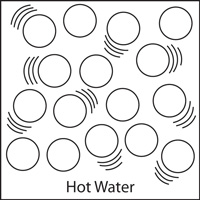
At higher temperatures
a)
particles in an object have less energy
b)
particles in an object move faster
c)
a gas contracts
12.
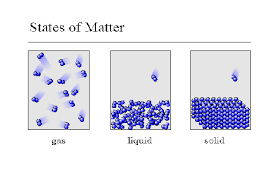
A gas
a)
has a definite shape but no definite volume
b)
has a definite volume but no definite shape
c)
has fast-moving particles
13.
Particles (molecules) in a ______________________ have more energy than the other states of matter.
a)
gas
b)
solid
c)
liquid
14.
The speed of the molecules determines the _____.
a)
volume
b)
density
c)
pressure
d)
temperature
15.

Particles of a liquid

a)

are tightly packed together and stay in a fixed position.

b)

are free to move around one another but still touch.

16.

Solid to Gas

a)

Deposition

b)

Sublimation

c)

Evaporation

17.
What is matter?
a)
Anything that has mass and volume
b)
The shape of an object
c)
How much an object weighs
d)
The pull of objects on one another
18.
Volume is.....
a)
the weight of an object
b)
the gravity of an object
c)
how much space an object takes up
d)
measured with a balance scale
19.
Which state of matter has a definite shape?
a)
Gas
b)
Solid
c)
Liquid
d)
Plasma
20.

Sally placed a thermometer in a cup of water. She recorded the temperature every five minutes.

What is the best claim based on this data?

a)

A. The water gained heat.

b)

B. The water lost heat.

c)

C. The water lost mass.

d)

D. The water gained cold.

21.

Bill observed the object.

Which of following best explains why he thought it was a solid?

a)

A. It is a solid because it does not change temperature.

b)

B. It is a solid because it does not change mass.

c)

C. It is a solid because it does not change volume.

d)

D. It is a solid because it does not change shape.

22.

Jim needs to measure the volume of a liquid in an investigation.

Which instrument would be best for measuring the volume?

a)
b)
c)
d)
23.

Which of the models below best shows the energy change when ice melts?

a)
b)
c)
d)
24.

Mary put the same amount of matter into the three containers.


Based on her scientific investigation, how can the matter be classified?

a)

A. It is a liquid because it has the same volume but changes shape.

b)

B. It is a gas because it has the same volume but changes shape.

c)

C. It is a solid because it has the same volume but changes mass.

d)

D. It is a liquid because it has the same volume but changes mass.

25.

Sarah observed a type of matter. She observed that the matter would fill any container she put it in.


How could she best explain why this matter was a gas?

a)

A. It was a gas because it had a definite shape.

b)

B. It was a gas because it had a definite volume.

c)

C. It was a gas because it did not have a definite volume.

d)

D. It was a gas because it did not have a definite mass.

26.
Which types of particles have the strongest attractive forces between them?
a)
solids
b)
liquids
c)
gases
27.

This explains the behavior of solids, liquids and gases and is based on the concept that particles of matter are always in motion.

a)

ideal gas law

b)

atomic theory

c)

kinetic molecular theory

d)

Newton's 1st Law of Motion

28.

Subatomic particles with a negative charge

a)

Electrons

b)

Neutrons

c)

Protons

d)

Quarks

29.
Value representing the number of protons in an element
a)
Atomic Mass
b)
Mass Number
c)
Valence Electrons
d)
Atomic Number
30.
Atoms of the same element with a different number of neutrons
a)
Ion
b)
Gluons
c)
Isotope
d)
Quarks
31.
Where electrons are likely to be found as they travel around the nucleus
a)
Nucleus
b)
Electron Cloud
c)
Within a Proton
d)
Within a Neutron
32.
Discovered the electron within the atom
a)
Thomson
b)
Chadwick 
c)
Schrodinger & Heisenberg
d)
Dalton
33.
Created the Planetary Model of the atom
a)
Bohr
b)
Dalton
c)
Rutherford
d)
Chadwick
34.
Discovered the neutron within the atom
a)
Democritus
b)
Thomson
c)
Rutherford
d)
Chadwick
35.
Which two subatomic particles make up the nucleus of an atom?
a)
Protons and Electrons
b)
Neutrons and Electrons
c)
Electrons and Protons
d)
Protons and Neutrons
36.
In this picture, the Electrons are found in which color?
a)
Blue
b)
Red
c)
Green
37.
What electrical charge does a proton have?
a)
+1
b)
0
c)
-1
d)
+2
38.
What mass does a neutron have?
a)
1
b)
0
c)
-1
d)
+2
39.
The total number of protons and neutrons in an atom is called the...
a)
Atomic number
b)
Proton number
c)
Mass number
d)
Weight number
40.
How many protons does an aluminium atom have? (Use the image to help you)
a)
27
b)
14
c)
40
d)
13
41.
Which particle is negatively charged?
a)
proton
b)
atom
c)
neutron
d)
electron
42.
One cup of water is left outside for two days when it was checked there was only half a cup left. What happened?
a)
evaporation; chemical change
b)
condensation; physical change 
c)
evaporation; physical change
d)
condensation; chemical change
43.
Which one of these is a chemical property?
a)
melting point
b)
boiling point
c)
color
d)
flammability
44.
which one is the definition of chemical property?
a)
a property or characteristic of a substance that is observed during a reaction where the chemical composition of a substance is changed
b)
any change that results in the formation of new chemical substances
c)
combustibility
45.
Density
a)
Physical Property
b)
Chemical Property
46.
In baking biscuits and other quick breads, the baking powder reacts to release carbon dioxide bubbles. The carbon dioxide bubbles cause the dough to rise. 
a)
Physical Change
b)
Chemical Change
47.
Chewing food to break it down into smaller particles represents a _________ change, but the changing of starch into sugars by enzymes in the digestive system represents a ___________change. 
a)
Chemical then Physical 
b)
Physical then Chemical
c)
Both Physical
d)
Both Chemical
48.
Density, melting point, boiling point:These may all be classified as
a)
chemical properties
b)
physcial properties
49.
Juan observes these properties of an unknown substance. The substance is white, has a crystaline structure, dissolves in water and burns when a flame is applied. What is a chemical property of the substance?
a)
color
b)
crystaline structure
c)
dissolves
d)
burns
50.
This is an example of a
a)
physical change
b)
chemical change
51.
Jack has a rock. The rock has a mass of 14g and a volume of 2cm3. What is the density of the rock?
a)
7 mL
b)
7 g/cm3
c)
28 g/cm3
d)
1/7 g/cm3