wayground logo

Free Printable Worksheets

Font size

S
M
L
XL
Worksheets

NGSS Chemistry Unit 2 Review

Total questions: 73

Worksheet time: 1hrs 10mins

Name
Class
Date
1.

Sea-floor spreading begins here.

a)

Continental shelf

b)

Sea mounts

c)

Trenches

d)

Mid-ocean ridge

2.

Why does subduction occur?

a)

Old crust is more dense and gravity helps pull the crust back into the mantle.

b)

Old crust is less dense and it sinks back into the mantle.

c)

Old crust is warm and melts back into the mantle.

d)

Old crust has no where else to go but through trenches.

3.

Convection currents happen when

a)

Rock/magma gets heated and sinks. It then cools down and rises.

b)

Rock/magma doesn't move.

c)

Rock/magma gets more dense and rises. It then cools down and sinks.

d)

Rock/magma gets heated and rises. It then cools down and sinks.

4.

The only liquid layer inside the Earth.

a)

Asthenosphere

b)

Mantle

c)

Outer core

d)

Inner core

5.
one tectonic plate moves under another
a)
convergent plate boundary
b)
divergent plate boundary
c)
transform plate boundary
d)
subduction
6.
a boundary at which two plates move away from each other
a)
convergent plate boundary
b)
divergent plate boundary
c)
transform plate boundary
d)
subduction
7.
a boundary at which two plate move toward each other
a)
convergent plate boundary
b)
divergent plate boundary
c)
transform plate boundary
d)
subduction
8.
What type of boundary is in this image?
a)
convergent plate boundary
b)
divergent plate boundary
c)
transform plate boundary
d)
subduction
9.
Which type of crust is more dense?
a)
oceanic
b)
continental
c)
divergent
d)
pizza
10.
What is the process in which hot molten rock rises, then cools and sinks back to the core?
a)
plate tectonics
b)
continental drift
c)
convection
d)
divergence
11.
What is the process in which two plates move toward each other but one sinks under the other?
a)
subduction
b)
convection
c)
divergence
d)
transformation
12.

New oceanic crust (sea floor) is created at this boundary.

a)

Divergent Oceanic

b)

Divergent Continental

c)

Convergent Oceanic

d)

Transform

13.

The process where oceanic crust slides under another plate and is melted is called ___________.

a)

seafloor spreading

b)

subduction

c)

continental drift

d)

recycling

14.
What is the outermost layer of the Earth called?
a)
Core
b)
Mantle
c)
Crust
15.
What are the puzzle pieces of the Earth's surface called?
a)
Tectonic plates
b)
Puzzles
c)
Earthquakes
16.
What is the vocabulary word for the line where two tectonic plates move past each other?
a)
Plate Line
b)
Fault Line
c)
Puzzle Line
17.
What are the two types of earthquake waves?
a)
P and S waves
b)
Surface and Underground waves
c)
Fast and Slow waves
18.
The place where the earthquake is felt on the Earth's surface is called...
a)
Epicenter
b)
Hypocenter (focus)
c)
Surface
d)
Crust
19.
What is the instrument used to measure earthquakes?
a)
Seismograph
b)
Seisologist
c)
Scale
20.
Which type of wave is the first to arrive after an earthquake occurs?
a)
P Wave
b)
Rayleigh Wave
c)
S Wave
d)
Shear Wave
21.
P Waves can move through which of the following?
a)
Gas
b)
Liquid
c)
Solid
d)
All of these
22.
S Waves can move through which of the following?
a)
Gas
b)
Liquid
c)
Solid
d)
All of these
23.
This famous transform fault is located in the western United States creates significant earthquake activity for California
a)
New Madrid
b)
Denali Fault
c)
Ramapo Seismic Zone
d)
San Andreas
24.
Which travels fastest, always being the first detected by seismic stations?
a)
P waves
b)
S waves
25.
This layer of the Earth is found between the core and the crust.
a)
mantle
b)
outer core
c)
inner core
d)
crust
26.
The layer that lies beneath the mantle and surrounds the inner core. 
a)
mantle
b)
outer core
c)
inner core
d)
crust
27.
The solid, dense center of our planet that extends from the bottom of the outer core to the center of the Earth.. 
a)
mantle
b)
outer core
c)
inner core
d)
crust
28.
The driving force of the tectonic plates are convection currents, where can these be found?
a)
inner core
inner core
b)
crust
c)
mantle
d)
outer core
29.
What layer has a solid inner part and a liquid outer part?
a)
Crust
b)
Mantle
c)
Core
d)
none
30.
What layer is the thinnest?
a)
Crust 
b)
Mantle
c)
Core
d)
They are all the same size
31.
What layer is made of plates that move around and bump into each other?
a)
Crust
b)
Mantle
c)
Core
d)
All of them
32.
Which layer has the highest density?
a)
Crust
b)
Mantle
c)
Core
d)
All the same
33.
True or False...You can touch only one of the Earth's layers.
a)
True
b)
False
34.
Which layer of the Earth is responsible for Earth's magnetic field?
a)
outer core
b)
inner core
c)
mantle
d)
crust
35.
The core is made-up of what two elements?
a)
iron and nickel
b)
iron and oxygen
c)
nickel and silicon
d)
oxygen and silicon
36.
Temperature _____________________ as you go deeper into the earth.
a)
increases
b)
decreases
c)
goes up and down depending on the layer
d)
stays the same
37.
What are the two kinds of crust that the Earth has?
a)
Oceanic and Crustatious Crust
b)
Oceanic and Continental Crust
c)
Optic and Continental Crust
38.

Which of Earth's layers is best described as liquid metal?

a)

crust

b)

mantle

c)

outer core

d)

inner core

39.

What is energy?

a)

moving energy

b)

stored energy

c)

renewable energy

d)

The ability to do work.

40.

What is potential energy?

a)

moving energy

b)

stored energy

c)

renewable energy

d)

non renewable energy

41.

What is kinetic energy?

a)

moving energy

b)

potential energy

c)

stored energy

d)

renewable energy

42.

Which of these things is an example of potential energy?

a)

a car motor

b)

firewood

c)

battery

d)

a fan

43.

Which of these energy sources come from inside the earth's crust?

a)

oil

b)

coal

c)

solar

d)

gas

44.

What is given off from energy?

a)

water

b)

heat

c)

smoke

d)

ash

45.

Which of these is an example of kinetic energy?

a)

a bicycle

b)

a battery

c)

a solar panel

d)

firewood

46.
YOUR BODY OBTAINS ENERGY FROM THE FOOD YOU EAT. WHAT IS THE FORM OF ENERGY IN FOOD?
a)
KINETIC
b)
ELASTIC
c)
GRAVITATIONAL
d)
CHEMICAL
47.
WHEN AN ARCHER BENDS A BOW, WHAT TYPE OF ENERGY INCREASES IN THE BOW?
a)
GRAVITATIONAL
b)
ELASTIC
c)
KINETIC
d)
THERMAL
48.
WHICH ENERGY TRANSFORMATION OCCURS WHEN A TELEVISION SPEAKER PRODUCES MUSIC?
a)
ELECTRICAL TO SOUND
b)
ELASTIC TO SOUND
c)
THERMAL TO SOUND
d)
SOUND TO ELECTRICAL
49.
WHAT ANOTHER NAME FOR THERMAL ENERGY?
a)
HEAT ENERGY
b)
ITS SIZE
c)
ITS POTENTIAL ENERGY
d)
ITS MECHANICAL ENERGY
50.
AS A ROLLER COASTER MOVES DOWN A HILL, POTENTIAL ENERGY IS CONVERTED INTO KINETIC ENERGY, THERMAL ENERGY, AND SOUND ENERGY. WHAT IS TRUE ABOUT THE TOTAL ENERGY OF THIS SYSTEM?
a)
ENERGY IS GAINED (CREATED) AS THE ROLLER COASTER MOVES
b)
ENERGY IS LOST (DESTROYED) AS THE ROLLER COASTER MOVES
c)
THE TOTAL ENERGY REMAINS THE SAME AS THE ROLLER COASTER MOVES
d)
THE TOTAL ENERGY CONSTANTLY CHANGES AS THE ROLLER COASTER MOVES
51.
WHICH OF THE FOLLOWING IS AN ENERGY CONVERSION FROM LIGHT ENERGY TO CHEMICAL ENERGY?
a)
TURNING ON A STOVE TO HEAT DINNER
b)
TURNING ON A LAMP
c)
GROWING AN APPLE TREE
d)
MAKING TOAST IN A TOASTER
52.
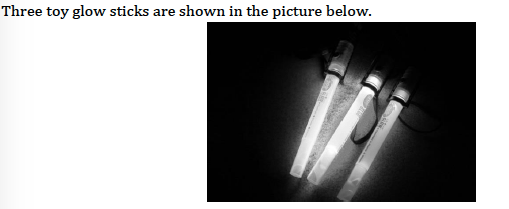
The glow sticks produce light for a short amount of time. The light from the glow stick is a conversion from what to what?
a)
thermal to light
b)
gravitational to potential
c)
radiant to electrical
d)
chemical to light
53.
On a roller coaster, where is maximum potential energy?
a)
At the bottom of a big hill
b)
When going around a corner
c)
When going upside down
d)
At the top of a big hill
54.
On a roller coaster, where is maximum kinetic energy?
a)
At the bottom of a big hill
b)
When going around a corner
c)
When going upside down
d)
At the top of a big hill
55.
Energy that is stored in bonds between atoms is:
a)
Mechanical energy
b)
Chemical energy
c)
Kinetic energy
d)
Nuclear energy
56.
Energy that comes from the nucleus of an atom. A form of potential energy.
a)
chemical energy
b)
Nuclear energy
c)
Sound energy
d)
Electrical energy
57.
Heat energy is also called
a)
electrical energy
b)
chemical energy
c)
light energy
d)
thermal energy
58.
The process by which energy is transferred from a warmer object to a cooler object by means of physical contact
a)
Thermal Energy
b)
Convection
c)
Radiation
d)
Conduction
59.
Energy that travels across distances in the form of electromagnetic waves. 
a)
Convection
b)
Radiation
c)
Conduction
d)
Induction
60.
Materials that transfer energy easily.
a)
Conductors
b)
Insulators
c)
Heat
d)
Energy
61.
Heat transfer always goes from-
a)
Cold to Hot
b)
Hot to Cold
c)
Heat doesn't transfer
d)
Freezing to Cold
62.
Conduction is heat transfer by -
a)
Touch
b)
Circles
c)
Waves
63.
In what direction do hot liquids and gasses move?
a)
Side to Side
b)
Down
c)
Up
d)
Back and Forth
64.
In what direction to cold liquids and gasses move?
a)
Side to Side
b)
Up
c)
Down
d)
Back and Forth
65.
What happens to particles as they heat up?
a)
They slow down
b)
Nothing
c)
They don't move
d)
They speed up
66.

What type of heat transfer takes place in liquids and gasses?

a)

Conduction

b)

Convection

c)

Radiation

d)

Thermal Equilibrium

67.
What type of heat transfer takes place in solids?
a)
Conduction
b)
Convection
c)
Radiation
68.
What type of heat transfer takes place through open space?
a)
Conduction
b)
Convection
c)
Radiation
69.
This is an example of-
a)
Conduction
b)
Convection
c)
Radiation
70.
Which example below is an example of conduction?
a)
Boiling macaroni
b)
The attic is warmer than the basement
c)
The Sun heating the Earth
d)
Touching hot sand with your feet
71.
Which example below is an example of radiation?
a)
Standing on a hot metal bridge
b)
The attic is warmer than the basement
c)
The Sun heating the Earth
d)
Touching hot sand with your feet
72.
As you touch a hot stove the heat transfers -
a)
from your hand to the stove
b)
from the stove to your hand
c)
It doesn't transfer
73.
Convection could occur in which of the materials below?
a)
A block of wood
b)
The ocean
c)
A bowl of ice cream
d)
In space