wayground logo

Free Printable Worksheets

NEW

Font size

S
M
L
XL
Worksheets

Year 10 Chemistry

Total questions: 73

Worksheet time: 2hrs 53mins
Name
Class
Date
1.
The central region of an atom where its neutrons and protons are is its 
a)
nucleus 
b)
electron cloud
c)
core 
d)
center 
2.
An atom with atomic number 6 would have how many protons 
a)
6
b)
12
c)
3
d)
cannot be determined 
3.
A part of the atom that has a negative charge is?
a)
Proton
b)
electron
c)
neutron
4.
If the number of protons changes, does the atom change its identity?
a)
YES!
b)
NO!
5.
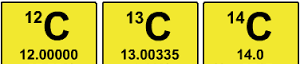
What do these isotopes of carbon all have in common?
a)
neutrons & mass number
b)
atomic number and neutrons
c)
atomic number and electrons
d)
protons, atomic number, and mass number
6.
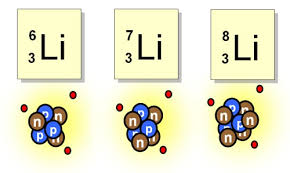
How many neutrons does the isotope of lithium have?
a)
8
b)
3
c)
4
d)
5
7.
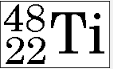
How many protons does this isotope of titanium have?
a)
48
b)
22
c)
26
d)
70
8.
In a correctly written symbol what would be located in the "A" position?
a)
number of neutrons
b)
atomic number
c)
number of electrons 
d)
mass number
9.
What quantities vary between isotopes of an element?
a)
protons, electrons, and atomic mass
b)
protons, electrons, and atomic number
c)
neutrons and electrons
d)
neutrons and atomic mass
10.
which atom has  4 neutrons?
a)
Li-6
b)
Li-7
c)
Li-8
d)
they have the same # of neutrons
11.
How many neutrons in C-14?
a)
6
b)
7
c)
14
d)
8
12.
Isotopes are atoms of the same element with different #’s of __________ & therefore different __________.
a)
n0 ;  atomic #’s
b)
p+ ; atomic #’s
c)
e- ; atomic masses
d)
n0 ; atomic masses
13.
How many neutrons does the isotope below have?     89 36Kr
a)
53
b)
36
c)
89
d)
125
14.
If X is the symbol for an element, which of the following two symbols represent    isotopes of the same element?     I. 7735X  II. 7733X  III. 8137X  IV. 8135 X
a)
I and II
b)
III and IV
c)
I and IV
d)
I and III
15.
How many neutrons does an atom of the isotope Neon-22 have?
a)
12
b)
10
c)
22
d)
20
16.
Four isotopes of lead include lead-204, lead-206, lead-207, and lead-208.  The average atomic mass of lead is 207.2.  Which isotope of lead is likely to be the most abundant.
a)
204
b)
206
c)
207
d)
208
17.
Two isotopes of carbon are carbon-12 and carbon-14.  These isotopes differ from one another by two protons.
a)
true
b)
false
18.
In the equation,  146C --> 147N + 0-1B, the _______ decay of radioactive carbon-14 results in the creation of a new nitrogen-14 atom.
a)
Radioactive
b)
Beta
c)
Alpha
d)
Gamma
19.
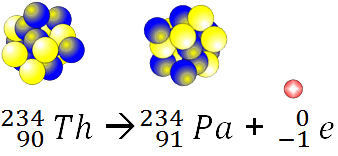
Which type of nuclear radiation is being emitted here?
a)
Alpha
b)
beta
c)
gamma 
d)
none
20.
A helium nucleus with two protons and two neutrons is called a(n) ____.  
a)
alpha particle
b)
electroscope
c)
beta particle
d)
gamma ray
21.
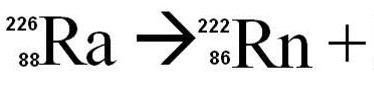
Complete the nuclear equation and determine the type of decay that is occurring in this reaction. 
a)
alpha
b)
beta
c)
gamma
d)
none
22.

Solve this equation for alpha decay.

85209At --> ___ + 24He

a)

83205Bi

b)

86209Rn

c)

81207Tl

d)

85208At

23.
Balance the following equation:
146C --> 0-1e + ________
a)
145B
b)
146C
c)
147N
d)
42He
24.

Gamma rays have

a)

no mass

b)

a huge mass

c)

a small mass

d)

an average mass

25.

Solve this equation for beta decay.

614C --> ___ + -10e

a)

410Be

b)

714N

c)

210He

d)

613C

26.

Carbon-14 has a half life of 5730 years, how many years would it take the 4.0 g sample to decay to 0.25 g?

a)

4 years

b)

5730 years

c)

22,920 years

d)

28,650 years

27.

An isotope of silver has a half-life of 10 minutes. What fraction of the original mass would remain after one hour?

a)

1/64

b)

1/2

c)

1/4

d)

1/8

28.
What makes an element radioactive?
a)
When it's nuclei expands
b)
When it's electrons explode
c)
When it's nuclei behave
d)
When it's nuclei decay
29.

What does pH measure?

a)

the amount of hydrogen (H+) ions

b)

the amount of hydroxide (OH-) ions

c)

amount of water

d)

all of the above

30.

Which of the following is the strongest acid?

a)

1

b)

5

c)

3

d)

8

31.

Which of the following is a characteristic of a base?

a)

bitter

b)

sour

c)

corrosive

d)

releases hydrogen ions in water

32.

Which of the following is a characteristic of an acid?

a)

bitter

b)

slippery

c)

sour

d)

releases hydroxide ions in water

33.
What is the only substance with a neutral pH of 7?
a)
Milk
b)
Orange Juice
c)
Water
d)
Blood
34.
Complete the sentence.
A substance that is more basic has a _____ pH than a substance that is acidic.
a)
lower
b)
higher
c)
the same
d)
none of the above
35.
A neutralization reaction will (almost) always produce...
a)
water & salt
b)
water
c)
salt
d)
water & carbon
36.

Zn(OH)2 is an example of a...

a)

acid

b)

base

c)

salt

37.
Identify the salt in the following equation:
Zn(OH)2 + HNO3   ---> H2O  + Zn(NO3)2
a)
Zn(OH)2
b)
HNO3
c)
H2O
d)
Zn(NO3)2
38.

In a ____ reaction, an acid and an alkali produce a salt and a water.

a)

concentrated

b)

decomposition

c)

dilute

d)

neutralization

39.

Complete the following reaction:

HCl + Mg(OH)2 -->

a)

MgCl2 + H2O

b)

Mg +H2O

c)

MgCl2 + H2

d)

MgCl2 + H2O + CO2

40.
Complete the following reaction:
Hydrochloric acid + magnesium hydroxide --> 
a)
Magnesium chloride + water 
b)
Magnesium + water
c)
Magnesium chloride + hydrogen gas 
d)
Magnesium chloride + water + carbon dioxide 
41.

What are indicators used for

a)

Measuring density of substances

b)

Drinking

c)

Measuring strength of acids or alkalis

d)

Decoration

42.
NaCl is a ...
a)
acid
b)
base
c)
salt
d)
water
43.

Complete the following word equation:

Metal + Acid -->

a)

Salt + water

b)

Salt + hydrogen

c)

Salt + Water + Carbon dioxide

44.

Complete the following word equation:

Metalcarbonate + acid -->

a)

Salt + Hydrogen

b)

Salt + Water + Carbon Dioxide

c)

Salt + Water

45.

How do you remove the water to leave solid copper sulfate crystals?

a)

Filter

b)

Evaporate

c)

Distill

46.

What does the word insoluble mean?

a)

Does dissolve

b)

Doesn't dissolve

c)

Is part of a solid

47.
Salts that are made with sulfuric acid are called ______________.
a)
chlorides
b)
sulfates
c)
nitrates
d)
carbonates
48.

How do you separate an excess insoluble reactant from a solution?

a)

Filtration

b)

Precipitation

c)

Crystalisation

d)

Evaporation

49.

Which two chemicals could you react to make only potassium chloride and water?

a)

Potassium and hydrochloric acid

b)

Potassium hydroxide and hydrochloric acid

c)

Potassium oxide and sulfuric acid

d)

Potassium and sulfuric acid

50.

_________________ + nitric acid --> calcium nitrate + water

a)

calcium sulfate

b)

calcium oxide

c)

calcium carbonate

d)

calcium

51.

What is the test for Hydrogen gas?

a)

Squeaky pop

b)

Lime water turning cloudy

c)

Add pH paper

52.

What is the test for Carbon Dioxide?

a)

Add Litmus paper

b)

Lime water turning milky

c)

Squeaky pop

53.

When a soluble salt is formed from an acid and an insoluble base, how do you know when an excess of a base has been added?

a)

When bubbles of gas appear

b)

When the reactant all dissolves

c)

When some of the reactant is left unreacted/undissolved

d)

When a colour change happens

54.

Why do you add excess of the insoluble reactant when making a soluble salt?

a)

To make sure all the acid is used up

b)

To separate the solid from the solution

c)

To make sure a reaction occurs

d)

To have the reaction happen faster

55.

What is the name of the element with an atomic number of 3?

a)

Lithium

b)

Magnesium

c)

Sodium

d)

Potassium

56.

Why does a higher temperature increase the rate of a reaction?

a)

it increases both the frequency and energy of particle collisions

b)

it only increases the frequency of particle collisions

c)

it only increases the energy of particle collisions

d)

it reduces the activation energy of the reaction

57.

Grinding a effervescent tablet into powder increases the rate of reaction due to increased

a)

concentration

b)

surface area

c)

temperature

d)

reactants

58.

Adding a catalyst ___________ the activation energy.

a)

Raises

b)

Lowers

c)

Doesn't affect

d)

Inreases

59.

The minimum amount of energy needed for colliding particles to react is called

a)

Chemical Energy

b)

Kinetic Energy

c)

Activation Energy

d)

Potential Energy

60.

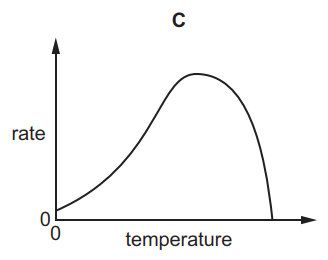
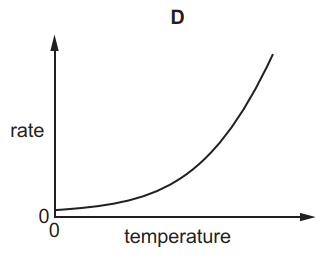
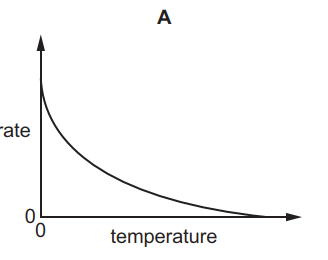
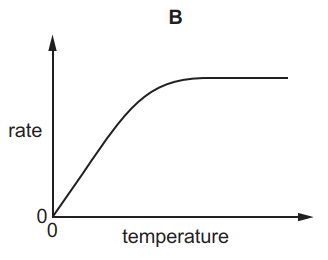
Which graph shows the effect of increasing temperature on the rate of reaction of calcium carbonate with dilute hydrochloric acid?
a)
b)
c)
d)
61.
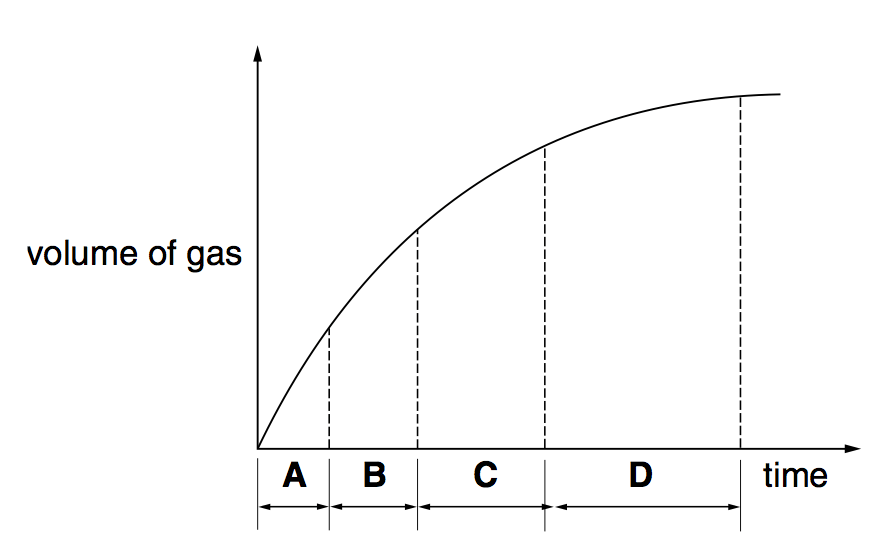
The graph shows how the total volume of a gas given off from a reaction changes with time. In which time interval is least gas given off? 
a)
A
b)
B
c)
C
d)
D
62.
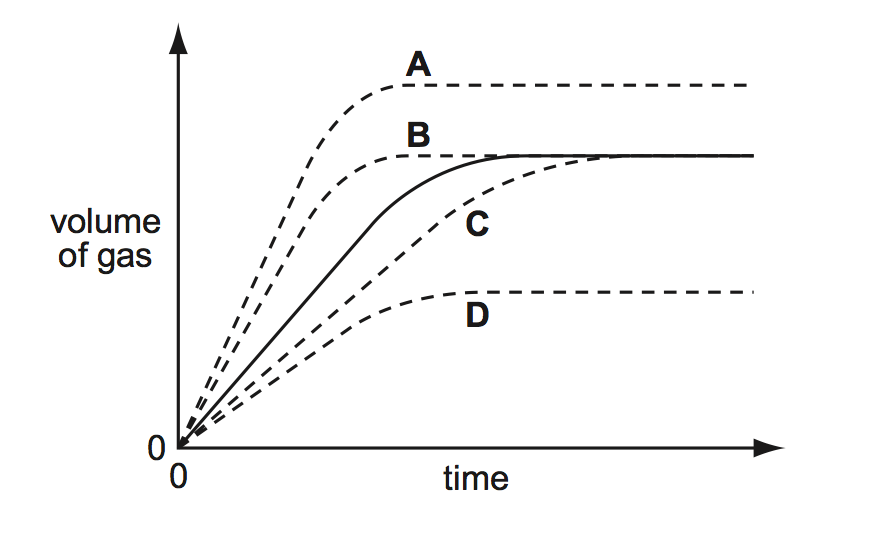
In an experiment, a 2 g lump of zinc and 2 g of powdered zinc are added separately to equal volumes of dilute sulphuric acid. The solid line on the graph shows the volume of gas given off when the 2 g lump is used. Which dotted line is obtained when the zinc is powdered? 
a)
A
b)
B
c)
C
d)
D
63.
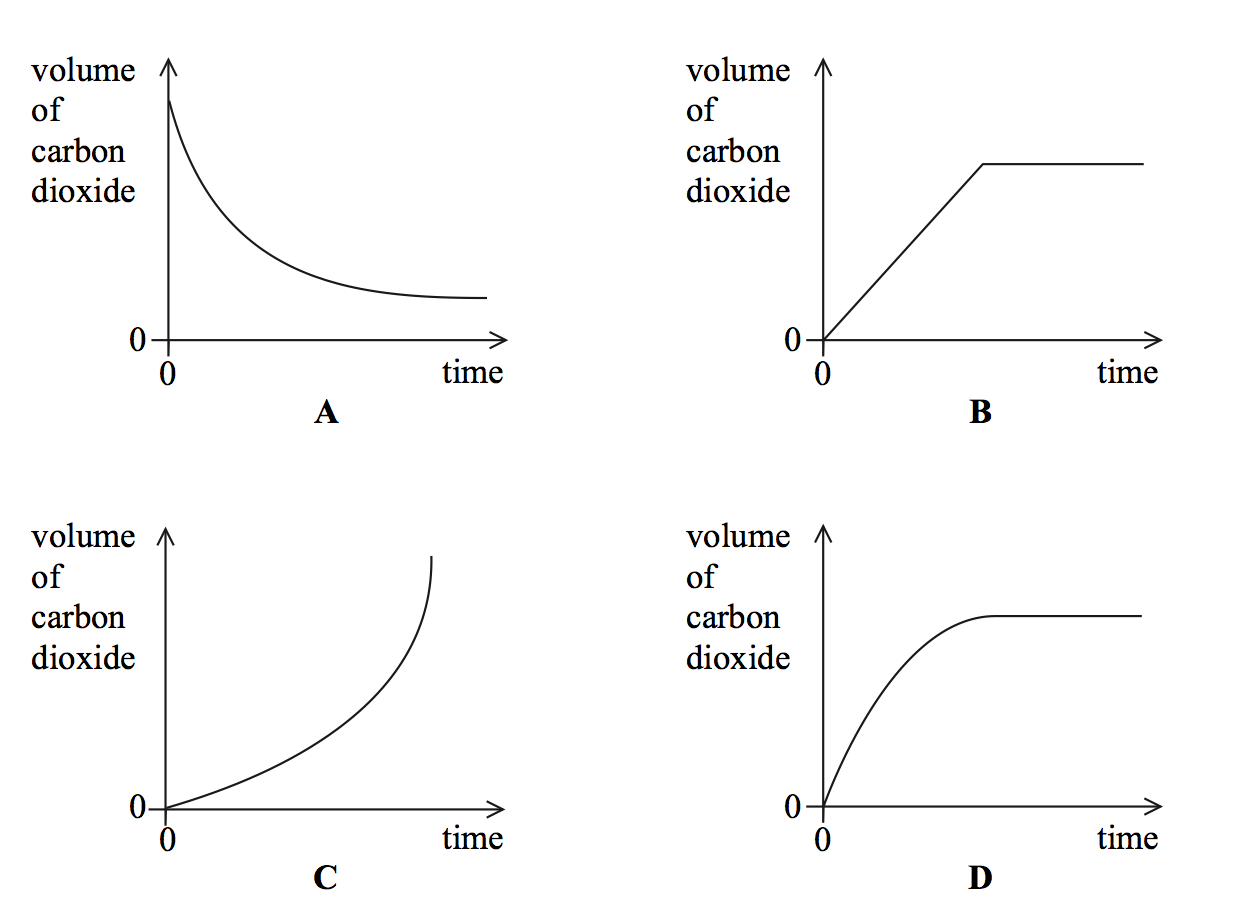
A student investigated the rate of reaction of calcium carbonate with dilute hydrochloric acid. Every minute, the student recorded the total volume of carbon dioxide produced, until some time after the reaction was complete.
Which graph shows the correct results? 
a)
A
b)
B
c)
C
d)
D
64.
Order the letters from highest to lowest rate of reaction.
a)
A > B > C > D
b)
A > BC > D (B and C have the same rate)
c)
A > B > CD (C and D have the same rate)
d)
D > C > B > A
65.
Why does a catalyst increase the rate of reaction?
a)
it produces extra energy for the reactants
b)
it increases the speed of the reactant particles
c)
it increases the frequency of particle collisions
d)
it reduces the activation energy of the reaction 
66.
Why don't all collisions between particles cause a reaction?
a)
the particles also need to collide with a catalyst
b)
not all the particles collide with enough energy
c)
not all the particles collide at a high enough temperature
d)
the particles need to collide with each other twice
67.

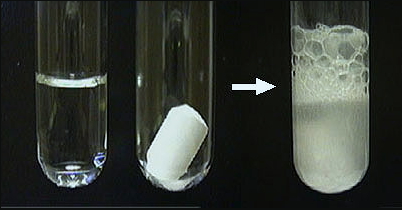
How could we make this reaction happen more quickly?

a)

Decrease the concentration of the acid

b)

crush the chalk to increase the surface area

c)

Put the test tube in an ice bath

68.

The major theory of reaction rate is called

a)

Collision theory

b)

Crash theory

c)

Newton's laws

d)

Thermodynamics

69.
The following graph shows two different reaction pathways for the same overall reaction at the same temperature. Which pathway is slower and why?
a)
Red, because the activation energy is larger
b)
Blue, because the activation energy is lower
c)
both reaction progress at the same rate
70.
What does NOT happen when the temperature is increased?
a)
Particles collide more often
b)
Particles collide with more energy
c)
Particles move faster
d)
More particles collide in the correct orientation
71.
What makes an effective collision?
a)
When molecules collide.
b)
When molecules collide with the proper orientation.
c)
When molecules collide with proper orientation and enough kinetic energy.
d)
High Temperature.
72.
What is the rate of reaction?
a)
How fast a reaction is 
b)
How big a reaction is
c)
How loud a reaction is
d)
How much gas a reaction produces
73.
Which letter corresponds to the activation energy of the forward reaction?
a)
A
b)
B
c)
C
d)
D