wayground logo

Free Printable Worksheets

NEW

Font size

S
M
L
XL
Worksheets

Chemistry and Properties of Life

Total questions: 75

Worksheet time: 1hrs 4mins
Name
Class
Date
1.
Which of the following properties of water enables it to move from the roots to the leaves of plants?
a)
Water expands as it freezes.
b)
Water is an excellent solvent.
c)
Water exhibits cohesive behavior.
d)
Water moderates temperature.
2.
What property of water allows it to be such a versatile solvent that it is often called the "universal solvent?"
a)
Purity
b)
Polarity and cohesion
c)
High heat capacity
d)
Expansion upon freezing
3.
Large bodies of water do not quickly fluctuate in temperature. Why?
a)
Water is a solvent.
b)
Water has a high heat capacity.
c)
Water acts as a buffer.
d)
Water is non-polar.
4.
Water striders can walk across the surface of calm water. Their feet push the surface of the water down slightly, but they do not break the surface. Why?
a)
The insects are light enough so they do not break the hydrogen bonds holding the water molecules together
b)
The insects actually use their wings to hover slightly above the water’s surface and they only skim it with their feet.
c)
The insect’s feet are non-polar, so they are repelled by the polar water molecules and are pushed away from the water’s surface.
d)
The insects are small enough to see the individual water molecules, so they are able to step carefully from one molecule to the next
5.
What two elements make up water?
a)
Helium and oxygen
b)
Hydrogen and oxygen
c)
helium and carbon
d)
oxygen and carbon
6.
What word describes when water is attracted to other substances?
a)
cohesion
b)
adhesion
c)
capillary action
d)
surface tension
7.
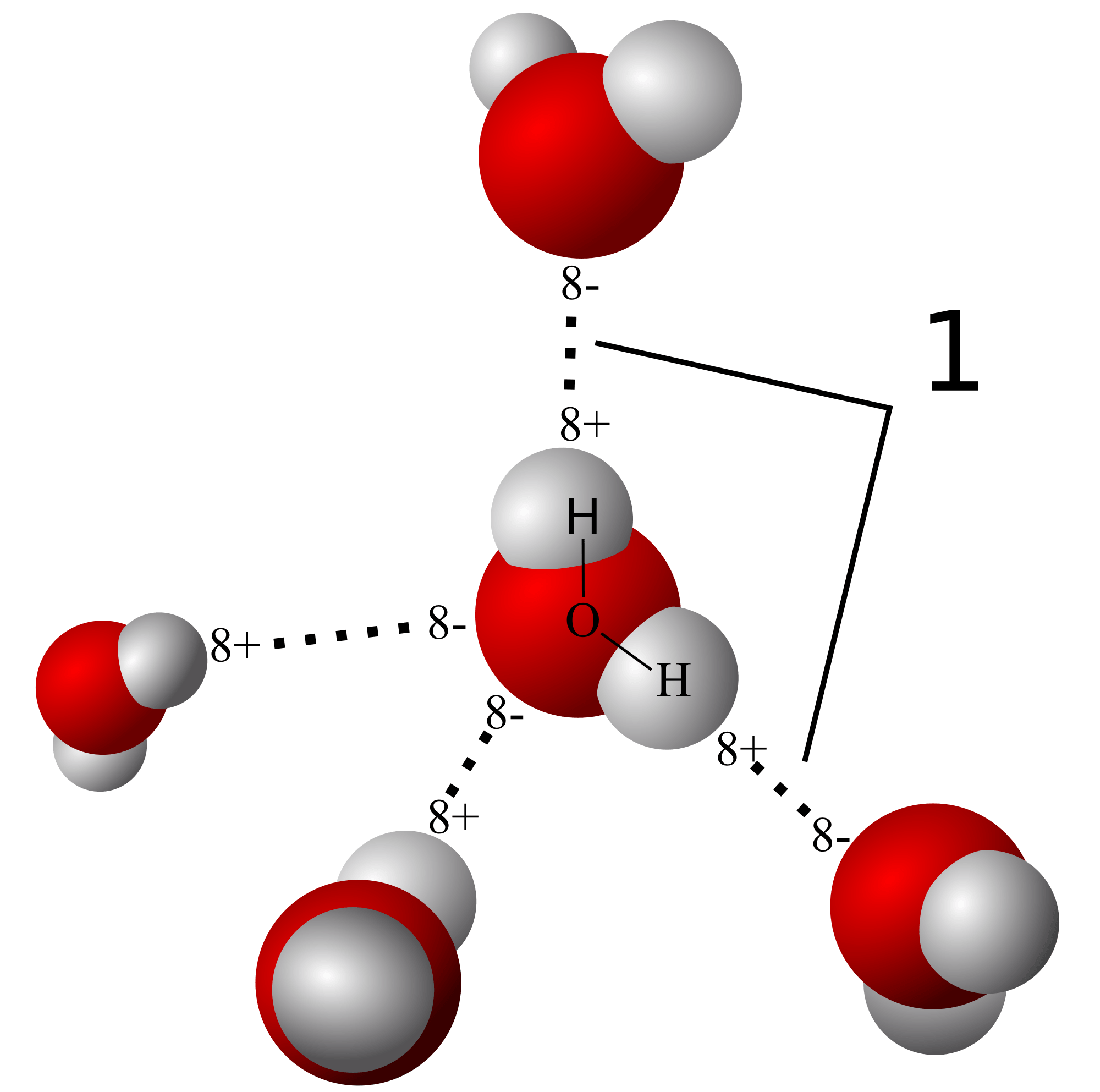
Why can water have no net charge but have slight charges in different parts of the molecule?
a)
The oxygen end is slightly negative and the hydrogen end is slightly positive
b)
The hydrogen end is slightly negative and the oxygen end is slightly positive
c)
The hydrogen and oxygen ends change in polarity
d)
Because it is hydrophobic
8.
Why does water move from the roots to the leaves of plants?
a)
Water is pushed by solutes
b)
Capillary action pulls the water molecules like a chain
c)
Water is pulled by gravity
d)
Water’s cohesion causes it to “pull” towards the leaves
9.
Attractions between water molecules are called
a)
Covalent bonds
b)
Ionic bonds
c)
Polar bonds
d)
Hydrogen bonds
10.
The attraction that causes water and other liquids to form drops on thin films is called ________________. This is also water’s ability to be attraction to other water molecules.
a)
adhesion
b)
capillary action
c)
cohesion
d)
surface tension
11.
Which is NOT a unique property of water?
a)
Frozen water floats on liquid water.
b)
Water covers most of the Earth’s surface and retains a large amount of heat.
c)
Water molecules stick to each other through hydrogen bonds.
d)
Water cools very rapidly.
12.
Why does ice float?
a)
As water freezes, it expands and its density decreases.
b)
As water freezes, it takes up more hydrogen from the atmosphere, causing it to have a greater buoyancy.
c)
As water freezes, air becomes trapped between the hydrogen bonds of water molecules.
d)
As water freezes, it takes up more oxygen from the atmosphere, causing it to have a greater buoyancy.
13.
Water is polar because...
a)
The unequal sharing of electrons gives the water molecule a slight negative charge near its oxygen atom and a slight positive charge near its hydrogen atoms.
b)
The molecule has two poles, at which the it is colder than other regions of the molecule.
c)
The unequal sharing of electrons gives the water molecule a slight negative charge near its hydrogen atoms and a slight positive charge near its oxygen atom.
d)
The water molecule is neutral.
14.
molecule in which opposite ends have opposite electric charges
a)
cohesion
b)
polar molecule
c)
hydrogen bond
d)
solution
15.
Which end of the water molecule has a slightly positive charge?
a)
the oxygen end
b)
the hydrogen end
c)
both ends are slightly positive
d)
neither end is positive
16.
Water molecules are attracted to other kinds of molecules because of the property.
a)
Cohesion
b)
Adhesion
c)
Surface Tension
d)
Universal Solvent
17.
Water is a universal solvent because it...
a)
It can be found anywhere
b)
It freezes when it gets cold
c)
floats when frozen
d)
Dissolves most substances
18.
What is the reason why oil and water don't mix?
a)
Oil is too heavy to mix with water
b)
Water can only mix with polar molecules 
c)
Water can only mix with non-polar molecules
d)
Oil is too light to mix with water 
19.
A general definition of cohesion is the attraction of:
a)
particles of the same substance
b)
particles of a different substance
c)
particles of both the same and different substances
d)
particles of neither the same or different substances
20.
A high specific heat means...
a)
It heats up quickly with energy added
b)
It requires more energy to change temperature
21.
Which of the following is LEAST likely to dissolve in water?
a)
nonpolar fats and oils
b)
polar sugar molecules
c)
salt made of a positive sodium ion and a negative chloride ion
d)
all of the substances will dissolve easily in water
22.
Which statement best describes an effect of the low density of frozen water in a lake?
a)
When water freezes, it contracts, decreasing the water level in a lake.
b)
Water in a lake freezes from the bottom up, killing most aquatic organisms. 
c)
When water in a lake freezes, it floats, providing insulation for organisms below.
d)
 Water removes thermal energy from the land around a lake, causing the lake to freeze.
23.
Which property of water will cause water to bead up on glass?
a)
Adhesion
b)
Cohesion
c)
Ability to dissolve substances
d)
High specific heat
24.
What is a living thing?
a)
Reproduction
b)
Organism
c)
Development
d)
Homeostasis
25.
What is an organism whose entire body is only 1 cell known as?
a)
unicellular
b)
multicellular
c)
cell
d)
Homeostasis
26.
What is the balancing of an organism’s internal environment to keep conditions suitable ?
a)
stimulus
b)
multicellular
c)
cell
d)
Homeostasis
27.
What is an organism whose body is made of more than 1 cell known as?
a)
unicellular
b)
multicellular
c)
cell
d)
Homeostasis
28.
What is a thing or event that causes a specific reaction?
a)
response
b)
stimulus
c)
cell
d)
development
29.
Which is an example of an organism using homeostasis?
a)
A dog panting to lower body temperature
b)
Walking sticks blending in
c)
Growing from a tadpole into a frog
d)
Shivering to lower body temperature
30.
An example of a multicellular organism is a...
a)
amoeba
b)
bacteria
c)
crab
31.
In the word BIOLOGY, the prefix BIO means
a)
the study of...
b)
life, living
c)
organism
d)
biology
32.
What is known as the production of offspring?
a)
Reproduction
b)
Growth
c)
Development
d)
Homeostasis
33.
This picture is a good example of
a)
Growth
b)
Development
34.
This picture is a good example of
a)
Growth
b)
Development
35.
When you step out into the cold, your body shivers in order to keep its temperature at 98.6F.
a)
All living things use energy
b)
All living things contain cells
c)
All living things maintain homeostasis
d)
All living things grow
36.
The roots of a plant grow towards a source of ground water.
a)
All living things use energy
b)
All living things reproduce
c)
All living things respond to their environment
d)
All living things grow
37.

Smallest living unit of a living organism

a)

Cells

b)

Reproduce

c)

Genetic code

d)

Homeostasis

38.
All living things are composed of cells. 
a)
True
b)
False
39.
Living things need energy to survive?
a)
True
b)
False
40.
Rocks are not living because
a)
they never move
b)
they aren't needed for humans
c)
they are not made of cells
d)
they don't break down
41.
Living things require energy to survive.
a)
True
b)
False
42.

A chemical bond where electrons are shared between two atoms. In this type of bond no ions are. You will find these bonds when carbon bonds to other elements.

a)

Covalent bond

b)

Element

c)

Hydrogen bond

43.

A combination of two or more atoms

a)

Period

b)

Molecule

c)

Atom

d)

Family

44.

A chemical bond between two atoms where one or more electrons are passed from one atom to another. When they give up electrons, each of the atoms should have a filled shell. An example is the sodium chloride bond.

a)

Ionic bond

b)

Hydrogen bond

c)

Element

d)

Covalent bond

45.

What is one way Neutrons are different from electrons?

a)

they both are negative

b)

neutrons have no charge, while electrons have a negative charge

c)

Both are in the nucleus( center of atom)

d)

Electrons are inside nucleus and neutrons are outside the nucleus.

46.

How are electrons similar to neutrons?

a)

Both have negative charge

b)

Both are part of a molecule

c)

Both make up parts of an atom

d)

Both are in nucleus

47.

What is the atomic number?

a)

35

b)

18

c)

17

d)

52

48.

How many protons and electrons does this element have?

a)

35

b)

18

c)

17

d)

52

49.

How many neutrons does Chlorine have?

a)

18

b)

17

c)

35

d)

52

50.

What is the atomic mass of Neon?

a)

10

b)

20

c)

30

51.
What is the name for an ion with a positive charge?
a)
cation
b)
anion
c)
onion
d)
union
52.
What is the name for an ion with a negative charge?
a)
cation
b)
anion
c)
onion
d)
union
53.
What are valence electrons?
a)
sum of the protons and neutrons
b)
protons minus electrons
c)
electrons in the inner shells
d)
electrons in the outer shell
54.
If an atom loses two electrons what charge will it have?
a)
-2
b)
-1
c)
+1
d)
+2
55.
If an atom gains two electrons what charge will it have?
a)
-2
b)
-1
c)
+1
d)
+2
56.
If an atom has 7 protons and 7 electrons what charge will it have?
a)
-2
b)
-1
c)
0
d)
+2
57.

Oxygen has eight total electrons. How many valence electrons does oxygen have?

a)

2

b)

4

c)

5

d)

6

58.
What do we call a covalent bond where electrons are shared UNEVENLY or UNEQUALLY?
a)
Ionic
b)
Polar Covalent
c)
Nonpolar Covalent
d)
Van der Waals Force
59.

Subatomic particles with a negative charge

a)

Electrons

b)

Neutrons

c)

Protons

d)

Quarks

60.
subatomic particles found on the outermost shell & responsible for the atom's reactivity
a)
neutrons
b)
valence electrons
c)
isotopes
d)
ions
61.
Subatomic particles with a positive charge
a)
neutrons
b)
atomic mass
c)
protons
d)
isotopes
62.
A charged atom
a)
Ion
b)
Isotope
c)
Electron Cloud
d)
Quark
63.
A tiny but very dense, positively charged portion of the atom that holds most of the atomic mass
a)
Electron Shells
b)
Orbitals
c)
Electron Cloud
d)
Nucleus
64.
Arrangement of elements organized by atomic number
a)
Electron Cloud 
b)
Periodic Table 
c)
Electron Configuration
d)
None of these
65.
Calculation used to find the number of neutrons in an atom
a)
Atomic Mass - Atomic Number
b)
Atomic Number - Atomic Mass
c)
Atomic Mass - Electrons
d)
none of these
66.
What two types of atoms make a covalent bond?
a)
2 Nonmetals
b)
1 Nonmetal and 1 Metal
c)
2 Metals
d)
2 Noble Gases
67.
Diatomic elements are defined as IDENTICAL elements that bond with each other (i.e. Oxygen with Oxygen).  What type of bond should they form?
a)
Ionic
b)
Polar Covalent
c)
Nonpolar Covalent
d)
Van der Waals force
68.
The two types of feedback systems that help organisms maintain homeostasis are:
a)
positive and negative 
b)
receptor and effector
c)
static and dynamic
d)
minor and major
69.
Maintaining body temperature is an example of a:
a)
negative feedback loop
b)
positive feedback loop
70.

When glucose levels in the blood rise, your brain sends a signal to your pancreas. The pancreas releases insulin, which opens channels in cell membranes to allow glucose to enter the cell, lowering blood sugar levels. This is an example of a:

a)

Positive Feedback Loop

b)

Negative Feedback Loop

71.

An example of a positive feedback loop is ____________.

a)

Childbirth

b)

Blood Pressure regulation

c)

Body Temperature regulation

d)

All of the above

72.
If the environment gets cold, we will often shiver in order to:
a)
keep body temperature the same as the external temperature
b)
decrease body temperature
c)
increase body temperature
d)
regulate blood pressure
73.

When you get cut, your skin cells release hormones that signal platelets to come and stop the bleeding. Platelets then release more hormones that signal even more platelets to help stop bleeding. The hormone signals continue until the cut is closed. This is an example of what type of feedback?

a)

Positive Feedback Response

b)

Negative Feedback Loop

74.
Rapid growth during puberty causes your body to release more and more growth hormones. As you grow, more and more growth hormones are released until puberty is reached, and then the hormones stop.
a)
Positive Feedback Response
b)
Negative Feedback Loop 
75.

If the calcium in your blood decreases below homeostasis levels, a gland in the brain will sense the decrease and send a chemical message to your bones. Your bones will release calcium into the blood, bringing blood calcium levels back up. This is an example of what type of feedback?

a)

Positive Feedback Response

b)

Negative Feedback Loop