wayground logo

Free Printable Worksheets

Font size

S
M
L
XL
Worksheets

Neurons, signaling, and muscle contraction

Total questions: 64

Worksheet time: 32mins

Name
Class
Date
1.

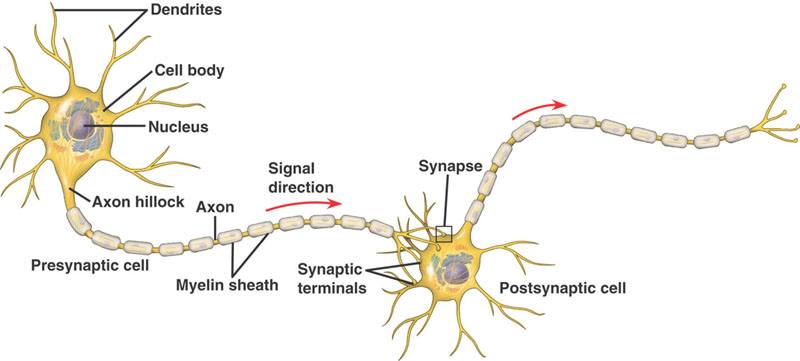
What part of the neuron receives incoming messages from other cells?

a)

nucleus

b)

cell body

c)

dendrites

d)

synaptic terminals

2.

What structure(s) aid in speeding up synaptic transmission across the axon?

a)

Nodes of Ranvier

b)

dendrites

c)

myelin sheath

d)

both Nodes of Ranvier and the myelin sheath

3.

The central nervous system

a)

consists of the brain and spinal cord

b)

consists of the nerves that communicate motor and sensory signals throughout the rest of the body

4.

Structure D represents

a)

a sensory neuron

b)

a motor neuron

c)

an internueron

d)

a sensory receptor

5.

Structure B represents

a)

a sensory receptor

b)

an interneuron

c)

a motor neuron

d)

a sensory neuron

6.

During which stage of this action potential do sodium ions (Na+) flow through the sodium channels from the outside of the membrane to the inside of the membrane?

a)

threshold

b)

depolarization

c)

repolarization

d)

refractory period

7.

During which stage of the action potential does the membrane return to its resting state?

a)

undershoot

b)

depolarization

c)

rising phase of the action potential

d)

falling phase of the action potential

8.

An action potential

a)

is another name for a nerve impulse

b)

is an all or none response to the depolarization of the membrane of the nerve cell

c)

cannot occur unless the nerve cell is at its resting potential

d)

all of these answers are correct

9.

What is released by the presynaptic membrane into the synaptic cleft?

a)

neurotransmitters

b)

excitatory neurotransmitters

c)

inhibitory neurotransmitters

d)

all of these are released by the presynaptic membrane

10.

The sodium-potassium pump

a)

uses diffusion to attain -70mV

b)

uses ATP to create a membrane differential along the axon

c)

is stimulated by neurotransmitters

d)

is an example of passive transport across a membrane
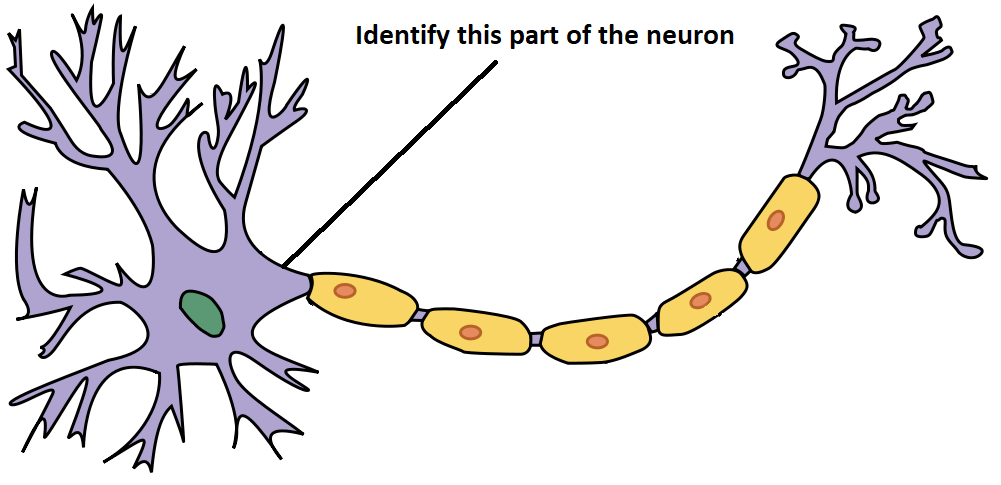
11.
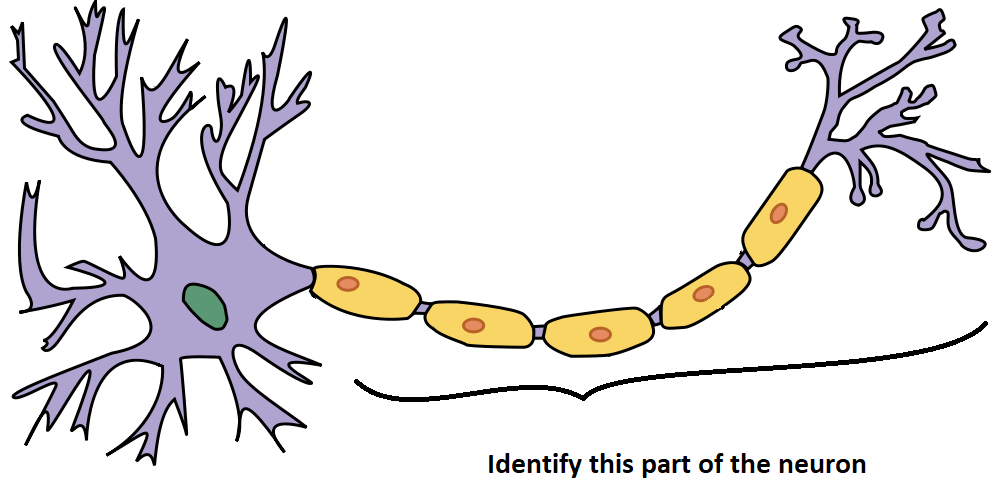
a)

Nucleus

b)

Cell Body

c)

Axon

d)

Node of Ranvier

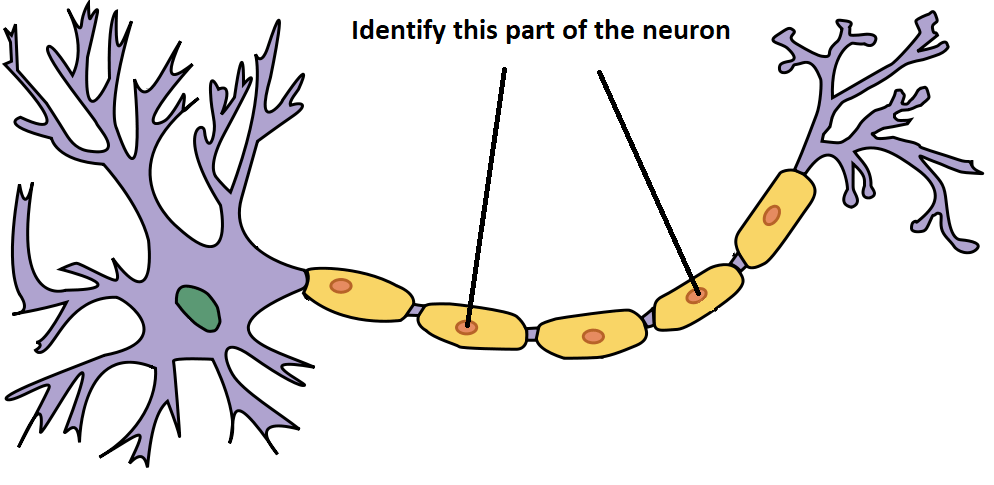
12.
a)

Nucleus

b)

Cell Body

c)

Axon

d)

Node of Ranvier

13.
a)

Dendrites

b)

Axon Terminals

c)

Myelin Sheath

d)

Schwann Cells

14.
When a neuron is depolarized, what are the first channels to open?
a)
Sodium
b)
Potassium
c)
Calcium
d)
ACTH
15.
a signal molecule that transmits nerve impulses across synapses
a)
neuron
b)
neurotransmitter
c)
nerve
d)
action potential
16.
When a neuron is resting, the inside of the axon has a ____________ charge.
a)
positive
b)
negative
17.
Which ions are involved in the electrical nerve impulse?
a)
Iodine and Sodium
b)
Potassium and Sodium
c)
Iron and Sodium
d)
Calcium and Iodine
18.

When a neuron is at REST,

a)

the inside of the neuron is negatively charged compared to the outside.

b)

the inside of the neuron is positively charged compared to the outside.

c)

there is no charge difference established

d)

none of these is true

19.

Depolarization occurs when

a)

sodium channels open

b)

potassium channels open

c)

sodium channels close

d)

potassium channels close

20.
Neurotransmitters are released from the
a)
Dendrites
b)
Post-synaptic neuron
c)
Presynaptic neuron
d)
Axon
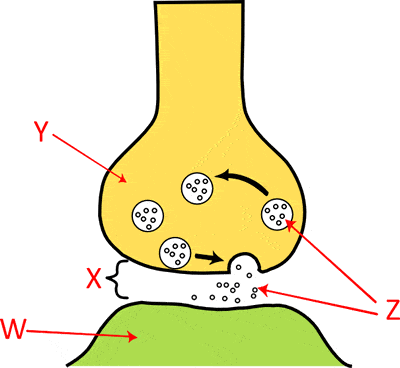
21.
Z
a)
Dendrite
b)
Axon Terminal
c)
Neurotransmitters
d)
Synapse
22.
W
a)
Axon Terminal Button
b)
Neurotransmitters
c)
Dendrite
d)
Synapse
23.
X
a)
Axon Terminal Button
b)
Neurotransmitters
c)
Dendrite
d)
Synapse
24.

calcium is responsible for

a)

signaling the release of the neurotransmitter

b)

signaling Na to be released into the membrane

c)

signaling the release of K out of the membrane

d)

serving as the neurotransmitter

25.

all are factors in the speed of action potential EXCEPT

a)

diameter of the axon

b)

the state of the myelin sheath on the axon

c)

temperature

d)

length of the axon

26.

when does the stimuli cause an action potential?

a)

when it reaches threshold

b)

just below the threshold

c)

just above threshold

27.
How many nerve cells does the brain contain?
a)
100 million
b)
86 billion
c)
86 million 
d)
100 billion
28.
Which is the correct sequence in the transmission of a neural impulse?
a)
axon, dendrite, cell body, synapse
b)
dendrite, axon, cell body, synapse
c)
synapse, axon, dendrite, cell body
d)
dendrite, cell body, axon, synapse
29.
An axon conducts nerve impulses _________ the cell body.
a)
away from
b)
toward
c)
both toward and away
d)
around, bypassing
30.
The brain's supporting cells are called: 
a)
glial cells
b)
mitochondria
c)
neurons
d)
nuclei
31.
Neurons that travel toward the central nervous system are called
a)
afferent neurons
b)
efferent neurons
c)
exit neurons
d)
CNS neurons
32.
The gap that a message has to cross to get from one neuron to the other is called the _____
a)
synapse
b)
dendrite
c)
axon
d)
synaptic cleft
33.

By what process do vesicles containing neurotransmitter leave the axon terminal?

a)

Exocytosis

b)

Endocytosis

c)

Diffusion

d)

Through gated channels

34.
Neurons send signals in the brain and body via...
a)
neurotransmitters only
b)
electrical impulses only
c)
wifi
d)
neurotransmitters AND electrical signals
35.

These are chemical substances that breaks down a neurotransmitter so that the post synaptic neuron can depolarize in order to fire again

a)

Enzyme

b)

Protein

c)

Astrocyte

d)

Myelin

36.

The average synaptic delay is how long?

a)

1-2 seconds

b)

1-2 microseconds

c)

1-2 milliseconds

37.
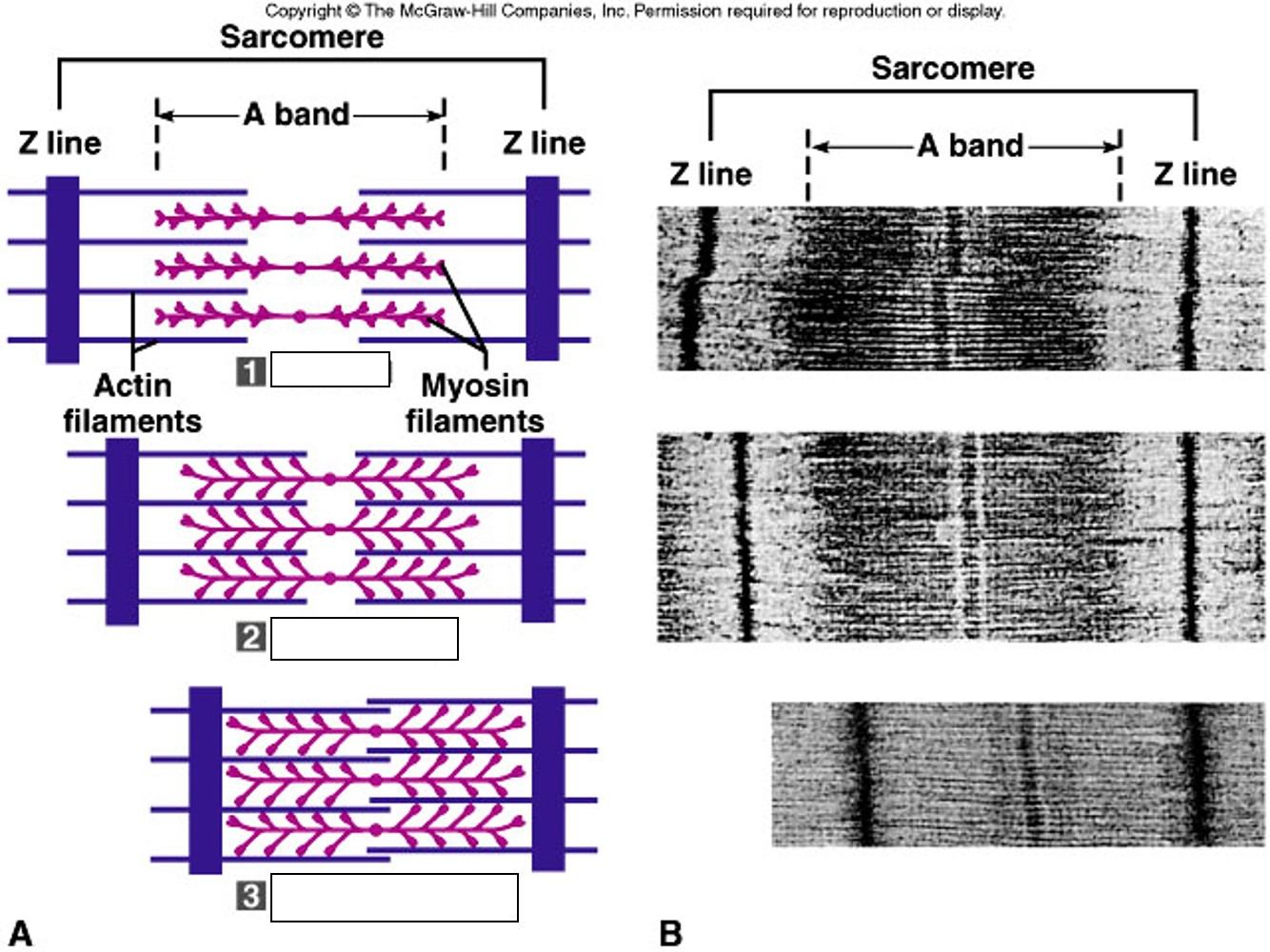
During muscle contraction the 'Z' Lines will...
a)
Disappear
b)
Get Farther apart
c)
Get Closer Together
d)
Appear Thicker
38.
During full muscle contraction the H Zone will...
a)
Disappear
b)
Get wider
39.
During full muscle contraction the A Band will...
a)
Disappear
b)
Get wider
c)
Stay the same
d)
Get narrower
40.
Which of the following occurs first in muscle contraction?
a)
Myosin globular head 'uncoils' releasing stored energy.
b)
Cross Bridges are formed between actin and myosin
c)
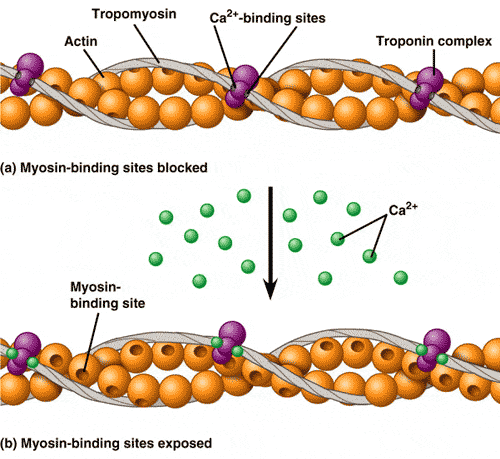
Tropomyosin changes shape (conformation) to expose myosin binding sites.
d)
Calcium Binds with Troponin
41.
Which of the following occurs first in muscle contraction?
a)
Myosin /Actin Cross bridge shifts to move actin.
b)
Phosphate is released form the myosin globular head
c)
Calcium Enters the Sarcoplasm (Cytoplasm) of the muscle cell.
d)
ADP is released form the myosin globular head.
42.
What opens the ligand gated sodium/potassium channel?
a)
Calcium Ion Binding to the channel protein.
b)
Acetylcholine binding to the channel protein.
c)
Electrical Signal opening the channel protein.
d)
Acetylcholinesterase binding to the channel protein.
43.
In order for tropomyosin to change conformation, calcium has to bind with...
a)
Voltage Gated Ion Channel
b)
Ligand Gated Ion Channel
c)
Troponin Protein
d)
Actin Protein
44.
Which TWO IONS are pumped in/out of the sarcolemma as part of muscle contraction?
a)
Sodium / Calcium
b)
Calcium / Potassium
c)
Sodium / Potassium
45.
Which ion, when present, changes the conformation of tropomyosin?
a)
Calcium
b)
Sodium
c)
Potassium
d)
Lithium
46.
Which is more true to cause muscle contraction?
a)
Actin Pulls on the myosin
b)
Myosin Pulls on the Titin
c)
Myosin Pulls on Actin
d)
Actin Pulls on Titin
47.
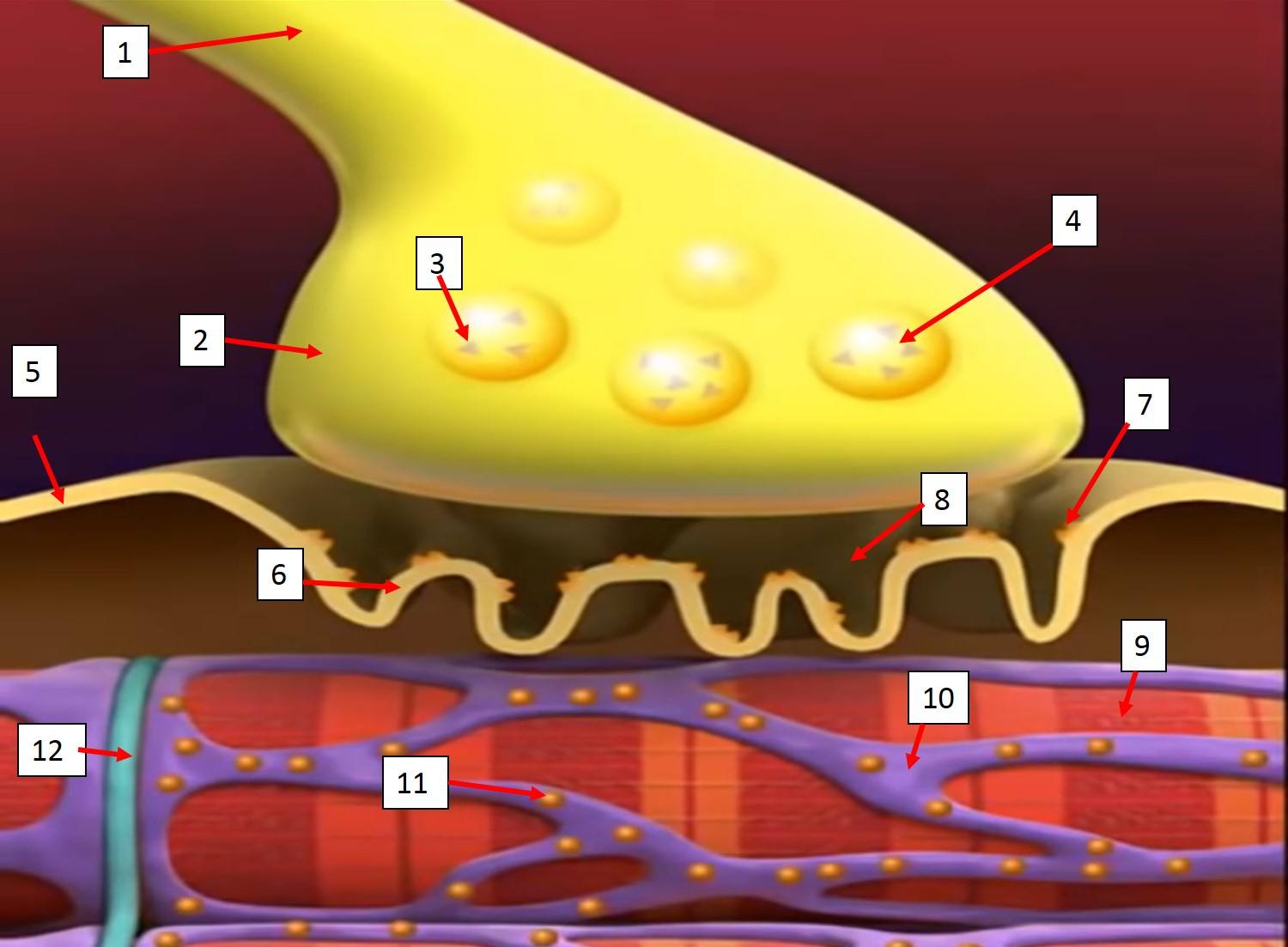
The organelle containing actin and myosin identified as #9
a)
ACh
b)
Sarcolemma
c)
Vesicle
d)
Myofibril
48.
Another name for a muscle cell.
a)
Fiber
b)
Sacrolemma
c)
Sacromere
d)
Fascicle
49.
Contractile unit of a muscle.
a)
sarcomere
b)
motor unit
c)
fascicle
d)
myofibril
50.
Thin filaments in a myofibril are
a)
Sarcomeres
b)
Sarcoplasm
c)
Actin
d)
Myosin
51.
Thick filaments are in a myofibril are
a)
ATPase
b)
Sarcoplasmic reticulum
c)
Actin
d)
Myosin
52.
The plasma membrane of a skeletal muscle cell is called the:
a)
sarcomere
b)
myofilament
c)
sarcolemma
d)
sarcoplasm
53.
The functional unit of the muscle cell is the: 
a)
Sarcomere
b)
Osteon
c)
Myofilament
d)
Muscle fiber
54.
What two chemicals are necessary for muscle contraction to occur?
a)
Niacin and Potassium
b)
Calcium and ATP
c)
Sodium and Potassium
d)
Ach and Potassium
55.
Calcium:
a)
causes ATP binding to actin
b)
increases the action potential along the sarcolemma
c)
binds to proteins on myosin
d)
triggers the binding of myosin to actin
56.
What is a crossbridge?
a)
Where myosin binds to actin
b)
Where the calcium crosses into the cytoplasm
c)
Where calcium binds with troponin
d)
None of the answers are correct.
57.
The part of the sarcomere that A (green) refers to is the?
a)
Z Line
b)
M Line
c)
H Line
d)
A Line
58.
The part of the sarcomere that B (Orange) refers to is the?
a)
Z Line
b)
M Line
c)
H Line
d)
A Line
59.
The part of the sarcomere that C (Blue) refers to is the?
a)
Actin
b)
Myosin
c)
Troponin
d)
Tropomyosin
60.
The part of the sarcomere that D (Red) refers to is the?
a)
Actin
b)
Myosin
c)
Troponin
d)
Tropomyosin
61.
What state is the sarcomere in #3
a)
Relaxed
b)
Contracting
c)
Fully Contracted
d)
None of the above
62.

Why are squid neurons thicker than human neurons?

4 lines
63.

Striated (skeletal) muscle is made of many multinucleate cells called muscle fibres, which contain many (a)  

64.

How prepared were you for this section?

a)

Very

b)

Somewhat

c)

A little

d)

Not at all