wayground logo

Free Printable Worksheets

Font size

S
M
L
XL
Worksheets

APES Unit A: Earth Systems & Resources

Total questions: 93

Worksheet time: 4hrs 49mins

Name
Class
Date
1.

This image shows which of the following?

a)

Earthquake

b)

Mountain formation

c)

Subduction zone

d)

Riff Valley formation

2.

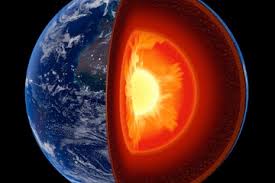
As you travel from the crust to the inner core, how would temperature and density of the material change?

a)

The would all increase

b)

The would all decrease.

c)

They would stay the same.

d)

Temperature would decrease, but pressure and density would increase.

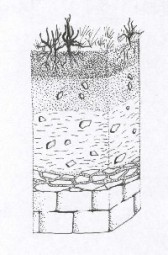
3.

Which of Earth's layers is broken into several large tectonic plates?

a)

Asthenosphere

b)

Lithosphere

c)

Inner core

d)

Outer core

4.

Which of these layers is found directly above the Earth's core?

a)

crust

b)

mantle

c)

inner core

d)

outer core

5.

How are Sedimentary rocks formed?

a)

Through the process of heat and pressure.

b)

Through the process of compaction and cementation.

c)

Through the process of weathering, erosion and deposition.

d)

Through the process of melting

6.

Identify the three different types of rock:

a)

Metamorphic

b)

Igneous

c)

Sedimentary

d)

Lithosphere

7.

Which of these statements is correct?

a)

Continental crust is thicker than oceanic crust

b)

Continental crust is thinner than oceanic crust

c)

Continental crust is smaller than oceanic crust

d)

Continental crust is more dense than oceanic crust

8.

A subduction zone is

a)

a denser tectonic plate sinks below another

b)

at every type of convergent plate boundary

c)

at every type of divergent plate boundary

d)

at transform boundaries

9.
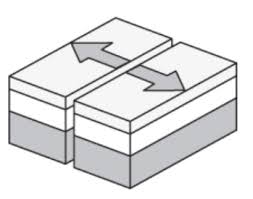
Name the boundary
a)
convergent boundary
b)
divergent boundary
c)
transform boundary
d)
sergent boundary
10.
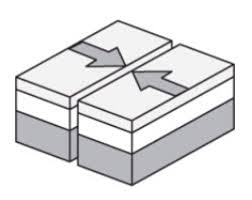
Name the boundary
a)
convergent boundary
b)
divergent boundary
c)
transform boundary
d)
sergent boundary
11.
Name the boundary
a)
convergent boundary
b)
divergent boundary
c)
transform boundary
d)
sergent boundary
12.
The area around the pacific plate where boundaries form is called...
a)
death ring
b)
fire zone
c)
ring of fire
d)
zone of fire
13.
Associated with transform boundaries.
a)
Volcanoes
b)
mountains
c)
trenches
d)
earthquakes
14.
Where you will find the ozone layer.
a)
stratosphere
b)
thermosphere
c)
exosphere
d)
mesosphere
15.
Where weather occurs.
a)
stratosphere
b)
thermosphere
c)
troposphere
d)
mesosphere
16.
Where satellites orbit.
a)
troposphere
b)
thermosphere
c)
exosphere
d)
mesosphere
17.
The most common gas in the atmosphere (78%).
a)
Nitrogen
b)
Oxygen
c)
Carbon Dioxide
d)
Trace gases
18.
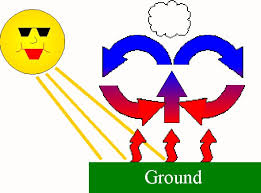
Warm air rises and the cool air sinks demonstrates this type of heat transfer. 
a)
conduction
b)
convection
c)
radiation
d)
Insolation 
19.
What is the Coriolis Effect and how does it effect global winds?
a)
Curving of winds due to rotation of earth curves wind counterclockwise in Northern Hemisphere and clockwise in the Southern Hemisphere
b)
Movement of ocean currents caused by earth rotation' counterclockwise in Northern Hemisphere and clockwise in Southern Hemisphere
c)
curve of global winds caused by global rotation clockwise in Northern Hemisphere and counterclockwise in Southern Hemisphere
20.
Which is NOT a freshwater ecosystem?
a)
stream
b)
lake
c)
ocean
d)
river
21.
Earth revolves around the sun
a)
Precession
b)
Rotation
c)
Revolution
22.
Spinning on an axis
a)
Rotation
b)
Nutation
c)
Solstice
23.
The time and date of the year when day and night are equal length. 
a)
Fusion
b)
Solstice
c)
Equinox
24.
The thin layer of the Earth upon which tectonic plates move around is called the
a)
mantle
b)
asthenosphere
c)
lithosphere
d)
outer layer
25.
What is a fault?
a)
the point inside Earth at which an earthquake occurs
b)
the point on Earth's surface directly above the earthquake focus
c)
a fracture in Earth along which movement has occurred
d)
a fracture in Earth along which NO movement has occurred
26.
Earth’s outermost sphere is called the
a)
atmosphere
b)
biosphere
c)
geosphere
d)
hydrosphere
27.
Which sphere contains volcanoes?
a)
biosphere
b)
geosphere
c)
hydrosphere
d)
atmosphere
28.
Which sphere contains rivers?
a)
biosphere
b)
geosphere
c)
hydrosphere
d)
atmosphere
29.
A __________ is a mountain built from melted rock which rises from the Earth's interior to the surface, and can occur on land or in the sea
a)
volcanoes
b)
earthquakes
c)
channel
d)
eruptions
30.
The majority of the world’s active volcanoes on land are located along tectonic plate boundaries that surround the ______________________________________.
a)
Atlantic Ocean
b)
Indian Ocean
c)
Pacific Ocean
d)
Southern Ocean
31.
The measure of the energy released by an earthquake is called ___________________________________.
a)
magnitude
b)
dominant
c)
fault
d)
energy capacity
32.
____________________________________________ are blocks of lithosphere that consist of the crust and the rigid, outermost part of the mantle and glide across the underlying asthenosphere
a)
crust
b)
mantle
c)
tectonic plates
d)
faults
33.
Which of the following is NOT one of the three types of soil?
a)
clay
b)
sand
c)
silt
d)
mud
34.
Layers of soil are also known as:
a)
Soil Profiles
b)
Soil Horizons
c)
Soil sheets
d)
Soil cores
35.
What is the layer of soil that contains humus, leaf litter, and other organic matter?
a)
O - Organic
b)
A - Topsoil
c)
B - Subsoil
d)
R - Bedrock
36.
Which layer is the bottom of the soil profile?
a)
C - Partially Weathered Parent Material
b)
D - Separated rock
c)
R - Bedrock
d)
A - Topsoil
37.
Which layer of soil contains bedrock that has been cracked slightly?
a)
A - Topsoil
b)
B - Subsoil
c)
C- Partially Weathered Parent Material
d)
R - Bedrock
38.
If the Earth did not rotate on its axis, there would be no
a)
Greenhouse effect
b)
Coriolis effect
c)
Global warming
d)
Convection
39.
Due to the Coriolis Effect, water in the Southern Hemisphere moves
a)
clockwise
b)
counter-clockwise
c)
both
d)
neither
40.
A strong surface current that runs along the east coast of the United States and carries warm water to Europe.
a)
California Current
b)
Global Conveyor Belt
c)
Gulf Stream
d)
Surface Current
41.
What is the function of the ozone layer?
a)
to allow UV rays to get to Earth
b)
to block UV rays from getting to Earth
c)
To keep oxygen in
d)
to allow meteors to get to Earth
42.
Which layer has the highest pressure?
a)
thermosphere
b)
stratosphere
c)
troposphere
d)
ionosphere
43.
The atmospheric circulation cell nearest the equator, air rises near the equator and falls at about 30 degrees N & S are
a)
Polar Cells
b)
Ferrel Cells
c)
Hadley cells
44.
Atmospheric circulation cell between 30 and 60 degrees N and S, air rises at 60 degrees and falls at 30 degrees
a)
Polar Cells
b)
Ferrel Cells
c)
Hadley cells
45.
The surface winds within the Hadley Cells that blow from the east.
a)
Trade Winds
b)
Westerlies
c)
Polar Easterlies
d)
Jet Stream
46.
The surface winds within the Ferrel Cells that blow from the west.
a)
Trade Winds
b)
Westerlies
c)
Polar Easterlies
d)
Jet Stream
47.
What is not a characteristic of an El Nino?
a)
There is a flatter thermocline across the Pacific
b)
There is more rain on the West coasts of North and South america
c)
There are weaker Trade Winds
d)
Ther is better fishing off the coast of Peru because of increased upwelling
48.
How of Earth's water is fresh water?
a)
99%
b)
75%
c)
3%
d)
1%
49.
Where is most of the Earth's freshwater located?
a)
underground
b)
in lakes and rivers
c)
in the ocean
d)
frozen in glaciers
50.
Soil sample that is 60% clay, 30% silt, and 10% sand has which texture? 
a)
clay
b)
clay loam
c)
sandy loam
d)
silt 
51.
Which of the following is the correct order of soil particles in order of increasing particle size?
a)
clay-sand-silt
b)
sand-clay-silt
c)
silt-clay-sand
d)
clay-silt-sand
52.
The Hawaiian Islands were formed
a)
at a divergent plate boundary
b)
at a hot spot
c)
at a convergent plate boundary
d)
at a transform fault
53.
Rock that forms when minerals form from solutions or sediment from older rocks get pressed and cemented together.
a)
Sedimentary Rock
b)
Metamorphic Rock
c)
Igneous Rock
54.
This rock was formed by lots of fossils that settled on top of each other over time. What type of rock is this?
a)
Sedimentary
b)
Igneous
c)
Metamorphic
55.
This rock cooled on the outside of a volcano and contained air bubbles when it was forming. What type of rock is this?
a)
Sedimentary
b)
Igneous
c)
Metamorphic
56.
This rock started as molten magma. What type of rock is this?
a)
Sedimentary
b)
Igneous
c)
Metamorphic
57.
After lots of time, pressure, and heat, you get this kind of rock. What type of rock is this?
a)
Sedimentary
b)
Igneous
c)
Metamorphic
58.
During sea floor spreading, molten material rises up from the mantle...
a)
along the continents
b)
at the mid ocean ridges
c)
deep ocean trenches
d)
at north and south poles
59.
A subduction zone is formed...
a)
when one tectonic plate sinks below another
b)
at every type of convergent plate boundary
c)
at every type of divergent plate boundary
d)
at transform boundaries
60.
Plate movement is caused by ______________.
a)
the rotation of the Earth
b)
ocean tides
c)
convection currents in the mantle
d)
the moon's gravity
61.
Which list is in the correct order of atmospheric layers starting from Earth's surface?
a)
troposphere, stratosphere, mesosphere, thermosphere, exosphere
b)
Thermosphere, stratosphere, troposphere, mesosphere, exosphere
c)
Exosphere, troposphere, mesosphere, stratosphere, thermosphere
d)
mesosphere, stratosphere, thermosphere, exosphere, troposphere
62.
Which of the following contributes to the unequal warming of earth?
I. variation in the angle of sunlight that reaches Earth
II. variation in the amount of surface area over which the Sun's rays are distributed
III. variation in the amount of sunlight reflected from clouds
a)
I only
b)
I and II only
c)
II and III only
d)
III only
63.
Which of the following has the highest albedo?
a)
soil
b)
snow
c)
water
d)
pavement
64.
Temperature changes in adiabatic heating occurs due to 
a)
water vapor condensing
b)
a pressure increase
c)
absorption of sunlight
d)
a pressure decrease
65.
The maximum amount of water vapor air can hold at a given temperature is called the
a)
saturation point
b)
latent heat capacity
c)
absolute humidity
d)
dew point
66.
The Coriolis effect is responsible for
a)
the convergence of two ascending Hadley cells
b)
the location of atmospheric currents caused by the unequal heating of Earth
c)
the cooling effect of air as it rises and expands
d)
the deflection of atmospheric currents
67.
Which of the following does NOT play a role in causing a rain shadow?
a)
cold polar air
b)
prevailing trade winds
c)
mountain ranges
d)
adiabatic cooling
68.
High productivity and nutrient availability in the ocean occurs in the areas with
a)
gyres
b)
upwelling
c)
warm waters
d)
prevailing wersterlies
69.
Gyres do all of the following EXCEPT
a)
redistribute heat in the ocean
b)
result from the Coriolis effect
c)
rotate clockwise in the Northern Hemisphere
d)
redistribute nutrients from the deep ocean
70.
Migratory behavior of salmon in the Pacific northwest was assisted by
a)
fish ladders
b)
warmer temperatures
c)
greater cutting of trees along the banks to promote warmer temperatures
d)
all of the above
71.
Freshwater accounts for ___ percent of total water in the water.
a)
1
b)
3
c)
10
d)
20
72.
In an aquifer,
a)
groundwater is found in spaces between sediments and rock layers
b)
underground water is always confined
c)
underground water is always unconfined
d)
water recharge is rapid
73.
The following are characteristics of confined aquifers:
I. They are polluted more easily than unconfined aquifers
II. They are recharged directly overhead from waters falling at the surface
III. They are surrounded by layers of impermeable rock
They may contain water that is 10-20,000 years old
a)
I and II only
b)
III only
c)
III and IV only
d)
I, II, III, and IV
74.
The water table is
a)
anywhere water is visible on the surface
b)
where streams and lakes intersect
c)
the uppermost level at which water fully saturates rock or soil
d)
synonymous with groundwater
75.
Unconfined aquifers
a)
are polluted more easily than confined aquifers
b)
are recharged directly overhead from waters falling at the surface
c)
may contain water that is 10-20,000 years old
d)
both the 1st and 2nd choices
76.
A cone of depression may develop
a)
where artesian wells are common
b)
if groundwater is deep
c)
where groundwater is abundant
d)
in areas adjacent to a deep well from which a great deal of water is rapidly pumped
77.
Saltwater intrusion into freshwater aquifers may be a problem in
a)
coastal areas
b)
mountainous areas
c)
the midwestern United States
d)
forested areas
78.
The world's three largest rivers are the 
a)
Yangtze, Congo, and Indus
b)
Yangtze, Amazon and Tigris
c)
Amazon, Yangtze, and Congo
d)
Amazon, Nile, and Hudson
79.
Oligotrophic lakes
a)
are synonymous with eutrophic lakes
b)
contain many fish because they are free of pollutants
c)
are polluted by nitrogen and phosphorous
d)
have low productivity due to low amounts of nutrients
80.
According the the figure, the lake with the largest water volume is
a)
Lake Victoria
b)
Lake Superior
c)
Lake Tanganyika
d)
Lake Baikal
81.
Levees do which of the following?
I. prevent flooding
II. cause flooding downstream
III. prevent deposition of sediment on floodplains
a)
I only
b)
III only
c)
II and III
d)
I, II and III
82.
Dams are used for which of the following?
I. Create reservoirs for drinking water
II Power turbines that generate electricity
III. Better conditions for salmon migration
a)
I only
b)
II only
c)
I and II
d)
I and III
83.
The purpose of aqueducts is
a)
to protect river channels
b)
to store water
c)
to move water from one place to another
d)
to create wells
84.
Currently, some water-poor countries are obtaining fresh water through
a)
transporting huge amounts of glacial water
b)
building levees
c)
resalination
d)
desalination
85.
Reverse osmosis is preferable to distillation as a method of desalination because
a)
it produces less salty brine which is damaging to wildlife
b)
the salt it produces can be deposited safely on land
c)
the salt is safely returned to the ocean
d)
the equipment is more efficient and often less costly
86.
Half of the amount of desalinated water is produced in ____
a)
the Middle East
b)
Asia
c)
South America
d)
Central America
87.
The United Nations estimates that ____ people live in regions that have a scarcity of water.
a)
3 billion
b)
1.2 billion
c)
0.5 billion
d)
150 million
88.
According to the figure, the greatest per capita water use in the world is seen in
a)
Canada
b)
United States
c)
South Africa
d)
Kenya
89.
According to the figure, the total per capita water use in India is closest to _____ liters
a)
1,000
b)
2,000
c)
3,000
d)
4,000
90.
Drip irrigation
a)
is valuable in areas where underground hoses do not have to be moved for annual plowing
b)
involves dripping water near the roots of a plant
c)
is 95% water efficient
d)
all of the above
91.
Hydroponic agriculture
I. uses soil
II. uses a nutrient rich solution
III. uses little or no pesticides
a)
I only
b)
I and II
c)
II and III
d)
I, II, and III
92.
According to the figure, household per capita use of water per day is greatest in
a)
Australia
b)
the United States
c)
Iraq
d)
India
93.
Nearly ____ percent of the world's population lacks access to safe drinking water
a)
5
b)
10
c)
15
d)
20