wayground logo

Free Printable Worksheets

Font size

S
M
L
XL
Worksheets

Animal Classification

Total questions: 51

Worksheet time: 44mins

Name
Class
Date
1.

Name the groups that we use to classify vertebrate animals

a)

Goats, Sharks, Amphibians, and Panda's

b)

Reptiles and Mammals

c)

Mammal, Fish, Reptile, Amphibian, and Bird

2.

Which group of animals are warm blooded?

a)

Birds and Mammals

b)

Reptiles and Amphibians

c)

Mammals and Fish

3.

Check all the animal groups that are cold blooded

a)

Reptile

b)

Mammal

c)

Amphibian

d)

Fish

e)

Bird

4.

Which animal group drinks its mother's milk?

a)

Reptiles

b)

Birds

c)

Mammals

5.

Which animal group is covered in feathers?

a)

Amphibians

b)

Birds

c)

Fish

6.

Which animal group lives part of its life on land and part in water?

a)

Reptiles

b)

Fish

c)

Amphibians

7.

Which animal group spends its entire life in water?

a)

Fish

b)

Reptiles

c)

Amphibians

8.

Which animal groups hatch from eggs?

a)

Only Birds

b)

Birds, Reptiles, Amphibians, and Fish

c)

Mammals and Reptiles

9.

Which animal group has smooth, moist skin?

a)

Reptiles

b)

Birds

c)

Amphibians

10.

Which animal group does a Lizard belong to?

a)

Amphibian

b)

Fish

c)

Reptile

11.
Almost all bacteria are...
a)
Unicellular
b)
Multicellular
12.
Which two kingdoms are entirely multicellular?
a)
Animalia and Plantae
b)
Animalia and Protista
c)
Protista and Plantae
13.
To which phylum do crabs and spiders belong?
a)
Echinodermata
b)
Arthropoda
c)
Cnidaria
d)
Mollusca
14.
To which phylum do birds and cats belong?
a)
Arthropoda
b)
Chordata
c)
Echinodermata
d)
Cnidaria
15.
To which phylum do sea stars and corals belong?
a)
Echinodermata
b)
Arthropoda
c)
Cnidaria
d)
Annelida
16.
To say that an organism is heterotrophic means...
a)
it cannot reproduce asexually
b)
it cannot make its own food
c)
it cannot breathe oxygen gas
17.
Which kingdoms have some organisms that can make their own food (autotrophic)?
a)
Plantae and Animalia
b)
Fungi and Plantae
c)
Protista and Plantae
18.
True or False: All living things are made of one or more cells.
a)
True
b)
False
19.
Algae and Kelp belong to the Kingdom...
a)
Plantae
b)
Protista
c)
Fungi
d)
Eubacteria
20.
Fungi are a type of...
a)
decomposer
b)
producer
21.
Most animals in this phylum have a backbone.
a)
Arthropoda
b)
Chordata
c)
Annelida
d)
Mollusca
22.
What are the 8 levels of classification of living things from most general to most specific?
a)
domain, kingdom, phylum, class, order, family, genus, species
b)
domain, kingdom, phylum, class, order, family, genius, species
c)
domain, kingdom, phamily, class, order, family, genus, species
d)
domain, king, phillip, class, order, family, genus, species
23.
How do scientists organize living things?
a)
by looks
b)
by shared characteristics
c)
by size
d)
by differences
24.
What is the science of organizing, classifying and naming living things.
a)
taxonomy
b)
taxadermy
c)
taxicab
d)
toxicology
25.
In a properly written scientific name, which part is lowercase?
a)
species
b)
genus
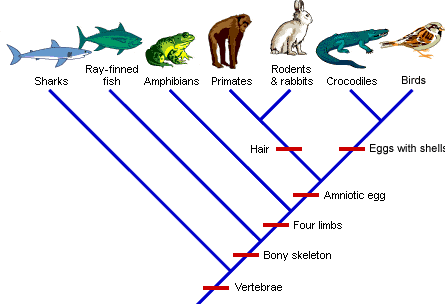
26.
Who is the closest relative to the birds?
a)
crocodiles
b)
sharks
c)
fish
d)
amphibians
27.
An organism that has cells that lack a nucleus are called:
a)
Eukaryote
b)
Heterotroph
c)
Prokaryote
d)
Autotroph
28.
The study of how things are classified is known as:
a)
binomial nomenclature
b)
a dichotomous key
c)
taxonomy
29.
The 2-part naming system developed by Linneus is known as:
a)
dichotomous key
b)
taxonomy
c)
binomial nomenclature
d)
classification
30.
Use the dichotomous key above to classify the unknown organism in the picture
a)
Kentuckyus
b)
Californius
c)
WalaWala
d)
Beverlus
31.
Tigers, Jellyfish, Gorillas and Sponges are all part of kingdom _______.
a)
Animalia
b)
Plantae
c)
Fungi
d)
Bacteria
32.
An illustration and a dichotomous key are given. What is the correct classification for this organism?
a)
Class Insecta
b)
Order Amblygygi
c)
Order Araneae
d)
Order Scorpiones
33.
A dichotomous key for trees is provided. Hikers found a tree that has large brown cones and single sharp needles. What species of tree have the hikers found?
a)
Juniper
b)
Pine
c)
Spruce
d)
Fir
34.
A labeled diagram of a fiddler crab is provided. Which of the following is an accurate observation of the structures of a fiddler crab? Fiddler crabs have -
a)
five pairs of walking legs on each side.
b)
an enlarged propodus on both front legs.
c)
a pair of eyes on stalks at the top of the body.
d)
two pairs or chelipeds for a total of four.
35.
Which two orgainsms have hair? 
a)
Sharks & Ray Finned Fish
b)
Primates & Rodents
c)
Birds & Crocodiles
d)
Rabbits & Birds
36.
Who first proposed binomial nomenclature as a way of classifying organisms?
a)
Carolus Linnaeus
b)
Carl's Jr.
c)
Charles Darwin
d)
Henry Groseclose
37.
Which of the following does not belong in the Fungi Kingdom? 
a)
Yeast
b)
Ameoba
c)
Mold
d)
Mushroom
38.
What is the correct way to write the scientific name correctly?
a)
Genus species
b)
genus Species
c)
Genus Species
d)
genus species
39.
What does "KPCOFGS" mean?
a)
The 4 common characteristics of living things
b)
The 7 levels of taxonomy
c)
The 5 kingdoms
40.
"Lion" is an example of what?
a)
Scientific name
b)
Common name
c)
Adaptations
d)
Food
41.

Find the description of a dog and list the order of yes and no

1.Is this animal a mammal

Yes ........................... Go to 2

No ........................... Go to 3


2.Does this animal have claws

Yes ........................... Go to 3

No ........................... Go to 4


3.Does this animal have scales

Yes ......................... Snake

No .......................... Go to number 4


4.Does this animal have fur?

Yes ......................... Dog

No .......................... Dolphin

a)

Yes, Yes, No, Yes

b)

No,Yes

c)

Yes,Yes,Yes

d)

Yes,No,No

42.
What is the purpose of a dichotomous key?
a)
to find a common ancestor
b)
to show the evolution of organisms
c)
to show relationships between organisms
d)
to identify organisms
43.

What is the correct classification for the pictured organism?

a)
b)

Insecta

c)

Scorpiones

d)

Araneae

e)

Amblypygi

44.

A student discovers an arachnid with a segmented abdomen, long legs, and a tail with no stinger.

The student uses the dichotomous key below to identify it.

1. a) Abdomen segmented.............go to 2

b) Abdomen not segmented ......go to 4

2. a) Abdomen with tail....................go to 3

b) Abdomen without tail...............go to 5

3. a) Tail with stinger..........................Scorpion

b) Tail without stinger.....................Whip scorpion

4. a) Legs longer than body.............Daddy Long Legs

b) Legs not longer than body……….Wind scorpion

5. a) Covered with spines .......................Mite

b) Few spines.....................................Tick

a)

Whip Scorpion

b)

Daddy Long Legs

c)

Mite

d)

Tick

45.

Which letter in the picture has two pairs of wings?

a)

M

b)

K

c)

F

d)

L

46.

What class is the picture of?

a)
b)

Arachinda

c)

Crustacea

d)

Centipede

e)

Insecta

47.

Which leaf is shown in the drawing?

a)

Magnolia

b)

Redbud

c)

Sweetgum

d)

None of the above

48.

Which of the paired statements could be used to tell the difference between the two insects using a dichotomous key?

a)

Has 6 legs

Has 8 legs

b)

Large hind legs

Small hind legs

c)

2 pairs of spots on wing cover

3 pairs of spots on wing cover

d)

Antennae absent

Antennae present

49.

Which shark is the picture of?

a)

Cow Shark

b)

Great White Shark

c)

Hammerhead Shark

d)

Saw Shark

50.

What is bird Y?

a)

Certhidea

b)

Geospiza

c)

Camarthyncus

d)

Platyspiza

51.

What is B?

a)

Bivalve

b)

Gastropoda

c)

Annelida

d)

Teuthida