wayground logo

Free Printable Worksheets

NEW

Font size

S
M
L
XL
Worksheets

Types of Faults and more...

Total questions: 40

Worksheet time: 38mins

Name
Class
Date
1.
A type of fault where rocks on either side move past each other sideways is called:
a)
normal fault
b)
reverse fault
c)
strike-slip fault
2.
Which of these boundaries/stresses/faults all correctly go together?  Choose all that apply.
a)
normal, divergent, tension
b)
reverse, convergent, shearing
c)
strike-slip, transform, compression
3.
Rock layers undergo stress when they are squeezed at convergent boundaries. This stress is called:
a)
compression
b)
combining
4.
Rock layers undergo stress when they are stretched apart at divergent boundaries. This stress is called:
a)
tightening
b)
tension
5.
What type of stress is this?
a)
compression
b)
shearing
c)
tension
6.
a)
normal fault
b)
reverse fault
c)
strike-slip fault
7.
What type of stress is this?
a)
compression
b)
shearing
c)
tension
8.
a)
normal fault
b)
reverse fault
c)
strike-slip fault
9.
The type of plate boundary where two plates come together is a .....
a)
Convergent Boundary
b)
Divergent Boundary
c)
Transform Boundary
d)
Plate Boundary
10.
Which of the following causes Earth's tectonic plates to move?
a)
Energy from the Sun
b)
Magnetic Pole Reversal
c)
Convection currents in the mantle
d)
Faults in Mountain Ranges
11.
What type of plate boundary is this?
a)
Plate
b)
Divergent
c)
Convergent
d)
Transform
12.
What type of event will occur at this boundary?
a)
Earthquake
b)
Volcano Eruption
c)
Tornado
d)
Mountain Building
13.
A divergent boundary occurs when plates ....
a)
Pull apart
b)
Come together
c)
Slide past each other
d)
subducting
14.
What type of plate boundary is this?
a)
Transform
b)
Convergent
c)
Divergent
d)
Plate
15.

Oceanic Trenches are formed by _______ plate boundaries

a)

Convergent

b)

Transform

c)

Plate

d)

Divergent

16.
Mountains are created when....
a)
Two continental plates collide
b)
Two oceanic plates pull apart
c)
An Oceanic plate subducts under a Continental Plate
d)
Two continental plates pull apart
17.
The Great Rift Valley in Africa and the Mid-Ocean Ridge were all created by this boundary
a)
Divergent
b)
Convergent
c)
Reform
d)
Transform
18.
What are the two types of crust
a)
continental and oceanic
b)
ocean and upper
c)
lower and upper
d)
pizza and subway
19.
Transform boundaries are most likely to produce what phenomenon?
a)
volcanoes
b)
deep sea trenches
c)
underwater mountain ranges
d)
earthquakes
20.
When an oceanic plate and a continental plate collide, which one will subduct?
a)
oceanic
b)
continental
c)
neither
21.
The area where two tectonic plates meet.
a)
mantle
b)
focus
c)
plate boundary
d)
convection
22.
This landform can occur at a divergent plate boundary.
a)
ocean trench
b)
mid-ocean ridge
c)
tall mountains
d)
transform fault
23.
A subduction zone is formed...
a)
when one tectonic plate sinks below another
b)
at every type of convergent plate boundary
c)
at every type of divergent plate boundary
d)
at transform boundaries
24.

Which type of stress is associated with a strike-slip fault?

a)

Tension

b)

Eustress

c)

Shearing

d)

Compression

25.

Which type of stress is associated with a normal fault?

a)

Tension

b)

Eustress

c)

Shearing

d)

Compression

26.

Which type of stress is associated with a reverse fault?

a)

Tension

b)

Eustress

c)

Shearing

d)

Compression

27.

Identify this type of fault.

a)

Normal

b)

Reverse

c)

Strike-Slip

28.

Identify this type of fault.

a)

Normal

b)

Reverse

c)

Strike-Slip

29.
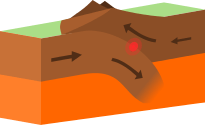
What kind of plate boundary is shown here?
a)
divergent
b)
convergent
c)
transform
d)
subducting
30.
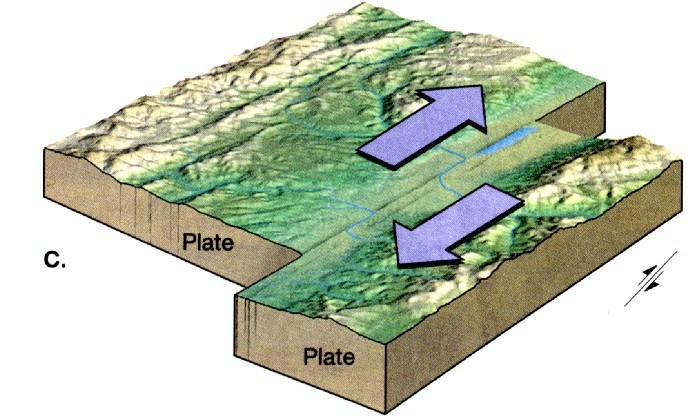
What kind of plate boundary is shown here?
a)
divergent
b)
convergent
c)
transform
d)
submergent
31.
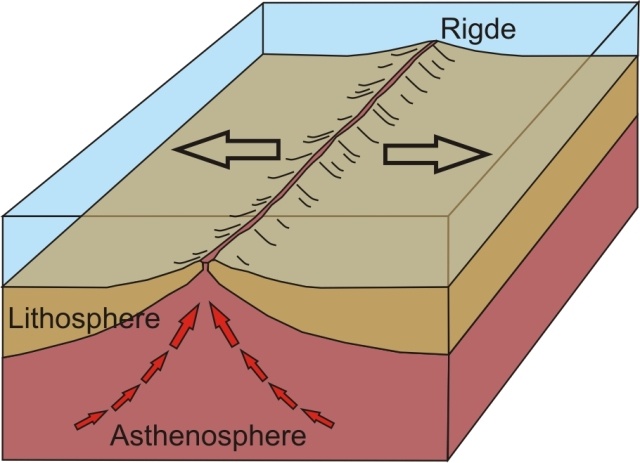
What kind of plate boundary is shown here?
a)
divergent
b)
convergent
c)
transform
d)
strike slip
32.

The area around the pacific plate where boundaries form is called...

a)

death ring

b)

fire zone

c)

ring of fire

d)

zone of fire

33.
The San Andreas Fault in California is an example of a ________.
a)
divergent boundary
b)
convergent boundary
c)
transform fault
d)
subduction zone
34.

Which of the following is where one plate slides under another plate?

a)

submarine zone

b)

divergence zone

c)

subduction zone

d)

lower zone

35.
Oceanic crust is
a)

Younger and less dense than continental crust

b)

Thinner, younger (due to recycling at subduction zones) and more dense than continental crust

c)

Older, thicker and less dense that continental crust

d)

Bigger, less dense, and younger than continental crust

36.
How and where does the mid-ocean ridge form?
a)

occur at spreading plate boundaries (divergent) and involve the moving apart of oceanic plates

b)

occur at converging plate boundaries and involve the moving together of oceanic plates

37.
How is an ocean trench formed?
a)
Ocean trenches occur when divergent plates spread apart.
b)
Ocean trenches occur when convergent plates come together and push up.
c)
Ocean trenches occur when one plate slides under another plate.
d)
Ocean trenches form when Spongebob goes too deep in the ocean.
38.

What type of convergent boundary (reverse fault) is shown in the image?

a)

Ocean/Ocean Convergent

b)

Ocean/Continental Convergent

c)

Continental/Continental Convergent

d)

Transform Fault Boundary

39.

What type of convergent boundary (reverse fault) is shown in the image?

a)

Ocean/Ocean Convergent

b)

Ocean/Continental Convergent

c)

Continental/Continental Convergent

d)

Transform Fault Boundary

40.

What type of convergent boundary (reverse fault) is shown in the image?

a)

Ocean/Ocean Convergent

b)

Ocean/Continental Convergent

c)

Continental/Continental Convergent

d)

Transform Fault Boundary