
 Worksheets
Waves
Total questions: 53
Worksheet time: 39mins
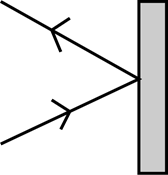
The illustration shows a light ray striking an object.
In the illustration, the light ray striking the object is-
diffraction
Deflection
reflection
all of these

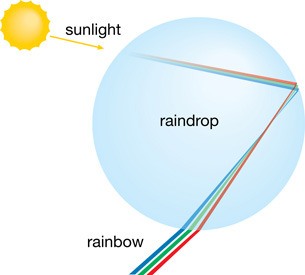

Reflection
Refraction
Diffraction
The wave goes around something that gets in the way.
Reflection
Refraction
Diffraction
The wave bounces off of the surface.
Reflection
Refraction
Diffraction
The wave bends because the speed of the wave changes.
Reflection
Refraction
Diffraction

What would you call this?
Refraction
Diffraction
Bends
Reflection
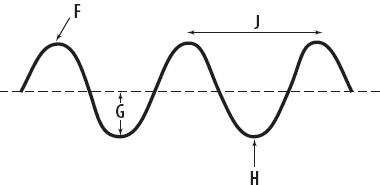
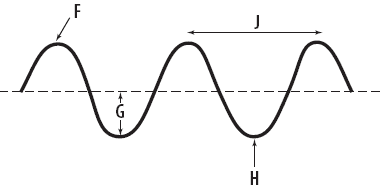
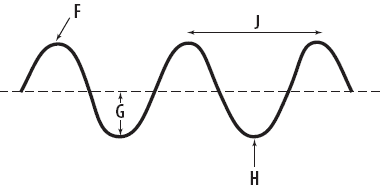
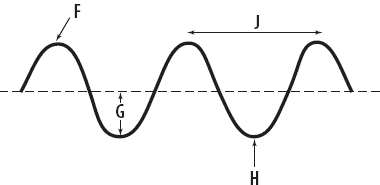


the region in which the material is spread apart.
compression
rarefaction
frequency

In sound waves, the most dense area of dots is called ____ and the least dense areas is called _____
compression, rarefaction
rarefaction, compression
Wavelength
all of these

Volume is measured in _____
hertz
meters
decibels
meters/second


Beneath the water line, one could measure the angle of _____
Reflection
Refraction
Incidence
In a solid, sound waves travel _____ in a liquid.
faster than
slower than
the same as
all of these
Fabrics, carpets, curtains and such are used in auditoriums to _____ sound.
reflect
absorb
refract
diffract
Frequency is measured in _____
hertz
meters
decibels
meters/second
Refraction happens because the wave ____
changes speed as it changes mediums
changes speed as it changes directions
changes color as it changes mediums
the type of wave changes
_____ travels the fastest.
sound at room temperature
light at room temperature
sound at freezing temperature
smell at room temperature
Waves that need a medium are called
electromagnetic
light
mechanical
microwaves
Objects appear different in size and shape in a container of water due to _____.
refraction of the light waves.
interference of the water and light waves.
polarization of the light waves.
diffraction of the light waves.

When the car moves AWAY from you, its horn seems_____.
Low frequency
High frequency
greater amplitude
the same as when it is coming towards you

When an ambulance move TOWARD you it has a ________.
high frequency
low frequency
medium frequency
the same as when it moves away
Increasing the amplitude will increase the _____.
energy
frequency
wavelength
all of these
In space,you cannot hear because _____
there are no air molecules to carry sound.
the sounds o space are too loud
the sun destroys the sound waves
there is no magnetic field
has limited amount of information
digital
analog
uses codes, such as binary and morse
digital
analog
unlimited amount of information
digital
analog
can repair distortions
digital
analog
distortions made worse when amplified
digital
analog
information broken into numbered pieces to reassemble faster
digital
analog
can transmit information faster
digital
analog
Sound travels through all of these EXCEPT _____
water
helium
metal
vacuum
What is the study of sound?
acoustics
frequency
pitch
ultrasound


Which of these are analog examples?
human voice
microphone
old school telephone (similar to one near cafeteria)
speakers
all of these
Which of these are digital examples?
computer with disc drive
alphabet
01010101
cell phone
all of these

To draw the angle of reflection based on the angle of incident.
AC must reflect BD
E must reflect BD
AC must reflect E
CD must reflect AB

When a wave encounters an obstacle, and it either passes through it or around it. The wave bends or spreads out. This is...
diffraction
reflection
refraction
amplitude

