wayground logo

Free Printable Worksheets

Font size

S
M
L
XL
Worksheets

18. Cell Energetics

Total questions: 84

Worksheet time: 2hrs 41mins

Name
Class
Date
1.
Is found in the cell membrane as a bilayer. 
a)
lipids
b)
protein
c)
nucleic acid
d)
carbohydrate
2.

What are the products of aerobic respiration?

a)

Glucose and oxygen

b)

Carbon dioxide and water

c)

Lactic acid

d)

Carbon monoxide

3.
What molecule is broken down to provide energy for life processes?
a)
oxygen
b)
carbon dioxide
c)
glucose
d)
water
4.
A weightlifter is using heavy weights in short bursts for a competition. Because his muscle cells are not able to take in enough oxygen to make very much ATP the weightlifter begins to get fatigue in his muscles. Which of the following processes is most likely going on in the muscles of the weightlifter as he competes in his event
a)
As the cells run out of oxygen they switch to anaerobic respiration, which allows the cell to make small amounts of ATP in the absence of oxygen. 
b)
As the cells run out of oxygen, they die off gradually and the weightlifter's muscles have fewer contracting muscle cells.
c)
The cells will never run out of oxygen if the weightlifter is breathing.
d)
As the cells run out of oxygen, they will continue to make the same amount of ATP, since oxygen is not required to make ATP. 
5.
This organelle is the _____________.
a)
chloroplast
b)
Golgi bodies
c)
nucleus
d)
mitochondria
6.
which kind of cells would have the most mitochondria?
a)
brain cells
b)
bone cells
c)
plant cells
d)
muscle cells
7.
What does it mean for something to be anaerobic?
a)
It requires CO2
b)
It does not require CO2
c)
It requires oxygen
d)
It does not require oxygen
8.

The correct word equation for aerobic respiration is

a)

carbon dioxide + water (+ energy) → glucose + oxygen

b)

water + oxygen → carbon dioxide + glucose (+ energy)

c)

glucose + oxygen → carbon dioxide + water (+ energy)

d)

glucose + water → carbon dioxide + water (+ energy)

9.

Anaerobic means

a)

with oxygen

b)

without oxygen

c)

to run for a long time

10.

What are the products (what is released) of cellular respiration? (Mark all of them!)

a)

oxygen

b)

glucose

c)

carbon dioxide

d)

water

e)

ATP (energy)

11.
How do plants get the carbon that they need?
a)
from the air
b)
from water
c)
from the soil
d)
from fertilizer
12.

What are the reactants (taken into) of cellular respiration? (Mark all of them!)

a)

oxygen

b)

glucose

c)

carbon dioxide

d)

water

e)

energy

13.
Which process occurs in the cytoplasm?
a)
glycolysis
b)
aerobic respiration
c)
Krebs' cycle
d)
Electron transport
14.
ATP is 
a)
Adenosine Diphosphate
b)
Adenosine Triphosphate
c)
not an energy molecule
d)
Adenotriplet phosphate
15.
What are the products of aerobic respiration?
a)
Glucose and oxygen
b)
Carbon dioxide and water
c)
Lactic acid
d)
Carbon monoxide
16.
What type of respiration requires oxygen?
a)
Aerobic
b)
Anaerobic
17.

True or false: Both anaerobic and aerobic respiration use glucose

a)

True

b)

False

18.

True or False: Anaerobic respiration causes cramp

a)

True

b)

False

19.

If cells need more energy/respire more. What do they need more of in them?

a)

Cytoplasm

b)

Nucleus

c)

Mitochondira

d)

Membrane

20.

Do plant cells carry out respiration

a)

Yes

b)

No

21.

If there is not enough oxygen then ___________ respiration is used

a)

Anaerobic

b)

Aerobic

22.

anaerobic respiration produces energy and two other substances

a)

carbon dioxide and water

b)

carbon dioxide and oxygen

c)

oxygen and lactic acid

d)

carbon dioxide and lactic acid

23.

Which type of respiration produces the most energy

a)

Anaerobic

b)

Aerobic

c)

Both produce the same amount

24.

The correct word equation for Anaerobic respiration is

a)

glucose → lactic acid + oxygen

b)

glucose → lactic acid (+ energy released)

c)

glucose + oxygen → lactic acid (+ energy released)

d)

lactic acid → energy released

25.

How many types of anaerobic respiration do we have?

a)

3

b)

1

c)

2

d)

4

26.

Which of the following is a common waste product of anaerobic and aerobic respiration?

a)

Water

b)

Carbon dioxide

c)

Heat

d)

Oxygen

27.

Why is lactic acid formed in the muscle of an athlete who ran around 100m race?

a)

Because glucose is broken down in the absence of oxygen

b)

Because lactic acid was in his blood

c)

Because lactic acid was sprinkled on the stadium

d)

Because glucose is broken down in the presence of oxygen

28.

Anaerobic respiration takes place

a)

In the presence of sunlight

b)

The presence of oxygen

c)

In the absence of oxygen

d)

In presence of carbon dioxide

29.

What respiration takes place Mainly in the mitochondria?

a)

Anaerobic respiration

b)

Aerobic respiration

c)

Respiration

d)

Fermentation

30.

Cellular respiration is the process that our cells use to ….

a)

convert sugar (glucose) into energy (ATP)

b)

break food down into smaller molecules (sugars)

c)

makes acid

d)

breathe

31.

The process of fermentation happens ...

a)

whenever a plant receives direct sunlight.

b)

when there is too much glucose for aerobic respiration.

c)

whenever the muscles need more acid.

d)

when there isn’t enough oxygen for aerobic respiration.

32.

Which of the following statements is true

a)

The products of photosynthesis are the reactants of cellular respiration.

b)

The products of photosynthesis are not necessary for respiration to occur.

c)

The reactants of photosynthesis are also the reactants of cellular respiration.

d)

The products of photosynthesis are also the products of cellular respiration.

33.
Glycolysis results in the net gain of:
a)
2 ATP
b)
4 ATP
c)
4 NADH
d)
2 Acetyl CoA
34.
The number of ATP molecules produced out of Krebs Cycle is:
a)
2
b)
3
c)
4
d)
0
35.
What is a reactant for the electron transport chain?
a)
NADPH
b)
ATP
c)
Oxygen
d)
Water
36.
How many ATP are produced in the Electron Transport Chain?
a)
2
b)
30
c)
34
d)
38
37.
The reactants of photosynthesis are
a)
sugar and water.
b)
sugar and oxygen.
c)
carbon dioxide and water.
d)
carbon dioxide and oxygen.
38.
In which eukaryotic organelles does photosynthesis occur?
a)
mitochondria
b)
stomata
c)
xylem
d)
chloroplast
39.
Which statement about photosynthesis is correct?
a)
Plants get the energy they need for photosynthesis from water.
b)
Plants get the energy they need for photosynthesis from soil.
c)
Plants get the energy they need for photosynthesis from sunlight.
d)
Plants do not require energy to perform photosynthesis.
40.
Which of the following is the correct equation for PHOTOSYNTHESIS?
a)
6CO2 + 6H2O --> 6O+ C6H12O6
b)
6CO+ C6H12O6 + 6H2O --> O
c)
6O2 + 6H2O --> 6CO+ C6H12O6
d)
C6H12O6 + 6O2 ---> 6H2O + 6CO2 
41.
Which gas is removed from the atmosphere during photosynthesis?
a)
hydrogen
b)
oxygen
c)
nitrogen
d)
carbon dioxide
42.
In which organelle (part of the cell) does photosynthesis take place?
a)
mitochondria
b)
chloroplast
c)
nucleus
d)
cell membrane
43.
What is the source of energy for photosynthesis?
a)
carbohydrates-chemical
b)
sunlight-radiant
c)
heat-thermal
d)
television-electrical
44.
What are the reactants (what's needed) for photosynthesis?
a)
glucose and oxygen
b)
light, water, and carbon dioxide
45.
What gas is released by plants during photosynthesis?
a)
sulfur
b)
carbon dioxide
c)
oxygen
d)
hydrogen
46.
What is the correct equation for cellular respiration?
a)
6O2 + C6H12O6 -> 6CO2 + 6H2O + Energy
b)
6O2 + C6H12O6 + Energy -> 6CO2 + 6H2O
c)
6CO2 + 6H2O -> 6O2 + C6H12O6 + Energy
d)
6CO2 + 6H2O + Energy -> 6O2 + C6H12O6
47.
What is cellular respiration?
a)
the breakdown of glucose  to release ATP
b)
the breakdown of glucose to release NADH
c)
the breakdown of glucose to release FADH
d)
the breakdown of glucose to release carbon
48.

What is the definition of a heterotroph?

a)

An organism that can make it's own food.

b)

An organism that breaks down decaying material.

c)

An organism that has to eat other organisms to obtain energy.

d)

An organism that only eats plants.

49.

What are the products of photosynthesis?

a)

Oxygen + H2O + Energy (ATP)

b)

Oxygen + H2O

c)

CO2 + H2O + Energy (ATP)

d)

Oxygen + Glucose

50.

What are the products of cellular respiration?

a)

Oxygen + H2O + Energy (ATP)

b)

Oxygen + H2O

c)

CO2 + H2O + Energy (ATP)

d)

Oxygen + Glucose

51.

What are the reactants of cellular respiration?

a)

CO2 + glucose

b)

Glucose + CO2 + Energy (Sun)

c)

Oxygen + glucose

d)

CO2 + H2O + Energy (Sun)

52.
What is the correct equation for cellular respiration?
a)
6O2 + C6H12O6 -> 6CO2 + 6H2O + Energy
b)
6O2 + C6H12O6 + Energy -> 6CO2 + 6H2O
c)
6CO2 + 6H2O -> 6O2 + C6H12O6 + Energy
d)
6CO2 + 6H2O + Energy -> 6O2 + C6H12O6
53.
The diagram below shows the relationship between photosynthesis and cellular respiration and the organelles in which they occur.Which statement describes how photosynthesis and cellular respiration are interrelated?
a)
 Oxygen is produced during cellular respiration and stored during photosynthesis.
b)
Carbon dioxide and water released by cellular respiration are used in photosynthesis.
c)
Photosynthesis releases the energy that is stored during the process of cellular respiration.
d)
 Glucose is used during cellular respiration to produce food that is broken down during photosynthesis.
54.
Which of the following is the correct sequence of events in cellular respiration?
a)
glycolysis, fermentation, Krebs cycle 
b)
glycolysis, Krebs cycle, electron transport
c)
Krebs cycle, electron transport, glycolysis
d)
Krebs cycle, glycolysis, electron transport
55.
Where do the light-dependent reactions take place?
a)
in the stroma
b)
outside the chloroplasts
c)
in the thylakoid membranes
d)
only in chlorophyll molecules
56.
Why is photosynthesis important?
a)
creates oxygen for animals to breath
b)
creates energy for heterotrophs to use
c)
creates food for plants to use
d)
all of these are correct
57.
What is another name for glucose?
a)
Chlorophyll
b)
Chloroplasts
c)
Stomata
d)
Sugar
58.
Where does carbon dioxide enter plants?
a)
The leaves
b)
Stem
c)
Roots
59.
Plants can...
a)
Only use photosynthesis
b)
Only use cellular respiration
c)
Use photosynthesis and cellular respiration
60.
Reactants are...
a)
Substances present at the beginning of a chemical reaction
b)
substances present at the end of a chemical reaction
61.
C6H12O6 + 6O2 --> 6CO2 + 6H2O is the chemical equation for ____________ __________.
a)
photosynthesis
b)
cellular respiration
62.
The following are ______ in the photosynthesis formula?
H2O+CO2+Sunlight
a)
Products
b)
Reactants
63.
Plants, and life forms that use photosynthesis, are called
a)
Heterotrophs
b)
Megatrophs
c)
Autotrophs
d)
Phototrophs
64.
Living things that gain energy by eating other organisms are called
a)
Megatrophs
b)
Phototrophs
c)
Autotrophs
d)
Heterotrophs
65.

Chlorophyll is green because green light is

a)

Absorbed

b)

Reflected

66.
What is the pigment in chloroplasts that performs photosynthesis?
a)
Chlorosynthesis
b)
Chlorophyll
c)
ADP
d)
Electron Transport
67.
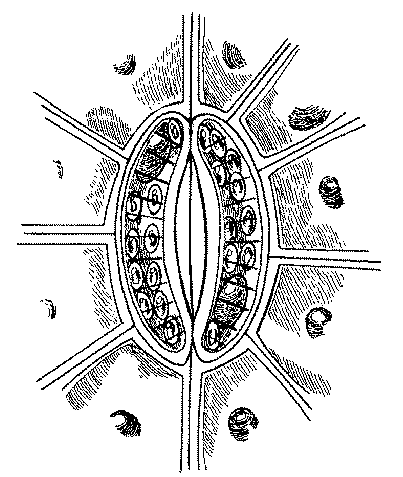
Look at the image
What substances and organelle work together to absorb sunlight to perform photosynthesis in this example?
a)
cell wall and chloroplast
b)
mitochondria and water
c)
vacuole and carbon dioxide
d)
chloroplast and chlorophyll
68.
How does the stomata work?
a)
It helps transport sugars to the root cells.
b)
It helps to transport nutrients to the roots.
c)
It helps to exchange gases and water.
d)
It helps to conduct fermentation in the leaf.
69.
Photosynthesis is a two-stage process.  What are the names of the stages?
a)
Stage 1 and Stage 2
b)
Light-Dependent and Light-Independent
c)
Light and Dark
d)
Chlorophyll and Transpiration
70.
Pigments are located in:
a)
mitochondria
b)
chloroplasts
c)
stroma
d)
cytoplasm
71.
Where does the light independent stage of photosynthesis occur?
a)
grana
b)
stroma
c)
thylakoid membranes
d)
cytosol
72.
The formula for glucose is...
a)
C12 H22 O11
b)
NaCl
c)
NaOH
d)
C6 H12 O6
73.

One cause of muscle soreness is

a)

the Krebs cycle

b)

glycolysis

c)

alcoholic fermentation

d)

lactic acid fermentation

74.

Which process is used to produce beer and wine?

a)

glycolysis

b)

the Krebs Cycle

c)

lactic acid fermentation

d)

alcoholic fermentation

75.

Yeast go through which type of fermentation to make bread and wine?

a)

Lactic Acid

b)

Alcoholic

76.

Alcoholic Fermentation is different than Lactic Acid Fermentation in that it gives off

a)

ATP

b)

Carbon dioxide

c)

Oxygen

d)

ADP

77.

in which organisms does lactic acid occur?

a)

Animals, yeast, plants

b)

humans, plants, bacteria, animals

c)

Animals only

d)

yeast only

78.
Which end product of alcoholic fermentation is important in the baking industry?
a)
lactic acid
b)
carbon dioxide
c)
ATP molecules
d)
alcohol
79.
Which types of respiration are useful in increasing the amount of gas in a food product?
a)
fermentation producing lactic acid only
b)
fermentation producing carbon dioxide and ethanol only
c)
aerobic respiration and fermentation producing lactic acid
d)
aerobic respiration and fermentation producing carbon dioxide and ethanol
80.
What does metabolism mean?
a)
Converting energy into food
b)
Making light reactions happen
c)
Converting food into energy
81.

Which organism go through cellular respiration?

a)

animals

b)

plants

c)

both animals and plants

d)

none

82.

Which of the following structure is where cellular respiration (Kreb's Cycle and Electron Transport Chain) occurs in the cell?

a)

nucleus

b)

cytoplasm

c)

mitochondria

d)

vacuoles

83.
What is cellular respiration?
a)
the breakdown of glucose  to release ATP
b)
the breakdown of glucose to release NADH
c)
the breakdown of glucose to release FADH
d)
the breakdown of glucose to release carbon
84.

Anaerobic respiration yields about ______ ATP per glucose whereas aerobic respiration yields about _______ ATP per glucose.

a)

38, 2

b)

2, 36

c)

2, 18

d)

18, 2