Wayground logo

Free Printable Worksheets

Font size

S
M
L
XL
Worksheets

Pre-AP Physics: Force Test

Total questions: 35

Worksheet time: 9hrs 45mins

Name
Class
Date
1.

The property of matter that resists changes in motion is called

a)

friction

b)

gravity

c)

inertia

d)

weight

2.

If a force of 12 N is applied to an object with a mass of 2 kg, the object will accelerate at

a)

0.17 m/s2

b)

6 m/s2

c)

24 m/s2

d)

12 m/s2

3.

How does acceleration of an object change in relation to its mass? It is

a)

directly proportional

b)

Acceleration doesn't depend on mass at all

c)

inversely proportional

4.

If the net force acting on a cart doubles, what happens to the cart's acceleration?

a)

It quarters

b)

It halves

c)

It stays the same

d)

It doubles.

e)

It quadruples.

5.

Suppose a cart is being moved by a force. If suddenly a load is dumped into the cart so that the cart's mass doubles, what happens to the cart's acceleration?

a)

It quarters.

b)

It halves.

c)

It stays the same.

d)

it doubles

e)

It quadruples.

6.

A horse exerts a 500 N force on a heavy wagon, causing it to accelerate. What force does the wagon exert on the horse?

a)

less than 500 N.

b)

500 N.

c)

more than 500 N.

d)

it’s not possible to tell.

7.

A baseball player bats a ball with a force of 1000 N. The reaction force that the ball exerts against the bat is:

a)

less than 1000 N.

b)

1000N

c)

more than 1000 N.

d)

impossible to determine.

8.
What is the net force when the forces acting on an object are balanced?
a)
less than 0 N
b)
more than 0 N
c)
equal to 0 N
d)
100 N
9.
Friction acts
a)
in the same direction as motion
b)
only on objects that are not in motion
c)
in the opposite direction of motion
d)
 only on objects that are in fluids
10.
Air resistance acts in what direction on a falling object?
a)
upward
b)
sideways
c)
downward
d)
backwards
11.
What causes an object's motion to change?
a)
zero force
b)
inertia
c)
balanced force
d)
unbalanced force
12.
Newton's Third Law of Motion says that for every action there is an equal and opposite reaction. This means that
a)
forces do not act on moving objects
b)
forces only act on moving objects
c)
forces come in action-reaction pairs
d)
forces act only in the opposite direction of motion
13.
What type of friction is between two objects that are not moving?
a)
static friction
b)
rolling friction
c)
 sliding friction
d)
 fluid friction
14.
What type of friction acts on you when you are swimming?
a)
static friction
b)
rolling friction
c)
 sliding friction
d)
 fluid friction
15.
What type of friction acts on a soccer ball after it has been kicked?
a)
static friction
b)
rolling friction
c)
 sliding friction
d)
 fluid friction
16.
You exert a force of 120 N on a desk to the right. Your friend exerts a force of 150 N in the same direction. What is the net force?
a)
30 N
b)
120 N
c)
150 N
d)
270 N
17.

states that an object acted upon by a net force will accelerate in the direction of the force, and that the acceleration equals the net force divided by the object's mass

a)

Newton's first law of motion

b)

Newton's third law of motion

c)

Newton's second law of motion

d)

center of mass

18.
A book rests on a table.  The force of gravity pulls down on the book with a force of 20 newtons. What prevents the books from accelerating downward at 9.8 m/sec2    
a)
The table presses back up on the book with an equal and opposite force of 20 newtons.
b)
The table presses back up on the book with a force greater than 20 newtons.
c)
The table and the book together are accelerating downwards at  9.8 m/sec2
d)
The inertia of the book holds it up
19.

What is the force on a 1000 kg elevator that is falling freely at 9.8 m/sec2

a)

102.04 n

b)

9,800 n

c)

980 n

d)

103 n

20.
What is the acceleration of a 50 kg object pushed with a force of 500 newtons?
a)
100 m/s2
b)
25,000 m/s2
c)
10 m/s2
d)
25 m/s2
21.
A force of 250 N is applied to an object that accelerates at a rate of 5 m/sec2.  What is the mass of the object?
a)
100kg 
b)
1,250kg
c)
50kg
d)
5kg
22.
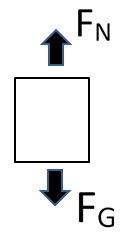
Name the missing force....
a)
weight force
b)
normal force
c)
frictional force
d)
tension force
23.

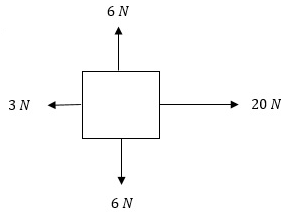
What is the NET FORCE of this diagram?

a)

17 N, right

b)

17 N, left

c)

23 N, right

d)

12 N, up

24.

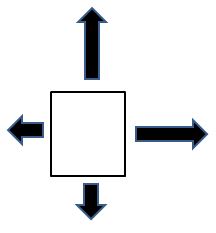
The down-arrow in this diagram is most-likely:

a)

gravity

b)

normal

c)

a push or pull

d)

friction

25.

Which of the following is true about this free-body diagram?

a)

the forces are are balanced

b)

the object is free-falling

c)

the object is moving upward

d)

the forces are unbalanced

26.

What forces are on a leopard laying on a log?

a)

Fg & Fapp

b)

Fb & Fg

c)

Fg & FN

d)

Ff & FN

27.
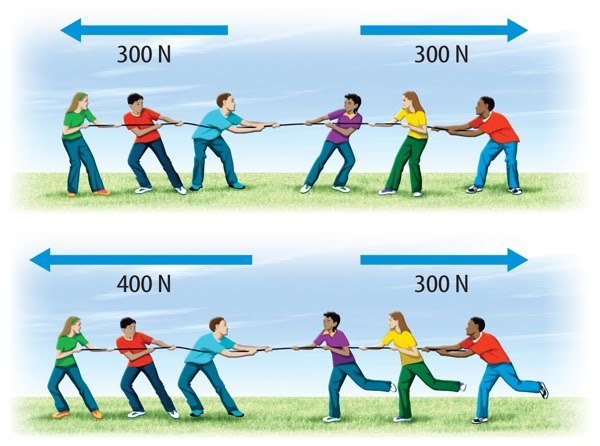
Which one is balanced?
a)
top
b)
bottom
c)
both
28.

Which diagram best shows person pushing a couch (accelerating) across the floor?

a)
b)
c)
d)
29.

Camille launches has a catapult that changes the velocity of a ball (m= 2 kg) from 0 to 10 m/s in one sec. What is the average force that is exerted on the ball during launch?

a)

20 N

b)

5 N

c)

8 N

d)

0.2 N

30.

A 80 kg skydiver is free falling at a constant velocity of 19 m/s. What is the net (total) force acting on her?

a)

1,520 N

b)

0 N

c)

800 N

d)

Not enough information to answer

31.
If a force of 26 N is exerted on two balls, one with a mass of 0.52 kg and the other with a mass of 0.78 kg, which ball will have the greater acceleration?  (F=ma)
a)
The one with a mass of .78 kg will have the greatest acceleration.
b)
The one with a mass of .52 kg will have the greatest acceleration.
c)
They will both accelerate at the same rate.
32.

A 2 kg brick is pulled by a force of 10N. Friction force is 4 N. What is the acceleration?

a)

3 N

b)

3 m/s2

c)

5 m/s2

d)

2 m/s2

33.
What is the mass of a truck if it produces a force of 15000 N while accelerating at a rate of 6 m/s2?
a)
Mass is 0.25 kg
b)
Mass is 2500 kg
34.
the tendency of an object to resist a change in its motion
a)
acceleration
b)
inertia
c)
mass
d)
frame of reference
35.
Which force produces a change in motion?
a)
unbalanced force
b)
balanced force
c)
gravitational force
d)
frictional force