Wayground logo

Free Printable Worksheets

Font size

S
M
L
XL
Worksheets

Climate Change

Total questions: 64

Worksheet time: 1hrs 7mins

Name
Class
Date
1.

1.Some greenhouse gases are naturally present in the Earth's atmosphere

a)

True

b)

False

2.

2.Which of the following is a greenhouse gas?

a)

CO2

b)

CH4

c)

Water vapor

d)

All of the above

3.

3.What is the Greenhouse Effect?

a)

The name of climate change legislation that passed by congress

b)

When you paint your house green to become an environmentalist

c)

When the gasses in our atmosphere trap heat and block it from escaping our planet

d)

When you build a greenhouse

4.

4.Which of the following are consequences associated with climate change?

a)

The ice sheets are declining, glaciers are in retreat globally, and our oceans are more acidic than ever

b)

Surface temperatures are setting new heat records about each year

c)

More extreme weather like droughts, heat waves, and hurricanes

d)

Global sea levels are rising at an alarmingly fast rate — 17 centimeters (6.7 inches) in the last century alone and going higher.

e)

All of Above

5.

9.Which of the following have been linked to climate change?

a)

droughts

b)

melting of polar ice caps

c)

flooding

d)

all of the above

6.

10.Possible human solutions for limiting global warming and climate change are...

a)

being more energy-efficient

b)

using renewable sources of energy

c)

removing carbon from fossil fuel emissions

d)

all of the above

7.

11.Compared to other greenhouse gases, carbon dioxide is very effective in trapping heat near the surface of the Earth.

a)

True

b)

False

8.
The two main factors that determine the climate of a region are _____________ and ______________.
a)
altitude and pressure
b)
pressure and temperature
c)
temperature and precipitation
d)
altitude and pressure
9.
Because Earth's axis is _________________, the hemispheres receive different amounts of solar energy at different times.
a)
straight
b)
titled
c)
bent
d)
not there
10.
Increased carbon dioxide may cause global warming by trapping more ____________ in the atmosphere.
a)
water
b)
gases
c)
heat
d)
water vapor
11.
Scientists observe the thickness of a tree's _________ to learn about past climate conditions.
a)
rings
b)
branches
c)
roots
d)
bark
12.
The gradual increase in the temperature of the atmosphere is known as ___________________.
a)
sunspots
b)
global warming
c)
ice ages
d)
arid
13.
Visible light reaches Earth’s surface while infrared light is trapped as heat. Which characteristic of Earth’s atmosphere causes this to happen?
a)
the hole in the ozone
b)
the greenhouse effect
c)
atmospheric pressure
d)
the inversion layer
14.
Which of the following is the best conclusion that can be made from this graph?
a)
atmospheric carbon dioxide levels have been decreasing since 1960
b)
Hawaii has a lot of carbon dioxide
c)
humans have been working hard to decrease carbon dioxide levels
d)
atmospheric carbon dioxide levels have increased steadily since 1960
15.
Which of the following gases DOES NOT trap heat?
a)
carbon dioxide
b)
nitrogen
c)
water vapor
d)
methane
16.
Which of the following is contributing to an increase in carbon dioxide in the atmosphere?
a)
deforestation
b)
photosynthesis
c)
oceans
d)
all of the above
17.
Melting of glaciers and polar ice caps....
a)
will result in cooler temperatures in the Arctic
b)
will result in sea-levels rising
c)
Will have no effect on ecosystems
d)
None of the above
18.
What is the definition of weather?
a)
a period of abnormally dry weather that lasts at least 2 years
b)
the specific condition of the atmosphere at a particular place and time
c)
a complex community of organisms and the community's environment
d)
a release of toxic gas
19.
What is the average weather for a particular time and region called?
a)
drought
b)
weather
c)
emissions
d)
climate
20.
Carbon is stored in
a)
Trees and other living things
b)
Oceans
c)
underground in soil and fossil fuels
d)
All are correct
21.
Any amount of CO2 (Carbon Dioxide) in the atmosphere is bad for our planet.
a)
True
b)
False
22.
The conditions in an area over a long period of time?
a)
Climate
b)
Weather
23.
Changes from minute-to-minute, hour-to-hour, day-to-day
a)
Climate
b)
Weather
24.
A tornado warning was issued for Kansas City this morning.
a)
Climate
b)
Weather
25.
Winters in Minnesota frequently experience temperatures below zero.
a)
Climate
b)
Weather
26.
Texas has long, hot summers.
a)
Climate
b)
Weather
27.
It snowed for three days last week.
a)
Climate
b)
Weather
28.
What is climate?
a)
 What's going on with the atmosphere at any particular time
b)
The type of weather that occurs during a particular season
c)
An area's pattern of weather over a long period of time
d)
How much sunshine an area gets 
29.
When humans burn fossil fuels, most of the carbon quickly enters the                       as carbon dioxide.
a)
Water
b)
Atmosphere
c)
Sun
d)
Air
30.
Which one of these does not add CO2 to the atmosphere?
a)
cooking with gas
b)
planting trees
c)
burning wood
d)
riding in a bus
31.
What does not produce carbon dioxide?
a)
Photosynthesis
b)
Burning Fossil Fuels
c)
Animal respiration
d)
Plants decaying
32.
How does the carbon in grass become part of a lion?
a)
The lion eats the grass
b)
Carbon from grass doesn't end up in a lion. 
c)
The carbon ends up in the lion's food chain. 
d)
The lion breathes in carbon given out by the plant
33.
Which of the following removes carbon from the atmosphere?
a)
Combustion
b)
Respiration
c)
Photosynthesis
d)
Death
34.
Organisms that do not decompose can be buried and become what?
a)
water
b)
nutrients
c)
air
d)
fossil fuels
35.
If the plant population decreased, the amount of carbon would _________.
a)
Stay the same
b)
Increase
c)
Decrease
36.

The circulation of the element Carbon among Earth's atmosphere, land, oceans, and organisms is called _____________.

a)

the Carbon Cycle

b)

the Oxygen Cycle

c)

the Carbon dioxide Cycle

d)

the Water Cycle

37.

____________________ is a part of oceans, air, rocks, soil, and all living things.

a)

Nitrogen

b)

Water

c)

Carbon

d)

Silver

38.

Respiration is a process where living things (animals) inhale ______________ and exhale _____________________.

a)

Oxygen, Nitrogen

b)

Carbon Dioxide, Oxygen

c)

CO2, O

d)

Oxygen, Carbon Dioxide

39.

How is the carbon cycle similar to the water cycle?

a)

Both involve liquid substances falling to the Earth from the atmosphere?

b)

Neither process works at low temperature.

c)

Both involve the transfer of substances between animals, plants, and the Earth.

d)

Both involve the transfer of substances between the earth and outer space.

40.

What is a carbon sink?

a)

Something that adds to the atmosphere.

b)

Something that removes carbon from the atmosphere.

c)

Something that adds carbon to the earth's crust.

d)

Something that removes carbon from the earth's crust.

41.

How does carbon become locked inside the earth?

a)

Tree roots expel carbon into the soil as they grow.

b)

Humans use machines to pump carbon dioxide into large underground rocks.

c)

Rocks become richer in carbon as time goes by.

d)

The carbon-rich bodies of plants and animals decay into the earth after they die.
42.
How plants and animals interact in the CO2/O cycle?
a)
Plants release O into the atmosphere which animals inhale. Animals exhale CO2 into the atmosphere which is breath in by plants.
b)
Animals release O into the atmosphere which plants inhale. Plants exhale CO2 into the atmosphere which is breath in by animals.
c)
Plants and animals don't need each other.
d)
Plants and animals take in O and release CO2.
43.
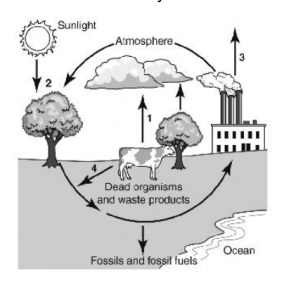
What is happening at 1?
a)
respiration: releasing CO2
b)
decomposing CO2 in the soil
c)
photosynthesis: absorbing CO2
d)
turning CO2 from the atmosphere into organic molecules
44.
Melting ice caps will cause the poles to have a ____________ albedo.
a)
higher
b)
lower
c)
same
45.
If the ice caps continue to melt, then there is less albedo at the poles.  This process will continue to melt more ice and have less albedo.  This is an example of a...
a)
fruit loops
b)
loop di loop
c)
negative feedback loop
d)
positive feedback loop
46.
Currently, about 10% of Earth is covered with ice year-round. If this ice melts, what could happen to Earth’s temperature?
a)
Increase
b)
Decrease
c)
Remain the Same
d)
Not enough information 
47.
The greenhouse effect is beneficial as it helps to sustain life on earth by naturally trapping heat in the atmosphere. 
a)
False
b)
True
48.

What kind of energy is infrared?

a)

heat energy

b)

electrical energy

c)

nuclear energy

d)

sound energy

49.

The greenhouse effect is due to

a)

the absorption and reradiation of infrared radiation by the atmosphere

b)

the reflection of ultraviolet radiation by the atmosphere

c)

the absorption of ultraviolet radiation by the atmosphere

d)

the reflection of infrared radiation from Earth's surface

e)

the absorption of ultraviolet radiation by Earth

50.
What does the term "anthropogenic" mean?
a)
something that is NOT caused by human activity
b)
a naturally occurring cause
c)
originating from human activity
d)
something that everyone should care about
51.
Which of the following is a natural cause of long term climate change?
a)
Burning Fossil Fuels
b)
Milankovitch Cycles
c)
Deforestation
d)
All of them
52.
At the beginning of the Industrial Revolution global average CO2 levels were approx. ____.  Now they are approx.  ____
a)
0 ppm, 405 ppm
b)
125 ppm, 405 ppm
c)
280 ppm, 405 ppm
d)
405 ppm, 280 ppm
53.

Thicker tree rings indicate poor growing conditions for plants and trees.

a)

True

b)

False

54.

How can monitoring glaciers provide evidence for climate change?

a)

When climate gets warmer, glaciers get larger.

b)

When glaciers retreat it means that it is getting colder.

c)

Glaciers contain old thermometers to measure temperatures.

d)

When climate is warmer, glaciers retreat. When climate is colder, glaciers expand and get larger.

55.

The gases that make up Earth’s atmosphere are commonly referred to as air. What are the two most abundant gases in the atmosphere?

a)

nitrogen and carbon dioxide

b)

nitrogen and oxygen

c)

water vapor and argon

d)

oxygen and carbon dioxide

56.
Reduced vegetation on Earth results in:
a)
more carbon dioxide in the atmosphere
b)
increased habitats
c)
less room for humans
d)
more oxygen in the atmosphere  
57.

Living vegetation and the ocean are known as "carbon sinks" because

a)

they are made of carbon.

b)

they create carbon.

c)

they destroy carbon.

d)

they store carbon.

58.
Based on the graph, which country releases the most Greenhouse Gases?
a)
Russia
b)
Brazil
c)
China
d)
U.S.
59.

What is it called when CO2 is absorbed by the ocean and reacts with seawater to produce acid.

a)

water pollution

b)

ocean acidification

c)

seaweed salad vinegar

d)

hydrochloric acid

60.

Coral bleaching

a)

Education and public awareness campaigns to preserve the health of coral reefs.

b)

The process to clean coral before it is sold.

c)

The process by which corals lose their algae and color under stressful conditions like high water temperature and light intensity.

d)
61.

On the picture, the heat out is decreasing. What can we assume if this is happening?

a)

There is no change in the graph

b)

We don't have any greenhouse gasses

c)

Greenhouse gasses are decreasing

d)

Greenhouse gasses are increasing

62.

In the picture we see that the temperature is increasing and decreasing daily. Why is this happening?

a)

We are burning fossil fuels

b)

We have greenhouse gasses

c)

Our sun rises and sets each day causing temperatures to rise and fall.

d)

None of the above

63.

What does the following image indicate?

a)

Arctic ice goes through natural variation

b)

Arctic ice is gradually increasing

c)

Arctic Ice has remained the same.

d)

Arctic ice is gradually declining.

64.

What conclusion can you draw from the graph on sea level

a)

The Sea Level has remained constant.

b)

The Sea Level increases are part of natural variation.

c)

As glaciers have melted the sea level has risen.

d)

Poseidon has been angered and is slowly flooding the earth.