
 Worksheets
Earth's Energy and EM Spectrum Quiz
Total questions: 45
Worksheet time: 40mins
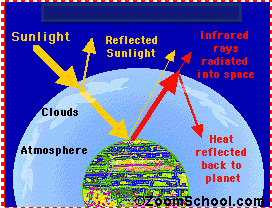
What is the process called in which gasses in Earth's atmosphere trap heat and send it back down to Earth's surface making it 30oC warmer than it would be otherwise?
El nino
Greenhouse effect
Reconvectionation
Global warming
Greenhouse gases, in moderate amounts, keep the Earth's temperature stable.
True
False
Which of the following has the highest albedo?
the oceans
glacial ice
the ground
roads

The following is an example of what type of feedback loop?
Negative Feedback Loop
Neutral Feedback Loop
Positive Feedback Loop
Global Warming Feedback Loop
Which of the following is an example of a greenhouse gas?
Carbon Dioxide
Hydrogen
Oxygen
Neon
________________ is the only way that energy can travel through outer space, since it does not require a medium.
Convection
Conduction
Radiation
Much of Earth’s internal energy is left over from ___________________________,
Earth's formation
Earth's conduction
Earth's core collapsing
Earth's magnetic core
The Mount Pinatubo eruption released nearly 20 million tons of sulfur dioxide, which formed tiny droplets of sulfuric acid that floated high in the atmosphere. Check all true statements regarding this.
It increased the albedo of the atmosphere, reflecting more energy back out into space.
Temperature increased.
Temperature decreased.
It decreased the albedo of the atmosphere, absorbing more energy.
It had no effect on the temperature.
The thermal energy in the interior of the Earth comes from what two main sources (check both):
solar radiation
energy leftover from Earth's formation
radioactive decay
convection of ocean currents
When radioactive isotopes in the rock of the crust and the mantle decay, they release energy which is absorbed by the surrounding rock, heating it up. This is called:
conductive heating
convective heating
radioactive heating
radiogenic heating
Why can you see most objects?
Light reflects off them
Light is absorbed by them
Light is bent by the object
EM waves are ____________ waves.
Transverse
Longitudinal
Seismic

_____ have the longest wavelengths and lowest frequencies of all electromagnetic waves.
microwaves
radio waves
gamma rays
ultraviolet
The shortest wavelength in visible light is______.
violet
red
blue
yellow
The higher the frequency, the ______ the energy.
higher
lower
neither, stays the same
Which type of EM wave has the highest frequency?
gamma ray
radio waves
microwaves
infrared rays
Which of the following is the correct order of the EM spectrum from low frequency to high frequency?
UV, visible, infrared, microwaves
Infrared, microwave, UV, x-rays
UV, visible violet, visible red, infrared
radio, microwave, UV, gamma
Which of the following is in the correct order of the EM spectrum from short wavelength to long wavelength?
UV, visible, radio, microwaves
Infrared, microwave, UV, x-rays
UV, visible violet, visible red, infrared
radio, microwave, UV, gamma
Which type of electromagnetic radiation has the shortest wavelength?
Radio Waves
Visible Light
Microwaves
Gamma Rays
What region of light can the human eye perceive?
infrared
visible
gamma
x-rays
Which of the following electromagnetic waves do humans sense as heat?
ultraviolet light
x-rays
gamma rays
infrared rays
Which region of the EM spectrum is responsible for giving you sunburn?
radio
microwaves
infrared
Ultraviolet
Which is the worst (most energetic and ionizing) type of radiation?
gamma rays
x-rays
ultraviolet waves
visible light
When light hits an area and bounces back it is called:
echo
refraction
reflection
absorbing
Why does the leaf appear green?
Most light wavelengths are transmitted while the green light wavelengths are absorbed
Most light wavelengths are absorbed while the green light wavelengths are reflected
Most light wavelengths are reflected while the green light wavelengths are transmitted
Most light wavelengths are reflected while the green light wavelengths are absorbed
If a black and white car were in the parking lot together, which car would be hotter?
They would be the same.
The black car would be hotter.
The white car would be hotter.
The black car would be cooler.
Small particles suspended in the atmosphere that can reflect or absorb sunlight (depending on their composition) are called ___.
pollution
smog
aerosols
condensation nuclei
If an aerosol reflects sunlight, it can ___ the planet.
cool
warm
insulate
protect
Soot particles deposited on ice or snow are called black carbon, and can warm the planet because they decrease the _____ of the ice and snow.
insulation
albedo
temperature
The Earth's albedo is relatively low, because the albedo of land and water is much lower than the albedo of _____.
forests
cities
clouds
Volcanic eruptions can send sulfur gases into the upper atmosphere where they react with water to make tiny droplets of sulfuric acid. This haze reflects more sunlight, thereby ___ the planet.
Insulating
warming
cooling
protecting
Which angle of light will heat the wood the most?


Magenta light is a mixture of red and blue light. Which color of light would heat a magenta brick the most?
red
blue
green
All colors of light will heat the brick equally.

