wayground logo

Free Printable Worksheets

Font size

S
M
L
XL
Worksheets

Semester 1 Final Exam Review-Chemistry

Total questions: 94

Worksheet time: 1hrs 11mins

Name
Class
Date
1.
How would you write 4.3756 x 10in standard form?
a)
437,560,000
b)
0.00043756
c)
43,756
d)
4,3756
2.
How would you write 0.0005 in scientific notation?
a)
50 x 105
b)
5 x 10^-4 
c)
5 x 10³
d)
.5 x 103
3.
How do you write
8.317 x 10⁶
in standard form?
a)
8, 371, 000
b)
83, 170, 000
c)
837, 100
d)
8, 317, 000
4.
Express the following in standard notation:
8.025 x 10⁻⁸
a)
.00000008025
b)
.000000008025
c)
802,500,000,000
d)
80,250,000,000
5.
What is the volume of Object X?
a)
10.0 cm3
b)
15.0 cm3
c)
20.0 cm3
d)
25.0 cm3
6.
What is the measurement using the correct number of sig. figs.?
a)
8.5mL
b)
8.50mL
c)
8.45mL
d)
8.4mL
7.
What is the measurement using the correct number of sig. figs.?
a)
89cm
b)
88.9cm
c)
88.90cm
d)
88cm
8.
How many significant figures are in the measurement 40,500 mg?
a)
four
b)
five
c)
three
d)
two
9.
Which group of measurements  is the most precise? (Each group of measurements is for a  different object)
a)
2.0 g, 3.0 g, 4.0 g
b)
1 g, 3 g, 5 g
c)
2 g, 2.5 g, 3 g
d)
2 g, 3 g, 4 g
10.
In the measurement 0.503 L, which digit is the estimated digit?
a)
5
b)
3
c)
the 0 immediately to the left of the 3
d)
the 0 t the left of the decimal point
11.
How many significant figures are in the measurement 811.40 grams?
a)
two
b)
three
c)
four
d)
five
12.

How close a measurement is to the accepted value is called..

a)

Accuracy

b)

Precision

c)

Significant

d)

Estimate

13.
The students measured length during a science experiement, they got 12 cm. But the actual measurement was 14.25 cm. What was the percent error?
a)
15.79%
b)
18.75%
c)
2.25%
d)
18%
14.
Jessie estimates the weight of her cat to be 8 pounds.  The actual weight of the cat was 10 pounds.  Find the percent error.  
a)
15%
b)
20%
c)
25%
d)
30%
15.
A set of data are all close to each other, but they are not close to the actual value.  This set of data can be described as...
a)
accurate
b)
precise
c)
both precise and accurate
16.
A set of data are all close to each other, and they are close to the actual value.  This set of data can be described as...
a)
accurate
b)
precise
c)
both precise and accurate
17.
40 cm = ______ mm
( 1 cm = 10 mm)
a)
4000
b)
40
c)
400
d)
None of the Above
18.

6 kg = _____ g

a)

6

b)

6000

c)

600

d)

.006

19.
Convert 300 cm to m:
(100 cm = 1 m)
a)
3 m
b)
30 m
c)
0.3 m
d)
0.03 m
20.
7,000 g = ____ kg
(1 kg = 1000 g
a)
70
b)
7000
c)
7
d)
0.07
21.
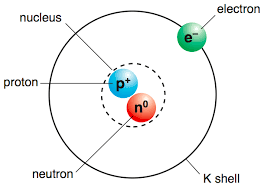
The positive particles of an atom are 
a)
electrons 
b)
positrons 
c)
neutrons 
d)
protons 
22.
the central region of an atom where its neutrons and protons are is its 
a)
nucleus 
b)
electron cloud
c)
core 
d)
center 
23.
an atom with atomic number 6 would have how many protons 
a)
6
b)
12
c)
3
d)
cannot be determined 
24.
Particles in an atom that are neutral and have no charge are 
a)
negatrons 
b)
electrons 
c)
neutrons 
d)
protons 
25.
A particle that moves around the nucleus is a(n)...
a)
Proton
b)
Neutron
c)
Electron
d)
Quark
26.

If an atom has 12 protons, which of the following must it also have to be considered a neutral atom?

a)

12 neutrons

b)

12 electrons

c)

12 protons

d)

24 protons and neutrons

27.
If an atom has 10 protons, 10 neutrons, and 10 electrons, what is the mass of the atom?
a)
10
b)
20
c)
30
28.

What charge does an atom have when it GAINS electrons?

a)

Positive

b)

Negative

c)

Neutral

29.

What two particles determine the mass number?

a)

Protons and electrons

b)

Electrons and neutrons

c)

Protons and neutrons

30.

When an atom loses an electron, it becomes a(n) _____________ ion.

a)

positive

b)

negative

c)

neutral

d)

polyatomic

31.

If the mass number of this chlorine atom is 36, how many neutrons does it have?

a)

17

b)

18

c)

19

d)

can't be determined

32.

Most of the mass of an atom is found in the ______.

a)

nucleus

b)

proton

c)

electron cloud

d)

isotope

33.
Two atoms of the same element but with different mass numbers are called________
a)
electrons
b)
isotopes
c)
variables
d)
electron cloud
34.

What are the 3 subatomic particles of an atom?

a)

carbon atom, proton, electron

b)

quarks, neutrons, protons

c)

nucleus, protons, electrons

d)

protons, neutrons, electrons

35.

Which subatomic particles contribute the least to the mass of an atom?

a)

Neutrons

b)

Protons

c)

Electrons

36.

Valence electrons are the number of

a)

protons in the atom

b)

electrons in the atom

c)

protons + neutrons in the nucleus

d)

electrons in the outside shell of the atom

37.
What particle uniquely identifies an element?
a)
Number of Valence Electrons
b)
Number of Protons
c)
Number of Electrons
d)
Atomic Mass
38.
4.35% of all X atoms have a mass of 39.946 amu. 83.79% have a mass of 41.941 amu, 9.50% have a mass of 42.941 amu, and 2.36% have a mass of 43.939 amu. What is the average atomic mass of atom X?
a)
41.97 amu
b)
42.19 amu
c)
10.43 amu
d)
40.04 amu
39.
24.1% of all the isotopes of a an element have a mass of 75.23 amu, 48.7% have a mass of 74.61 amu, and 27.2% have a mass of 75.20 amu.
What is the average mass of this element?
a)
74.92 amu
b)
24.97 amu
c)
75.01 amu
d)
74.51 amu
40.
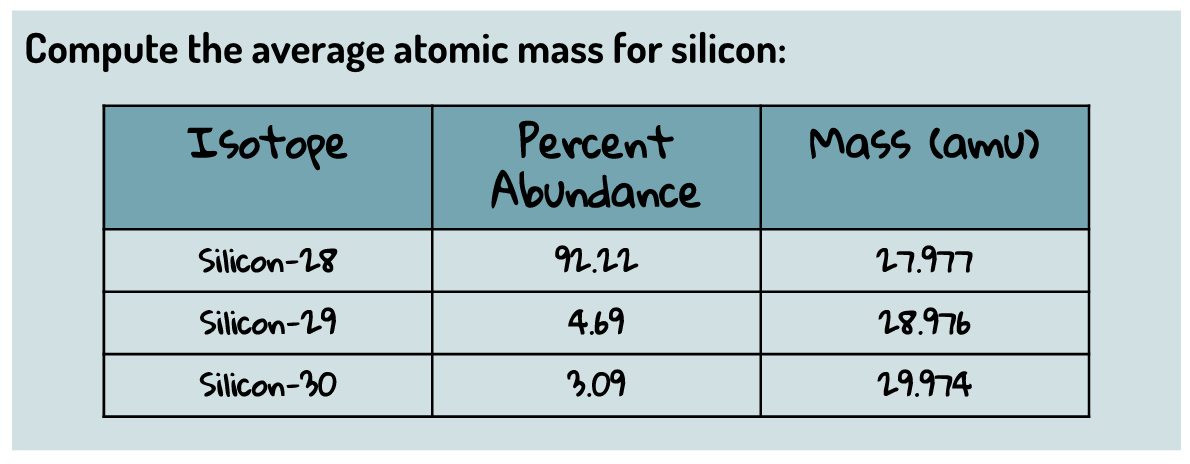
Compute the average atomic mass for silicon:
a)
27.977
b)
28.09
c)
28.976
d)
The average mass cannot be determined from provided information.
41.
Which of these is a property of metals?
a)
It's malleable
b)
It can't conduct electricity
c)
They are used in food
d)
It's very brittle
42.
Which of these grouping of elements could have the characteristic of brittle?
a)
Metal
b)
Nonmetal
43.
Which of the following is a good conductor of heat?
a)
Metal
b)
Nonmetal
c)
Metalloid
44.
Some characteristics of a metal are that it is malleable and ductile.
a)
TRUE
b)
FALSE
45.
If a material can easily be drawn into the shape of a wire, it is
a)
Ductile
b)
Magnetic
c)
Malleable
d)
Reactive
46.
Which elements are found on the left to middle of The Periodic Table? 
a)
Metals
b)
Nonmetals
c)
Metalloids
d)
Candles
47.
Silicon is a semiconductor and has properties of both metals and nonmetals. What type of element is Silicon? 
a)
Metal
b)
Nonmetal
c)
Metalloid
d)
Pretty
48.
Which elements are found on the right side of The Periodic Table?
a)
Metals
b)
Nonmetals
c)
Metalloids
d)
Water
49.
All of these properties describe metals except...
a)
malleable
b)
conductors
c)
brittle 
d)
shiny
50.

Which of the following groups does iron belong to?

a)

Alkali metals

b)

Alkaline earth metals

c)

Transition metals

d)

Halogens

51.

Which of the following groups of elements are considered perfect in their electronic structure and are inert.

a)

Noble gases

b)

Halogens

c)

Alkali metals

d)

Alkaline earth metals

52.

Which of the following groups of elements contain the most reactive nonmetals?

a)

noble gases

b)

halogens

c)

transition elements

53.

Which of the following elements are found in compounds in nature and lose two electrons when bonding?

a)

Alkaline earth metals

b)

Alkali metals

c)

Transition metals

d)

Halogens

54.

Which of the following group of elements are known for their brightly colored compounds and have multiple oxidation states?

a)

transition metals

b)

alkali metals

c)

alkaline earth metals

d)

halogens

55.

Which of the following group of elements has an oxidation state of +1?

a)

Alkali metals

b)

Alkaline earth metals

c)

Halogens

d)

Transition metals

56.

Which of the group of elements contain all gases?

a)

Noble gases

b)

Halogens

c)

Transition elements

57.

Which of these elements is a halogen?

a)

Iodine

b)

argon

c)

silver

d)

boron

58.

Which of these elements is an alkaline earth metal?

a)

sodium

b)

sulfur

c)

silver

d)

strontium

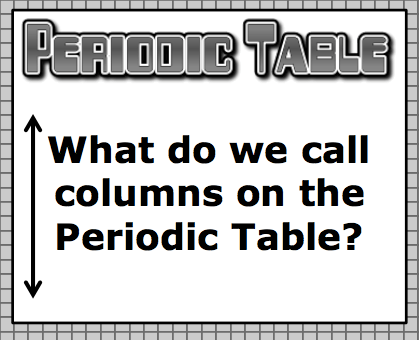
59.
a)
Periods
b)
Groups
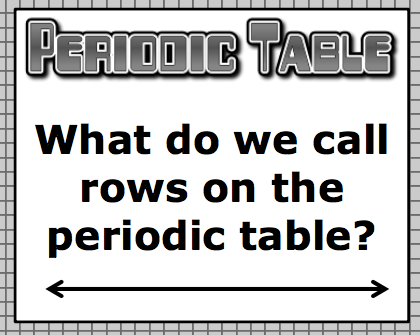
60.
a)
Periods
b)
Groups
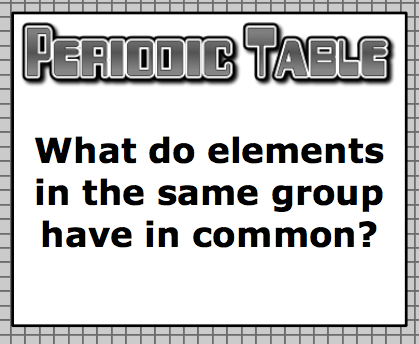
61.
a)
energy levels
b)
valence electrons
c)
protons
d)
neutrons
62.
a)
energy levels
b)
valence electrons
c)
protons
d)
neutrons
63.
Where are the nonmetals located on the periodic table?
a)
top left corner
b)
bottom left corner
c)
top right corner
d)
bottom left corner
64.
How did Mendeleev arrange the elements?
a)
alphabetical 
b)
density
c)
melting point
d)
atomic mass
65.
What is the electron configuration for this atom?
a)
1s22s22p6
b)
1s22s22p5
c)
1s22s22p3
d)
2s22p3
66.
What atom matches this electron configuration?
1s22s22p63s2
a)
Neon
b)
Magnesium
c)
Aluminum
d)
Potassium
67.
Which element is depicted from this orbital diagram
a)
Fluorine
b)
Neon
c)
Chlorine
d)
Argon
68.
Which is associated with more energy? 
a)
2p
b)
2s
c)
3p
d)
1s
69.
Anions are _______ that form ____________ ions and __________ electrons.
a)
nonmetals, positive, lose
b)
nonmetals, negative, gain
c)
metals, positive, gain
d)
metals, positive, lose
70.
Which element is pictured?
a)
neon
b)
fluorine
c)
magnesium
d)
argon
71.
What atom matches this electron configuration?
1s2s2p3s2
a)
Neon
b)
Magnesium
c)
Aluminum
d)
Potassium
72.
How many electron can be found in a s orbital?
a)
2
b)
3
c)
4
d)
1
73.
How many electron can be found in a p orbital?
a)
2
b)
3
c)
4
d)
6
74.
What is the electronic configuration of iron?
a)
1s22s22p63s23p64s23d6
b)
1s22s22p63s23p63d8
c)
1s22p63s23p64s23d6
d)
1s22s22p63s23p64s13d6
75.
Which electron configuration belongs to Chlorine (Cl)?
a)
1s2s2p3s3p5
b)
1s2s2p3s3p6
c)
1s2s2p3s3p7
76.
What atom matches this electron configuration?
1s22s22p63s23p64s23d10
a)
Zinc
b)
Copper
c)
Nickel
d)
Germanium
77.
What is the formula for aluminum fluoride?
a)
AlF
b)
Al2F3
c)
AlF3
d)
Al3F2
78.
A chemical bond resulting from the electrostatic attraction between positive and negative ions is called a(n)
a)
covalent bond.
b)
ionic bond.
c)
charged bond.
d)
dipole bond.
79.
When metals bond with non-metals they form what type of bonds
a)
covalent
b)
ionic
c)
cooperative
d)
lewis
80.
If my charge becomes 2+ what does that say about me?
a)
I am stealing 2 electrons
b)
I am losing 2 electrons
c)
I am in period 2
d)
I have an atomic # of 2
81.
If I gain electrons I become
a)
Positive because I've added to my atom
b)
negative because I've added electrons
c)
same because i'm balanced
d)
equal because now I have electrons
82.
What is the correct formula for the compound, lithium oxide?
a)
LiO
b)
Li2O
c)
LiO2
d)
Li2O2
83.
The name for CrN:
a)
Chromium nitride
b)
Chromium (I) nitride
c)
Chromium (III) nitride
d)
Chromium nitride (III)
84.
The oxidation number for Fe in Fe2O3:
a)
+2
b)
+3
c)
+1
d)
-2
85.
The oxidation number for copper in Cu2S:
a)
+1
b)
+2
c)
-1
d)
-2
86.
Which is not a pattern of covalent compounds?
a)
they end in -ide
b)
they have Roman Numerals
c)
they have nonmetals only
d)
they have prefixes
87.
What does the Roman Numeral in the name of a multivalent compound represent?
a)
the charge on the anion
b)
the charge on the cation
c)
the number of cations
d)
the number of metal ions
88.
KNO3 is used in fertilizers as a source of potassium and nitrogen. If you want to buy fertilizer with this compound, what chemical name should you look for?
a)
potassium nitrate
b)
potassium nitrite
c)
potassium nitride
d)
potassium nitrogen
89.
What is the name of PdO2?
a)
palladium (IV) oxide
b)
palladium oxygen
c)
palladium oxide
d)
palladium (II) oxide
90.
What is the name of Si2Cl6?
a)
disilicon hexachlorine
b)
disilicon hexachloride
c)
silicon hexachloride
d)
silicon chloride
91.

A tightly-bound group of atoms that is covalently bonded, yet carries a net charge:

a)

monatomic ion

b)

polyatomic ion

92.

Which of the following compounds contains the lead(II) ion?

a)

PbO

b)

PbCl4

c)

Pb2O

d)

Pb2S

93.

What is the correct name for the compound CoCl2?

a)

cobalt(I) chlorate

b)

cobalt(I) chloride

c)

cobalt(II) chlorate

d)

cobalt(II) chloride

94.
The formula for magnesium cyanide is...
a)
Mg(CN)2
b)
MgCN2
c)
MgCN
d)
(Mg)2CN