wayground logo

Free Printable Worksheets

NEW

Font size

S
M
L
XL
Worksheets

Ecology Test Review CMSS 21

Total questions: 74

Worksheet time: 1hrs 2mins

Name
Class
Date
1.

Photosynthetic plants are what part of a food web?

a)

tertiary consumers

b)

secondary consumers

c)

producers

d)

primary consumers

2.

The diagram pictured shows what?

a)

A food chain

b)

A food web

c)

A food pyramid

d)

A biomass pyramid

3.

An organism that gains energy by eating another organism is called a what?

a)

autotroph

b)

heterotroph

c)

omnitroph

d)

detrititroph

4.
Environmental factor, such as predation, disease, and competition, that depends on the number of members in a population per unit area.
a)
density-independent factor
b)
density-dependent factor
c)
emigration
d)
immigration
5.
Environmental factor, such as storms and extreme heat or cold, that affects populations regardless of their density.
a)
density-independent factor
b)
density-dependent factor
c)
emigration
d)
immigration
6.
Movement of individuals from a population
a)
density-independent factor
b)
density-dependent factor
c)
emigration
d)
immigration
7.
Largest number of individuals in a species that the environment can support long-term.
a)
population delpunsity
b)
dispersion
c)
population growth rate
d)
carrying capacity
8.
Increasing concentration of toxic substances, such as DDT, in organisms as trophic levels increase in food chains or food webs
a)
Edge Effect
b)
Habitat Fragmentation
c)
Biological Magnification
d)
Eutrophication
9.

What is the original source of energy in most ecosystems?

a)

carbohydrates

b)

sunlight

c)

water

d)

carbon

10.
symbiotic relationship in which both organisms benefit
a)
competition
b)
Mutualism
c)
nitrogen fixation
d)
energy pyramid
11.
A living relationship between two species in which one organism is harmed is called...
a)
mutualism
b)
commensalism
c)
parasitism
d)
niche
12.

The amount of energy that transfers from one trophic level to the next...

a)

10%

b)

20%

c)

80%

d)

50%

13.

A living organism that puts materials from dead organic matter back to the soil is called a ____________?

a)

carnivore

b)

decomposer

c)

herbivore

d)

omnivore

14.
Commensalism is where one organism is benefiting and the other organism is _____________________. 
a)
not effected
b)
helped
c)
harmed
d)
hurt
15.

1. A bee and a flower work together to benefit each other. This is an example of _________________. The bee helps the flower by pollinating it and the flower helps the bee by providing it with nectar.

a)

commensalism

b)

parasitism

c)

mutualism

16.
A clown fish and a sea anemone are in a close relationship. The sea anemone provides shelter and protection for the clown fish. However, the sea anemone is not harmed. This is an example of  ______________________. 
a)
commensalism
b)
parasitic relationship
c)
mutualism 
17.
Which of the following would be the most likely effect, if there were a sudden increase in the cricket population?
a)
There would be a decrease in the small bird population.
b)
There would be a decrease in the grass/flowers population.
c)
There would be a decrease in the mice population.
d)
There would be an increase in the grass/flowers population.
18.
Which is NOT an abiotic factor:
a)
soil
b)
air
c)
bacteria;
d)
water
19.
A herd of rhinos live in an area of the savanna that has a carrying capacity of 25.  What could happen if 7 additional rhinos immigrated into the existing herd?
a)
There will be enough food, water, and shelter for all of the rhinos.
b)
There will be no change in the ecosystem from the original 25 rhinos.
c)
The food, water and shelter will be limited and could cause emigration and competition.
d)
The rhinos will have to immigrate and leave the existing savanna.
20.
A __________ includes all living and non-living things in an environment. 
a)
population
b)
niche
c)
abitotic
d)
ecosystem
21.
Field mice eat corn. Which would most likely happen if the field mouse population grew?
a)
There would be more corn to feed the field mice.
b)
There would be less corn due to the mice eating it.
c)
The habitat would get overpopulated because the mice woudl eat too much.
22.
Which represents the largest group in a food web?
a)
carnivores
b)
omnivores
c)
herbivores
d)
producers
23.
Examples of how humans negatively affect local ecosystems are
a)
Building dams, deforestation (cutting down trees), adding point sources to nearby streams to allow for run-off, building roads and structures, and salting roads.
b)
Creating laws to prohibit fishing from local streams.
c)
Planting trees and other plants to attract native species.
d)
Removing non-native species from the environment.
24.
In a grassland ecosystem, lions prey on wildebeest. The population of lions has declined steadily because of illegal hunting. What will most likely happen to the population of wildebeest?
a)
The wildebeest population will increase
b)
The wildebeest population will decrease
c)
The wildebeest population will remian the same
25.
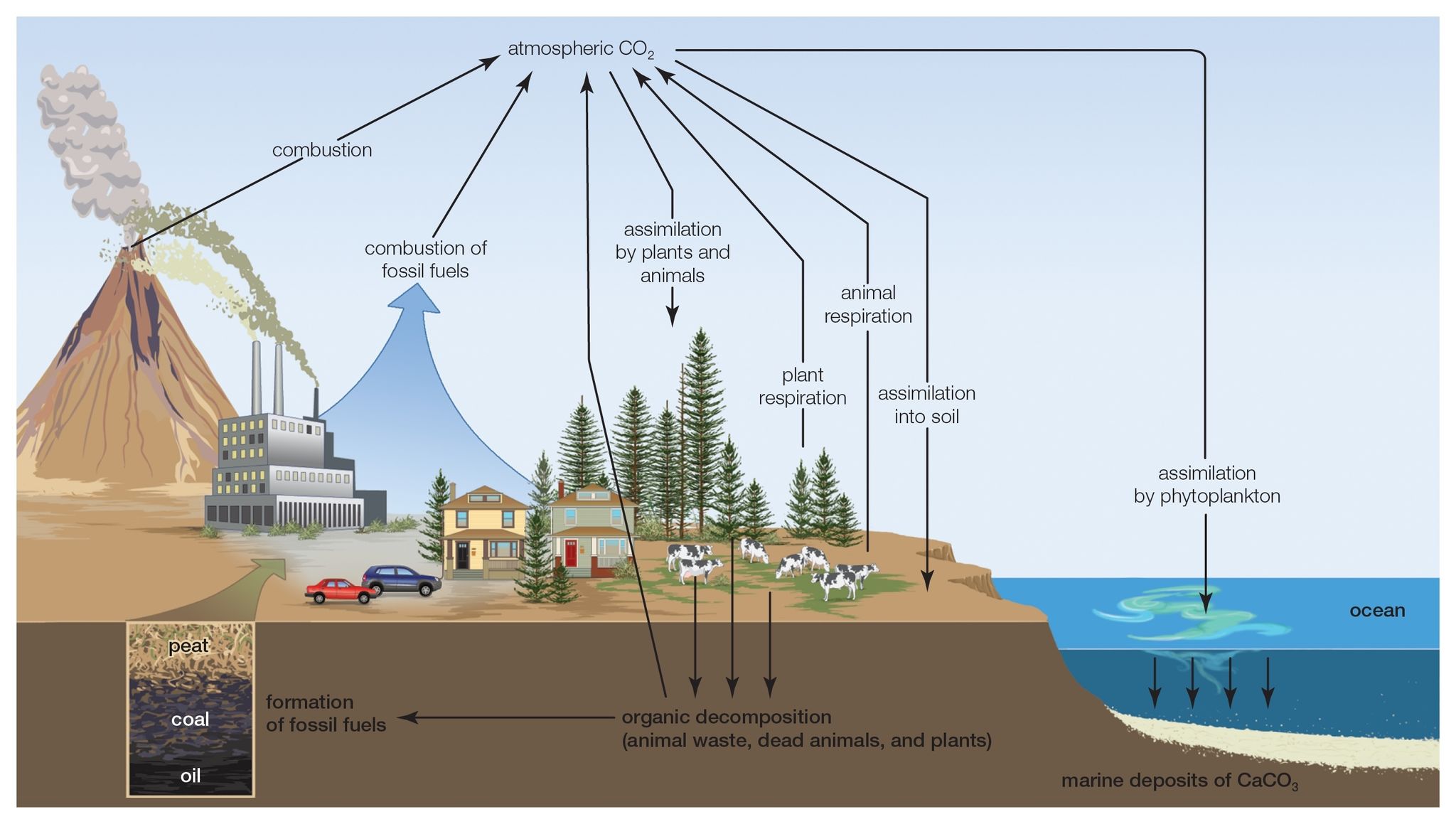
Which of the following add carbon dioxide to the atmosphere?
a)
volcanoes
b)
combustion of fossil fuels
c)
animal and plant respiration
d)
all of these
26.
How nitrogen is "fixed" into useable form for plants
a)
only through action of bacteria
b)
only through lightning
c)
through action of bacteria & lightning
d)
through photosynthesis
27.

Eutrophication causes

a)

A decrease in phytoplankton

b)

algae bloom and decrease of oxygen the killing of fish

c)

water to get healthier

28.

What happens if a population grows past its carrying capacity?

a)

The population keeps growing

b)

The population starts to die off

c)

The entire species will go extinct

d)

The carrying capacity just increases

29.
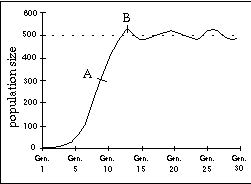
What is the carrying capacity of the graph?
a)
around 500
b)
more than 500
c)
less than 500
d)
around 600
30.

How does carbon dioxide leave the atmosphere?

a)

Through transpiration

b)

Through photosynthesis

c)

Through factory emission

d)

Through respiration

31.
Plants and animals cannot use nitrogen directly from the air.
a)
True
b)
False
32.
Which nutrient is not cycled through the atmosphere?
a)
carbon
b)
nitrogen
c)
phosphorous
d)
water
33.
Maria and her classmates are observing animals at the pond. They notice that wood storks and ibisies both feed on fish. Which of these describes the relationship between these two birds.
a)
Parasitism
b)
Competition
c)
Predator and prey
d)
Producer and consumer
34.

Which symbols best describe commensalism?

a)

+,+

b)

+,-

c)

+,0

d)

-,0

35.

If the amount of food or resources available increases, the carrying capacity for an animal.....

a)

Stays the same

b)

Increases

c)

Decreases

d)

Fluctuates

36.

Which type of growth is best illustrated by this rabbit population?

a)

exponential

b)

logistic

c)

S-shaped

d)

predator-prey

37.

Water, sunlight, shelter, and space are resources that are often........

a)

abiotic limiting factors

b)

biotic limiting factors

c)

non-limiting factors

d)

exponetial factors

38.

According to the graph, what is causing the deer population to decrease

a)

They got sick

b)

The wolf population is decreasing

c)

The wolf population increased

d)

They ran out of food

39.

Predator population lags behind prey population because......

a)

Increase in predators leads to decrease in prey

b)

Increase in predators leads to increase in prey

c)

Increase in predators leads to decrease in producers

d)

Increase in producers leads to increase in prey

40.

Which organism in the food web would

contain the highest concentration of chemical pollutants?

a)

producers

b)

primary consumers

c)

secondary consumers

d)

tertiary consumers

41.

Which organism shown in the food chain above would contain the greatest concentration of chemical pollutants?

a)

phytoplankton

b)

krill

c)

tuna

d)

shark

42.
The ozone layer protects us from
a)
UV rays
b)
CFCs
c)
Increased atmospheric heat
d)
Decreased atmospheric heat
43.
The ozone layer is damaged by
a)
CFCs
b)
Increase in greenhouse gases
c)
Increased global temperatures
d)
Sulfuric and nitric acids
44.
Increase in which gas is primarily responsible for increased global warming?
a)
Carbon dioxide
b)
Water vapor
c)
Methane
d)
Nitric oxides
45.
Kudzu has overgrown many parts of southern Missouri and native ground plants have disappeared from the area. This is an example of:
a)
Parasitism between kudzu and the native plants
b)
A predator prey relationship between ground plants and kudzu
c)
Competition occurring between the native and invasive species
d)
Commesalism occurring between the kudzo and native plants
46.

Why do the populations of invasive species grow so quickly?

a)

Invasive Species are native to an area.

b)

Invasive species are prey to many animals.

c)

Invasive species have no natural predators.

d)

Invasive species keep the ecosystems in equilibrium.

47.

Click on the map to help answer this question: What can we predict about the population of Feral Swine for the year 2016?

a)

There will be less feral swine in 2016 than there were in 1982.

b)

There will be more feral swine in 2016 than there were in 2010

c)

There were fewer feral swine in 2004 than 1982.

d)

There will be no change in feral swine population.

48.
2 factors which decrease population size
a)
Birth Rate, Immigration
b)
Death Rate, Immigration
c)
Birth Rate, Emigration
d)
Death Rate, Emigration
49.
How much energy is passed on to each trophic level in an energy pyramid?
a)
10%
b)
90%
c)
50%
d)
80%
50.
If grass stores 1,000 energy units received from the sun, the ecological efficiency of the ecosystem is 10% and the trophic levels are grass → cow → human, how many units of energy does the human receive of the original 1,000 units?
a)
1
b)
10
c)
100
d)
200
51.
When would convergent evolution occur?
a)
When organisms share a common ancestor
b)
When organisms live in similar environments
c)
When organisms become increasingly different
d)
When organisms experience a change in their environment
52.
Bird wings and butterfly wings are an example of
a)
Homologous structure
b)
Analogous structure
c)
Mimicry
d)
Camoflague
53.
Individuals with favorable traits survive, reproduce, and pass their traits onto their offspring. This is called
a)
Mutation
b)
Adaptation
c)
Evolution
d)
Natural Selection
54.
Mutations are important because they bring about
a)
death of the organism in which they develop
b)
genetic variation needed for a population to evolve
c)
benefits for the individual, not for the population
d)
Hardey-Weinberg equilibrium within a population
55.
Which of the following is NOT an example of natural selection? 
a)
People selectively breeding hamsters.
b)
Insect populations developing resistance to certain pesticides.
c)
Bacteria becoming resistant to antibiotics.
d)
Male birds of certain species developing colorful feathers to attract female mates.
56.

Which of the following is an example of natural selection?

a)

Bald Eagles are hunted until near extinction, population recovers.

b)

Small group of iguanas floats to an island, starts a new population.

c)

Red fox pups are more likely to survive in a snowy environment if they are born white.

d)

Farmer chooses seeds from largest apples to plant next year. This results in larger apples from year to year.

57.

The scientific name for water bear is Hypsibius dujardini. What is its genus?

a)

Hypsibius

b)

dujardini

c)

water

d)

tardigrade

58.
Who is the closest relative to the birds?
a)
crocodiles
b)
sharks
c)
fish
d)
amphibians
59.
Which organism is MOST closely related to the common chimpanzee?
a)
grey wolf
b)
human
c)
monarch butterfly
d)
tiger snake
60.
Organisms that belong to the same _________ share the MOST DNA.
a)
family
b)
kingdom
c)
genus
d)
species
61.

The scientific name of a cherry blossom tree is Prunus yedoensis. What is its genus?

a)

Plantae

b)

Prunus

c)

Yedoensis

d)

Felis

62.

The scientific name for an organism comes from its _____.

a)

class and phylum

b)

family and species

c)

kingdom and phylum

d)

genus and species

63.
A flash flood carried a raft of Amazon ants away from their original population. There is enough distance between the two groups, that they will never meet in nature again. What type of reproductive barrier is this?
a)
behavioral isolation
b)
temporal isolation 
c)
gametic isolation
d)
geographic isolation 
64.

In the Great Lakes region of North America, gray wolves and coyotes are similar species but do not mate because their breeding periods occur at different times of the year.

a)

Geographic isolation

b)

Behavioral isolation

c)

Temporal isolation

65.
The method of naming organisms by using two names is known as
a)
binomial nomenclature
b)
dinomial menoclature
c)
dichotomous naming
d)
the scientific method
66.

An animal that lowers its metabolism during heat or drought (like a mouse in the desert) or covers itself in slime to prevent itself from drying out is using the innate behavior:

a)

Ick Factor

b)

migration

c)

estivation

d)

hibernation

67.

Which behavior is genetically based and NOT linked to past experiences?

a)

innate behavior

b)

habituation

c)

operant conditioning

d)

classical conditioning

68.

Canada geese fly south in fall to find food. In spring they fly back up north to have their young. What type of behavior is this?

a)

defense

b)

hibernation

c)

courtship

d)

migration

69.

The viceroy butterfly looks almost identical to the toxic Monarch butterfly, protecting it from predators. What is this called?

a)

hibernation

b)

migration

c)

camouflage

d)

mimicry

70.

A moth that moves towards a light at night is an example of:

a)

phototaxis

b)

chemotaxis

c)

migration

d)

estivation

71.

Which of the following is the correct order from broadest to smallest?

a)

Kingdom, Class, Order, Family, Genus, Species, Phylum

b)

Species, Genus, Family, Order, Class, Phylum, Kingdom

c)

Kingdom, Phylum, Order, Class, Family, Genus, Species

d)

Kingdom, Phylum, Class, Order, Family, Genus, Species

72.

Which of the following is the correct way to show the scientific name for tiger?

a)

Panthera Tigris

b)

Panthera tigris

c)

panthera Tigris

d)

panthera tigris

73.

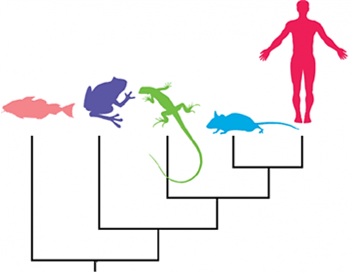
According to this phylogenetic tree, which creature is the least related out of all pictured?

a)

Fish

b)

Frog

c)

Salamander

d)

Human

74.

Identify leaf F

a)

Cydonia

b)

Magnolia

c)

Aesculus

d)

Fraxinus

e)

Ilex