
 Worksheets
Astronomy Spectral Analysis Unit Quizziz
Total questions: 100
Worksheet time: 2hrs 14mins

Each element produces its own pattern of emission spectra lines because each element has its own distinct
Speed of light
Electron configuration
Number of neutrons
None of these

The color of emitted light with the LONGEST wavelength is
violet
green
red
indigo
The color of emitted light with the SHORTEST wavelength is
violet
green
red
indigo

This device is a
telescope
spectrascope
microscope
prism
The color of emitted light with the HIGHEST frequency is
violet
green
red
indigo
The color of emitted light with the LOWEST frequency is
violet
green
red
indigo

The unknown emissions spectra belongs to the element
Hydrogen
Mercury
Neon
Sodium

The unknown emissions spectra belongs to the element
Hydrogen
Mercury
Neon
Sodium

The unknown emissions spectra belongs to the element
Hydrogen
Mercury
Neon
Helium
A wave with a long wavelength will have a ______ frequency and _____ energy
high, low
high, high
low, high
low, low

What is the reaction involved if the electron moves from position 1 to 2?
Light will be emitted
Light will be absorbed
The electron will become less excited
The electron will decrease a quantum

The electron moves from position 1 to 2. How does the state of the electron shift during this reaction?
The electron becomes less excited.
The electron returns to the ground state.
The electron becomes more excited.
Light is emitted
A particle of visible light or other electromagnetic radiation is called a....
Packet
Photon
Hubble Unit
AU
A wave consisting of alternating electric and magnetic energy is called...
Gravitational Wave
Tidal Wave
Insular Wave
Electromagnetic Wave

What is the distance from crest to crest or trough to trough of any given wave?
Wavelength
Crest Length
Photon
Trough Length
When the light source and the observer move away from each other, which color shift occurs?
Blueshift
Redshift
Light is considered a...
particle
electron
wave
Both wave and particle
When the light source and observer are moving closer together, which color shift occurs?
Blueshift
Redshift
Spectra of light with black lines
Absorbance Spectra
Emission Spectra
Continuous Spectra
The hotter an object is, the brighter it is.
Newton's Law
Wein's Law
Kirchhoff's Law
Stefan's Law
As an object increases in temperature, the average wavelength of the light it emits gets shorter.
Newton's Law
Wein's Law
Kirchhoff's Law
Stefan's Law
Cold gases absorb specific wavelengths of light. When they are hot enough to emit light, they emit the wavelengths they absorbed when cold.
Newton's Law
Wein's Law
Kirchhoff's Law
Stefan's Law
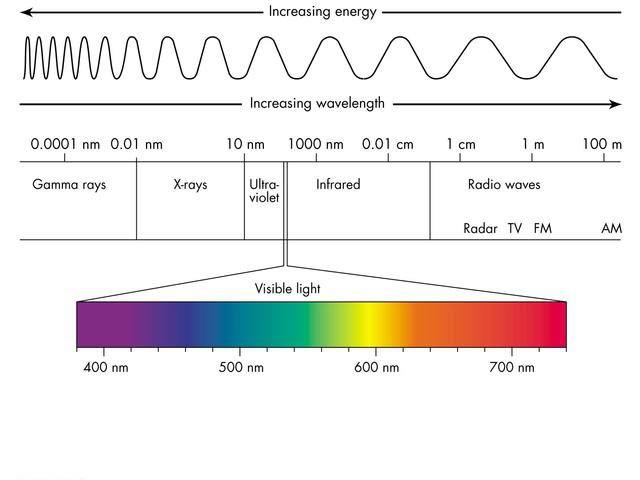
What is the correct order of the visible light spectrum starting with the longer wavelength?
Red, yellow, orange, blue, violet, indigo
Violet, indigo, blue, green, yellow, orange, red
Green, yellow, blue, indigo, red, orange
Red, orange, yellow, green, blue, indigo, violet


How do scientists know that stars are moving?
The Doppler Effect
Emission Lines
Radio Waves
The Electromagnetic Spectrum
How do scientists know what stars are made of?
The Doppler Effect
Emission Lines
Radio Waves
The Electromagnetic Spectrum

Emission spectra result from ________________ gas.
hot, low-density
hot, high-density
cool, low-density
cool, high-density
Absorption spectra result from ________________ gas.
hot, high-density
hot, low-density
cool, high-density
cool, low-density


What evidence did you observe that proves that elements give off their own unique color spectrum?
All of the gas tubes produced a full spectrum. (A rainbow.)
When we looked at white light through a prism, we saw the rainbow.
Each gas tube gave off its own unique color and color spectrum when we looked at the light through the spectroscope. None of them were the exact same.
Each gas tube gave off the same color and color spectrum when we looked at the light through a spectroscope.


Which section of the electromagnetic spectrum is the ONLY one we can see?
X-rays
Visible Light
Gamma Rays
Ultraviolet Rays

We primarily use __________ to find information about the temperature of high-density material.
absorption spectra
blackbody curves
emission spectra
laser oscillators
We primarily use emission/absorption spectra to identify ____________ of stars.
composition
temperature
luminosity
frankfurter

The peak wavelength on a wavelength vs intensity graph corresponds to?
The photon of light with the longest emission emitted
The wave of light with the highest energy that any star can emit
The color/wavelength of light that is emitted the most by a star
The highest wavelength/color of light a star emits
Black bodies emitters are objects whose color is only dependent on the _____________ of the object.
size
temperature
distance
composition

Which of the statements below is true for the emission spectra
The emission is only in the visible region
The peak intensity increases with temperature
The peak intensity decreases with temperature
The peak frequency decreases with temperature
The peak wavelength increases with temperature

Five emission spectra for five identical objects are shown in the figure below. the higest temp is for graph________________ and the object that has peak at lowest energy is _________
A and B
A and F
B and F
C and B
which type of EMR is between infrared and ultraviolet on the spectrum?
visible
microwaves
gamma rays
radio waves
which of these types of EMR has the highest energy?
microwaves
radio waves
infrared
ultraviolet

which of these blackbody radiation curves is peaking in the visible part of the spectrum?
a
b
c

which of these is a continuous spectra?
a
b
c
which of these types of EMR has the longest wavelength?
x-ray
radio waves
infrared
ultraviolet
which of these spectra is created by the emission of light?
a
b
c
which of these blackbody radiation curves is created by the object with the highest energy?
a
b
c
which of these blackbody radiation curves is created by the object with the longest wavelength light?
a
b
c
which of these is an absorption spectra?
a
b
c
Because of limited human senses, which type(s) of radiation are we most well equipped to observe?
visible
visible, x-ray and ultraviolet
visible, infrared and gamma
visible, microwaves and infrared

which elements are present in this star?
magnesium and calcium
magnesium and hydrogen
iron and magnesium
iron and hydrogen


If astronomers examine the spectral lines of a distant galaxy and saw that they displayed a blue shift, what would this mean about the motion of the galaxy?
The galaxy is not moving.
The galaxy is moving toward Earth.
The galaxy is moving away from Earth.
The galaxy is shifting back and forth at 650 Thz, the frequency of blue light.
Astronomers examine the spectra from a distant galaxy and find that the spectra exhibit a red Doppler shift. What does this mean about the galaxy?
The galaxy is not moving.
The galaxy is moving away from Earth.
The galaxy contains mostly red giant stars.
The galaxy is a spiral galaxy.

(Q4) If you pointed an infrared sensor at the sun, would you be able to detect it? (Does the sun produces infrared energy?)
Yes, we also feel the infrared energy as warmth on our skin.
No.

(Q5) If you pointed an ULTRAVIOLET sensor at the sun, would you be able to detect it? (Does the sun produces UVenergy?)
Yes, that is why we get sunburns.
No.
In the simulation, as you go from low temperature objects (like the Earth) to high temperature objects (like the star Sirius A), what happens to the color produced?
It transitions from not emitting light, to emitting red light, then yellow, green, and lastly violet / blue.
It transitions from emitting blue light (the Earth), to emitting red light, then yellow, and lastly violet / blue.
Objects go from being blue to green to red as they heat up.

How can light (radiation) best be described?
by using wavelengths only
as having different frequencies
something that can be measured
energy that travels through space

What color would this object glow if it were heated to 5,000 K?
Green
Yellow
Red
Infrared

What happens to the color this object is glowing with as it cools down from 5,000 K?
It goes from yellow to white to blue.
It goes from yellow to orange to red.
It goes from infrared to white to blue.
It goes from ultraviolet to infrared to red.
An ambulance is driving towards you as you stand on the sidewalk. What happens to the pitch of the siren as it comes towards you?
It increases
It decreases
You are standing on the side of the road when a police car races past you with its siren on. After the police car passes you, what happens to the pitch of the siren?
It increases
It decreases
It turns red
An astronomer looks at a star in the night sky. Based on his calculations the star's light is shifting towards the color blue. What does this mean about the star?
It's moving towards the astronomer
It's moving away from the astronomer
It's not moving at all
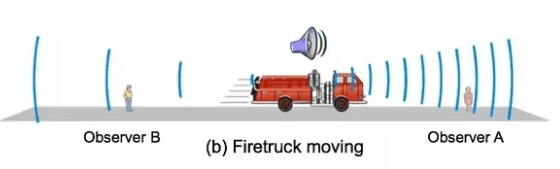
Look at the picture. Who is experiencing a higher pitched sound?
Observer A
Observer B
There's no difference
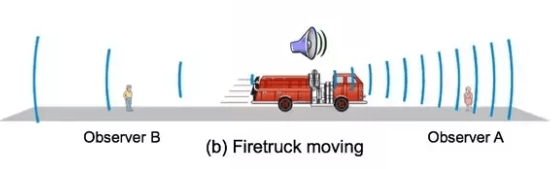
Look at the picture. Who is experiencing a lower pitched sound?
Observer A
Observer B
There is no difference
the doppler effect causes a shift in...
pitch
wavelength
frequency
All of the above
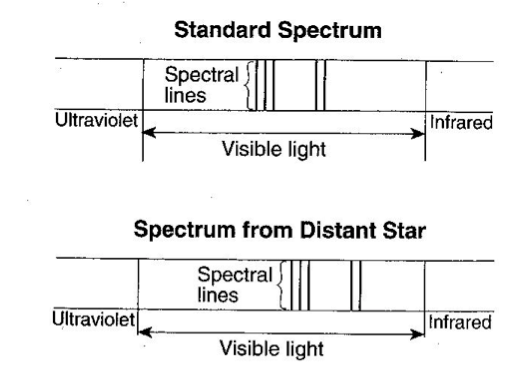

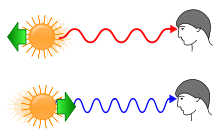
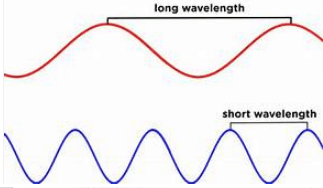
What happens to the wavelengths of energy if they are moving AWAY from a source?
The waves stretch out and get longer.
The waves compress and get shorter.

What is the doppler effect?
a change in the frequency of sound, light or other waves to cause a change in pitch
A change in pitch that causes frequency, sound, light and other waves to disappear
I have no idea
A change in sound that alters frequency

