

wayground logo

Free Printable Worksheets

NEW

Font size

S
M
L
XL
Worksheets

Science Review-Quarters 1-2.5

Total questions: 60

Worksheet time: 1hrs 2mins

Name
Class
Date
1.
A __________ is a chunk of ice & dust that has a bright head & a long narrow tail.
a)
asteroid
b)
planet
c)
meteoroid
d)
comet
2.
The ______is between the orbits of Mars & Jupiter.
a)
solar system
b)
asteroid belt
c)
terrestrial planets
d)
photosphere
3.
A force of attraction between any two objects is called _____________.
a)
static electricity 
b)
rotation
c)
gravity
d)
orbit
4.
How long does it take Earth to complete one revolution around the Sun?
a)
24 hours
b)
one week
c)
one month
d)
one year
5.
Earth completes one full ___________ on its axis every 24 hours.
a)
rotation
b)
revolution
c)
resolution
d)
reservation 
6.
Select the order from smallest to largest.
a)
Sun, Milky Way, solar system, universe
b)
Sun, Milky Way, universe, solar system
c)
Sun, solar system, Milky Way, universe
d)
Sun, solar system, universe, Milky Way
7.
Where is a meteorite located?
a)
In the atmosphere
b)
In outer space
c)
On the ground
8.
What is the correct order of the planets from the sun? 
a)
Mercury, Venus, Earth, Mars, Jupiter, Saturn, Uranus, Neptune.
b)
Mercury, Earth, Venus, Mars, Jupiter, Saturn, Uranus, Neptune.
c)
Mercury, Venus, Earth, Mars, Saturn, Jupiter, Uranus, Neptune. 
d)
Mars, Venus, Earth, Mercury, Jupiter, Saturn, Uranus, Neptune. 
9.
Which is the largest object in our solar system?
a)
Sun
b)
Jupiter
c)
Earth
d)
Pluto
10.
Which planet is farthest from the sun?
a)
Neptune
b)
Pluto
c)
Earth
d)
Uranus
11.

A group of solar systems that are held together by gravity and classified by shape is called a(n)

a)

solar eclipse

b)

star

c)

galaxy

d)

asteroid

12.

What can you conclude from this diagram?

a)

Earth is a satellite of the moon

b)

The sun revolves around Earth

c)

Earth and the moon rotate in different directions

d)

The moon orbits Earth while Earth orbits the sun.

13.

All the planets in the solar system orbit the sun. What is the main difference between the orbits of the inner and outer planets?

a)

The inner planets and outer planets orbit in different directions.

b)

The outer planets take longer to orbit the sun than the inner planets do.

c)

The inner planets travel a greater distance than the outer planets do.

d)

The outer planets rotate as they orbit the sun, and the inner planets do not.
14.
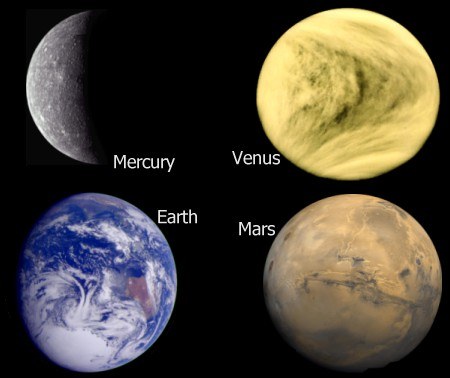
Earth and the other planets closest to the Sun are made mostly of _______
a)
gas
b)
metal
c)
water
d)
rock
15.
Where is the asteroid belt found?
a)
between earth and mars
b)
Between Uranus and Neptune
c)
Between Mercury and Venus
d)
Between Mars and Jupiter
16.
One of the main differences between the outer and inner planets is __________.
a)
The inner planets all have water
b)
the inner planets are much bigger than the outer planets
c)
the outer planets are gas planets
d)
the outer planets have rings, and the inner planets don't
17.
What is the big bang theory?
a)
A movie
b)
A planet
c)
A theory of how Jupiter will crash into Saturn
d)
A theory of how the Universe began
18.

Which model does this demonstrate?

a)

Geocentric

b)

Heliocentric

c)

Big Bang

d)

Steady State

19.

In which theory is the Sun in the center?

a)

Heliocentric

b)

Geocentric

c)

Big Bang

d)

Steady State

20.

Which theory is the OLDEST?

a)

Heliocentric

b)

Geocentric

c)

Big Bang

d)

They are all the same age.

21.

True or False: The Universe is still expanding today.

a)

True

b)

False

22.

I am known as the person who came up with the heliocentric model of the universe.

a)

Copernicus

b)

Ptolemy

c)

Galileo

d)

Hubble

23.
In the Northern hemisphere, the summer solstice occurs in 
a)
March
b)
June
c)
September
d)
December
24.
Earth has seasons because
a)
it has an axis
b)
the sun gets closer and farther from the sun
c)
axis is tilted as it moves around the sun
d)
the sun gets hotter
25.
In the Southern Hemisphere, the summer solstice is in 
a)
March
b)
June
c)
September
d)
December
26.
The tendency of a moving object to continue moving in a straight line or stay at rest is called
a)
orbital speed
b)
inertia
c)
gravity 
d)
mass
27.
The phase of the moon you see depends on
a)
where you are on Earth's surface
b)
how much of the sunlit side of the moon faces Earth
c)
if the moon is making its own light
d)
whether or not an eclipse is occurring.
28.
Earth spinning on its axis is 
a)
rotation
b)
revolution
c)
inertia
d)
phases
29.
When the moon is a full moon a(n) _______ eclipse can occur.
a)
solar
b)
lunar
30.
Which moon phases comes directly after a new moon?
a)
waning crescent
b)
waning gibbous 
c)
waxing crescent
d)
first quarter
31.
What phase of the moon is labeled 6?
a)
waning crescent
b)
waxing crescent
c)
waxing gibbous
d)
waning gibbous
32.
What moon phase is this picture?
a)
This is the full moon phase.
b)
This is the waxing gibbous moon phase.
c)
This is the waning gibbous moon phase.
d)
This is the first quarter moon phase.
33.
What moon phase is this picture?
a)
This is the new moon phase.
b)
This is the waxing crescent moon phase.
c)
This is the waxing gibbous moon phase.
d)
This is the waning crescent moon phase.
34.
What moon phase is this image?
a)
This is the full moon phase.
b)
This is the last quarter moon phase.
c)
This is the waxing gibbous moon.
d)
This is the new moon phase.
35.
What phase of the moon is this image?
a)
This is the last quarter moon phase.
b)
This is the full moon phase.
c)
This is the first quarter moon phase.
d)
This is the waxing gibbous moon phase.
36.
The cycle of the moon lasts about a _.
a)
day
b)
year
c)
week
d)
month
37.
Large body of air with the same temperature, pressure, and moisture characteristics is called?
a)
warm front
b)
cold front
c)
air mass
d)
jet stream
38.
Earth is unevenly heated due to its?
a)
oceans and moon
b)
tilt and shape
c)
gravity and clouds
d)
climate and weather
39.
The boundary between two air masses that meet is called?
a)
front
b)
back
c)
side
d)
air mass
40.
The layer of the atmosphere where weather occurs is the _.
a)
thermosphere
b)
stratosphere
c)
mesosphere
d)
troposphere
41.
The result of the weight of a column of air pushing down on an area is called _.
a)
altitude
b)
pressure
c)
density
d)
air pressure
42.
_____ climate is described as cold all year long and located in high latitudes.
a)
Polar
b)
Continental
c)
Dry
d)
Highland
43.
_______ climate is described as hot and wet, and is located in low latitudes.
a)
Tropical
b)
Dry
c)
Continental
d)
Moderate
44.
What kind of weather is a hurricane?
a)
severe weather
b)
not severe weather
45.
What is condensation?
a)
melting
b)
the climate of a region
c)
water vapor in the air that turns back into a liquid
46.
A liquid changes into a gas during _____.
a)
condensation
b)
precipitation
c)
evaporation
47.
What do you think will happen to a water puddle when the sun comes out and the temperature is warmer? 
a)
The water will turn into a gas.
b)
The water will turn into a solid.
c)
The water will turn into a liquid.
48.
What stage of the water cycle does number 1 in the picture show?
a)
condensation
b)
precipitation
c)
evaporation
d)
storage
49.
This front occurs when a warm air mass meets a cold air mass and stops.
a)
occluded front
b)
warm front
c)
stationary front
d)
cold front
50.
This front occurs when 3 air masses meet up forcing the warm air upward.
a)
occluded front
b)
stationary front
c)
warm front
d)
cold front
51.
Which air mass is forced upward at a front?
a)
cold air mass
b)
warm air mass
52.

Warm air masses are forced up when they meet a cold air mass. This is because the warm air mass is less......

a)

gravitational

b)

dense

c)

magnetic

d)

heavy

53.

What letter symbolizes a mid-ocean ridge?

a)

H

b)

G

c)

E

d)

B

54.

What letter symbolizes a seamount?

a)

B

b)

E

c)

G

d)

D

55.
What percentage of Earth's water is salt water?
a)
70-71%
b)
97%
c)
3%
d)
2%
56.
How much of the Earth is covered in water?
a)
70-71%
b)
97%
c)
3%
d)
2%
57.
What percentage of Earth's water is available in rivers, lakes, underground, and in the atmosphere?
a)
70-71%
b)
97%
c)
3%
d)
1%
58.
What is salinity?
a)
the amount of matter in a specific volume
b)
the degree of how hot or cold something is
c)
the landforms of the continent or the oceans
d)
how much salt is dissolved in a liquid
59.
Which number represents the Pacific Ocean?
a)
7
b)
2
c)
4
d)
9
60.
Which number represents the Arctic Ocean?
a)
7
b)
2
c)
4
d)
9
