Wayground logo

Free Printable Worksheets

Font size

S
M
L
XL
Worksheets

Unit 5 - Matter CPE

Total questions: 48

Worksheet time: 2hrs 33mins

Name
Class
Date
1.
A state of matter that has a definite volume and shape.
a)
solid
b)
liquid
c)
gas
d)
matter
2.
What does this picture represent? 
a)
solid
b)
liquid 
c)
gas
d)
plasma
3.
What does this picture represent? 
a)
solid
b)
liquid
c)
gas
d)
plasma
4.

Which state of matter has particles that are somewhat close together and have enouch kinetic energy to slide past each other?

a)

solid

b)

liquid

c)

gas

5.
Which state of matter has the lowest compressibility?
a)
Solid
b)
Liquid
c)
Gas
d)
Plasma
6.

The kinetic theory of matter states that all particles are constantly

a)

growing

b)

contracting

c)

reacting

d)

moving

7.
When the temperature of matter increases the particles...
a)
speed up and move closer
b)
speed up and move farther apart
c)
slow down and move closer together
d)
slow down and move farther apart
8.
Particles (molecules) in a ______________________ have more energy than the other states of matter.
a)
gas
b)
solid
c)
liquid
9.

The temperature at which matter freezes and there is no molecular motion.

a)

Freezing point

b)

melting point

c)

boiling point

d)

absolute zero

10.
Which diagram best shows the results of removing heat from this sample until it freezes?
a)
1
b)
2
c)
3
d)
4
11.

What phase does C represent?

a)

gas

b)

liquid

c)

solid

12.

Between which 2 points is ONLY a liquid found?

a)

A-B

b)

B-C

c)

C-D

d)

D-E

e)

E-F

13.
What is happening at D-E?
a)
A liquid is boiling.
b)
A liquid is freezing.
c)
A solid is melting.
d)
A liquid is increasing in temperature.
14.
Freezing
a)
Solid to gas
b)
Liquid to solid
c)
Gas to solid
d)
Liquid to gas
15.

A physical change from gas to liquid is called....

a)

expansion

b)

evaporation

c)

condensation

d)

sublimation

16.

Evaporation is what kind of change and WHY?

a)

Endothermic because it requires energy

b)

Exothermic because it requires energy

c)

Endothermic because it releases energy

d)

Exothermic because it releases energy

17.

CO2(s) --> CO2(g) . This is called

a)

boiling

b)

freezing

c)

condensation

d)

sublimination

e)

deposition

18.

Convert -89 oC to K

a)

184K

b)

362K

c)

-362K

d)

-184K

19.

At -55 C, oxygen is a ____? Its mp = -219 C and bp = -183 C.

a)

solid

b)

liquid

c)

gas

20.
Define a Physical Property
a)
A property of matter not involving in its manifestation a chemical change
b)
A property in which stops a chemical reaction from occuring.
c)
A property or behavior of a substance which undergoes a chemical change or reaction.
d)
A property which makes the object smell or taste different.
21.
Define a Chemical Property
a)
A property which depends on the objects size or matter.
b)
A property of matter not involving in its manifestation a chemical change
c)
A property or behavior of a substance which undergoes a chemical change or reaction.
d)
A property which makes the object smell or taste different.
22.
Physical or Chemical?  Water is nonflammable
a)
Physical
b)
Chemical
c)
Neither
23.
Physical or Chemical Property?  The temperature of boiling water is 100 degrees Celsius.
a)
Physical
b)
Chemical
c)
Neither
24.

In trying to identify a sample of a pure substance, we observe the following properties. Tell whether each one is a chemical property or a physical property.

It is easily etched by nitric acid.

a)

chemical property

b)

physical property

25.

In trying to identify a sample of a pure substance, we observe the following properties. Tell whether each one is a chemical property or a physical property.

It is a good heat conductor.

a)

chemical property

b)

physical property

26.

C6H5COOH(s) --> C6H5COOH(aq) . This is called ________.

a)

boiling

b)

dissolving

c)

condensation

d)

sublimination

e)

freezing

27.

C6H5COOH(s) --> C6H5COOH(aq) . This is a

a)

chemical change

b)

physical change

28.
a)
element
b)
compound
c)
mixture of elements
d)
mixture of compounds and elements
29.
This picture represents: 
a)
Element
b)
Compound
c)
Mixture of Elements
d)
Mixture of Compounds
30.
This picture represents which of the following?
a)
element
b)
compound
c)
mixture
31.
Which of the following is heterogeneous mixture?
a)
A
b)
B
c)
C
d)
D
32.
Which part of the illustration shows the particles in a homogeneous mixture?
a)
A and C
b)
C and D
c)
Only B
d)
Only D
33.
A compound differs from a mixture in that a compound
a)
contains only one element.
b)
varies in chemical composition depending on the   sample size.
c)
has a definite composition by mass of the   elements that the compound contains.
d)
can be classified as either heterogeneous or   homogeneous.
34.
Which of the following is best classified as a homogeneous mixture?
a)
pizza 
b)
 blood 
c)
hot tea
d)
copper wire
35.
Carbon
a)
Element
b)
Compound
c)
Homogeneous Mixture
d)
Heterogeneous Mixture
36.

CO2 would be a .....

a)

Compound

b)

Molecule

c)

Compound AND Molecule

d)

Sandwich

37.

O2 would be a .....

a)

Compound

b)

Molecule

c)

Element

d)

Element and a molecule

e)

Compound and a molecule

38.
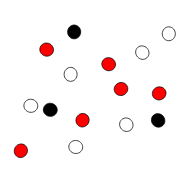
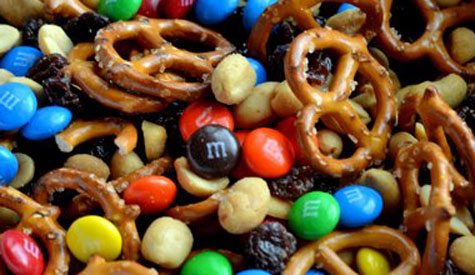
What type of mixture is this?
a)
homogenous mixture
b)
chemical
c)
heterogeneous mixture 
d)
solid mix
39.

A mixture of iron and sulfur can be separated by attracting the iron particles with a magnet. If the iron and sulfur mixture is heated strongly, iron (II) sulfide (FeS) forms, which is no longer magnetic and cannot be separated by physical methods. What is iron (II) sulfide (FeS)?

a)

element

b)

compound

c)

homogeneous mixture

d)

heterogeneous mixture

40.

When calcium reacts with water, the temperature changes from 18°C to 39°C. Which statement is correct?

a)

The solution at the end is acidic

b)

The reaction is reversible

c)

The reaction is exothermic

d)

The reaction is endothermic

41.
New substances formed from a chemical reaction are called
a)
products.
b)
reactants.
c)
chemicals.
d)
substances.
42.

 6 CO2+ 6 H2O + Energy → C6H12O6 + 6 O26\ CO_2+\ 6\ H_2O\ +\ Energy\ \rightarrow\ C_6H_{12}O_6\ +\ 6\ O_2 The products are

a)

 CO2 and H2OCO_2\ and\ H_2O  

b)

 C6H12O6 and O2C_6H_{12}O_6\ and\ O_2  

43.

 6 CO2+ 6 H2O + Energy → C6H12O6 + 6 O26\ CO_2+\ 6\ H_2O\ +\ Energy\ \rightarrow\ C_6H_{12}O_6\ +\ 6\ O_2 

a)

endothermic reaction

b)

exothermic reaction

44.
According to the law of conservation of mass, how much zinc was present in the zinc carbonate?
a)
40 g
b)
88 g
c)
104 g
d)
256 g
45.

Silver iodide powder has been used as an antiseptic and as an agent to seed clouds for rain. Silver iodide is 45.9% silver by mass. If you separate a 50.0-g sample of silver iodide into its elements, silver and iodine, how much silver would you have?

a)

23.0 g

b)

27.0 g

c)

109 g

46.
These can only be separated by chemical means. 
a)
element 
b)
compound 
c)
mixture 
d)
stuff 
47.

Filtration is a separation technique based on a difference in

a)

density

b)

solubility

c)

boiling point

d)

magnetism

48.

Water and alcohol are easily separated by distillation because of their

a)

different densities

b)

different boiling points

c)

different solubilities

d)

different melting points