wayground logo

Free Printable Worksheets

NEW

Font size

S
M
L
XL
Worksheets

Clouds, Air Masses, Fronts, Severe Storms& Air Pressure

Total questions: 65

Worksheet time: 1hrs 3mins

Name
Class
Date
1.
How do we name air masses?
a)
Water and temperature
b)
Air pressure
c)
Humidity and temperature
d)
Cold and warm
2.
How do we characterize an air mass that forms over the ocean?
a)
Dry
b)
Wet
c)
Cold
d)
Warm
3.
How do we characterize an air mass that forms over land?
a)
Dry
b)
Wet
c)
Cold
d)
Warm
4.
What types of air masses form over oceans?
a)
Maritime
b)
Continental
c)
Polar
d)
Tropical
5.
Air travels
a)
from high pressure to low pressure
b)
from low pressure to high pressue
6.
What's the humidity and temperature of a continental tropical air mass?
a)
Wet and cold
b)
Dry and warm
c)
Wet and warm
d)
Dry and cold
7.
What kind of breeze is this & what time of day/night would it form?
a)
Land breeze - daytime
b)
Land breeze - nighttime
c)
Sea breeze - daytime
d)
Sea breeze - nighttime
8.
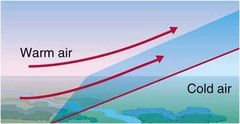
Which type of front is displayed?
a)
Cold
b)
Warm
c)
Stationary
d)
Occluded
9.
Which type of front is displayed?
a)
Cold
b)
Warm
c)
Stationary
d)
Occluded
10.
Which type of front is displayed?
a)
Cold
b)
Warm
c)
Stationary
d)
Occluded
11.
Which type of front is displayed?
a)
Cold
b)
Warm
c)
Stationary
d)
Occluded
12.
When two different air masses collide...
a)
A front forms
b)
They casually become one
c)
A new planet evolves
d)
Dinosaurs become extinct
13.
A wet, cold air mass would be - 
a)
maritime tropical 
b)
maritime polar
c)
continental tropical 
d)
continental polar
14.
A dry and cold air mass would be...
a)
Maritime polar
b)
Continental polar
c)
Maritime tropical
d)
Continental tropical
15.

Which of these locations did a tropical maritime (mT) air mass originate?

a)

over Antarctica

b)

over a Southern region of the Atlantic Ocean

c)

Over Canada

d)

Over Mexico

16.

If an air mass formed over land, and is mostly dry, which descriptor will likely be part of its name?

a)

Tropical

b)

Arctic

c)

Maritime

d)

Continental

17.
When a cold front is approaching, what happens?
a)
warm air is pushing under cold air causing humid weather and lower temperatures
b)
warm air is pushing under cold air causing humid weather and higher temperatures
c)
warm air rises, cools, and causes rain and thunderstorms
d)
cold air is pushed over warm air causing rain and thunderstorms
18.
In a high pressure area, the weather will likely be
a)
cooler and clear skies
b)
warm but cloudy
c)
cold and rainy
d)
snowy and clear
19.
What type of storm front is this? 
a)
warm front
b)
cold front
c)
stationary front
d)
occluded front
20.
What type of weather would you expect to see after a cold front has passed through an area?
a)
cool and clear skies
b)
warm and humid
c)
thunderstorms
d)
foggy
21.
What type of weather would you expect to see after a warm front has passed through an area?
a)
cool and clear skies
b)
warm and humid
c)
thunderstorms
d)
foggy
22.
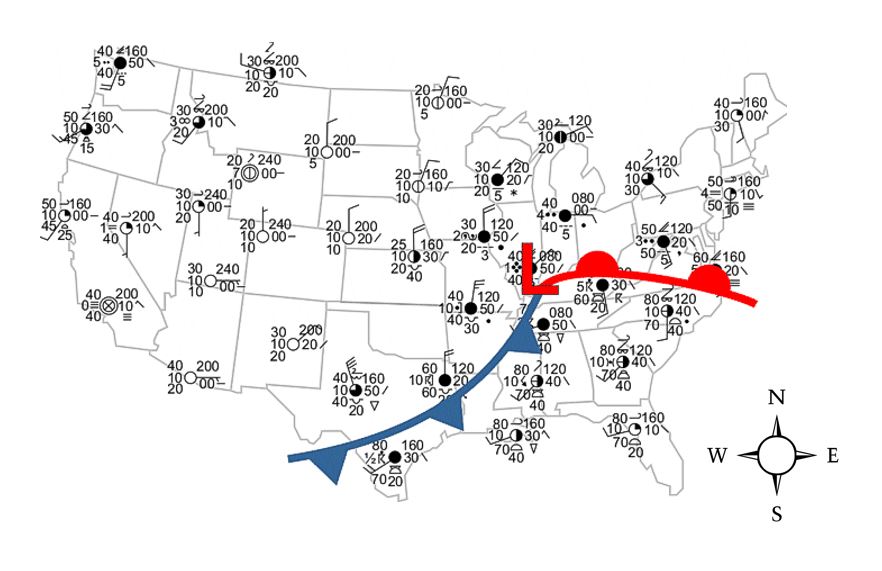
What direction is the cold front moving on the map? 
a)
Southwest
b)
Northwest
c)
Southeast
d)
Northeast
23.
What direction is the warm front moving on the map? 
a)
North
b)
South
c)
East
d)
West
24.

What type of front occurs when a warm air mass and a cold air mass do not have enough energy to move the other one out of the way?

a)

Warm front

b)

Cold front

c)

Stationary front

d)

Occluded front

25.
This symbol represents what type of front?
a)
cold front
b)
warm front
c)
stationary front
d)
occluded front
26.
This symbol represents what type of front?
a)
cold front
b)
warm front
c)
stationary front
d)
occluded front
27.
This symbol represents what type of front?
a)
cold front
b)
warm front
c)
stationary front
d)
occluded front
28.
A warm and dry air mass is best described as...
a)
continental tropical
b)
continental polar
c)
maritime tropical
d)
maritime polar
29.
This type of front brings many days of precipitation.
a)
cold front
b)
warm front
c)
stationary front
d)
occluded front
30.
Low pressure will usually bring what kind of weather?
a)
Sunny
b)
Calm
c)
Stormy
31.
Pressure is the effect of
a)
the weight of all the air above pressing down
b)
water vapor in the atmosphere
c)
greenhouse gases
d)
solar radiation
32.
High pressure will usually bring what kind of weather?
a)
clear and dry
b)
cloudy and wet
33.
Based on the information in the table, in which city will it most likely rain?
a)
City W
b)
City X
c)
 City Y
d)
City Z
34.
Which kind of weather change will occur with an increase in air pressure?
a)
cooler and dryer
b)
colder and rainier
c)
hotter and stormier
d)
warmer and moister
35.
On a cold, cloudy day, the local weather forecaster predicts that a high-pressure system will be moving into the area in the next 24 hours. Which weather conditions will this system most likely bring to the area?
a)
stormy
b)
sunny
c)
snowy
d)
hot
36.
This instrument measures air pressure
a)
thermometer
b)
anemometer
c)
barometer
d)
wind vane
37.
When temperature decreases what happens to air pressure?
a)
increases
b)
decreases
c)
stays the same
d)
isn't affected
38.
When temperature increases what happens to air pressure?
a)
increases
b)
decreases
c)
stays the same
d)
isn't affected
39.
What happens to air pressure as you climb a mountain?
a)
increases
b)
decreases
c)
stays the same
d)
isn't affected
40.
High pressure is associated with what kind of weather?
a)
Nice
b)
Naughty
c)
Rainy
d)
Cloudy
41.
Low pressure is associated with what kind of weather?
a)
Nice
b)
Naughty
c)
Cloudy
d)
No weather
42.
Air pressure is greater _______.
a)
at the top of the mountain
b)
at the bottom of the mountain
c)
at the center of the mountain
43.
Does cold air rise or sink?
a)
Rise
b)
Sink
44.
Does warm air rise or sink?
a)
Rise
b)
Sink
45.
What is the instrument called that measures air pressure?
a)
thermometer
b)
ruler
c)
yard stick
d)
barometer
46.
Moving air is called _______. 
a)
mud
b)
wind
c)
rain
d)
sunshine
47.

What front is this

a)

Occluded front

b)

Stationary front

c)

cold front

d)

warm front

48.
Clouds are made up of tiny drops of ______ or ice. The moisture in the cloud affects the weather.
a)
dust
b)
water
c)
cloud particles
d)
precipitation
49.
They are highest clouds in the sky. They look curly, white and feathery. Usually mean good weather.
a)
Cumulus
b)
Cumulonimbus
c)
Cirrus
d)
Stratus
50.
This is sometimes called a thunderhead cloud. It looks very tall like mountains and heavy rain comes from it. 
a)
Cumulus
b)
Cirrus
c)
Stratus
d)
Cumulonimbus
51.
They are low in the sky and look soft and fluffy. 
a)
Cirrus
b)
Cumulonimbus
c)
Cumulus 
d)
Stratus
52.
Low clouds (like fog), that are thick, cover the sky, and block the sun.  Usually bring continuous precipitation (rain or snow).
a)
stratus
b)
cumulus
c)
cirrus
d)
nimbo
53.
what type of cloud is shown?
a)
cumulus
b)
cirrus
c)
stratus
54.
what type of cloud is shown?
a)
cumulus
b)
cirrus
c)
stratus
55.
During which part of the water cycle does a cloud form?
a)
Evaporation
b)
Precipitation
c)
condensation
d)
Run off
56.
Clouds form with 
a)
atmospheric dust, low pressure, and moist air
b)
high pressure, high temperatures, and condensation nuclei
c)
low temperatures, zero dust particles, and dry air
d)
dry air, condensation nuclei, and low pressure 
57.

Electricity may flow within the cloud also flow between the cloud and the ground. These electrical currents are _________________.

a)

thunder

b)

particles

c)

lightning

58.

A ________________ is an intense storm with strong winds, heavy rain, lightning, and thunder.

a)

tornado

b)

hurricane

c)

thunderstorm

59.

A _________ can from when a rapidly spinning column of low pressure air, called a funnel cloud touches the ground.

a)

thunderstorm

b)

hurricane

c)

tornado

60.

A _____________ is a large, rotating low-pressure system that forms over the warm waters of oceans near the equator.

a)

tornado

b)

hurricane

c)

thunderstorm

d)

flooding

61.

Most hurricanes

a)

cannot be seen from space

b)

cross exposed land

c)

become dangerous category 5 storms

d)

lose their power when they move into cooler waters or moves over land

62.

Thunderstorm clouds are known as _____.

a)

cirrus clouds

b)

stratus clouds

c)

cumulonimbus clouds

d)

cumulus clouds

63.

Theses storms are the largest and most powerful storms on the planet.

a)

Thunderstorms

b)

Hurricanes

c)

Tornadoes

64.
Hurricanes develop in ________ regions.
a)
Arctic
b)
Tropical
c)
Arid
d)
None of the above
65.
How do the conditions for a tornado differ from the conditions for a hurricane?
a)
Tornadoes never form when there is rain, while hurricanes always form with rain.
b)
Tornadoes form under low pressure, while hurricanes form under high pressure
c)
Tornadoes form in a stable atmosphere, while hurricanes form in an unstable atmosphere 
d)
Tornadoes form over land, while hurricanes form over bodies of water