Wayground logo

Free Printable Worksheets

Font size

S
M
L
XL
Worksheets

Periodic Table

Total questions: 43

Worksheet time: 2hrs 49mins
Name
Class
Date
1.

The vertical (up and down) columns in the Periodic Table are called

a)

groups

b)

towers

c)

periods

d)

atomic numbers

2.
Sodium (Na) is found in period 
a)
3
b)
2
c)
4
d)
1
3.
What does the atomic mass tell you? 
a)
Basically,the number of electrons and protons
b)
The number of neutrons
c)
Basically, the number of protons and neutrons
d)
The number of protons.
4.

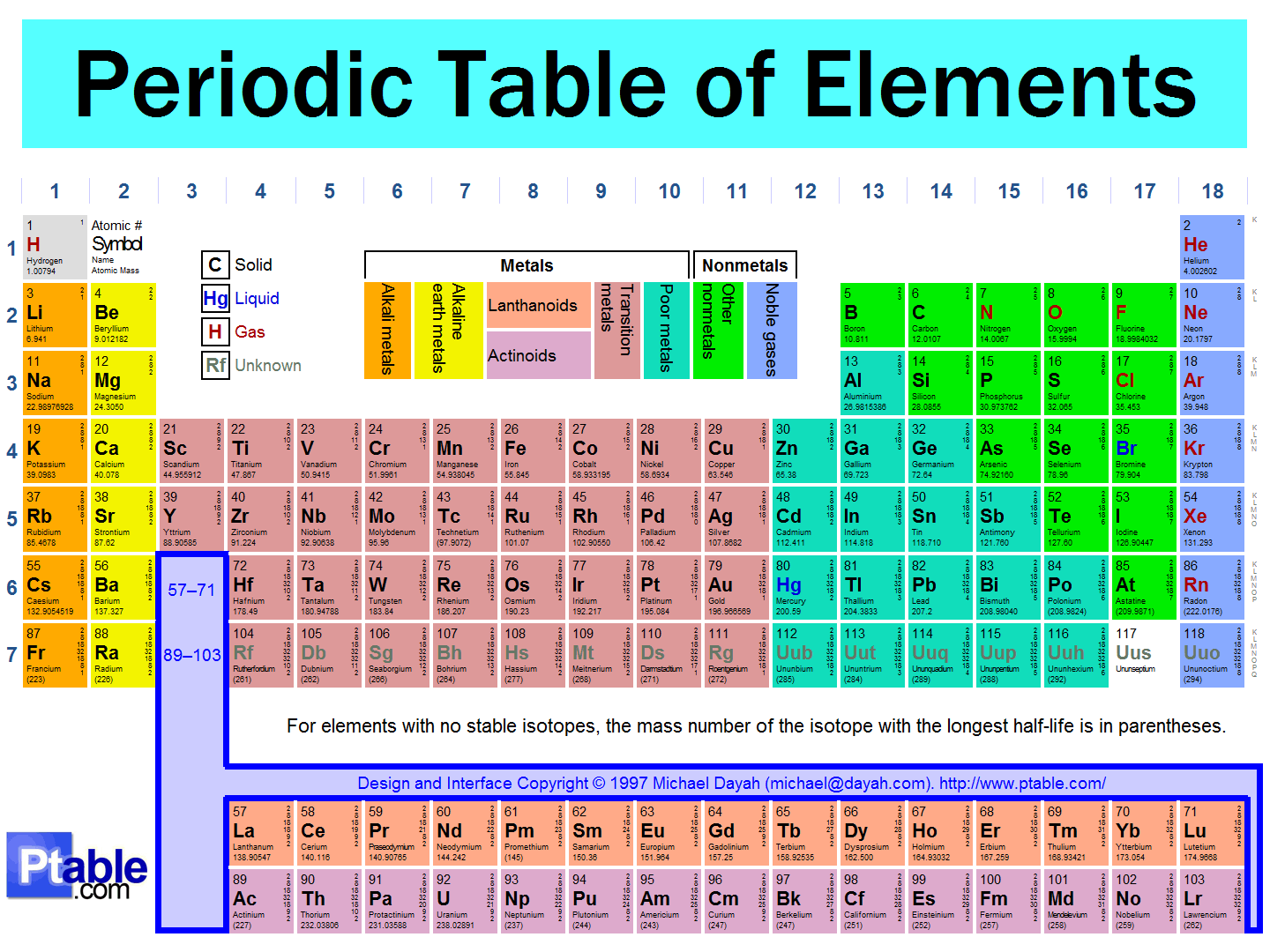
What does the 6 represent?

a)

relative molecular mass

b)

proton number

c)

electron number

d)

neutron number

5.

What does 12.011 represent?

a)

relative molecular mass

b)

atomic number

c)

element name

d)

chemical symbol

6.

What happens to the atomic numbers/ proton numbers as you move from left to right on the periodic table?

a)

Increase

b)

Decrease

c)

Stay the same

d)

Nothing

7.

Which element is located in period 4 and group 5?

a)

Vanadium (V)

b)

Zirconium (Zr)

c)

Niobium (Nb)

d)

Titanium (Ti)

8.

Which element has the greater Electronegativity (EN):

N or C?

a)

C

b)

N

9.
Put these in increasing order:
F, N, B
a)
B < N < F
b)
B < F < N
c)
N < F < B
d)
F < N < B
10.

Electronegativity is...

a)

the ability of an atom to attract one electron to itself.

b)

the ability of an atom to lose electrons

c)

the energy required to remove an electron from a specific atom

d)

how easy it is to make friends.

11.

The element with the largest electronegativity in the halogens series is -

a)

At

b)

F

c)

Cl

d)

Br

12.
The element with the lowest electronegativity in Period 3 is - 
a)
Na
b)
Cl
c)
Ar
d)
Mg
13.
What is ionization energy?
a)
Energy needed to destroy an atom
b)
Energy required to remove an electron
c)
Energy needed to split an electron
d)
Energy required to add an electron
14.
List the following in order of weakest to strongest ionization energy.
P, Cs, Co, Sr
a)
P, Co, Sr, Cs
b)
Cs, Sr, Co, P
c)
Sr, Cs, Co, P
d)
P, Co, Cs, Sr
15.

As you look from left to right across a period, electronegativity

a)

increases

b)

decreases

16.

The tendency of an atom to attract electrons to itself

a)

electronegativity

b)

charge

c)

bonding ability

d)

electron configuration

17.

What is the correct name for this polyatomic ion: CN–

a)

carbonate

b)

cyanide

c)

chromate

d)

chromite

18.

What is the correct name for this polyatomic ion: OH–

a)

hydrogen carbonate

b)

oxonium

c)

hydroxide

d)

acetate

19.

What is the correct name for this polyatomic ion: NO3–

a)

carbonate

b)

hydroxide

c)

nitrite

d)

nitrate

20.

What is the correct name for this polyatomic ion: CrO42–

a)

chromate

b)

dichromate

c)

carbonate

d)

ammonium

21.

What is the correct formula for the polyatomic ion called ammonium?

a)

NH3+

b)

NH3

c)

CN+

d)

NH4+

22.

What is the correct formula for the polyatomic ion called sulphate?

a)

SO32–

b)

HSO4–

c)

SO42–

d)

CH3COO–

23.

What is the correct formula for the polyatomic ion called dichromate?

a)

CO32–

b)

Cr2O72–

c)

CrO42–

d)

CrO3–

24.
phosphorus trichloride
a)
KCl3
b)
PCl3
c)
K3Cl
d)
P3Cl
25.
silicon dioxide
a)
SO2
b)
NaO2
c)
SiO2
d)
SiO
26.
diphosphorus pentoxide
a)
P2O5
b)
PO5
c)
P5O2
d)
P2O6
27.
SiCl4
a)
silicon tetrachloride
b)
silicon quadchloride
c)
monosilicon tetrachloride
d)
silicon chloride
28.
The chemical formula of carbon tetrachloride is
a)
CCl
b)
C₄Cl
c)
CCl₄
d)
C(IV)Cl
29.
The chemical formula of dinitrogen textroxide is
a)
Ni₂O₄
b)
NiO
c)
N₂O₄
d)
NiO₂
30.
The name of P₄S₁₀ is
a)
phosphorous sulfide
b)
phosphorus sulfide
c)
tetraphosphorus decasulfide
d)
phosphorus (X) sulfide
31.
The name of SO₃ compound is
a)
sulfate
b)
sulfur oxide
c)
sulfur trioxide
d)
monosulfur trioxide
32.
The electron configuration of an atom is 1s22s22p6.  The number of electrons in the atom is 
a)
3
b)
6
c)
8
d)
10
33.
What atom matches this electron configuration?
1s22s22p63s23p64s23d10
a)
Zinc
b)
Copper
c)
Nickel
d)
Germanium
34.
An orbital can at most hold how many electrons?
a)
1 electron
b)
2 electrons
c)
3 electrons
d)
4 electrons
35.
The electron configuration of an atom is 1s22s22p6.  The number of valence electrons in the atom is 
a)
3
b)
6
c)
8
d)
10
36.
What is the charge of an atom that has lost one electron?
a)
-1
b)
-2
c)
+1
d)
+2
37.
What is the electronic configuration of iron?
a)
1s22s22p63s23p64s23d6
b)
1s22s22p63s23p63d8
c)
1s22p63s23p64s23d6
d)
1s22s22p63s23p64s13d6
38.
How many electron can be found in a p orbital?
a)
2
b)
3
c)
4
d)
6
39.

What electron configuration matches an oxygen ion? (Z=8)

a)

1s22s22p63s2, 3p64s23d104p5

b)

1s22s22p4

c)

1s22s22p6

d)

1s22s22p63s23p64s23d1

40.

State the valence electronic configuration for Mg (Z=12)

a)

3s2

b)

3s2 3p1

c)

3s2 3p3

d)

3s2 3p4

41.

In 1s2, the 2 means

a)

there are 2 electrons in this level

b)

it is the 2nd energy level

c)

there is a +2 charge

d)

there is a -2 charge

42.
Which electron configuration belongs to Copper (Cu)?
a)
1s2 2s2 2p6 3s2 3p6 4s2 3d8
b)
1s2 2s2 2p6 3s2 3p6 4s2 3d9
c)
1s2 2s2 2p6 3s2 3p6 4s2 3d10
43.
What do you start electron configuration with?
a)
1s2
b)
1d10
c)
1f14
d)
1p6