
 Worksheets
AP BIO Unit 3 Energy
Total questions: 150
Worksheet time: 3hrs 47mins
The active site of an enzyme can:
bind allosteric regulators.
bind competitive inhibitors.
bind non-competitive inhibitors.
change the Gibbs Free Energy of the reaction.
Which of the following do not affect enzymes ability to function?
pH
substrate concentration
temperature
water
In general, enzymes do NOT:
bind permanently to their substrates
have names ending in -ase
have their function changed with extremely high temperatures
react with a specific substrate
The break down of larger molecules into small one.
metabolism
catabolism
anabolism
oxidation
sum of all chemical reactions
chemosynthesis
cellular respiration
metabolism
photosynthesis

What is being represented by the letter B in the image?
Substrate
Enzyme
reactants
Product


Some of the drugs used to treat HIV patients are competitive inhibitors of the HIV reverse transcriptase enzyme. Unfortunately, the high mutation rate of HIV means that the virus rapidly acquires mutations with amino acid changes that make them resistant to these competitive inhibitors. Where in the reverse transcriptase enzyme would such amino acid changes most likely occur in drug-resistant viruses?
in or near the active site
at an allosteric site
at a cofactor binding site
in regions of the protein that determine packaging into the virus capsid
When you have a severe fever, what grave consequence may occur if the fever is not controlled?
destruction of your enzymes' primary structure
removal of amine groups from your proteins
change in the tertiary structure of your enzymes
removal of the amino acids in the active sites of your enzymes
How might an amino acid change at a site distant from the active site of the enzyme alter the enzyme's substrate specificity?
by changing the enzyme's stability
by changing the enzyme's location in the cell
by changing the shape of the protein
by changing the enzyme's pH optimum

For the enzyme-catalyzed reaction shown in Figure 6.2, which of these treatments will cause the greatest increase in the rate of the reaction, if the initial reactant concentration is 1.0 micromolar?
doubling the activation energy needed
cooling the reaction by 10°C
doubling the concentration of the reactants to 2.0 micromolar
doubling the enzyme concentration

In Figure 6.2, why does the reaction rate plateau at higher reactant concentrations?
Feedback inhibition by product occurs at high reactant concentrations.
Most enzyme molecules are occupied by substrate at high reactant concentrations.
The reaction nears equilibrium at high reactant concentrations.
The activation energy for the reaction increases with reactant concentration.

Which of the following in Figure 6.4 would be the same in either an enzyme-catalyzed or a noncatalyzed reaction?
a
b
c
d

Which of the following represents the activation energy needed for the enzyme-catalyzed reverse reaction, C + D → A + B, in Figure 6.4?
a
b
c
d
Succinate dehydrogenase catalyzes the conversion of succinate to fumarate. The reaction is inhibited by malonic acid, which resembles succinate but cannot be acted upon by succinate dehydrogenase. Increasing the ratio of succinate to malonic acid reduces the inhibitory effect of malonic acid.
Based on this information, which of the following is correct?
Succinate dehydrogenase is the enzyme, and fumarate is the substrate.
Succinate dehydrogenase is the enzyme, and malonic acid is the substrate.
Succinate is the substrate, and fumarate is the product.
Fumarate is the product, and malonic acid is a noncompetitive inhibitor.


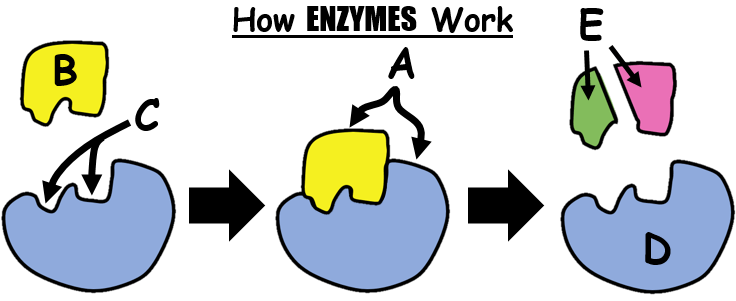
Which of the following correctly describes enzyme structure and function?
The shape of an enzyme is responsible for its function.
All enzymes can bind to all substrates.
The substrate is responsible for the shape of the enzyme.
The location of an enzyme determines its function.
Which enzyme breaks down hydrogen peroxide to water and oxygen gas?
sucrase
lactase
catalase
peroxidase
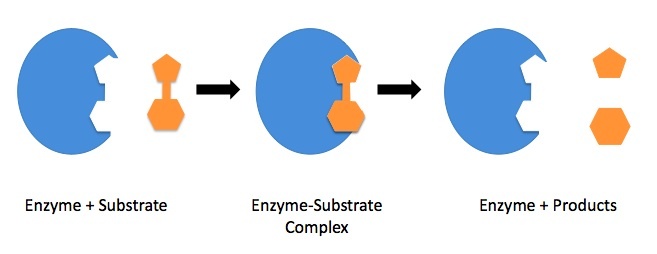
Which of the following is an example of an exergonic reaction?
cellular respiration
protein synthesis
nerve conduction
muscle contraction
what controls a metabolic pathway
enzymes
chemicals
intermediates
energy
Fireflies emit light. The production of light by an organism is called bioluminescence. To generate visible light, cells in a firefly’s tail produce thousands of luciferase enzymes. Luciferase binds to a chemical called luciferin. Once bound, the luciferase enzyme speeds up a chemical reaction that combines an oxygen molecule and luciferin to produce oxyluciferin. This reaction requires energy and releases light. Which of the following best describes how the luciferase enzyme speeds up the chemical reaction?
Luciferase increases the amount of time the light is visible.
Luciferase decreases the amount of energy required for the reaction to start.
Luciferase increases the number of sites on luciferin that must bind to oxygen.
Luciferase decreases the temperature of the environment inside the body of the firefly.
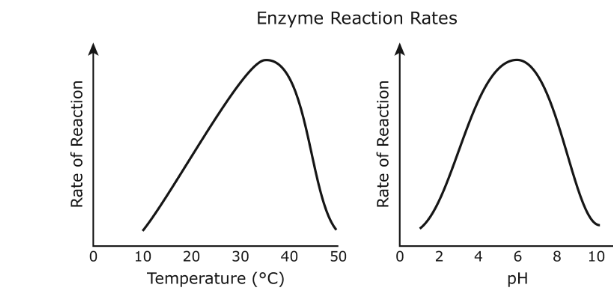
The graphs show the reaction rate for an enzyme across a range of temperatures and pH.
Based on these data, this enzyme functions best as what temperature and pH?
Temperature of 27oC and a pH of 4
Temperature of 37oC and a pH of 6
Temperature of 40oC and a pH of 8
Temperature of 50oC and a pH of 10

Pepsin and trypsin are two of the digestive enzymes that break down protein. A group of students studied the pH requirements of these enzymes. The graph below shows the results.
The students found that pepsin functions best in an acid environment and trypsin functions best in a neutral environment. Based on their observations, pepsin most likely aids in digestion in which part of the human body?
Pancreas
Intestines
Mouth
Stomach

The diagram represents one way an enzyme can be inhibited.
Which statement explains the effect of an inhibitor on an enzyme?
A substrate will be able to bond with the enzyme.
The enzyme will likely be attacked by immune cells.
The enzyme will be unable to produce more enzymes.
A substrate will be unable to attach to the enzyme.
What happens to the rate of reaction in a test tube when a competitive inhibitor is added?
The reaction speeds up because the competitive inhibitor helps the enzyme
The reaction rate speeds up because the enzyme’s shape is changed
There is no impact on the reaction rate because the inhibitor is competitive
The reaction slows down because the enzyme’s shape is changed
The reaction slows down because the competitive inhibitor binds to the enzyme
If nerve gasses are inhaled, they will temporarily bind to an area on many enzymes that will change the shape of the enzyme. This prevents the enzymes from interacting with other substances and interferes in proper nervous system functioning resulting in death. The nerve gas is an example of a(n):
Substrate
Activation Inhibitor
Production Inhibitor
Competitive Inhibitor
Non-competitive Inhibitor

The change in shape between structures 1 and 2 below can best be described as the:
Lock & Key Model
Induced Fit Model
Latch & Key Model
Molding Model
Optimal Fit Model
To do work, living systems will pair an endergonic reaction with a(n)________________
exergonic reaction
oxidative reaction
ATP synthesis
reduction reaction
Endergonic reactions are _____________; exergonic reactions are ____________
non-spontaneous; spontaneous
spontaneous; non-spontaneous
spontaneous; spontaneous
non-spontaneous; non-spontaneous


"citric acid cycle" = Krebs Cycle
How many ATP are gained (net) through glycolysis?
0
2
4
30-38


Thylakoid Membrane
Thylakoid Space
Stroma
Candy Coating

When are ATP and NADPH produced?
light-dependent reactions
Calvin Cycle
Krebs Cycle
light- independent reactions
During photosystem II, the hydrogen ions are pumped
out of the thylakoid lumen
into the thylakoid lumen
out of the chloroplast
into the chloroplast
Where do the oxygen molecules produced during photosynthesis come from?
photolysis in photosystem II
reduction of NADP+
oxidation of NADPH
proton gradient formation
During photosynthesis sugars are assembled during
photosystem II
photosystem I
Calvin cycle
Krebs cycle
CO2 is used in the Calvin cycle to make molecules of
NADPH
glycogen
G3P
Rubisco
Where is ATP synthase used during photosynthesis located?
stroma
chloroplast membrane
thylakoid membrane
cell membrane
Which of these does the Calvin Cycle do?
Split glucose into oxygen and hydrogen ions
use ATP to make carbohydrates
Use light to split water into oxygen and hydrogen ions
make NADP+ into NADPH
What usually causes oxygen concentration to drop in an aquatic environment?
temperature change
animals only respiring/ respiring more at night
photosynthetic organisms not photosynthesizing at night
red algae competing with green algae
When cells don't have enough oxygen to respire, what is their back-up plan?
Die.
Alcoholic fermentation
Lactic acid fermentation
Glcoysis + Kreb's cycle, but no oxidative phosphorylation
Why is oxygen necessary in cellular respiration?
It splits glucose
It makes ATP
It is the final electron acceptor
It isn't, oxygen is a conspiracy created by the government to trick people into thinking that trees are good so they can install microphones and cameras in trees everywhere to monitor us every chance they get... death to trees!
What happens to the Carbon from CO2 during photosynthesis?
It is lost as a gas
It is lost as water
It becomes a sugar
It becomes amino acids and structural proteins
ATP Synthase works by...
Using ATP to pump protons
Phosphorylating ADP using the kinetic energy of protons moving with their concentration gradient
Using oxygen to make water
Joining phosphates to amino acids
ATP production requires
A proton concentration gradient for ATP synthase
ATP
a cell
a variable temperature


What are the reactants to the Light Reactions?
Sunlight and Water
Sunlight and Oxygen
Oxygen and Water
Sunlight and Carbon Dioxide
What are the products to the light reactions?
Sunlight and Oxygen
Sunlight and Water
ATP, NADPH and Oxygen
ADP, NADP+ and Oxygen
What is the chemical equation for photosynthesis?
6 CO2 + 6 H2O ---sunlight---> 6 O2 and C6H12O6
ATP + NADPH ----> NADP+ and ADP
6 O2 and C6H12O6 ---sunlight---> 6 CO2 + 6 H2O
ADP and NADP+ ------> ATP and NADPH

What does light do when it strikes the chlorophyll molecules of photosystems I and II?
Light causes glucose to be synthesized directly inside the chlorophyll molecules of the photosystems.
Light causes electrons to get excited (gain energy) and travel down the electron transport chain embedded in the thylakoid membrane.
Light causes the conversion of water into carbon dioxide, oxygen, and electrons.
Light directly causes carbon dioxide to attach to RuBP during the carbon fixation stage of the Calvin Cycle.
As the electrons travel from photosystem II down the first electron transport chain, their energy is used to….
form oxygen, water, NADPH, and glucose.
pump hydrogen ions into the stroma, producing a concentration gradient that will later be used by an enzyme to form ADP and phosphate.
pump hydrogen ions into the thylakoid space, producing a concentration gradient that will later be used by ATP synthase to form ATP.
create glucose directly.
Why do hydrogen ions flow from the thylakoid space to the stroma through ATP synthase?
They are pumped actively through the ATP synthase. This uses ATP energy and causes the production of ADP and phosphate.
They flow through the Calvin cycle and produce light.
Hydrogen ions do not actually flow from the thylakoid space to the stroma. They flow the opposite way.
They flow passively from the high to low concentration via facilitated diffusion. As they flow through ATP synthase, the enzyme spins and produces ATP.


