
 Worksheets
Cells and Genetics NCFE Review
Total questions: 40
Worksheet time: 3hrs 20mins
Name
Class
Date
1.

Are paramecium considered a heterotroph, autotroph, or decomposer?
a)
Autotroph - meaning they can create their own food by using chloroplasts.
b)
Heterotroph - meaning they have to go search for their food.
c)
Decomposer - meaning they eat off of dead, rotting matter.
2.

What special way do paramecium eat?
a)
Parameciums use cilia to sweep food into a gullet-like mouth called an oral groove.
b)
Photosynthesis - this is the process of converting light energy into sugars for the organism.
c)
Parameciums engulf food with pseudopods
3.

A contractile vacuole is used by a paramecium to
a)
make their own food by the process of photosynthesis.
b)
secrete enzymes for digestion within the food vacuole.
c)
excrete excess water out of the cell
d)
produce antibodies to defend the cell from predators.
4.

How do paramecium move?
a)
Cilia - many tiny hair-like structures that allow the paramecium to move around its watery environment.
b)
Flagella - a whip-like structure that allows the paramecium to move around its watery environment.
c)
pseudopods - aka false foot, parameciums use cytoplasmic streaming which creates pseudopods to move around.
5.

What type of protist is this?
a)
euglena
b)
volvox
c)
paramecium
d)
amoeba
6.

What type of protist is this?
a)
euglena
b)
volvox
c)
paramecium
d)
amoeba
7.

What type of protist is this?
a)
euglena
b)
volvox
c)
paramecium
d)
amoeba
8.

What type of protist is this?
a)
euglena
b)
volvox
c)
paramecium
d)
amoeba
9.
Which two protists can make their own food?
a)
amoeba, paramecium
b)
volvox, euglena
c)
euglena, amoeba
d)
paramecium, volvox
10.
Euglena and Volvox move using _____.
a)
pseudopods
b)
cilia
c)
flagella
11.
Paramecium move using _____.
a)
pseudopods
b)
cilia
c)
flagella
12.
Amoebas move using _____.
a)
pseudopods
b)
cilia
c)
flagella
13.
All of the protists we have discussed in class are Eukaryotic. Eukaryotic cells have a _____.
a)
chloroplast
b)
nucleus
c)
cell wall
14.
What is a flagella?
a)
tiny hairs
b)
tail-like whip
c)
false foot
15.
What is cilia?
a)
tiny hairs
b)
tail-like whip
c)
false foot
16.
A microbe without a nucleus (prokaryote) that can be helpful or make people sick.
a)
Virus
b)
Bacteria
c)
Volvox
d)
Paramecium
17.
This organelle creates the energy for the cell
a)
mitochondria
b)
cell membrane
c)
ribosome
d)
endoplasmic reticulum
18.
The ____________ regulates what enters and leaves the cell.
a)
mitochondria
b)
cell membrane
c)
golgi bodies
d)
cytoplasm
19.
The _________ holds the dna for the cell
a)
vacuole
b)
smooth ER
c)
rough ER
d)
nucleus
20.

What cell part is NOT found in all cells?
a)
Cell Wall
b)
Cell Membrane
c)
Cytoplasm
d)
Genetic Material
21.
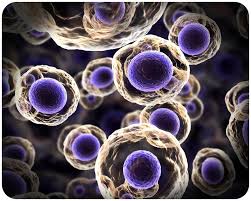
The two kinds of cells are Prokaryotes and Eukaryotes. How are they different?
a)
Prokaryotes have a nucleus.
b)
Eukaryotes have a nucleus.
c)
Prokaryotes are plant cells.
d)
There is no difference.
22.

I make proteins for the cell. What am I?
a)
ribosome
b)
mitochondria
c)
chloroplast
d)
lysosome
23.
What can only be found in plant cells?
a)
Cell membrane
b)
Vacuole
c)
Chloroplast
d)
Mitochondrion
24.

I store water in both plant and animal cells. What am I?
a)
cytoplasm
b)
ribosomes
c)
vacuole
d)
lysosomes
25.
Where does photosynthesis occur?
a)
mitochondria
b)
stomata
c)
xylem
d)
chloroplast
26.
What is the function of nucleus?
a)
Structure that organizes motion of chromosomes.
b)
Structure that contains DNA and directs the cell
c)
Membrane that surrounds and protects the cell
d)
Stack of membranes that packages chemicals
27.

Robert Hooke, Anton van Leeuwenhoek, Theodor Schwann, Rudolf Virchow, and Matthias Schliden were all responsible for what theory?
a)
The Theory of Gravity
b)
The Theory of Relativity
c)
The Cell Theory
d)
The Theory of Continental Drift
28.
All plants are made of cells. This was discovered by....
a)
Matthias Schleiden
b)
Rudolf Virchow
c)
Robert Hooke
d)
Aristotle
29.
Who looked at cork and named the cell?
a)
Robert Hooke
b)
Van Leeuwenhoek
c)
Robert Brown
d)
Francesco Redi
30.
"All animals are made of cells". This fact was discovered by...
a)
Matthias Schleiden
b)
Theodor Schwann
c)
Robert Hooke
d)
Rudolf Virchow
31.
What tool do you use to view the cells?
a)
metric ruler
b)
centrifuge
c)
microscope
d)
pipette
32.
Which of the following is NOT a cell theory.
a)
All non-living things are made of cells
b)
All cells come from pre-existing cells
c)
Cells are the basic unit of structure and function of all living things
33.

The passing of genetic traits from parent to offspring is called
a)
cross-pollination
b)
cross-breeding
c)
heredity
d)
genetics
34.

Which of the following is NOT one of the basic points of Cell Theory?
a)
All living things are made of cells.
b)
The cell is the smallest living thing that can perform all the functions of life.
c)
Cells are too small to see without a microscope.
d)
All cells must come from pre-existing cells.
35.
Which type of genetic factor can hide or mask another genetic factor?
a)
strong
b)
huge
c)
dominant
d)
recessive
36.
Gregor Mendel is often called _____________. This is due to his experiments with pea plant genetics.
a)
The Father of Heredity
b)
The King of Peas
c)
The Father of Genetics
d)
The Father of Modern DNA
37.
Heredity can be defined as
a)
A characteristic that an organism can pass onto its offspring through its genes.
b)
the passing of traits from parent to offspring.
c)
the scientific study of phenotypes.
d)
none of the answers are correct.
38.
Which of the following terms refers to the different possibilities of a gene?
a)
chromosome
b)
DNA
c)
Punnett Squares
d)
allele
39.
What do we call offspring of many generations that have the same trait?
a)
Hybrid
b)
Purebred
c)
Whitebread
d)
Ryebread
40.
5. _____is the passing of traits from parents to offspring (babies)
a)
DNA
b)
Heredity
c)
Evolution
100 %

