wayground logo

Free Printable Worksheets

Font size

S
M
L
XL
Worksheets

Test 3

Total questions: 87

Worksheet time: 4hrs 32mins

Name
Class
Date
1.
If a chemist calculates the maximum amount of product that could be obtained in a chemical reaction, he or she is calculating the
a)
theoretical yield
b)
mole ratio
c)
actual yield
d)
percentage yield
2.
Mole ratios are obtained from the
a)
balanced chemical equation
b)
periodic table
c)
molar mass
3.
What is the mole ratio of H2O to H3PO4 in the following chemical equation?   P4O10 + 6 H2O --> 4 H3PO
a)
6:4
b)
4:6
c)
1:3
d)
3:1
4.
2Al + 3H2SO4 -> Al2(SO4)3 + 3H2
How many grams of aluminum sulfate would be formed if 250g H2SO4 completely reacted with aluminum?
a)
0.85 g
b)
290 g
c)
450 g
d)
870 g
5.
For the reaction represented by the equation Cl2 + 2KBr → Br2 + 2KCl, how many grams of potassium chloride can be produced from 356 grams potassium bromide?
a)
749 g
b)
225 g
c)
479 g
d)
814 g
6.
When does a chemical reaction stop?
a)
When the lab is finished
b)
When the excess reactant is used up
c)
When the limiting reactant is used up
d)
Chemical reactions never stop
7.
Identify the limiting reagent when 6.00 g HCl combines with 5.00 g Mg to form MgCl2.
 
Mg +  2HCl --> MgCl2  +  H2   
 
a)
Mg
b)
H2
c)
MgCl2
d)
HCl
8.
How many grams are in 7.8 moles of NaCl?
a)
476grams
b)
460 grams
c)
452 grams
d)
462 grams
9.
Balance the following reaction :
 
CaC₂(s)   +   H₂O(l)   -->   C₂H₂(g)   +   Ca(OH)₂(aq)
a)
1,2,2,2
b)
1,2,1,1
c)
2,1,1,1
d)
2,1,2,1
10.
Using the following equation:
Fe2O3(s) + 3H2(g) → 2Fe(s) + 3H2O(l)
How many moles of iron can be made from  6 moles H2
a)
4 moles Fe
b)
6 moles Fe
c)
9 moles Fe
d)
2 moles Fe
11.
9. Complete the equation for the percent yield of a chemical reaction:
Percent yield=(________)
÷(________)×100%
a)
actual yield; theoretical yield
b)
theoretical yield; actual yield
12.
11.
LiOH + KCl → LiCl + KOH 

b)  I actually produced 6 grams of lithium chloride and I began this reaction with 20 grams of lithium hydroxide. What is my percent yield?
a)
16.9%
b)
5.91%
c)
1.88%
d)
12.3%
13.
Fe (s) + S (l) --> FeS (s)  

In the experiment above, 7.62 g of Fe are allowed to react with 8.67 g of S.
How much FeS is formed?
a)
14.8 g
b)
12.2 g
c)
13.7 g
d)
19.9 g
14.
Gas pressure is caused by
a)
gas molecules colliding with surfaces
b)
gas molecules condensing to a liquid
c)
gas molecules hitting other gas molecule
d)
barometers
15.
a)
Gases do not move in straight line
b)
Most of the volume of gas is empty space
c)
Gas particles are not in constant random motion
d)
Gas particles attract each other
16.
a)
Gas particles are elastic and do not attract each other.
b)
The kinetic energy of gas is dependent on temperature 
c)
Energy is not lost when gas particles collide with each other or with the walls of the container.
d)
All of the above
17.
When the temperature is constant (k) inside a balloon, if you add pressure on it, the volume will ..... 
a)
Decrease
b)
Increase
c)
Not Change at all
d)
Particles will solidify 
18.
Pick the best answer to explain all properties of gases....
a)
They're fluids 
Can be compressed
Little space between particles 
b)
They're solids 
Can be compressed
Lots of space between particles 
c)
They're fluids 
Cannot be compressed
Lots of space between particles 
d)
They're fluids 
Can be compressed
Lots of space between particles 
19.

How do you convert C to Kelvin (K)?

a)

C + 273

b)

C x 273

c)

C / 273

d)

C + 32 + 273

20.
Directly proportional means that as one value increases ....................
a)
the other stays the same 
b)
the other increases as well
c)
the other decereases
d)
the other goes to zero
21.
Inversely proportional means as one value increases the other............. 
a)
increases 
b)
decreases 
c)
stays the same 
d)
goes to zero
22.
How do gas molecules move? 
a)
in an orderly fashion 
b)
constantly and randomly
c)
in straight line paths
d)
in a circular motion
23.
When the temperature of matter increases the particles...
a)
speed up and move closer
b)
speed up and move farther apart
c)
slow down and move closer together
d)
slow down and move farther apart
24.
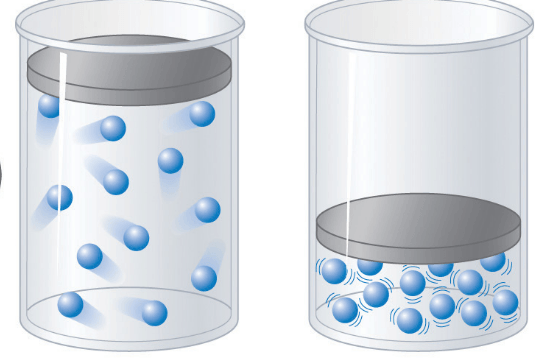
Which container will have a lower pressure?
a)
left
b)
right
c)
they both have the same pressure
d)
I don't know
25.

What is the empirical formula for C4H6

a)

CH

b)

CH3

c)

C2H3

d)

C4H6

26.

Find the empirical formula for a compound which contains 32.8% chromium and 67.2% chlorine.

a)

CrCl

b)

CrCl3

c)

Cr3Cl

d)

Cr2Cl6

27.

A compound containing 92.3 percent carbon and 7.7 percent hydrogen. What is the empirical formula?

a)

CH

b)

CH2

c)

C2H

d)

C2H2

28.

Compound contains 42.05 g of nitrogen and 95.95 g of oxygen. What is the formula?

a)

NO

b)

NO2

c)

N2O

d)

N2O4

29.
What is the molecular formula if the empirical formula is C2H5 and the molecular molar mass is 58.14 g/mol?
a)
C2H5
b)
C4H10
c)
C1H2.5
d)
C4H8
30.
What is the empirical formula of the following molecular formula:  C3H6
a)
C3H6
b)
CH2
c)
C2H4
d)
CH3
31.
What is the molecular formula if the empirical formula is CH2O and the molecular molar mass is 180.18?
a)
CH2O
b)
C2H4O2
c)
C4H8O4
d)
C6H12O6
32.

A compound contains 40.0% sulfur and 60.0% oxygen by mass. What is its empirical formula?

a)

S2O3

b)

S2O

c)

SO2

d)

SO

33.

If the volume of a gas is doubled at constant temperature, what happens to its pressure?

a)

It becomes zero

b)

It doubles

c)

It halves

d)

It remains the same

34.

What is the molecular formula of a compound with an empirical formula of CH3 and a molar mass of 30 g/mol?

a)

C4H12

b)

C3H9

c)

C2H6

d)

CH3

35.

Which of the following best describes the relationship between pressure and volume of a gas at constant temperature?

a)

They are directly proportional

b)

They are inversely proportional

c)

They are unrelated

d)

They both remain constant

36.

A compound has an empirical formula of CH2O and a molar mass of 180 g/mol. What is its molecular formula?

a)

C3H6O3

b)

C2H4O2

c)

C6H12O6

d)

CH2O

37.

What is the percent yield if the theoretical yield of a reaction is 25 grams and the actual yield is 20 grams?

a)

20%

b)

5%

c)

125%

d)

80%

38.
A 15.67 g sample of a hydrate of magnesium carbonate was heated to drive off the water. The mass was reduced to 7.58 g. What is the formula of the hydrate?
a)
MgCO3 · 5H2O
b)
MgCO3 · 4H2O
c)
MgCO3 · 6H2O
d)
MgCO3 · 1H2O
39.
A compound is a hydrate when it...
a)
is composed of only hydrogen and oxygen
b)
is a state of water
c)
traps water inside of the compound
d)
repels water from the compound
40.

A 4.175 gram sample of a certain hydrate of copper (II) sulfate, CuSO4•xH2O, is heated until all the water is driven off. The resulting anhydrous compound weighs 3.120 grams. What is the formula of the hydrate?

a)

CuSO4•H2O

b)

CuSO4•3H2O

c)

CuSO4•6H2O

d)

CuSO4•4H2O

41.
Based on the activity series, will this reaction occur?
Ni (s) + H2O (l) →
a)
Yes
b)
No
42.
Based on the activity series, will this reaction occur?
Cd (s) + HCl (aq) →
a)
Yes
b)
No
43.
Based on the activity series, will this reaction occur?
Br2 (l) + KI (aq) →
a)
Yes
b)
No
44.

Predict the product(s) of this reaction (don't worry about balancing):

Mg + HCl →

a)

MgHCl

b)

MgCl2 + H2

c)

MgCl2 + H

d)

MgCl + H2

45.

Predict the product(s) of this reaction (don't worry about balancing):

SrI2 +Br2

a)

Sr + I2Br2

b)

SrBr + I2

c)

SrBr2 + I2

d)

Sr + IBr2

46.
Predict the product(s) of this reaction (don't worry about balancing):
C12H22O11 + O2 →
a)
CO + HO
b)
CO2
c)
CO2 + H2O
d)
H2O
47.
What  will be the result of the following: 
Br2 + NaF ->
a)
bromine will replace Na
b)
Na will replace Br
c)
Br will replace F
d)
no reaction will occur
48.

What are the products of the following reaction?

C2H4 + O2

a)

C2O2 + H4

b)

CO2 + H2 + O2

c)

CO + H

d)

CO2 + H2O

49.

Predict the products of this synthesis reaction: H2 + Cl2

a)

HCl

b)

H2Cl2

c)

H2Cl

d)

HCl2

50.

Which of the following reactions will actually occur?

a)

F2(g) + FeI2(aq) → FeF2(aq) + I2 (g)

b)

Cl2(g) + SrF2(aq) → SrCl2(aq) + F2(g)

c)

I2(g) + MgBr2(aq) → MnI2(aq) + Br2(g)

d)

Br2(l) + CoCl2(aq) → CoBr2(aq) + Cl2(g)

51.
Glycerol has a molar mass of 92.09g/mol. Its percent composition is: 39.12% C, 8.75% H, and 51.12% O. What is the molecular formula for glycerol?
a)
C2H3O2
b)
CH2O
c)
C2H4O2
d)
C3H8O3
52.
A formula with the lowest whole # ratio of elements in a compound is called
a)
Molecular Formula
b)
Chemical Formula
c)
Empirical Formula 
d)
Distance Formula
53.

What is the empirical formula for C4H6?

a)

CH

b)

CH3

c)

C2H3

d)

C4H6

54.
Using the balanced equation in question 1,
Mg(s)   +   HCl(aq)  -->   MgCl₂(aq)   +   H₂(g)
What is the mass in grams of H₂ gas when 4.0 moles of HCl is added to the reaction?
a)
0.99 g
b)
4.0 g
c)
2.0 g
d)
6.0 g
55.
When 12 moles of O2 reacts with 1.1 mole of C10H8 what is the limiting reactant?  C10H8 + 12 O2 --> 10 CO2 + 4 H2O
a)
Oxygen
b)
C10H8
c)
Water
d)
Carbon Dioxide
56.
Fe + S --> FeS
If 7.62g Fe react with 8.67g S, what is the limiting reactant?
a)
Fe
b)
S
c)
FeS
d)
none 
57.

Which of the following is not a physical property of gases?

a)

absence of definite volume

b)

large density

c)

high compressibility

d)

fluidity

58.

For a fixed amount of gas at a constant temperature, the volume increases as the pressure...

a)

remains steady.

b)

increases.

c)

decreases.

d)

fluctuates.

59.

The pressure exerted by a gas does not depend on

a)

temperature.

b)

volume.

c)

number of moles present.

d)

the identity of the gas.

60.

The temperature of a gas is directly dependent on the _________________ of the gas.

a)

speed

b)

intermolecular forces

c)

kinetic energy

d)

volume

61.

The collisions of gas particles on the walls of a container are perfectly_______________.

a)

arranged

b)

elastic

c)

aligned

d)

sped

62.

There is/are no ___________________ present between gas particles or the walls of the container the gas is in.

a)

forces of attraction

b)

kinetic energy

c)

helium

d)

mL

63.

According to the KMT, gas particles are much smaller than the distance between particles. Based on this, we can then assume that most of the volume of gas is_______________.

a)

taken up

b)

gas particles

c)

empty

d)

small

64.

A weather balloon has a volume of 105L at 0.97 atm when the temperature is 318 K. What is the volume at 293 K and 1.05 atm?

a)

89.4 L

b)

0.32 L

c)

93.8 L

d)

3.13 L

65.

Convert -89oC to Kelvin.

a)

184 K

b)

362 K

c)

-362 K

d)

-184 K

66.
A gas occupies 4.98 L at 2.6 atm of pressure. What volume does it occupy at 1.8 atm pressure?
a)
12.9 L
b)
0.72 L
c)
7.2 L
d)
3.44 L
67.

This graph is an example of two variables that are:

a)

directly proportional

b)

inversely proportional

c)

unproportional

d)

casulally proportional

68.

Susanna just got a balloon giraffe at a carnival that has an initial temperature of 39.0°C and a volume of 1.28 L. If her brother plays a trick on and puts the balloon giraffe into the freezer, what would be the new volume of the balloon if the temperature drops down to 8.0°C?

a)

1.42 L

b)

6.85 x 10⁴ L

c)

3.78 L

d)

1.15 L

69.

Suppose an oxygen tank has a pressure of 120 atm at a room temperature of 25°C. If the temperature increases to 51°C, what will the resulting pressure of the oxygen tank be if the volume and amount of gas does not change?

a)

130 atm

b)

804 atm

c)

1.30 atm

d)

254 atm

70.

When temperature increases, which is true for a gas?

a)

The particles get closer together.

b)

The particles hit the walls of the container less.

c)

The particles move slower.

d)

The particles move faster.

71.

A sample of oxygen at 28.0°C has 3.366 atm. What will its temperature be at 150.0 kPa?

a)

132.8 K

b)

132.8 °C

c)

682.2 K

d)

12.35 K

72.

If a gas at 25.0°C and standard pressure occupies 3.60 liters, what will be its volume at 2.50 atm and 35.0°C?

a)

1130 L

b)

0.672L

c)

1.49 L

d)

2.02 L

73.

If a hairspray can is heated, what can be expected of the pressure of the gas inside the can?

a)

The pressure will increase

b)

The pressure will decrease

c)

The pressure will remain constant

d)

The pressure will equalize

74.

Which of these graphs correctly represents the relationship between pressure and temperature?

a)

1

b)

2

c)

3

d)

4

75.

What is STP?

a)

1*C and 100atm

b)

0*C and 1atm

c)

0K and 101.3kpa

d)

273*C and 273atm

e)

273K and 101.3 kpa

76.

If I initially have 4.0 L of a gas at a pressure of 1.1 atm, what will the volume be if I increase the pressure to 3.4 atm?

a)

1.29 L

b)

12.36 L

c)

1.29 atm

d)

12.36 atm

77.

A weather balloon has a volume of 105L at 0.97 atm when the temperature is 318K. What is the volume at 293K and 1.05 atm?

a)

89.4 L

b)

0.32 L

c)

93.8 L

d)

3.13 L

78.

A balloon contains helium gas with a volume of 2.60 L at 20oC and 768 mmHg. If the balloon ascends to an altitude where the pressure is 614 mmHg, and the volume is 3.14 L, what is the new temeperature of the gas?

a)

0 K

b)

303 K

c)

283 K

d)

193 K

79.
LeGarrette Blount decides to go scuba diving while on vacation in Mexico. As he swims deeper into the ocean, the pressure pushing on him increases. Based on the relationship in Boyle’s law, what would happen to the volume of a LeGarrette’s lungs with this increase in pressure?
a)
volume of the lungs would increase
b)
volume of the lungs would have no change
c)
volume of the lungs would double
d)
volume of the lungs would decrease
80.
How do gas molecules move? 
a)
in an orderly fashion 
b)
constantly and randomly
c)
in straight line paths
d)
in a circular motion
81.
Which container will have a lower pressure?
a)
left
b)
right
c)
they both have the same pressure
d)
I don't know
82.
Neon occupies a volume of 2.80 L at -35°C. What volume will it occupy at 43°C?
a)
3.44 L
b)
4.1 L
c)
2.65 L
d)
3.7 L
83.
If 6L of gas at 293K is compressed to 4L, what is the new temperature? 
a)
195K
b)
439.5K
c)
0.082K
d)
12.2K
84.

What percentage of the total atomic mass of carbon monoxide (CO) is composed of carbon?

a)

29%

b)

43%

c)

57%

d)

73%

85.

What is the percent by mass of N in (NH4)2S?

a)

47.1%

b)

68.1%

c)

44.1%

d)

41.1%

86.

Find the percentage composition of Mg in Mg3(PO4)2.


a)

27.48% Mg

b)

43.11% Mg

c)

16.00% Mg

d)

12.63% Mg

87.

The mass % of aluminum in aluminum sulfate Al2(SO4)3 is:

a)

12.93%

b)

45.70%

c)

7.89%

d)

35.94%

e)

15.77%