wayground logo

Free Printable Worksheets

Font size

S
M
L
XL
Worksheets

BIO.2,3,5 - Final Review

Total questions: 90

Worksheet time: 2hrs 46mins

Name
Class
Date
1.
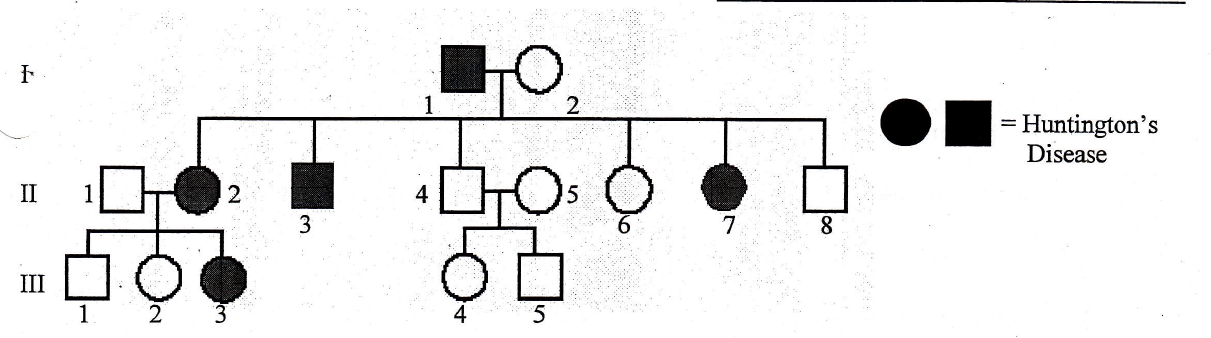
If this pedigree shows an autosomal recessive disorder, what MUST the genotype of individual II-3 be?
a)
HH
b)
Hh
c)
hh
d)
None of the above
2.
There are no carriers for Huntington's Disease- you either have it or you don't. Is Huntington's disease caused by a dominant or recessive trait?
a)
Dominant
b)
Recessive
3.
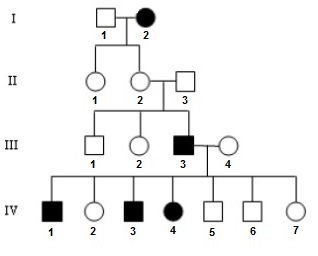
This pedigree represents the inheritance of hemophilia in this family. How many of the females have the hemophilia trait?
a)
8
b)
5
c)
2
d)
3
4.
Hemophilia is a recessive sex-linked trait. If H = normal & h = has hemophilia, which genotype represents a male with hemophilia. 
a)
XHY
b)
XHXh
c)
XhXh
d)
Xh
5.
How many girls in this family express this recessive disorder?
a)
4
b)
5
c)
6
d)
7
6.
What is the meaning of homozygous?
a)
Combination of the same alleles
b)
Combination of different alleles
c)
Expressed with a single copy of the allele
d)
Requires two alleles to be expressed
7.
What is the meaning of heterozygous?
a)
Combination of the same alleles
b)
Combination of the different alleles
c)
Expressed with a single copy of the allele
d)
Requires two alleles to be expressed
8.
Define genotype.
a)
Genetic make-up of a trait.
b)
Physical expression of a trait.
c)
Tool used to display potential probabilities for offspring.
d)
The amount of genes in a given population.
9.
Define the term - Recessive allele.
a)
Combination of the same alleles
b)
Expressed with a single copy of the allele
c)
Combination of the different alleles
d)
Requires two alleles to be expressed
10.
Define phenotype.
a)
Genetic make-up of a trait.
b)
Physical expression of a trait.
c)
Tool used to display potential probabilities for offspring.
d)
The amount of genes in a given population.
11.
Which statement is true of a plant with genotype TT and another with genotype Tt?
a)
Each would have differing phenotypes.
b)
All alleles are recessive.
c)
All alleles are dominant.
d)
Both have the same phenotype.
12.

____ of offspring would have the same phenotype as the parents if the cross was Yy by Yy?

a)

25%

b)

50%

c)

75%

13.
Which of these is an inherited behavior?
a)
A chameleon changing color
b)
A dog sitting on command
c)
A circus bear riding a bike
d)
An ape speaking in sign language
14.
Which behavior did a raccoon most likely learn from its environment?
a)
breathing
b)
providing for young
c)
eating out of trash cans
d)
drinking water
15.
Any change in the sequence of DNA is...
a)
transgenic shift
b)
Single Genotype
c)
Monohybrid Trait
d)
Mutation
16.
How do cancer cells differ from health cells?
a)
Cancer cells grow  uncontrollably, forming tumors
b)
Cancer cells grow    slowly, forming tumors
17.
What are things that cause changes in the DNA sequence called?
a)
dangerous
b)
unfortunate
c)
interferon
d)
mutagens
18.
Example of mutagens
a)
all
b)
x-rays
c)
ultraviolet radiation
d)
tobacco
19.

A mutation can be passed to offspring only if it takes place in a(n) ________ cell.

a)

sex

b)

rare

c)

diploid

20.
Why are insertion and deletion (frameshift) mutations so harmful?
a)
They change all of the codons from the mutation on down the line, which changes the amino acid sequence
b)
They insert things that an organism doesn't need.
c)
They often delete things that organisms need.
d)
Insertion and deletions are not any more harmful than substitution mutations.
21.

What is the protein made from the DNA molecule:

AAT GCC AGT

a)

LEU-ARG-SER

b)

LEU-GLU-THR

c)

TAA CGG TCA

d)

ARG-GLU-SER

22.
Where do mutations occur?
a)
DNA and RNA
b)
DNA 
c)
RNA
d)
mRNA and tRNA
23.
The survival of a species depends on its ability to adapt to changes in the environment. Which statement correctly describes a way that mutations increase the likelihood that a species will survive in a changing environment?
a)
Mutations are a source of variation in the species
b)
Mutations are the cause of disease in the species
c)
Mutations are not harmful when they occur in somatic cells
d)
Mutations are always passed on to subsequent generations
24.

Trisomy 21, or having 3 copies of chromosomes 21 is known as which type of mutation?

a)

Point

b)

Trinucleotide Repeat Expansion

c)

Nondisjunction

d)

Gene Translocation

25.

How does DNA replicate/copy itself?

a)

Carefully

b)

Semiconservatively

c)

Mitosis

d)

Xerox

26.

What are the 3 parts of DNA

a)

Sugar Phosphate Backbone

b)

Nitrogenous Bases

c)

Hydrogen Bonds

d)

Twizzlers and marshmallows

27.
Which of the following types of division results in 2 daughter cells that are genetically identical?
a)
mitosis
b)
gamete formation
c)
meiosis
d)
nondisjunction
28.
Which of the following types of division is for the purpose of genetic diversity and produces haploid cells?
a)
binary fission
b)
conjugation
c)
mitosis
d)
meiosis
29.
Which phase of the cell cycle is the longest?
a)
cytokinesis
b)
prophase
c)
interphase
d)
metaphase
30.
If a white flowered plant and a red flowered plant produce pink offspring, this is called -
a)
incomplete dominance
b)
codominance
c)
complete dominance
d)
sex-linked
31.
If a red flowered plant and a white flowered plant produce offspring with red and white spots, this is called -
a)
incomplete dominance
b)
codominance
c)
Mendelian inheritance
d)
complete domiance
32.
Traits that are controlled by many genes are called -
a)
multiple alleles
b)
codominance
c)
pleiotropy
d)
polygenic
33.
Suppose a double-stranded DNA molecule was shown to have 15% adenine bases. What would be the expected percentage of guanine bases in that molecule?
a)
15%
b)
35%
c)
85%
d)
Not enough information
34.
What is the flow of genetic information in cells from DNA to protein? (Central Dogma)
a)
RNA to DNA to protein
b)
DNA to RNA to protein
c)
protein to DNA to RNA
d)
RNA to protein to DNA
35.

There are 3 types of RNA. What are they? (Select all that apply)

a)

tRNA

b)

rRNA

c)

mRNA

d)

xRNA

36.

What combines together to make a protein?

a)

Amino Acid

b)

RNA

c)

Ribosome

d)

DNA

37.

How are amino acids held together?

a)

By the centromere

b)

By the peptide bond

c)

By the metaphase plate

d)

By the nucleus

38.
If two parents are heterozygous for type A blood, what is the probability that their offspring would have type O blood?
a)
100 %
b)
75%
c)
50%
d)
25%
39.
If a father is AA and a mother is AB, what is the probability for a child with AB blood? 
a)
0%
b)
25%
c)
50%
d)
75%
40.
If two parents have type AB blood, what is the probability that their child will have type O blood?
a)
0%
b)
25%
c)
50%
d)
100%
41.
Jim has type AB blood. His dad could be type O.
a)
True
b)
False
42.
surrounds the cell; controls what enters/leaves cell; maintains homeostasis
a)
vacuole
b)
cell wall
c)
cell membrane
d)
lysosome
43.
breaks down food to release energy
a)
nucleus
b)
lysosomes
c)
mitochondria
d)
vacuole
44.
moves substances within a cell (pipe like structures)
a)
endoplasmic reticulum
b)
nucleus
c)
cytoplasm
d)
vacuole
45.
cells that contain a true nucleus
a)
prokaryotes
b)
eukaryotes
c)
carbohydrate
d)
plant cells
46.

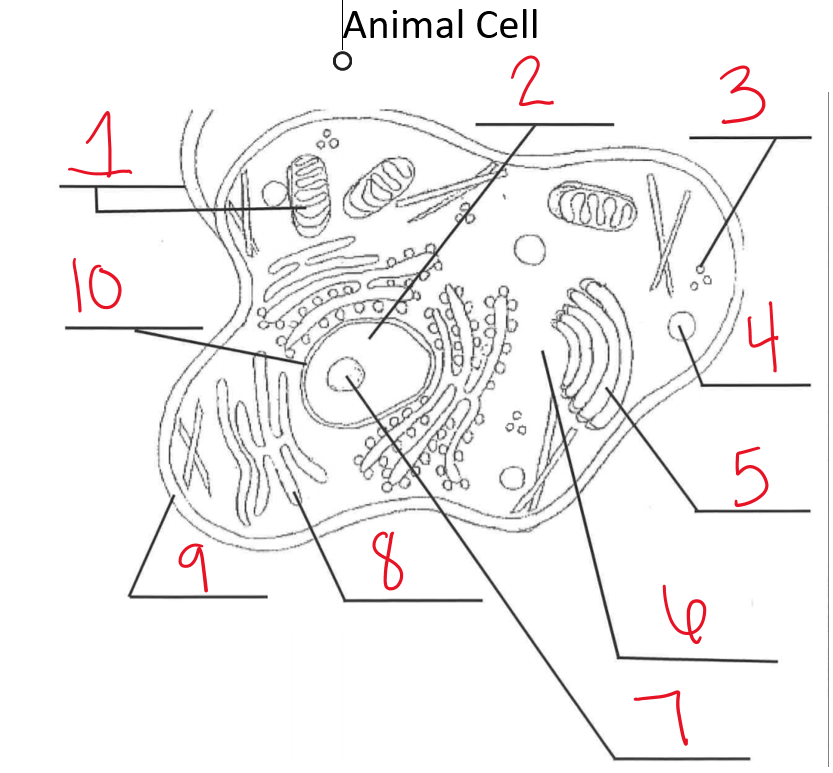
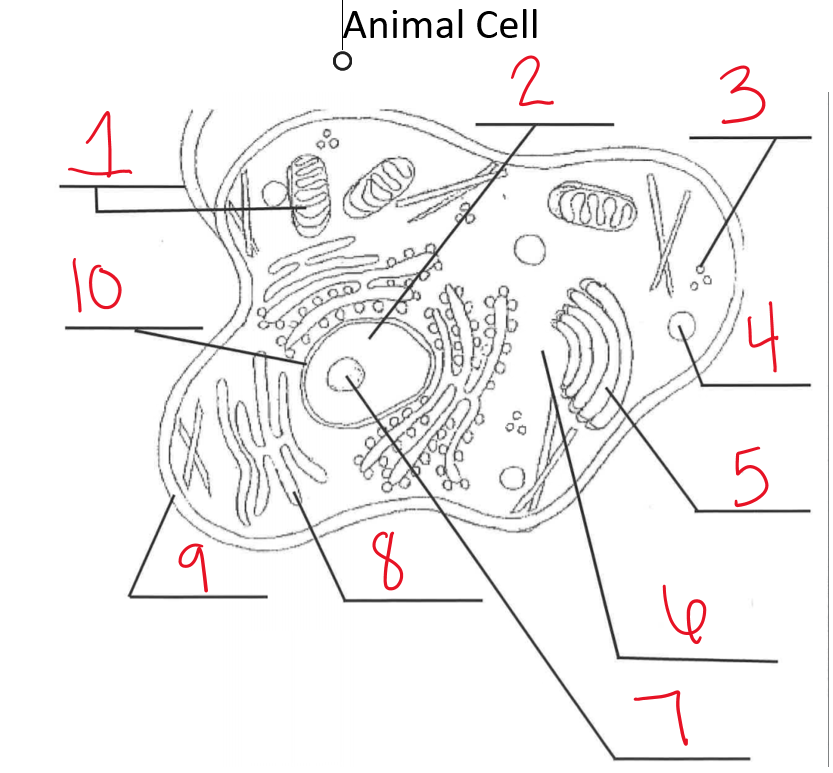
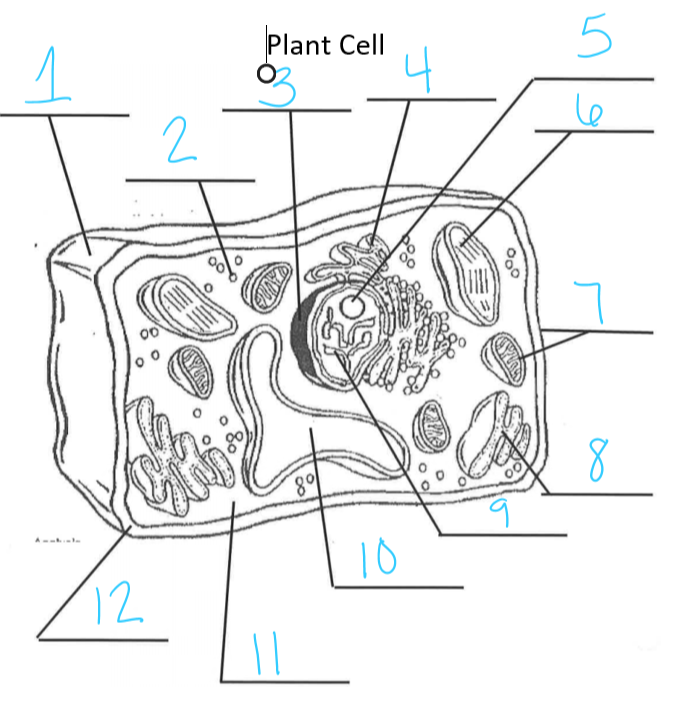
What organelle is labeled #7?

a)

Nucleus

b)

Nuclear membrane

c)

Nucleolus

d)

Vacuole

47.

What organelle is labeled #8?

a)

ER

b)

Golgi body

c)

DNA

d)

Mitochodria

48.

What organelle is labeled #1?

a)

Cell wall

b)

Cell membrane

c)

Cytoplasm

d)

Nuclear membrane

49.

What organelle is labeled #6?

a)

Chloroplasts

b)

Mitochondria

c)

Vacuole

d)

Ribosomes

50.
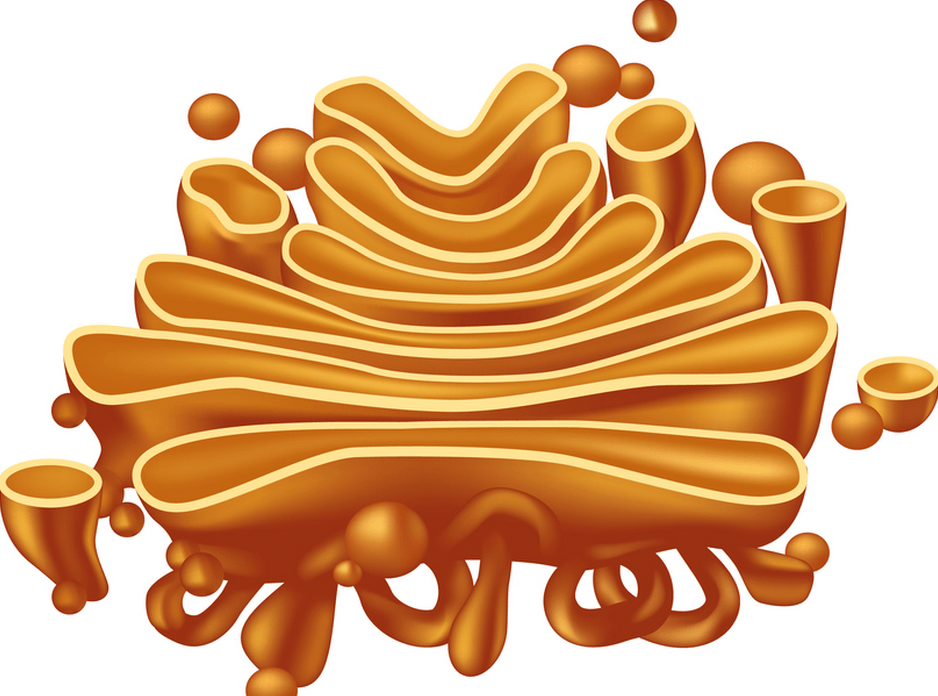
I am a protein packaging and shipping machine! Who am I?
a)
vacuole
b)
ribosome
c)
mitochondrion
d)
golgi apparatus
51.
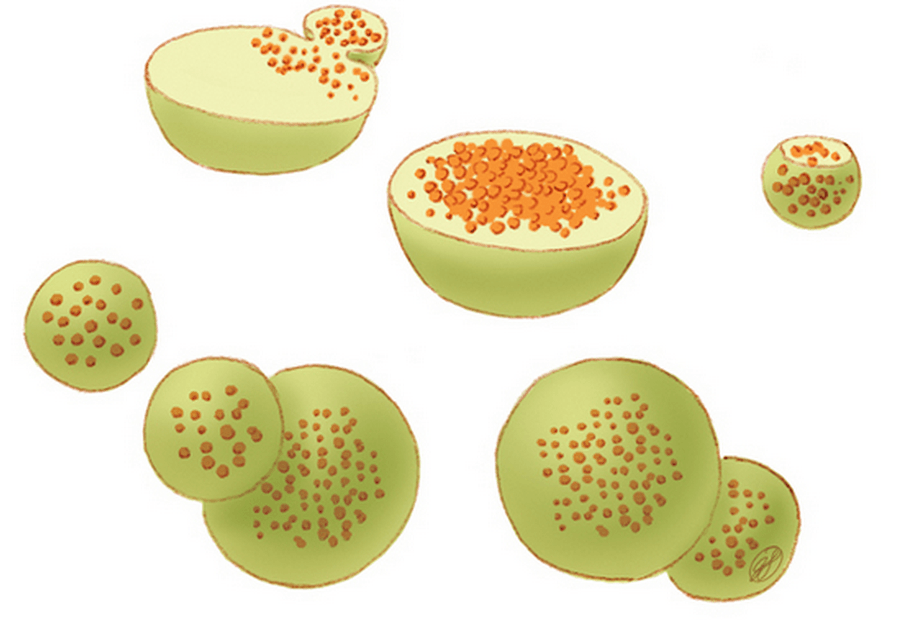
You might think of me as the trash collector, but recycler is maybe more accurate. What am I?
a)
mitochondria
b)
lysosome
c)
vacuole
d)
ribosome
52.
What would happen to the plant cell without the chloroplasts?
a)
There wouldn't be an organelle that performs photosynthesis
b)
There wouldn't be an organelle that serves as the resevoir for water and waste
c)
There wouldn't be an organelle that regulates what comes in and out of the cell
d)
They wouldn't be an organelle that makes necesary proteins
53.

Identify which number is the ribosome? (ANA)

a)

1

b)

3

c)

4

d)

6

54.
The letter B is pointing to  the...
a)
Smooth ER
b)
Mitochondria
c)
Rough ER
d)
Golgi Apparatus
55.
The letter K is pointing to  the...
a)
Smooth ER
b)
Mitochondria
c)
Rough ER
d)
Golgi Apparatus
56.
What is a substance called if it speeds up a chemical reaction?
a)
reusable
b)
catalyst
c)
specific
d)
fragile
57.
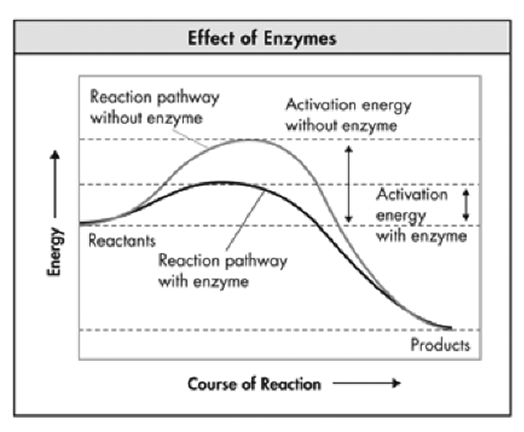
The graph shows how enzymes affect reactions in cells. Which statement best summarizes the information shown in the graph?
a)
Enzymes increase the energy of the reactants.
b)
Enzymes decrease the energy level of the products.
c)
Enzyme decrease the activation energy of the reaction.
d)
Enzymes reverse the direction of the reaction.
58.
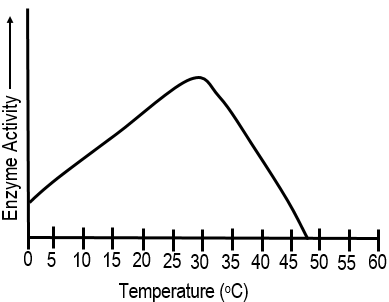
Based on the graph, what is the optimal temperature for this enzyme? 
a)
15oC
b)
40oC
c)
30oC
d)
35oC
59.
Enzymes are...
a)
nucleic acids
b)
proteins
c)
lipids
d)
carbohydrates
60.
What happens when enzymes are heated to a high temperature?
a)
The enzymes die.
b)
The shapes of the enzyme are altered denature
c)
The enzymes' amino acid sequence changes.
d)
The enzymes remain the same
61.
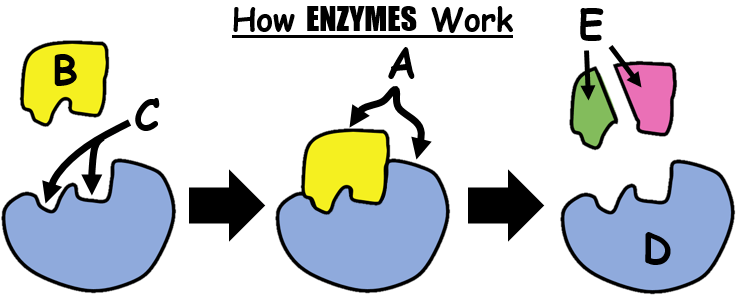
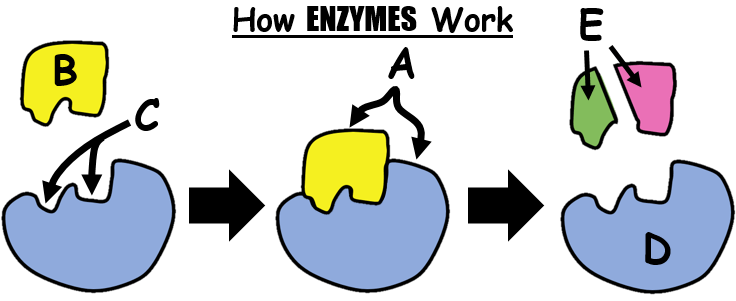
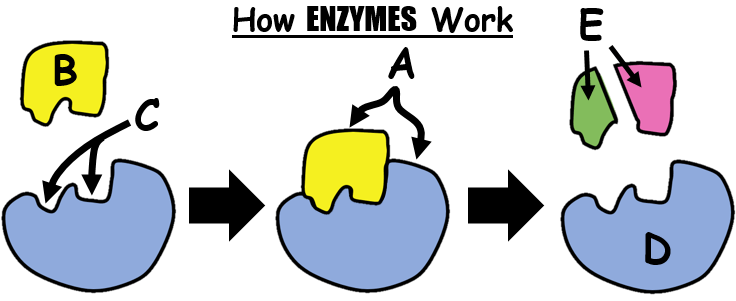
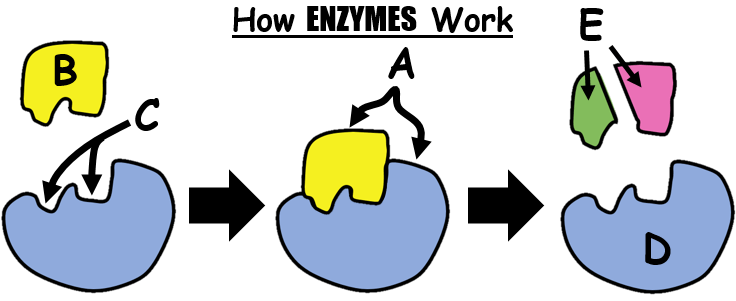
Letter D...
a)
active site
b)
enzyme
c)
substrate
d)
products
62.
Letter B...
a)
active site
b)
enzyme
c)
substrate
d)
products
63.
Letter C...
a)
active site
b)
enzymes
c)
substrate
d)
products
64.
Letter E...
a)
active site
b)
enzyme
c)
substrate
d)
products
65.
Each enzyme only has 1 substrate that will fit its active site.  What is this called?
a)
reusable
b)
catalyst
c)
specific
d)
fragile
66.
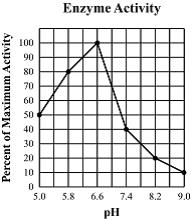
Which of the following conclusions can be drawn from this graph?
a)
The optimum pH of the enzyme is 6.6.
b)
The optimum pH of the enzyme is 5.8
c)
The enzyme’s activity increases as pH increases 5.0 to 9.0
d)
The enzyme’s activity is greater around pH of 8.0 .
67.
Which of these is most likely an enzyme?  
a)
Sucrose
b)
Galactose
c)
Fructose
d)
Amylase
68.
Which major macromolecule is being represented in this image? 
a)
carbohydrate
b)
lipid
c)
protein
d)
nucleic acid
69.
What type of macromolecule is being represented in this image? 
a)
carbohydrate
b)
lipid
c)
protein
d)
nucleic acid
70.
Which of the four major biological macromolecules can be easily identified by the nitrogen base and phosphate found in its structure?
a)
carbohydrate
b)
lipid
c)
protein
d)
nucleic acid
71.
REVIEW: Which of the following represents a formula for a chemical compound?
a)
H2O
b)
P2
c)
C6
d)
H
72.
Why are lipids insoluble in water?  
a)
lipids are polar
b)
lipids are non-polar
c)
lipids have a negative charge
d)
lipids are building blocks of protiens
73.
What are the single sugars that are the building blocks of carbohydrates?
a)
monosaccharides
b)
disaccharides
c)
polysaccharides
d)
amino acid
74.
Glycerol and fatty acids combine to form...?
a)
Carbohydrates
b)
Lipids
c)
Proteins
d)
Nucleic Acids
75.
Carbon, Hydrogen, Oxygen and Nitrogen are elements in what biomolecule?
a)
Carbohydrate
b)
Lipid
c)
Protein
d)
Nucleic acid
76.
I am responsible for long term energy storage in mammals.
a)
Protein
b)
Lipid
c)
Carbohydrate
d)
Nucleic Acid
77.
Which is NOT a monomer?
a)
sucrose
b)
glucose
c)
amino acid
d)
fatty acid
78.
Enzymes will make a reaction go _______ and use ______ energy.
a)
faster, less
b)
faster, more
c)
slower, less
d)
slower, more
79.
You are analyzing a compound in the laboratory. You find that it is made up of carbon, hydrogen, and oxygen in a ratio of two hydrogen atoms for each carbon atom. How will you classify the compound?
a)
lipid
b)
protein
c)
carbohydrate
d)
nucleic acid
80.
What is the function of macromolecule subunit below?
a)
energy
b)
catalyst
c)
stores genetic information
d)
composes the majority of the cell membrane
81.
What word describes when water is attracted to other substances?
a)
cohesion
b)
adhesion
c)
capillary action
d)
surface tension
82.

When water and other liquids stick together to form drops or thin films called ________________.

a)

adhesion

b)

capillary action

c)

cohesion

d)

surface tension

83.
molecule in which opposite ends have opposite electric charges
a)
cohesion
b)
polar molecule
c)
hydrogen bond
d)
solution
84.
Why does ice float?
a)
As water freezes, it expands and its density decreases.
b)
As water freezes, it takes up more hydrogen from the atmosphere, causing it to have a greater buoyancy.
c)
As water freezes, air becomes trapped between the hydrogen bonds of water molecules.
d)
As water freezes, it takes up more oxygen from the atmosphere, causing it to have a greater buoyancy.
85.
The reason the water balloon did NOT pop while held over a flame is water's _________.
a)
Less dense than air.
b)
Hydrogen bonds between water molecules.
c)
polarity.
d)
high specific heat capacity.
86.
Water is a universal solvent because it...
a)
It can be found anywhere
b)
It freezes when it gets cold
c)
floats when frozen
d)
Dissolves most substances
87.
Water striders can walk across the surface of calm water. Their feet push the surface of the water down slightly, but they do not break the surface. Why?
a)
The insects are light enough so they do not break the hydrogen bonds holding the water molecules together
b)
The insects actually use their wings to hover slightly above the water’s surface and they only skim it with their feet.
c)
The insect’s feet are non-polar, so they are repelled by the polar water molecules and are pushed away from the water’s surface.
d)
The insects are small enough to see the individual water molecules, so they are able to step carefully from one molecule to the next
88.
A general definition of cohesion is the attraction of:
a)
particles of the same substance
b)
particles of a different substance
c)
particles of both the same and different substances
d)
particles of neither the same or different substances
89.

Capillary Action

a)

The property of water that allows ice to float on the surface of liquid water

b)

The property of water that allows it to dissolve polar substances

c)

When water molecules stick to other surfaces

d)

The property of water that allows water to move up a thin tube (or the stem of a plant) by itself


90.
Attractions between the negative Oxygen atom of one water molecule and the positive Hydrogen atom of another water molecule are called
a)
Covalent bonds
b)
Ionic bonds
c)
Polar bonds
d)
Hydrogen bonds