wayground logo

Free Printable Worksheets

Font size

S
M
L
XL
Worksheets

TCAP EOC 1

Total questions: 115

Worksheet time: 2hrs 30mins

Name
Class
Date
1.
How do viruses reproduce?
a)
They copy their own genetic material inside a protein coat.
b)
They kill a cell and reproduce inside it.
c)
They invade a living cell and use the cell's functions to replicate their genetic material.
d)
They do not reproduce because they are not technically living things.
2.
Which cell part is present in eukaryotic cells, but not in prokaryotic cells?
a)
cell membrane
b)
cell wall
c)
cytoplasm
d)
nucleus
3.
The ability to taste a bitter chemical called PTC is a dominant trait in humans.  The Punnett square below shows a cross between two parents who are heterozygous for the ability to taste this chemical.  What is the probability, expressed as a percentage, that these parents will produce an offspring who is homozygous recessive for the tasting trait?
a)
0%
b)
25%
c)
50%
d)
75%
4.
A strand of DNA with the sequence A-C-T-T-G serves as a template to form a strand of mRNA with the sequence U-G-A-A-C.  During which process would this happen?
a)
replication
b)
transcription
c)
translation
d)
meiosis
5.
The diagram summarizes two stages in the production of the specialized cells used for sexual reproduction.
What happens in the stage labeled "process 2"?
a)
The chromosomes cross over.
b)
Th chromosomes number is reduced by half.
c)
The chromosomes move to opposite end of the cell.
d)
Four identical gametes form.
6.
Proteins are formed in the cytoplasm of cell using genetic instructions from DNA, which is located in the cells nucleus.  Which of the following best explains how the genetic information gets to the site of protein synthesis?
a)
DNA is divided during mitosis, and one strand travels outside the nucleus to bind with RNA and form a protein
b)
DNA is copied to make mRNA. The mRNA leaves the nucleus and goes to the ribosomes, where the information is used to guide protein synthesis.
c)
Genetic information travels from DNA in the nucleus along a strand of mRNA that is connected to ribosomes in the cytoplasm where proteins are made.
d)
The genetic code is transferred to ribosomes on tRNA molecules, which can pass through the nuclear membrane.
7.
The legs of crocodiles and mice have similar bone structures and develop in a similar way.  What type of structures are the leg bones?
a)
homologous structures
b)
analogous structures
c)
fossilized structures
d)
vestigial structures
8.
The standardized system for naming organism is known as binomial nomenclature.  What two pieces of information are used to name and identify organisms using this system?
a)
genus and species
b)
class and genus
c)
class and species
d)
domain and kingdom
9.
According to the diagram, when did the common ancestor of giant pandas and spectacled bears exist? 
a)
5-10 mya
b)
10-15 mya
c)
15-20 mya
d)
20-25 mya
10.
Movement of materials down the concentration gradient through a protein channel is an example of 
a)
facilitated diffusion
b)
active transport
c)
respiration
d)
osmosis 
11.
Which list includes only structures that would be found in a prokaryotic cell? 
a)
Cell wall, plasma membrane, mitochondria
b)
Central vacuole, cell wall, lysosome
c)
Cell wall, plasma membrane, cytoplasm
d)
Plasma membrane, nucleus, mitochondria
12.

Which of the following statements best describes the cell cycle?

a)

Interphase is the reproductive phase, mitosis is the growth phase

b)

Interphase is the growth phase, mitosis is the reproductive phase

c)

Cytokinesis is the growth phase, S-phase is the reproductive phase

d)

Cytokinesis is the reproductive phase, S-phase is the growth phase
13.
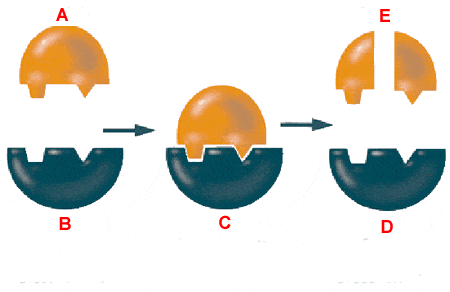
Which best describes the function of enzymes?
a)
to speed up chemical reactions in a cell
b)
to produce cellular energy
c)
to produce proteins
d)
to speed up cell division
14.
What are the products of photosynthesis? 
a)
glucose and oxygen
b)
glucose and carbon dioxide
c)
glucose and water
d)
water, carbon dioxide, and energy
15.
Which process uses ATP to move materials across the plasma membrane against the concentration gradient?
a)
passive transport
b)
active transport 
c)
facilitated diffusion
d)
osmosis
16.
Which process of the carbon cycle removes carbon dioxide from the atmosphere? 
a)
photosynthesis
b)
cellular respiration
c)
combustion of fossil fuels 
d)
death and decomposing organisms 
17.
What type of growth is shown by the human population? 
a)
Carrying capacity
b)
Logistical
c)
Exponential
d)
Stabilizing 
18.
Which method would be most helpful in preventing eutrophication of lakes and waterways?
a)
recycling aluminum
b)
conserving fossil fuels 
c)
reducing run-off from farms 
d)
using less pesticide 
19.
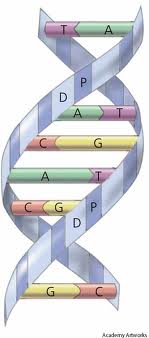
Which statement describes how complementary strands of DNA are linked?
a)
each sugar in one strand is paired with a complementary base in the other strand. 
b)
Each sugar in one strand is pained with a complementary phosphate in the other strand
c)
Each phosphate in one strand is paired with a complementary phosphate in the other
d)
Each base in one strand is paired with a complementary base in the other 
20.
Enzymes catalyze reactions by ___________ Activation Energy.
a)
Increasing
b)
Decreasing
21.
An experiment is performed on plants to see how different liquids affect plant growth. Each plant in the experiment is given a different liquid; water, apple juice, or milk. Each plant has the same amount of soil, sunlight, and listens to the same music. In this investigation, the independent variable is ...
a)
The type of plant
b)
The amount of sunlight
c)
The type of music
d)
The type of liquid
22.
The amount of energy that usually transfers from one trophic level to the next...
a)
10%
b)
20%
c)
80%
d)
50%
23.
What is something that prokaryotic and eukaryotic cells have in common?
a)
They have a nucleus. 
b)
They are multi-cellular. 
c)
They have DNA. 
d)
They have organelles that are membrane-bound.
24.
Which 2 molecules forms the sides (backbone) of the DNA ladder?
a)
deoxyribose and adenine
b)
deoxyribose and a hydrogen bond
c)
sugar and the nucleus
d)
deoxyribose (sugar) and phosphate
25.

The light independent reactions (Calvin Cycle) of photosynthesis happen where?

a)

stroma of chloroplast

b)

mitochondrial matrix

c)

stem

d)

thylakoid membrane

26.
In this image, the cell is using which type of molecular transport?
a)
Osmosis
b)
Diffusion 
c)
Endocytosis
d)
Exocytosis 
27.
What are the two reactants of cellular respiration?
a)
C6H12O6 & 6CO2
b)
6 CO2 & 6H2O
c)
C6H12O& 6O2
d)
6CO2 & 6O2
28.
Name structure #5.
a)
rough ER
b)
nucleus
c)
vesicle
d)
cytoplasm
29.
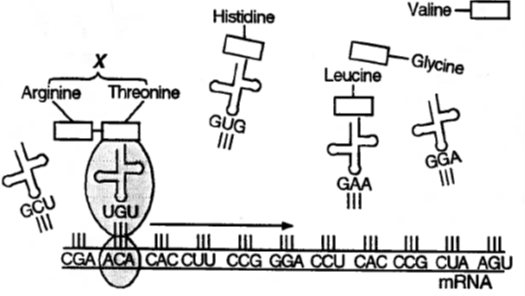
Name the process in the picture.
a)
transcription
b)
mitosis
c)
translation
d)
replication
30.
What process is occurring in the picture?
a)
DNA replication
b)
mitosis
c)
protein synthesis
d)
meiosis
31.
Name M.
a)
light dependent cycle
b)
Carbon dioxide
c)
glucose
d)
Calvin cycle
32.
Name B.
a)
phosophate
b)
glucose
c)
deoxyribose
d)
nitrogen base
33.
Which gas is filling the balloon in the experiment?
a)
Oxygen
b)
Carbon Dioxide
c)
Glucose
d)
Water
34.
These onion cells are losing water, they are suffering from .......
a)
turgor pressure
b)
plasmolysis
c)
hemolysis
d)
exocytosis
35.
What type of punnett square?
a)
codominance
b)
incomplete dominance
c)
complete dominance
d)
sex linked recessive
36.
Widow's peak is dominant to straight hair line. Cross a heterozygous widow's peak female with a heterozygous widow's peak male. What is the genotype ratio?
a)
1:2:1
b)
3:1
c)
1:1
d)
1:0
37.
Which of these is NOT true?
a)
Enzymes can denature (change shape) when the temperature gets too high.
b)
Enzymes can only be used once in a chemical reaction. 
c)
Extreme pH can denature enzymes.
d)
Enzymes speed up chemical reactions. 
38.
What molecule is this
a)
sucrose
b)
protein
c)
glucose
d)
cellulose
39.
What process is going on in this photo? 
a)
Transcription 
b)
Translation 
c)
Replication 
d)
All the above 
40.
This picture represents which type of cellular transport?
a)
passive transport
b)
endocytosis
c)
exocytosis
d)
osmosis
41.
The cell below is in a _________ solution.
a)
Hypotonic
b)
Hypertonic
c)
Isotonic
42.
What two products does a plant make during photosynthesis?
a)
Water and Glucose
b)
Oxygen and Glucose
c)
Oxygen and Water
d)
CO2 and Glucose
43.

What is the role of the pioneer species in Primary Succession?

a)

To kill any remaining organisms from before the disturbance

b)

To break down rock and rebuild soil

c)

To provide food for large animals

d)

To put fresh oxygen into the air

44.

What are some abiotic factors that could be limiting factors in the Iowa River ecosystem?

a)

Temperature, fertilizer runoff from fields, drought or flood

b)

Invasive species, floods

c)

Temperature, predators, droughts, floods, over fishing

45.
The diagram below represents a cell. Which organelle is the site where amino acids are synthesized into proteins? 
a)
1
b)
2
c)
3
d)
4
46.
An offspring will receive how many alleles from each parent to determine a specific trait?
a)
one
b)
two
c)
three
d)
five
47.
G = green, g = yellow
The genotype for a yellow plant is...
a)
GG
b)
Gg
c)
gg
d)
all of the choices result in yellow
48.
Which process is used to make mRNA from the DNA in the nucleus?
a)
transcription
b)
translation
c)
replication 
49.
Which RNA bases would pair with TACGAA in transcription
a)
AUGCUU
b)
ATGCTT
c)
GCATCC
d)
GCAUCC
50.
Where does transcription take place?
a)
nucleus
b)
cytoplasm
c)
ribosome
51.
How many amino acids are coded for by this sequence of nucleotides:
ATG GGA ACT CCA
a)
4
b)
2
c)
6
d)
12
52.
What is occurring in this picture?
a)
Translation
b)
Replication
c)
Translocation
d)
Transcription
53.
Which species’ DNA is most similar to the DNA of the toothed whale? 
a)
Hippopotamus 
b)
Baleen Whale
c)
Grazing Mammals
d)
Camels
54.
The white feathers of a snowy owl allow it to blend in with its environment during the winter months (snow). This is an example of ________________
a)
Species
b)
Environmental Change
c)
Adaptation
d)
Variation
55.
Cattle egrets forage (feed) in fields among cattle. The egret gets easy access to flying insects stirred up by the cattle, and the cattle don't care if they are there or not.
a)
mutualism
b)
commensalism
c)
competition
d)
parasitism
56.
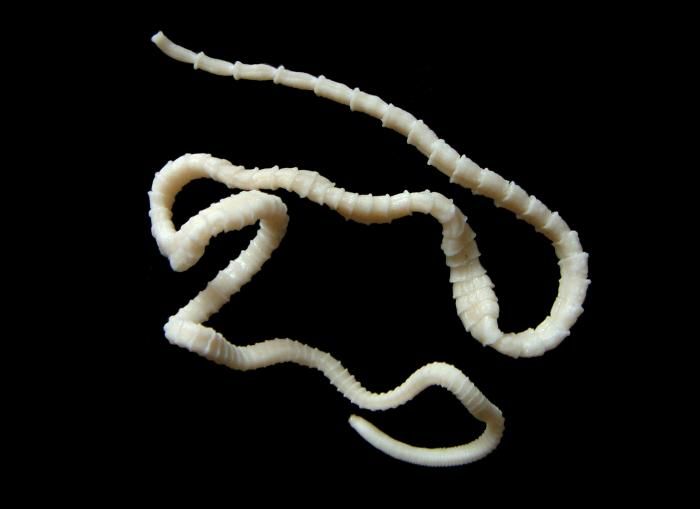
A tapeworm and a cat have this type of relationship.
a)
mutualism
b)
parasitism
c)
commensalism
d)
competition
57.
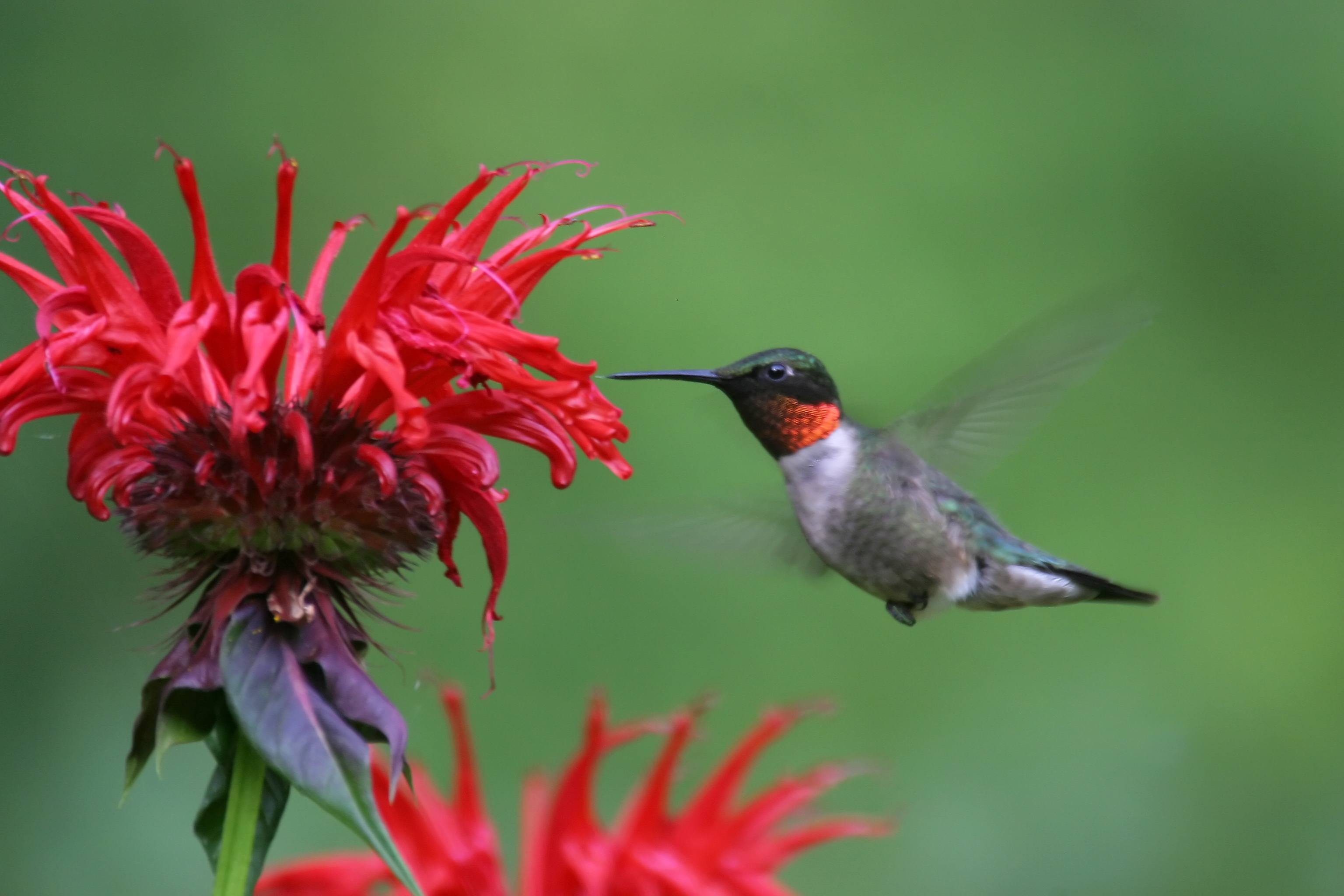
What type of symbiosis?  Hummingbirds feed on nectar from flowers.  The flowers are pollinated by hummingbirds as they move from flower to flower.
a)
commensalism
b)
mutualism
c)
parasitism
d)
predation
58.
Which type of cell has no nucleus?
a)
Eukaryote
b)
Prokaryote
c)
Animal
d)
Plant
59.
Which type of cell?
a)
Prokaryote
b)
Eukaryote
60.
Which type of cell?
a)
Prokaryote
b)
Eukaryote
c)
Mixed
61.
What is a change in an organism that allows for it to survive in its environment?
a)
homologous
b)
vestigial
c)
variation
d)
adaptation
62.
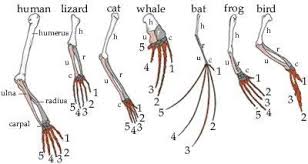
What is this an example of?
a)
vestigial structures
b)
embryology
c)
homologous structures
d)
fossil record
63.
Which layer is the oldest?
a)
1
b)
2
c)
3
d)
4
64.

This is a structure that was inherited but has lost most of its original function

a)

homologous

b)

analogous

c)

vestigial

d)

homozygous

65.

These structures are similar from common ancestry

a)

homologous

b)

analogous

c)

vestigial

d)

homozygous

66.

These structures share a common function but not structure for example the wing of a bird and the wing of an insect

a)

homologous

b)

analogous

c)

vestigial

d)

homozygous

67.

Which organelles can be found in the plant cell, but not the animal cell?

a)

nucleus, cytoplasm, and mitochondrion

b)

vacuole, nucleus, and cell membrane

c)

nucleus, vacuole, and cytoplasm

d)

central vacuole, cell wall, and chloroplast
68.
Which organelles can be found in the plant and animal cell?
a)
nucleus, chlorophyll, chloroplast
b)
vacuole, mitochondria, and cell wall
c)
mitochondria, cell membrane, and vacuole
d)
nucleus, cell membrane, and cell wall
69.
What property of water makes it the 'universal solvent'?
a)
it is a polar molecule
b)
it is an ionic compound
c)
it contains hydrogen bonds
d)
it steals electrons from other atoms
70.
Carbohydrates are made of... 
a)
C H O
b)
C H O N
c)
C H O N P
d)
C H O N S
71.
Glucose is a _____.
a)
carbohydrate
b)
lipid
c)
protein 
d)
nucleic acid
72.
Which group of organic molecules serve as long-term energy storage and make the cell membrane is?
a)
proteins
b)
carbohydrates
c)
lipids
d)
nucleic acids
73.
Also known as simple sugars, these are the monomers of carbohydrates.
a)
lipids
b)
nucleotide
c)
monosaccharide
d)
monomer
74.
The building blocks of nucleic acids are called ...
a)
amino acids
b)
nucleotides
c)
carbohydrates
d)
proteins
75.
ATP is...
a)
a unit of energy in the cell
b)
a type of lipid
c)
a molecule of DNA
76.
Phospholipids have a _________ head and a __________ tail.
a)
hydrophilic, hydrophobic
b)
hydrophobic, hydrophilic 
77.
The cell membrane is formed mostly by...
a)
carbohydrates
b)
proteins
c)
phospholipids
d)
nucleic acids
78.
Enzymes are _________ that __________ chemical reactions.
a)
proteins, slow down
b)
proteins, speed up
c)
lipids, slow down
d)
lipids, speed up
79.
Nucleotides are made up of three parts. The three parts are...
a)
DNA, RNA, and a sugar
b)
a lipid, a fat, and an oil
c)
a carbohydrate, a protein, and a fat
d)
a sugar, a phosphate, and a base
80.
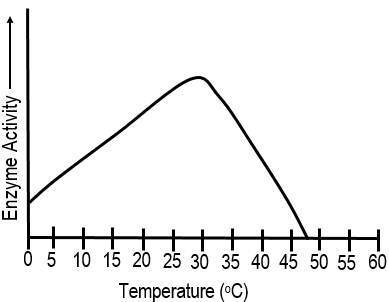
Based on the graph, what temperature does this enzyme work best? 
a)
15 C
b)
40 C
c)
30 C
81.
Which of the following binds to the active site of an enzyme? 
a)
substrate
b)
product
c)
codon
d)
none of the above
82.
What happens when enzymes are heated to a high temperature?
a)
The enzymes die.
b)
The shapes of the enzyme are altered or denatured
c)
The enzymes' amino acid sequence changes.
d)
The enzymes remain the same
83.

In the graph to the right, what is the population of deer at the carrying capacity of the environment?

a)

3

b)

7

c)

70

d)

40

84.
All of the living and nonliving things in an area that interact with each other are called a/an ______.
a)
community
b)
habitat
c)
population
d)
ecosystem
85.
What does the graph represent?
a)
Emigration
b)
Exponential growth
c)
Immigration
d)
Logistic Growth
86.
What type of transport is illustrated?
a)
facilitated diffusion
b)
active transport
c)
diffusion
d)
osmosis
87.
What will most likely be the result if all of the mitochondria are removed from a plant cell? 
a)
It will be unable to carry out respiration. 
b)
It will lose water through osmosis. 
c)
It will break down the ribosomes in the cell. 
d)
It will be unable to photosynthesize
88.
Fruit fly body cells have 8 chromosomes. After mitosis, you would expect a resulting fruit fly daughter cell to have ...
a)
16 chromosomes.
b)
46 chromosomes.
c)
8 chromosomes.
d)
4 chromosomes.
89.
Structure B is pointing to the _____. 
a)
chromosome
b)
centromere
c)
DNA
d)
chromatid
90.

In which cell below would a student likely observe a cell plate during mitosis?

a)

rat muscle cell

b)

alligator stomach cell

c)

onion root cell

d)

human lung cell

91.

Is the following cell diploid or haploid?

a)

Diploid

b)

Haploid

92.

Because water is polar, this means its molecules tend to stick to each other, which is called

a)

Adhesion

b)

Osmosis

c)

Cohesion

d)

Passive Transport

93.

During osmosis, water moves from areas of

a)

high to low concentration

b)

low to high concentration

c)

high to low concentration using energy

d)

low to high concentration using energy

94.

During Active transport, molecules are moved from areas of

a)

high to low concentration

b)

low to high concentration

c)

high to low concentration using energy

d)

low to high concentration using energy

95.

Which is correct about mitosis vs meiosis?

a)

Mitosis and meiosis produce two daughter cells.

b)

Mitosis produces four genetically different cells and meiosis produces two genetically identical cells

c)

Mitosis produces two genetically identical cells and meiosis produces four genetically different cells

d)

Mitosis occurs in sex cells, meiosis occurs in somatic cells

96.

In a controlled experiment, only 1 variable is changed at a time. This variable is the

a)

Dependent Variable

b)

Independent Variable

c)

Constant

d)

Control Group

97.

Which of the following makes their own food?

a)

Heterotroph

b)

Autotroph

c)

Consumer

d)

Decomposer

98.

Which of the following in NOT part of cell theory?

a)

Cells are the basic unit of structure & function of living things.

b)

All cells come from preexisting cells.

c)

All living things are composed of cells

d)

All cells have a nucleus

99.

Which process during protein synthesis takes instructions from DNA and creates mRNA?

a)

Transcription

b)

Translation

c)

Replication

d)

Apoptosis

100.

Homologous structures, like those in the picture, are due to

a)

similar function, no common ancestor

b)

different function, common ancestor

c)

structures no longer needed

d)

genetic disorder

101.

Which of the following is a homozygous genotype?

a)

Bb

b)

Blue eyes

c)

tt

d)

Round peas

102.
The diagram shows a container divided into two compartments by a membrane permeable to water but not to starch. Two solutions containing different concentrations of dissolved starch were placed on each side of the membrane. Which of the following describes what will happen to the water level during the process of osmosis?  
a)
The water level of both sides of the membrane will decrease 
b)
The water level on the right side of the membrane will increase 
c)
The water level on the left side of the membrane will increase
d)
The water level on both sides of the membrane will stay the same 
103.
An animal cell placed in a sugar solution is shown in the diagram. Which statement best describes how osmosis will affect this animal cell?  
a)
Water will move out of the cell and the cell will shrink
b)
Water will move into the cell and the cell will expand 
c)
Sugar will move out of the cell and the cell will expand 
d)
Sugar will move into the cell and the cell will expand
104.

In order to make hydrochloric acid, which is required in human digestion, ATP is used to move hydrogen ions from the blood to the stomach lining. This is an example of ___.

a)

Active Transport

b)

Passive Transport

c)

Osmosis

d)

Facilitated Diffusion

105.
 A paramecium is shown.  This paramecium lives in an environment where water is constantly entering the organism.  The paramecium uses specialized vacuoles to pump some of the water back into the environment against a concentration gradient. Which of these processes is used to pump extra water out of the paramecium?   
a)
Osmosis
b)
Diffusion
c)
Active Transport
d)
Electron Transport
106.
The diagram shows the semipermeable membrane of a cell and the concentration of solutions inside and outside the cell. Which of the following statements best describes how the molecules will move?   
a)
Water molecules will move out of the cell 
b)
Water molecules will move into the cell 
c)
Solute molecules and water molecules will move out of the cell 
d)
Solute molecules and water molecules will move into the cell 
107.
The stages of the cell cycle are shown in random order below.  Starting with prophase, sequence the diagrams to show the stages of mitosis.  
                       
a)
5-3-1-2-4
b)
3-1-4-2-5
c)
4-1-2-5-3
d)
2-3-1-5-4
108.
The diagrams show the stages of mitosis in random order.  What sequence correctly shows the stages of mitosis?             
a)
3-1-2-4
b)
1-3-4-2
c)
4-2-3-1
d)
2-1-4-3
109.
A daughter cell that resulted from a mitotic division has 24 chromosomes.  How many chromosomes did the parent cell have?   
a)
6
b)
12
c)
24
d)
48
110.
What must occur during the cell cycle to ensure proper division of the chromosomes?  
a)
The cell must grow in size
b)
The mitochondria must divide 
c)
The DNA of the cell must replicate
d)
The cell membrane must dissolve
111.
The diagram to the right shows the phase of mitosis when the centrioles are at opposite poles of the cell and the chromosomes are lined up midway between the centrioles. Which phase would be the next phase of mitosis?   
  
a)
anaphase
b)
prophase
c)
interphase
d)
telophase
112.
The figures below show four processes involving DNA and RNA.  Use these figures to answer the next question. 
Which figure shows the process of replication?
a)
figure 1
b)
figure 2
c)
figure 3
d)
figure 4
113.
A reduction in which of these would lead to a decrease in all other populations?
a)
Coyote
b)
Grass
c)
Grasshoppers 
d)
Squirrel 
114.
Which of these best explains the difference between the way animals and plants exchange gases with their environment?
a)
Animals use only photosynthesis, while plants use both photosynthesis and respiration
b)
Animals use only respiration, while plants use both photosynthesis and repiration
c)
Animals use both photosynthesis and respiration, while plants use only respiration
d)
Animals use both photosynthesis and respiration, while plants only use photosynthesis
115.
Which of these shows the steps by which proteins are coded and synthesized? 
a)
RNA-> DNA-> protein
b)
DNA-> RNA-> protein
c)
protein-> RNA-> DNA
d)
protein-> DNA-> RNA