wayground logo

Free Printable Worksheets

NEW

Font size

S
M
L
XL
Worksheets

Science Benchmark Review 19-20

Total questions: 72

Worksheet time: 3hrs 54mins

Name
Class
Date
1.
What is the charge of the electron
a)
positive
b)
no charge
c)
negative
d)
neutral
2.
Which of the following best describes an electron?
a)
It has no charge and about the same mass as a proton
b)
It has a negative charge and much less mass than a proton
c)
It has a positive charge and much more mass than a neutron
d)
It has a negative charge and about the same mass as a neutron
3.
Which of the following is not a compound?
a)
HCl
b)
Cl
c)
NaCl
d)
CO2
4.
Which of the following represents an element?
a)
H2O
b)
H2
c)
NaCl
d)
CaCO3
5.
What is made up two or more elements that are chemically combined?
a)
Element
b)
Mixture
c)
Compound
d)
Solids
6.
Is Iron (Fe) an element or a compound?
a)
Element
b)
Compound
7.
What is the mass number defined as?
a)
the number of protons
b)
the number of protons and neutrons
c)
the number of neutrons
d)
the number of protons and electrons
8.
How many carbon atoms (C) are in a COmolecule?
a)
1
b)
2
c)
3
d)
0
9.
How many Oxygen atoms (O) are in a  molecule  of CO2
a)
1
b)
2
c)
3
d)
0
10.
A physical change is?
a)
It changes the object into something different
b)
Objects or substances undergo a change that does not change their chemical composition
c)
it is just like a chemical reaction
d)
Paper burning
11.
A chemical change is?
a)
a shoe lace cut in half
b)
doesn't change anything
c)
changes the look of an object
d)
change that results in the formation of new chemical substances
12.
A way to show the number and type of elements (atoms) in a molecule or compound with a combination of symbols and numbers.
a)
Molecule
b)
Chemical formula
c)
Physical change
d)
Coefficient
13.
The central region of an atom where its neutrons and protons are is its _______.
a)
Nucleus 
b)
Electron cloud
c)
Core 
d)
Center 
14.
The atomic number of an elements is the total number of which particles in the nucleus?
a)
Neutrons
b)
Protons
c)
Electrons
d)
Protons and electrons
15.

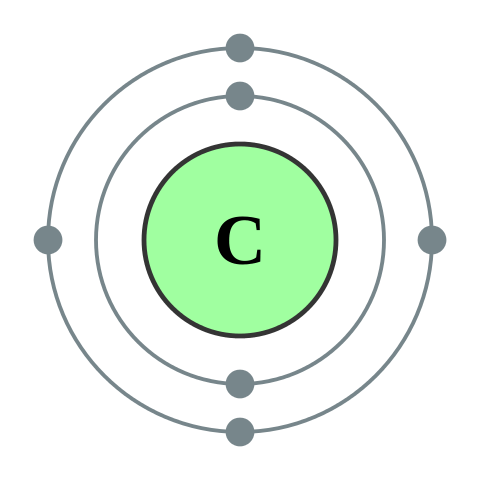
What is the atomic number of this atom shown in the Bohr model?

a)

11

b)

12

c)

13

d)

can't be determined

16.

How many valence electrons does carbon have?

a)

4

b)

5

c)

6

d)

7

17.

How many valence electrons have calcium?

a)

2

b)

5

c)

3

d)

1

18.
How many carbon atoms (C) are in a COmolecule?
a)
1
b)
2
c)
3
d)
0
19.
How many Oxygen atoms (O) are in a  molecule  of CO2
a)
1
b)
2
c)
3
d)
0
20.
Which two particles make up the nucleus of an atom?
a)
Protons and Electrons
b)
Protons and Neutrons
c)
Molecules and Compounds
d)
Neutrons and Electrons
21.
What is the role of an electron in an atom?
a)
Electrons live inside the nucleus and carry a neutral charge.
b)
Electrons circle the nucleus and have a positive charge.
c)
Electrons circle the nucleus and have a negative charge.
d)
Electrons live inside the nucleus and have a negative charge.
22.
Consider the chemical equation CH4 + 2 O2 → CO2 + 2 H2O. In this equation, CH4 is a
a)
product
b)
reactant
c)
displacement
23.
What is the left part of a chemical equation called?
H2 + O → H2O
a)
Reactants
b)
Products 
c)
Yields 
d)
Chemical Equation 
24.

How many reactants are in A + B ---> C ?

a)

1

b)

2

c)

3

d)

4

25.

Which are the reactants in the following reaction?

2Mg + O2 ---> 2MgO

a)

2MgO

b)

2Mg +O

c)

2Mg + O2

26.
Which is the name of the kind of solid substance formed in this figure?  
a)
aqueous 
b)
precipitate
c)
acid
d)
synthesis 
27.
Provides evidence that a chemical reaction has occurred. 
a)
dissolving 
b)
melting
c)
formation of a gas
d)
bending
28.
A student places a piece of a potato into a container of hydrogen peroxide. One observation the student makes is that bubbles form around the potato. The presence of bubbles might indicate the formation of a new substance because bubbles - 
a)
could show that a gas is forming
b)
always rise to the top of a liquid. 
c)
are almost always perfectly spherical.
d)
usually burst after a few minutes.
29.

Can be beaten into thin sheets

a)

Ductile

b)

Sonorous

c)

Malleable

d)

Flexible

30.

Can be drawn into wires

a)

Ductile

b)

Sonorous

c)

Malleable

d)

Flexible

31.

Another word for shiny

a)

Ductile

b)

Sonorous

c)

Malleable

d)

Lustrous

32.

Metals are good conductors of heat

a)

True

b)

False

33.

The majority of elements in the periodic table are

a)

metals

b)

non-metals

34.

Able to be beaten or hammered into shapes

a)

lustre

b)

malleable

c)

brittle

d)

insulator

35.

Where would this tossed baseball have the greatest amount of kinetic energy?

a)

point W

b)

point X

c)

point y

d)

point z

36.
a)
1
b)
2
c)
3
d)
4
37.
a)
1
b)
2
c)
3
d)
4
38.
Which of the following is a property of a non-metal?
a)
Conducts electricity and heats well
b)
Can be hammered into thin sheets
c)
Is brittle and breaks easily
d)
Has a shiny, metallic luster
39.
John was observing the physical properties of elements in order to classify them as either a metal, nonmetal, or metalloid. The first element was dull, brittle, and did not conduct heat. What would its classification be? 
a)
metal 
b)
nonmetal 
c)
metalloid
40.

Vertical columns of elements that DO share chemical properties (react the same) because they have the same number of VALENCE ELECTRONS in their outer shells.

a)

Groups

b)

Periods

41.

Horizontal rows of elements that share the same number of ENERGY LEVELS but DO NOT share chemical properties.

a)

Groups

b)

Periods

42.

The ______ are located on the left side of the zig-zag 'staircase' on the Periodic Table. (except for Hydrogen)

a)

metals

b)

non-metals

c)

metalloids

43.

The ___________ are located on the right side of the zig-zag 'staircase' on the Periodic Table (except for Hydrogen)

a)

metals

b)

non-metals

c)

metalloids

44.

The __________ are touching or bordering the zig-zag 'staircase' on the Periodic Table.

a)

metals

b)

non-metals

c)

metalloids

45.
a)
1st
b)
2nd
c)
3rd
d)
law of motion
46.
A piece of copper has a mass of 89g and a volume of 10 cm3.  What would be the density of the copper?
a)
0.89 g/cm3
b)
89 g/cm3
c)
8.9 g/cm3
d)
890 g/cm3
47.
Frank has a paper clip. It has a mass of 9g and a volume of 3cm3. What is its density?
a)
3 g/cm3
b)
1/3 g/cm3
c)
27 g/cm3
d)
39 g/cm3
48.
Frank has an eraser. It has a mass of 4g, and a volume of 2cm3. What is its density?
a)
8 g/cm3
b)
2 g/cm3
c)
1/2 g/cm3
d)
24 g/cm3
49.
What is the formula for density?
a)
density = mass x volume
b)
density = mass / volume
c)
density = mass + volume
d)
density = mass - volume
50.
The way a surface reflects light.
a)
color
b)
luster
c)
streak
d)
density
51.

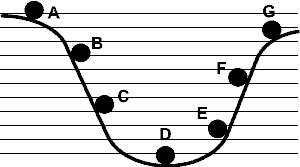
At which point does the ball has the greatest gravitational potential energy (GPE)?

a)

A

b)

G

c)

D

d)

C

e)

G

52.

You throw a ball into the air as shown in the diagram. At what point does the ball have the most gravitational potential energy?

a)

W

b)

X

c)

Y

d)

Z

53.

At which point on the roller coaster is the gravitational potential energy the greatest?

a)

W

b)

X

c)

Y

d)

Z

54.
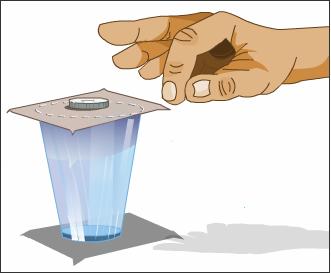
Sometimes tectonic plates do not move easily past one another, and the plates become stuck. Forces build up, and when the plates finally move, tension is released, as shown below. The sudden movement of the plates is caused by -

a)
the mass of the plates
b)
the weight of the plates
c)
unbalance forces
d)
gravitational force
55.
What is the formula to calculate speed?
a)
Speed = Distance x Time
b)
Speed = Distance/Time
c)
Speed = Time/Distance
d)
Speed = Time x Distance
56.
Calculate the speed:
A Car traveled 240 Km in 5 Hours
a)
48 Km/Hr
b)
1200 Km/Hr
c)
4.8 Km/Hr
d)
0.02 Km/Hr
57.
What is speed?
a)
The rate at which an object changes position
b)
The direction an object is moving
c)
moving fast
d)
change in speed or direction
58.
What is the tendency of an object to resist a change in motion?
a)
coffee
b)
motion
c)
inertia
d)
gravity
59.
What is Newton's First Law
a)
F=ma
b)
Every action has an equal and opposite reaction
c)
An object at rest stays at rest, an object in motion stays in motion. 
d)
Friction 
60.

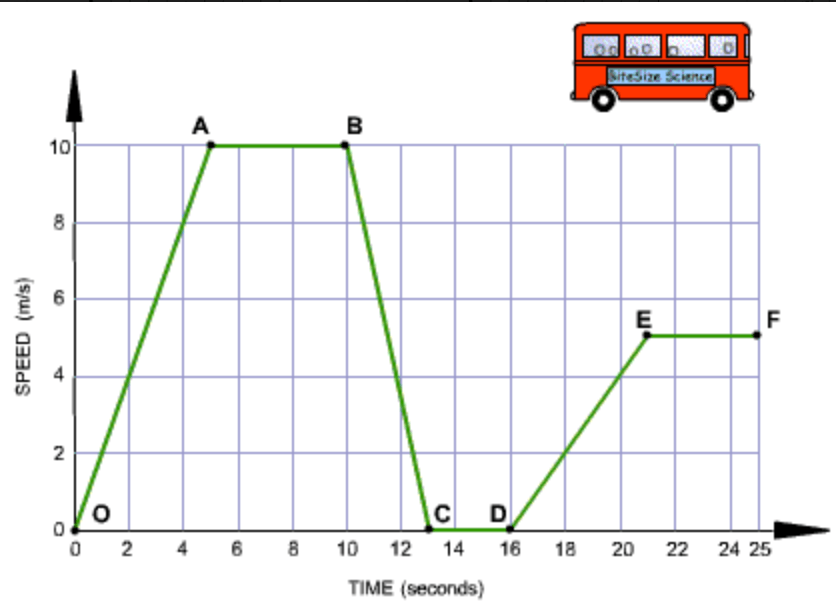
Segment O-A The bus is _________________.

a)

at rest

b)

returning (to original position)

c)

moving forward

61.

Segment A-B The bus is _________________.

a)

at rest

b)

returning (to original position)

c)

moving forward

62.

Segment B-C The bus is _________________.

a)

at rest

b)

returning (to original position)

c)

moving forward

63.

Segment C-D The bus is _________________.

a)

at rest

b)

returning (to original position)

c)

moving forward

64.

Segment O-A: The bus is _________________. It's speed changes from 0m/s to 10 m/s in 5 seconds.

a)

accelerating

b)

decelerating

c)

constant speed

d)

at rest

65.

Segment A-B: The bus is moving at a _________________ of 10 m/s for 5 seconds.

a)

accelerating

b)

decelerating

c)

constant speed

d)

at rest

66.

Segment B-C: The bus is _________________. It is slowing down from 10 m/s rest in 3 seconds.

a)

accelerating

b)

decelerating

c)

constant speed

d)

at rest

67.

Segment C-D: The bus is _________________. It has stopped.

a)

accelerating

b)

decelerating

c)

constant speed

d)

at rest

68.

Segment D-E: The bus is _________________. It is gradually increasing it's speed.

a)

accelerating

b)

decelerating

c)

constant speed

d)

at rest

69.

Segment E-F: The bus is moving at a _________________ of 5 m/s for 4 seconds.

a)

accelerating

b)

decelerating

c)

constant speed

d)

at rest

70.
What happened during C to D point?
a)
not moving
b)
increasing speed at a constant rate
c)
moving at a constant speed
d)
moving at 0 m/sacceleration
71.
What happened during A to B point?
a)
not moving
b)
increasing speed at a constant rate
c)
moving at a constant speed
d)
moving at 10 m/sacceleration
72.
a)
b)
c)
d)