wayground logo

Free Printable Worksheets

Font size

S
M
L
XL
Worksheets

Coach Reid - Review

Total questions: 115

Worksheet time: 2hrs 17mins

Name
Class
Date
1.
Which of these elements has the greatest atomic radius? 
a)
H
b)
N
c)
Cl
d)
Cs
2.
The symbols W, X, Y, and Z represent four elements shown on the outline of a periodic table.
Which element has the highest electronegativity?

a)
W
b)
X
c)
Y
d)
Z
3.
Fluorine, chlorine, bromine, and iodine all have the same number of valence electrons and have a tendency to gain electrons. Which element has the greatest ionization energy and electronegativity?
a)
fluorine
b)
chlorine 
c)
bromine 
d)
iodine 
4.
Based on their locations in the periodic table, which element has chemical properties most similar to those of calcium, Ca?
a)
beryllium, Be
b)
potassium, K
c)
titanium, Ti
d)
yttrium, Y
5.
The number of valence electrons in an element affects the reactivity of that element. Which element listed has the fewest valence electrons?
a)
beryllium (Be)
b)
sodium (Na) 
c)
oxygen (O) 
d)
neon (Ne)
6.
What is the family name of this group of elements? 
a)
Alkali metals 
b)
Halogens 
c)
Noble Gases 
d)
Alkali Earth Metals 
7.
Which element has 2 valence electrons? 
a)
cesium (Cs) 
b)
magnesium (Mg)
c)
boron (B)
d)
argon (Ar) 
8.
How many Valance electrons does Iodine Have?
a)
6
b)
16
c)
7
d)
17
9.
Which atom has the largest atomic radius?
a)
potassium
b)
rubidium 
c)
francium
d)
cesium
10.
Electronegativity is...
a)
how good an atom is at attracting electrons
b)
the ability of an atom to lose electrons
c)
the energy required to remove an electron from a specific atom
d)
how easy it is to make friends. 
11.
As you move down the periodic table atoms get bigger.  This is because ____________.
a)
The atoms have more mass.
b)
The atoms have more protons.
c)
The atoms have more energy levels
d)
The atoms have more neutrons
12.

Which element is located in period 4?

a)

Zirconium (Zr)

b)

Silicon (Si)

c)

Beryllium (Be)

d)

Iron (Fe)

13.

Two elements that have similar physical and chemical properties are most likely in the same...

a)

period

b)

row

c)

group

14.

In which group would an element that is not reactive most likely be located?

a)

1

b)

2

c)

16

d)

18

15.

In which group would an element that is very reactive most likely be located?

a)

1

b)

5

c)

15

d)

18

16.

In which group would an element that is a gas most likely be located?

a)

1

b)

3

c)

12

d)

18

17.
What is Bohr known for?
a)
atomos
b)
combining and separating atoms
c)
saying the atom is empty space
d)
saying electrons orbit on specific paths
18.
Who discovered the electron and when ?
a)
James Chadwick in 1897
b)
Rutherford in 1909
c)
JJ Thompson in 1897
d)
Marie Lavoisier in 1970
19.
How did Rutherford discover the proton?
a)
Cathode Ray Tube
b)
Gold Foil Experiment
c)
Planetary Model
d)
Plum Pudding Model
20.

Discovered the electron using cathode ray tube

a)

JJ Thomson

b)

John Dalton

c)

Ernest Rutherford

d)

Robert Millikan

21.
Which activity is allowed in a laboratory
a)
Eating
b)
Drinking
c)
Chewing gum
d)
None of the above
22.
This is a picture of a
a)
Flask
b)
Triple Beam Balance
c)
Beaker
d)
Meter Stick
23.
This is a picture of a
a)
Beaker
b)
Graduated Cylinder
c)
Test tube
d)
Flask
24.

This is a picture of a

a)

Beaker

b)

Graduated Cylinder

c)

Test tube

d)

Flask

25.

A graduated cylinder is used for

a)

swirling and mixing chemicals

b)

finding precise volume of liquid

c)

used to protect eyes

d)

put out large fires

26.
Identify the equipment shown here:
a)
grinder
b)
evaporating dish
c)
mortar and pestle
d)
crucible
27.
What piece of equipment is used to measure precise quantities of liquids?
a)
dropper
b)
mortar and pestle
c)
graduated cylinder
d)
wash bottle
28.
What piece of equipment is used for protecting eyes?
a)
lab apron
b)
thermometer
c)
test tube rack
d)
safety goggles
29.

What kind of physical property is this? Density

a)

intensive

b)

extensive

30.

What kind of physical property is this? Specific Heat

a)

intensive

b)

extensive

31.

What kind of physical property is this? Boiling Point

a)

intensive

b)

extensive

32.

What kind of physical property is this? Volume

a)

intensive

b)

extensive

33.

What kind of physical property is this? Mass

a)

intensive

b)

extensive

34.

What kind of physical property is this? Length

a)

intensive

b)

extensive

35.

What kind of physical property is this? Melting Point

a)

intensive

b)

extensive

36.
What is matter?
a)
a pure substance
b)
anything that occupies space and possesses mass
c)
an element
d)
a compound
37.
Ability to rust is this type of property:
a)
Physical property
b)
Chemical property
38.
Which of the following is a chemical change?
a)
human digestion
b)
cutting a tree down
c)
melting a chocolate bar
d)
Has a density of 1 gm/mL
39.
Properties that can be observed without trying to change the identity of the substance.
a)
Physical
b)
Chemical
40.

Burning a piece of paper is an example of a

a)

Physical Change

b)

Chemical change

41.

Tearing paper into small pieces is an example of a

a)

Mixture

b)

Physical change

c)

Chemical change

42.

Which of the following is a chemical change?

a)

Cutting bread

b)

Slicing carrots

c)

Melting butter

d)

Soured milk

43.

Which of the following is a physical change?

a)

Ice melting

b)

Baking potatoes

c)

Rusty nail

d)

Rotting wood

44.

Which change creates a NEW substance?

a)

Physical change

b)

Chemical Change

45.

A bond between a metal and a nonmetal is called a(n)

a)

covalent bond

b)

ionic bond

c)

metallic bond

d)

transfer bond

46.

A bond between a nonmetal and a nonmetal is called a(n)

a)

covalent bond

b)

ionic bond

c)

metallic bond

d)

transfer bond

47.

What type of bond involves the sharing of electrons between atoms?

a)

covalent bond

b)

ionic bond

c)

metallic bond

d)

transfer bond

48.

Identify the following compound as ionic or covalent: MgO

a)

ionic

b)

covalent

49.

Identify the following compound as ionic or covalent: Na2SO4

a)

ionic

b)

covalent

50.

Identify the following compound as ionic or covalent: CF4

a)

ionic

b)

covalent

51.

Identify the following compound as ionic or covalent: SO2

a)

ionic

b)

covalent

52.

Identify the following compound as ionic or covalent: CO

a)

ionic

b)

covalent

53.

When naming covalent compounds...

a)

You need roman numerals and no prefixes

b)

You do not need roman numerals or prefixes

c)

You need roman numerals and prefixes

d)

You do not need roman numerals but you do need prefixes

54.
Atoms are most stable when their outer shell is complete.
a)
true
b)
false
55.
Is hydrogen considered a metal or a non-metal?
a)
A metal
b)
Nonmetal
c)
Metalloid
56.
Why do elements bond?
a)
To be friends
b)
To create a new element
c)
To become stable
57.
Same repel, opposites
a)
avoid
b)
attract
c)
push
d)
pull
58.
Is this ionic bond drawn correctly?
a)
Yes
b)
No
59.
What is a valence electron?
a)
The sum of neutrons and protons.
b)
The # of electrons in the last shell.
c)
A type of bond.
d)
A popular compound.
60.
Group numbers on the periodic table help us determine 
a)
The number of valence electrons
b)
Color of the elements
61.
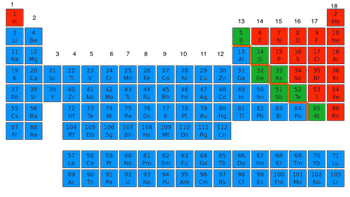
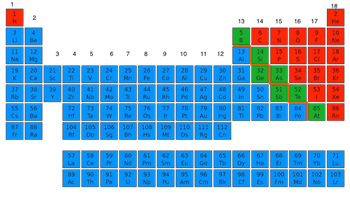
Where are metals located on the periodic table?
a)
Blue
b)
Green
c)
Red
62.
Where are the nonmetals located on the periodic table? 
a)
Blue
b)
Red
c)
Green
63.
Where are the metalloids located on the periodic table?
a)
Blue
b)
Red
c)
Green
64.

Which of the following are subatomic particles? (Check all that apply)

a)

protons

b)

neutrons

c)

megatrons

d)

electrons

65.

Which subatomic particle has a positive charge?

a)

proton

b)

neutron

c)

electron

d)

midichlorian

66.

Which subatomic particle has a negative charge?

a)

proton

b)

neutron

c)

electron

d)

cybertron

67.

Which subatomic particle as no charge, also known as a neutral charge?

a)

proton

b)

neutron

c)

electron

d)

chakra

68.

What is the center of an atom called?

a)

The headquarters

b)

The centrometer

c)

The hypothesis

d)

The nucleus

69.

The nucleus of an atom contains which subatomic particles?

a)

protons and electrons

b)

protons and neutrons

c)

electrons and neutrons

d)

protons, electrons, and neutrons

70.

Which subatomic particle does the RED(+) circle represent?

a)

proton

b)

neutron

c)

electron

d)

nucleus

71.

Which subatomic particle does the YELLOW(-) circle represent?

a)

proton

b)

neutron

c)

electron

d)

nucleus

72.

Typically in an atom, which two subatomic particles are equal in number?

a)

protons and neutrons

b)

all subatomic particles are equal in number

c)

neutrons and electrons

d)

protons and electrons

73.

Which subatomic particles is counted to determine the type of element the atom represents?

a)

proton

b)

neutron

c)

electron

d)

boron

74.

A substance that is 3 on the pH scale would be a(n):

a)

acid

b)

base

c)

neutral

d)

solute

75.
Which one of the following is an example of a base?
a)
orange juice
b)
dish soap
c)
vinegar
d)
lemons
76.
Bases are located where on the pH scale?
a)
any number can be a base
b)
below 7
c)
above 7
d)
number 7 is a base
77.
A substance that is a 10 on the pH scale would be a(n) ____.
a)
acid
b)
neutral
c)
base
d)
indicator
78.
At what location on the pH scale can you find acids?
a)
number 7 on the pH scale is acidic
b)
below 7
c)
above 7
d)
you can find acids all throughout the scale
79.

Neutral solutions have a pH of:

a)

0

b)

1

c)

7

d)

14

80.

Vinegar is an example of:

a)

An acid.

b)

A base.

c)

Neither an acid nor a base.

81.
What is the formula for phosphorous acid?
a)
H3PO4
b)
H2PO4
c)
H3P
d)
H3PO3
82.
Name HF
a)
hydrofluoric acid
b)
Hypofluoric acid
c)
hydrogen fluorine acid
d)
fluoric acid
83.
H3PO4
a)
hydrophsophorus acid
b)
phosphoric acid
c)
hydrogen phosphorous
d)
phosphori hydroxide
84.
H2SO3
a)
sulfuric acid
b)
hydrosulfuric acid
c)
sulfurous acid
d)
persulfuric acid
85.

The first scientist to organize the elements into a periodic table.

a)

Dalton

b)

Reid

c)

Rutherford

d)

Mendelev

86.

H3PO4

a)

hydrophsophorus acid

b)

phosphoric acid

c)

hydrogen phosphorous

d)

phosphori hydroxide

87.
What atom matches this electron configuration?
1s2s2p3s2
a)
Neon
b)
Magnesium
c)
Aluminum
d)
Potassium
88.
Which is the electron configuration for an oxygen atom?
a)
1s22s22p63s23p64s2
b)
1s22s22p4
c)
1s22s22p6
d)
1s22s22p63s23p6
89.
How many d orbitals are there in a given sublevel?
a)
1
b)
3
c)
5
d)
7
90.
What is the maximum number of electrons that an orbital can have?
a)
1 electron
b)
2 electrons
c)
3 electrons
d)
4 electrons
91.
How many electrons can the d sublevel hold?
a)
8
b)
10
c)
2
d)
4
92.
What is the shorthand electron configuration for Sulfur atom?
a)
[Ar] 3p4
b)
[He] 3s23p4
c)
[Ne] 3s23p4
d)
[Na] 3s23p3
93.
How many electrons can the first energy level hold?
a)
1
b)
2
c)
8
d)
0
94.
How many valence electrons does Chlorine have?
a)
5
b)
2
c)
7
d)
5
95.
Which of the following is a p block element?
a)
Ca
b)
Ar
c)
Re
d)
Au
96.
silicon dioxide
a)
SO2
b)
NaO2
c)
SiO2
d)
SiO
97.
diphosphorus pentoxide
a)
P2O5
b)
PO5
c)
P5O2
d)
P2O6
98.
SiCl4
a)
silicon tetrachloride
b)
silicon quadchloride
c)
monosilicon tetrachloride
d)
silicon chloride
99.
The chemical formula of sulfur hexabromide is
a)
SBr₆
b)
S₆Br
c)
S(VI)Br
d)
S6Br
100.
The name of P₄S₁₀ is
a)
phosphorous sulfide
b)
phosphorus sulfide
c)
tetraphosphorus decasulfide
d)
phosphorus (X) sulfide
101.
The chemical formula of tetraphosphorus heptaoxide is
a)
F₄O₁₀
b)
P₄O7
c)
PO
d)
P₁₀O₄
102.
The name of SO₃ compound is
a)
sulfate
b)
sulfur oxide
c)
sulfur trioxide
d)
monosulfur trioxide
103.

Which of the following is a p block element?

a)

Ca

b)

Ar

c)

Re

d)

Au

104.
What is the formula for aluminum fluoride?
a)
AlF
b)
Al2F3
c)
AlF3
d)
Al3F2
105.
A chemical bond resulting from the electrostatic attraction between positive and negative ions is called a(n)
a)
covalent bond.
b)
ionic bond.
c)
charged bond.
d)
dipole bond.
106.
How do the following two elements bond together?
Al3+  O2-         
a)
AlO
b)
Al2O3
c)
Al3O6
d)
Al3O2
107.
When metals bond with non-metals they form what type of bonds
a)
covalent
b)
ionic
c)
cooperative
d)
lewis
108.
If my charge becomes 2+ what does that say about me?
a)
I am stealing 2 electrons
b)
I am losing 2 electrons
c)
I am in period 2
d)
I have an atomic # of 2
109.
If I gain electrons I become
a)
Positive because I've added to my atom
b)
negative because I've added electrons
c)
same because i'm balanced
d)
equal because now I have electrons
110.
What do Roman Numerals represent in the name of a transition metal compound?
a)
how many atoms of the metal there are
b)
the oxidation number of the nonmetal
c)
the oxidation number of the metal
d)
the mass number
111.

This quiz is worth 100 points which could be the difference between passing and failing for the six weeks.

a)

True

b)

False

112.

Rutherford's gold foil experiment proved.

a)

The atom is mostly empty space.

b)

The atom has a positively charged nucleus which is small in size.

c)

All the above

113.

The horizontal row of the periodic table is usually referred to as a

a)

group

b)

alkaline

c)

period

d)

property

114.

Which of the following is an extensive property

a)

boiling point

b)

density

c)

melting point

d)

mass

115.

How many protons, neutrons, and electrons does an atom have with an atomic number 17 and mass number of 35.

a)

35 protons, 35 electrons, 17 neutrons

b)

17 protons, 35 electrons, 35 neutrons

c)

17 protons, 17 electrons, 35 neutrons

d)

17 protons, 17 electrons, 18 neutrons