
 Worksheets
Earth's motions and seasons
Total questions: 70
Worksheet time: 2hrs 45mins
directly over the equator.


Which of the following best explains why the tilt of Earth on its axis creates the seasons? Because the axis of Earth is tilted
the angle of sunlight varies on different parts of Earth at different times.
the amount of time it takes for the light to reach Earth changes a little throughout the year.
the surface area of Earth is not constant at all parts of its orbit.
the north pole of Earth will always be pointed away from the Sun, making it colder.


What season is it in New Jersey at letter A?
Winter
Summer
Spring
Fall


During what month is the Earth closest to the Sun?
January
June
September
December
Which way to the global winds blow in each hemisphere?
east to west in Northern Hemisphere and west to east in the Southern Hemisphere
west to east in Northern Hemisphere and east to west in Southern Hemisphere
North to south in the Northern Hemisphere and south to north in Southern Hemisphere
south to north in the Northern Hemisphere and north to south in the Southern Hemisphere

The diagram shows some examples of how surface winds are deflected in the Northern and Southern Hemispheres because of Earth's rotation. Earth's rotation causes winds to be deflected to the _______.
left in the Northern Hemisphere and right in the Southern Hemisphere
left in both the Northern and Southern Hemispehres
right in the Northern Hemisphere and left in the Southern Hemisphere
right in both the Northern and Southern Hemispheres
As viewed from Earth, most stars appear to move across the sky each night because
stars orbit around Earth
Earth rotates on its axis
stars revolve around the center of the galaxy
Earth revolves around the Sun
Which observation provides the best evidence that Earth rotates?
The length of the shadow cast by a flagpole at noontime changes from season to season.
The direction of swing of a freely swinging pendulum changes during the day.
The position of the planets among the stars changes during the year.
The location of the constellations in relationship to Polaris changes from month to month.


The change in the apparent position of the Big Dipper between the first day of summer and the first day of winter is best explained by Earth

Which diagram best represents the change in the motion of a Foucault pendulum that provides evidence of Earth’s rotation?

The constellation Pisces changes position during a night, as shown in the diagram below.
Which motion is mainly responsible for this change in position?
revolution of Earth around the Sun
rotation of Earth on its axis
revolution of Pisces around the Sun
rotation of Pisces on its axis
To a nighttime observer on Earth, how many degrees do the stars appear to move around Polaris in 3 hours?
60°
45°
90°
15°
Where is the sun directly overhead on December 21?
The Tropic of Capricorn (23.5 degrees S)
The south pole
The Tropic of Cancer (23.5 degrees N)
The equator
Where is the sun directly overhead on June 21?
The Tropic of Capricorn (23.5 degrees S)
The north pole
The Tropic of Cancer (23.5 degrees N)
The equator
Where is the sun directly overhead on March 21?
The Tropic of Capricorn (23.5 degrees S)
The north pole
The Tropic of Cancer (23.5 degrees N)
The equator

What time is at position 1?
12 p.m. (noon)
9 a.m.
3 p.m.
6 a.m.

Which date is represented by the diagram?
March 21
June 21
September 21
December 21
On which day do observers in New York State experience the greatest duration of insolation?
March 21
June 21
September 23
December 21
What time is at position 3?
12 p.m. (noon)
9 a.m.
3 p.m.
6 p.m.
How many degrees per hour does the Sun appear to move across the sky?
41 degrees
23.5 degrees
90 degrees
15 degrees
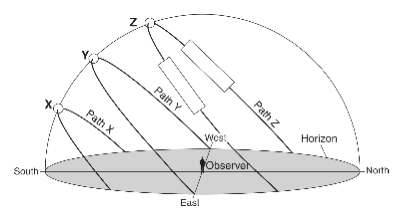

What would most likely happen to New York State's summer and winter temperatures if the tilt of Earth's axis increased from 23.5° to 30°?
Both the summers and winters would become cooler.
Both the summers and winters would become warmer.
The summers would become cooler and the winters would become warmer
The summers would become warmer and the winters would become cooler.

How many hours (h) of daylight are received at the Arctic Circle when Earth is at position A?
0hrs
12hrs
18hrs
24hrs
Which diagram best represents the regions of Earth in sunlight on June 21 and December 21? [NP indicates the North Pole and the shading represents Earth's night side. Diagrams are not drawn to scale.]


The model shows the apparent path of the Sun as seen by an observer in New York State on the first day of one of the four seasons.
Spring
Summer
Fall
Winter

The diagram represents the horizon and the Sun's apparent paths, A, B, and C, on three different dates, as viewed from the same location in New York State. Which table correctly shows the dates on which the apparent paths of the Sun were observed?


Which diagram represents the apparent path of the Sun on March 21 for an observer at the equator?


During which month does the Sun appear to rise farthest north of due east for an observer in New York State?
December
January
June
July

Which rays are DIRECT? A or B
A
B

Which season is represented by this figure?
Winter
Summer
Which choice matches the date with the correct location of sunrise and sunset
June - NE, NW Sept/March - E, W December - SE, SW
June - SE, SW Sept/March - E, W December - NE, NW
June - E, W Sept/March - NE, NW December - SE, SW
June - NE, NW Sept/March - SE, SW December - E, W

During which day of the year is the Sun most likely to follow the apparent path shown?
March 1
July 1
October 1
December 1

The observer had the longest shadow when the Sun was at position
1
2
3
4

This room is located in a building in Connecticut. On which side of the building is the window located?
north
south
east
west

From sunrise to sunset at location B, the length of the observer's shadow will
increase, only
decrease, only
increase, then decrease
decrease, then increase

Where on Earth's surface is the observer at location C located?
at the Equator
at the South Pole
at the North Pole
in Oswego, New York

According to the Sun's actual position shown in the diagrams, the most intense insolation is being received by the observer at location
A
B
C
D

What direction would the person at location D have to look in order to see the sun?
north
south
east
west

Where on Earth is the observer at location A most likely located?
At the equator
At the north pole
At the south pole
in Oswego New York

