
 Worksheets
Chemistry Fall Review
Total questions: 50
Worksheet time: 1hrs 1mins
Name
Class
Date
1.
(Target P5) Alkali metals, alkaline earth metals, and halogens are names associated with
a)
groups
b)
periods
c)
actinide series
d)
transition elements
2.
(Target P7) What element is a halogen that exists as a liquid at room temperature?
a)
Cl
b)
Br
c)
Hg
d)
Kr
3.
(Target P9) The d-block is ten groups wide because it represents the filling of the
a)
two d orbitals that hold a maximum of 5 electrons.
b)
two d orbitals that hold a maximum of 10 electrons.
c)
five d orbitals that hold a maximum of 5 electrons.
d)
five d orbitals that hold a maximum of 10 electrons.
4.
(Target P9) The electron configuration for an alkali metal in period 2.
a)
[He]1s1
b)
[He]1s2
c)
[He]2s1
d)
[Ne]2s2
5.
(Target P10) When bromine becomes an ion, what is the highest energy orbital that is filled?
a)
4d
b)
3p
c)
4p
d)
5s
6.
(Target P10) Isoelectronic elements
a)
have the same number of electrons
b)
involve noble gases
c)
involve charged elements
d)
all of the above
7.
(Target P10) Which of the following would become isoelectronic with argon when it ionizes?
a)
Na
b)
Al
c)
Ra
d)
K
8.
(Target P11) Which of the following factors contributes to the relatively greater atomic size of the higher atomic number elements within a particular family of the periodic table?
a)
more shielding of the outer electrons by the inner electrons
b)
larger nuclei
c)
smaller number of valence electrons
d)
greater number of protons
9.
(Target P11) Which of the following has the largest ionic radius?
a)
Br
b)
O2
c)
Mg
d)
K
10.
(Target P11) Ionization energy can be defined as
a)
the relative ability of an ion to repel electrons in a chemical bond
b)
relative ability of an element to attract electrons in a chemical bond
c)
energy needed to remove an electron from an atom.
d)
energy required to separate one mole of the ions of an ionic compound
11.
(Target P11) All of the following are true except
a)
the atomic radius of Na is greater than the ionic radius of Na.
b)
electronegativity of F is greater than the electronegativity of N.
c)
first ionization energy of Li is greater than the first ionization energy of Cs.
d)
atomic radius of Be is less than the atomic radius of F.
12.
(Target I2) Sn4+ is to Sn2+ as
a)
a gain of 2 electrons is to gain of 4 electrons
b)
a loss of 4 electrons is to a loss of 2 electrons
c)
a loss of 4 electrons is to a gain of 2 electrons
d)
a cation is to an anion
13.
(Target I1, I2) Choose the correct reactivity of potassium based on its electron configuration.
a)
Potassium will lose one valence electron and form a +1 ion.
b)
Potassium will gain one valence electron and form a -1 ion.
c)
Potassium will gain three valence electrons and form a +3 ion.
d)
Potassium will lose three valence electrons and form a -3 ion.
14.
(Target I3) What is the charge of iron in FeSO4?
a)
+1
b)
+2
c)
+3
d)
+4
15.
(Target I5) In the name iron (II) oxide, the roman numeral means that
a)
two kinds of atoms appear in the formula.
b)
two atoms appear in the formula.
c)
two is the charge of the iron in this formula.
d)
two oxygen atoms appear in the formula.
16.
(Target I5) Name the following compound: AlN
a)
Aluminum nitrate
b)
Aluminum nitrite
c)
Aluminum nitrous
d)
Aluminum nitride
17.
(Target C6) The electron-dot diagram for a covalent compound will show
a)
all electrons in each atom
b)
the gain of electrons
c)
the loss of electrons
d)
the sharing of electrons
18.
(Target C5) Which of the following is the name for NO
a)
mononitrogen monoxide
b)
nitrogen monoxide
c)
nitrogen oxide
d)
nitrous oxide
19.
(Target C6, C7) A tetrahedral molecule, such as CH4 , contains
a)
4 bonding pair / 0 lone pair
b)
4 bonding pair / 2 lone pair
c)
2 bonding pair / 1 lone pair
d)
3 bonding pair / 1 lone pair
20.
(Target C2,C6, C7) Using the VSPER model determine the shape for BeH2
a)
linear
b)
bent
c)
trigonal planar
d)
tetrahedral
21.
(Target SP16) What would be the most appropriate unit for measuring the amount of salt in a salt shaker?
a)
kg
b)
g
c)
mg
d)
mL
22.
(Target M2) Matter is defined as anything that
a)
has a definite volume
b)
can be weighed on a balance C. has a fixed volume and weight D. has mass and takes up space
c)
has a fixed volume and weight
d)
has mass and takes up space
23.
(Target M2, M3) Compounds and solutions are different because
a)
A. only compounds are a form of matter.
b)
compounds are pure substances while solutions are not.
c)
A. a compound can be physically separated.
d)
A. only compounds have uniform composition.
24.
(Target M2) Complete the statement correctly. Seawater is classified as a
a)
mixture because its composition is not consistent from sample to sample.
b)
mixture because it has two elements combined together in a compound.
c)
pure substance because it has two elements combined together in a compound.
d)
pure substance because its composition is not consistent from sample to sample.
25.
(Target M2, M3) __________ is a __________
a)
bronze, heterogeneous mixture
b)
skim milk, homogeneous mixture
c)
beach sand, homogeneous mixture
d)
air, pure substance
26.
(Target M4) Several chemistry students must separate a mixture of salt and water. Which of the following lab items should they use?
a)
Graduated cylinder, porous barrier
b)
Hot plate, beaker, filter paper
c)
Beaker, test tubes, funnel
d)
Bunsen burner, evaporating dish and ring with stand
27.
(Target A2) Which of the following particles has a mass that is almost the same as the mass of a proton?
a)
nucleus
b)
electron
c)
neutron
d)
positron
28.
(Target A3) Which of the following is correct for an atom of potassium-39?
a)
protons = 39; neutrons = 39; electrons = 39
b)
protons = 19; neutrons = 20; electrons = 19
c)
protons = 19; neutrons = 19; electrons = 20
d)
protons = 39; neutrons = 19; electrons = 39
29.
(Target A2, A3, A4) Mass number is to atomic number as
I. Carbon-12 is to 6 protons
II. Proton number is to electron number
III. The sum of the protons and neutrons is to the sum of the protons
IV. Boron-10 is to Boron-11
I. Carbon-12 is to 6 protons
II. Proton number is to electron number
III. The sum of the protons and neutrons is to the sum of the protons
IV. Boron-10 is to Boron-11
a)
I, III
b)
II, III, IV
c)
I, IV
d)
I, III, IV
30.
(Target A6) Which of the following properties are the same for the three isotopes of oxygen: Oxygen-16, Oxygen-18, and Oxygen-21?
I. average atomic mass II. neutrons
III. protons
IV. mass number
I. average atomic mass II. neutrons
III. protons
IV. mass number
a)
I, II
b)
II, III
c)
I, IV
d)
I, III
31.
(Target A8, A10) In a bright line spectra for an unknown element, which of the following colors would correspond to a larger quantity of energy emitted?
a)
Yellow
b)
Red
c)
Blue
d)
Green
32.
A substance that has definite shape and definite volume
a)
Solid
b)
Liquid
c)
Gas
d)
Plasma
33.
The majority of an atom's mass exists where?
a)
In the nucleus
b)
In the electron cloud
c)
In the space between the nucleus and the electrons
d)
In the neutrons
34.
What is emitted during Alpha Radiation?
a)
A helium nuclei.
b)
A helium atom
c)
Gamma Rays.
d)
Positrons
35.
What is NOT a characteristic of a Beta particle?
a)
Stopped by thin metal
b)
The most dangerous type of radiation
c)
High speed, High energy electrons or positrons
d)
can penetrate skin
36.

Which type of nuclear radiation is being emitted here?
a)
Alpha
b)
beta
c)
gamma
d)
none
37.
The three types of nuclear radiation in increasing order of penetrating power are ____.
a)
gamma, beta, alpha
b)
alpha, gamma, beta
c)
alpha, beta, gamma
d)
beta, gamma, alpha
38.
When uranium (92 protons) ejects an alpha particle, the nucleus left behind has
a)
92 protons.
b)
91 protons.
c)
90 protons.
d)
89 protons.
39.
What do control rods do in a nuclear reactor?
a)
Regulate the rate of reaction by absorbing and slowing neutrons
b)
Produce electricity
c)
Produce neutrons to increase the rate of reaction
d)
Reduce heat produced by the uranium rods
40.
_________ happens naturally due to an unstable nucleus.
a)
fission
b)
fusion
c)
radioactive decay
d)
K-capture
41.
The splitting of a nucleus into smaller nuclei is
a)
fusion
b)
fission
c)
decay
d)
gamma radiation
42.
Which of these statements correctly describes how the chain reaction occurs in nuclear fission.
a)
Uranium releases electrons to create electricity
b)
When a nuclear fission reaction occurs, the electrons emitted can strike other nuclei in the sample, and cause them to split
c)
When a nuclear fission reaction occurs, the neutrons emitted can strike other nuclei in the sample, and cause them to split
d)
Protons and neutrons change to electrons because the nuclei are so big
43.
Where does fusion occur naturally?
a)
Underwater
b)
All around us
c)
In the radioactive waste
d)
On the sun
44.
One disadvantage of nuclear energy is ___.
a)
it is a fossil fuel
b)
it leaves behind radioactive waste
c)
it emits large amounts of pollution into the atmosphere
d)
there are no disadvantages
45.
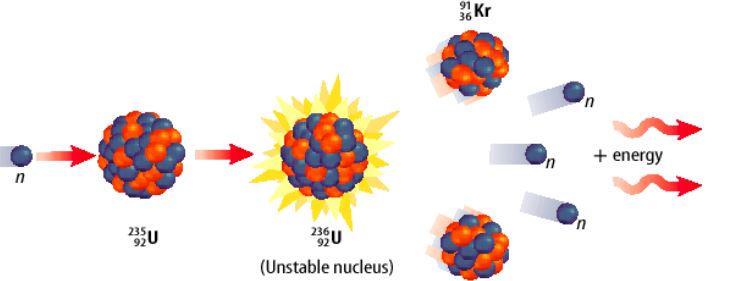
This is an example of...
a)
Fission reaction
b)
Fusion reaction
c)
Decomposition reaction
d)
Decay
46.

Italian Salad Dressing
a)
heterogeneous mixture
b)
homogeneous mixture
47.

What is Kool-aid?
a)
element
b)
Heterogeneous Mixture
c)
Homogeneous Mixture
d)
Compound
48.

Are these molecules also compounds?
a)
YES
b)
NO
49.
Frank has an eraser. It has a mass of 4g, and a volume of 2cm3. What is its density?
a)
8 g/cm3
b)
2 g/cm3
c)
1/2 g/cm3
d)
24 g/cm3
50.
What is the formula for density?
a)
density = mass x volume
b)
density = mass / volume
c)
density = mass + volume
d)
density = mass - volume
100 %

