wayground logo

Free Printable Worksheets

Font size

S
M
L
XL
Worksheets

AP Microeconomics Unit 6

Total questions: 61

Worksheet time: 56mins

Name
Class
Date
1.

If the quantity demanded is lower that the social optimum what should the government do to raise the equilibrium to that optimum?

a)

Nothing

b)

tax the buyers

c)

subsidize the sellers

d)

subsidize the buyers

2.

What is the tax per unit?

a)

$10

b)

$18

c)

$12

d)

$8

3.

G. Zachary Wilickers earns $35,000 per year and pays a 15% income tax while Hugh Mann earns $50,000 per year and pays a 17% income tax. This is an example of...

a)

A Regressive Tax

b)

A Progressive Tax

c)

A Proportional Tax

d)

A Flat Tax

4.

Octan is the leading producer of the Kragle. What will cause President Business to offer more world ending Kragle?

a)

A competitor, Turbo Oil, lowers the price of their Kragle.

b)

The price of a key ingredient increases.

c)

The price of a key ingredient decreases.

d)

The demand for the Kragle increases.

5.

Mr. Vergo finally realizes his dream of opening Holy Smokes. What will increase his demand for labor?

a)

The price of charcoal increases?

b)

Swine flu hits the US.

c)

There is a baby boom among pigs and price of pork decreases.

d)

The government taxes spare ribs.

6.

Producer surplus is measured by

a)

the area to the right of the supply curve but below the price equilibrium.

b)

the sum of buyer and seller surplus

c)

the area above the supply curve but below the equilibrium price.

d)

the right of the demand curve and above the price.

7.

Which of the following will cause the Production Possibilities Curve to shift outwards?

a)

Workers become better trained

b)

Forrest fires destroy 100,000 acres of land

c)

War destroys factories

d)

Skilled workers leave the country.

8.

What will happen is the price of ukuleles decrease

a)

The demand for ukuleles will increase

b)

The supply of ukuleles will decrease.

c)

the quantity of ukuleles demanded will increase.

d)

None of the above.

9.

To calculate marginal revenue product,

a)

multiply the marginal product by the marginal cost.

b)

multiply the marginal product by the product price.

c)

divide the marginal product by the marginal cost.

d)

None of the answers are correct.

10.

What is the main difference between firms in the long run and firms in the short run?

a)

Short run firms cannot change the size of the plant.

b)

Long run firms cannot change the size of the plant.

c)

Short run is enough time to change the amount of capital.

d)

Short run firms can change the size of the plant.

11.

What will happen to the supply of corn if the US Government established a price floor for it.

a)

reduce the surplus

b)

cause a surplus

c)

decrease supply

d)

Shift the demand curve outwards

12.

Suppose both Kenya and Pakistan produce lawn darts and Pogs. Kenya can produce lawn darts at a lower opportunity cost than Pakistan. Pakistan can produce Pogs at a lower opportunity cost than Kenya. According to the law of comparative advantage, if they wanted to produce only on good and establish a trade for the good they are no longer producing,

a)

Pakistan should stop producing lawn darts.

b)

Pakistan should stop producing Pogs.

c)

Both countries should decrease production of both goods.

d)

Kenya should stop producing lawn darts.

13.

What is the opportunity cost of going from point A to point D?

a)

30 toothbrushes

b)

15 toasters

c)

20 toasters

d)

There is no opportunity cost.

14.

What is the marginal utility of eating a fourth slice of bread?

a)

40

b)

10

c)

5

d)

140

15.
When consumption of a good generates a positive externality, which of the following must be true at the market equilibrium? 
a)
Marginal social benefit is less than marginal private cost. 
b)
Marginal social benefit is greater than marginal private benefit. 
c)
Marginal social cost is greater than marginal social benefit. 
d)
Marginal social cost is less than marginal private benefit. 
16.
If the production of a good generates a negative externality, which of the following is true at the private market equilibrium? 
a)
The private market equilibrium quantity is equal to the socially optimal quantity. 
b)
The marginal private cost is greater than the marginal social cost. 
c)
The price of the product equals the marginal social cost. 
d)
The private market equilibrium quantity is greater than the socially optimal quantity. 
17.
If the production of a good generates a positive externality, the government can increase allocative efficiency by: 
a)
taxing the producer of the good
b)
setting a price ceiling to encourage production of the good
c)
subsidizing the producer of the good 
d)
prosecuting firms that produce the good without proper permits
18.
Refer to the image. The socially optimal quantity and the per-unit tax that will achieve the socially optimal quantity are which of the following? 
a)
Quantity = Q1
Tax = P4-P2
b)
Quantity = Q2
Tax = P3-P2
c)
Quantity = Q2
Tax = P3-P1
d)
Quantity = Q3
Tax = P4-P2
19.
Refer to the image.  Given the position of the marginal social cost curve, one can conclude that the:
a)
production of good X creates a negative externality
b)
private cost of producing good X exceeds the social cost of production at all levels of output 
c)
market quantity, Q3, is the socially optimal quantity
d)
free market will produce too little of good X 
20.
Which of the following best represents a positive externality? 
a)
Purchasing a pass for an amusement park 
b)
Being disturbed by neighboring construction noise 
c)
Dumping waste on someone else’ s property 
d)
Enjoying watching birds at a neighbor’s bird feeder 
21.
Which of the following is true when there are negative externalities associated with the production of a good? 
a)
The market will adjust automatically to equate marginal social costs and marginal social benefits. 
b)
Marginal social costs will exceed marginal private costs unless businesses are forced to internalize the external costs. 
c)
Marginal private costs will exceed marginal social costs, but the government can correct the problem. 
d)
Producers should be subsidized so that they will produce more of the good. 
22.
The difference between what consumers are willing to pay for units of a good and the price consumers actually pay for units of the good is called:
a)
a positive externality 
b)
marginal utility
c)
consumer surplus 
d)
producer surplus
23.
Which of the following is true based on the graph shown? 
a)
Quantity of education in the private market is more than the socially optimal quantity 
b)
Producers of education could be taxed in order to achieve the socially optimal quantity 
c)
Consumption of education has a negative externality 
d)
Consumers of education could be subsidized in order to achieve the socially optimal quantity 
24.

If the production of a good generates a negative externality, which of the following is true at the private market equilibrium?

a)

The private market equilibrium quantity is equal to the socially optimal quantity.

b)

The marginal private cost is greater than the marginal social cost.

c)

The price of the product equals the marginal social cost.

d)

The private market equilibrium quantity is greater than the socially optimal quantity.

25.
Which of the following is true when there are negative externalities associated with the production of a good? 
a)
The market will adjust automatically to equate marginal social costs and marginal social benefits. 
b)
Marginal social costs will exceed marginal private costs unless businesses are forced to internalize the external costs. 
c)
Marginal private costs will exceed marginal social costs, but the government can correct the problem. 
d)
Producers should be subsidized so that they will produce more of the good. 
26.

Apartment dwellers who buy fire alarms or fire extinguishers generate a

a)

negative externality.

b)

positive externality.

27.

Driving a car on crowded highway produces

a)

a negative externality.

b)

a positive externality.

28.

The market should produce the quantity where

a)

marginal social cost equals marginal social benefit.

b)

marginal private cost equals marginal social benefit.

c)

external cost equals external benefit.

d)

private cost is greater than social cost.

29.

Marginal Social Cost minus Marginal Private Cost equals

a)

internal cost.

b)

external cost.

c)

marginal cost.

d)

marginal revenue.

30.

A negative externality results due to firms

a)

being very, very , bad.

b)

not paying the full cost of production.

c)

firms internalizing production costs.

d)

firms not realizing they are polluting.

31.
A ______ Externality occurs when a cost of production or consumption falls on a 3rd Party.
a)
Negative
b)
Neutral
c)
Positive
32.

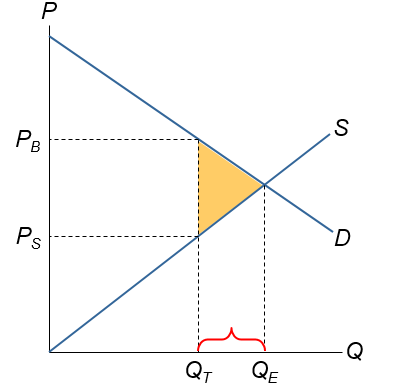
The shaded triangle on the diagram shows

a)

the DWL of overproduction.

b)

the impact of a positive externality.

c)

the DWL of underproduction.

d)

consumer surplus.

33.

Which of the following statements are true?

a)

Area J represents the DWL of overproduction.

b)

Area F shows total surplus being maximised at equlilbrium.

c)

Area H shows DWL of underproduction if Q2 is produced.

d)

Area M shows producer surplus.

34.
When a third party member is affected by the interaction of a buyer and seller, we call this
a)
An externality
b)
The tragedy of the commons
c)
consumer surplus
d)
total welfare
35.
Getting a flu shot is an example of a ________ externality
a)
Negative
b)
Neutral
c)
Positive
36.
What is the underlying mechanism which explains why a good does not become a private one?
a)
Tragedy of the Commons
b)
Negative Externalities
c)
Positive Externalities
d)
Free Rider Problem
37.
The role of government in a market system
a)
does not exist
b)
is restricted to establishing property rights
c)
includes improving situations that would otherwise result in a market failure
d)
includes improving on situations that would otherwise result in a government failure?
38.
What can be done to solve problems related to the tragedy of the commons?
a)
Privatization
b)
Regulations, restrictions and quotas
c)
Public education
d)
All of the above
39.
What is an example of a negative consumption externality?
a)
Increased standards of education in schools
b)
Increased research and development into cancer prevention
c)
Health impacts for society of passive tobacco smoking
d)
Environmental Pollution
40.
What does it mean to internalise an externality?
a)
Trade permits between firms until the externailty decreases to zero through an shift upwards of the MSC curve to intersect at the new optimal level of production
b)
The costs that were previously imposed on society are made internal because they are now paid for by the two parties to the transaction; the producers and the consumers
c)
The costs that were previously imposed on society are made internal because they are now paid for by the producers entirely
d)
The costs that were previously imposed on society are made internal because they are now paid for by the consumers entirely
41.

Most sales taxes are regressive because

a)

taxable purchases are capped at $50,000 a year.

b)

wealthier people pay less tax on a purchase than poorer people would pay on the same item.

c)

most people cannot afford to buy such luxury goods as yachts, furs, and diamonds

d)

poorer taxpayers spend a larger proportion of their income on taxable goods and services than do wealthier taxpayers.

42.
Which of the following is the best example of a pure public good? 
a)
Electricity from a public utility
b)
Mail delivery service by the post office 
c)
Social Security payments
d)
National defense
43.
National defense is an example of a public good because:
a)
it requires tax revenues to fund any production 
b)
it is non-excludable and non-rival
c)
the private market typically produces the socially efficient level of output 
d)
the public is protected from invasion 
44.
Public goods are underproduced in a competitive market because the free-rider problem causes which of the following? 
a)
Reduced market demand 
b)
Fixed supply
c)
Negative externalities 
d)
Effective price ceilings 
45.
A perfectly competitive manufacturing industry pollutes public water in its production process, leaving the water unsuitable for use by the surrounding communities. At the market equilibrium output level, which of the following is true? 
a)
The market equilibrium output is equal to the socially efficient output     
b)
Marginal private cost exceeds marginal private benefit.
c)
Marginal social cost exceeds marginal social benefit 
d)
The market equilibrium output is less than the socially efficient output 
46.
Assume that under new environmental regulations, tire companies have to pay taxes based on how much pollution is created when producing each tire. The price paid by consumers and the quantity of tires sold will most likely change in which of the following ways? 
a)
Price: Increase
Quantity: Increase
b)
Price: Decrease
Quantity: Decrease
c)
Price: Increase
Quantity: Decrease
d)
Price: Decrease
Quantity: Increase
47.
A free-rider problem arises when a good is: 
a)
non-excludable
b)
non-rival
c)
produced in a competitive market 
d)
produced in a monopolistic market 
48.
Assume that the firms in an industry pollute a river. If there is no government intervention, the firms will:
a)
pay production costs that are higher than actual social costs 
b)
charge a lower price than is necessary to maximize profit 
c)
charge a higher price to pay for the pollution 
d)
produce more output than is socially efficient 
49.

Tom bought a pizza and ate it. No one else can benefit from the pizza now :-( . This quality is an example of

a)

excludability

b)

non-excludability

c)

rivalry

d)

non-rivalry

50.

What is the difference between a private and a public good?

a)

A private good shows rivalry and excludability in consumption.

b)

A private good shows rivalry and excludability in production.

c)

A public good shows rivalry and excludability in consumption.

d)

A public good shows rivalry and excludability in production.

51.

The diagram shows a production possibility frontier for an economy operating at point X. The opportunity cost of producing 75 units of consumer goods is:

a)

25 units of consumer goods

b)

30 units of capital goods

c)

60 units of capital goods

d)

75 units of consumer goods

52.

The government introduces a subsidy which shifts supply from S to S1. What is the cost of the subsidy to the government?

a)

PP2BC

b)

P1PCD

c)

P1P2BD

d)

0P1DQ1

53.

Is a situation in which the market, on its own, does not distribute resources efficiently.

a)

Public good

b)

Private sector

c)

Externality

d)

Market Failure

54.

Income level that is unable to provide adequate support for a family

a)

Poverty Threshold

b)

Poverty Rate

c)

Lorenz Curve

d)

Leading Indicators

55.

How salaries and wages are diffused through a society

a)

Income Distribution

b)

Poverty Threshold

c)

Capital Deepening

d)

Core Inflation Rate

56.

A graphical representation of income distribution. It's perfectly straight if everyone earns the same income.

a)

Lorenz Curve

b)

Purchasing Power

c)

Deflation

d)

Globalization

57.
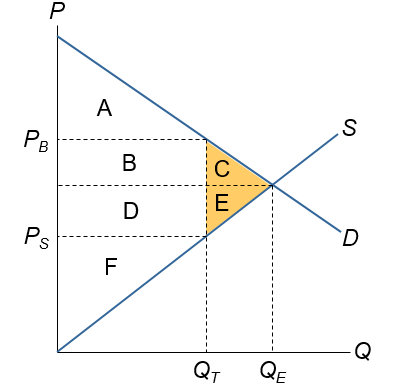
The shaded area of the graph represents
a)
Consumer surplus
b)
Loss of consumer surplus
c)
Loss of producer surplus
d)
Deadweight loss
58.
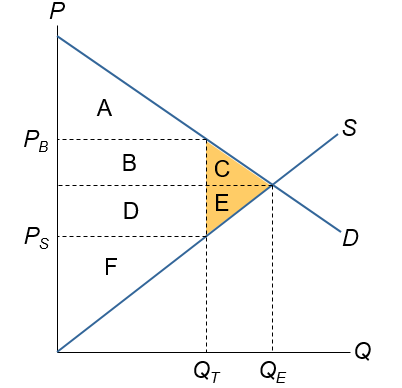
Which area represents total government revenue?
a)
A and F
b)
C and E
c)
B and D
d)
A+B+D+F
59.
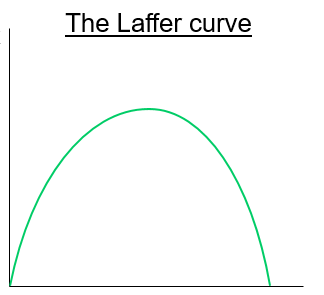
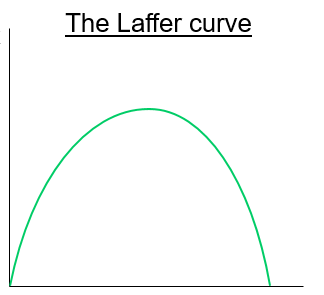
According to the Laffer Curve, the y axis would represent
a)
Consumer Surplus
b)
Social Welfare
c)
Government Revenue
d)
Tax Rate
60.
The Laffer Curve illustrates
a)
Continuous growth of deadweight loss
b)
The taxation revenue earned from the rate of a tax.
c)
The amount of total producer surplus
d)
The amount of total consumer surplus
61.
Which area represents consumer surplus after the tax?
a)
Area A only
b)
Area D only
c)
B and D
d)
Area A +B + C