
 Worksheets
Botany Fall Final Review
Total questions: 60
Worksheet time: 54mins
Name
Class
Date
1.
Sunlight, Water and __________ are needed to conduct photosynthesis?
a)
Oxygen
b)
Carbon Dioxide
c)
Sugar
d)
Atoms
2.
The Apical Meristem is...
a)
Tissue that transports nutrients
b)
Protection around the roots
c)
Area of growing cells
d)
Cells that transport food
3.

This is an example of
a)
Phototropism
b)
Gravitropism
c)
Thigmotropism
d)
Allthetropisms
4.
The main function of the stem is to
a)
Store water
b)
transport substances between roots and leaves
c)
Store carbohydrates
d)
Carry out photosynethesis
5.
Which of the following is responsible for the exchange of gases between the plant and the atmosphere during photosynthesis?
a)
primary and secondary meristems
b)
xylem and phloem
c)
guard cells and stomata
d)
cambium and epidermis
6.
Plants need carbon and oxygen to produce glucose during photosynthesis. How do most plants obtain these elements?
a)
They take in carbon dioxide dissolved in water through the roots and transport them using xylem.
b)
The take in carbon dioxide in the air through the stomata of the leaves.
c)
They absorb carbon monoxide (CO) through respiration.
d)
They absorb carbon (C) from the soil and oxygen (O2) from the air.
7.
What is true of all plants
a)
multicellular
b)
unicellular
8.
The green pigment in plants is due to the presence of
a)
chlorophyll
b)
Chlorine
c)
Chlorophyta
d)
chromatophores
9.
What is the function of vascular tissue?
a)
Transports water and nutrients,
b)
Carries out photosynthesis.
c)
get rid of excess water
d)
Stores nitrogen
10.
Definition: Openings in the plant cell that allow for gas exchange to take place.
a)
Epidermis
b)
Guard Cells
c)
Phloem
d)
Stomata
11.
Monocots, such as grasses, usually have ______ root systems
a)
simple, straight
b)
taproot
c)
fibrous
d)
aerial
12.
TIssue type found lining the outside of plant organs.
a)
Dermal
b)
Vascular
c)
Ground
13.
TIssue type where most photosynthesis occurs
a)
Dermal
b)
Vascular
c)
Ground
14.
TIssue type used to transport materials.
a)
Dermal
b)
Vascular
c)
Ground
15.
Tissue type that includes xylem and phloem.
a)
dermal
b)
vascular
c)
ground
16.
Tissue type that includes root hairs, trichomes, and guard cells.
a)
dermal
b)
vascular
c)
ground
17.

What are these openings in the dermal tissue of a leaf?
a)
Trichomes
b)
Xylem
c)
Stomata
d)
Phloem
18.
The structures (parts) in the plant's cells that capture energy from the sun and use it to make food are called __________.
a)
cell walls
b)
nucleus
c)
chloroplasts
19.
Additional layer around the outside of plant cells made from cellulose that protect and give shape
a)
Cell Wall
b)
Chloroplast
c)
Cell Membrane
d)
Golgi Complex
20.
Storage of food, water, wastes, and enzymes.
a)
Vacuole
b)
Mitochondria
c)
Cell Membrane
d)
Cytoplasm
21.
Produces proteins
a)
Ribosome
b)
Nucleus
c)
Cytoplasm
d)
Endoplasmic Reticulum
22.
Control center of the cell (like a brain)
a)
Nucleus
b)
Nucleolus
c)
Cytoplasm
d)
Endoplasmic Reticulum
23.
Package and transport proteins from the cell
a)
Golgi Complex (body)
b)
Endoplasmic Reticulum
c)
Ribosome
d)
Mitochondria
24.
Control center of the cell (like a brain)
a)
Nucleus
b)
Nucleolus
c)
Cytoplasm
d)
Endoplasmic Reticulum
25.
The top layer of soil is called ________.
a)
bedrock
b)
topsoil
c)
subsoil
d)
grass
26.
What do leaves use to make food?
a)
air, flowers, seeds
b)
air, sunlight, water
c)
roots, stems, water
27.

This type of root is long and all grow the same.
a)
Fibrous Roots
b)
Taproots
c)
Pumpkin Roots
d)
Stems
28.

This type of root grow very deep in the ground and store food for the plant.
a)
Fibrous Roots
b)
Taproots
c)
Pumpkin Roots
d)
Stems
29.

Where are the stomata found on the leaf?
a)
On the cuticle
b)
In the mesophyll layer
c)
On the underside of the leaf
d)
In the vascular tissue
30.
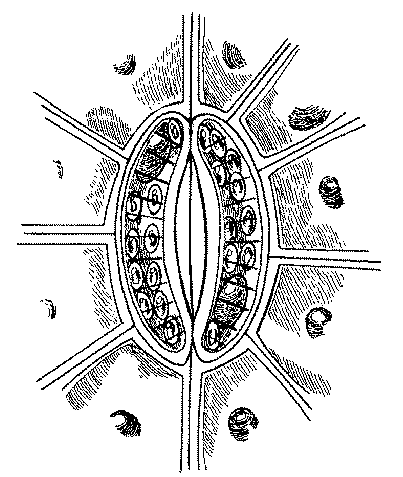
How does the stomata work?
a)
It helps transport sugars to the root cells.
b)
It helps to transport nutrients to the roots.
c)
It helps to exchange gases and water.
d)
It helps to conduct fermentation in the leaf.
31.

Identify the marked structure above.
a)
Spongy Mesophyll
b)
Palisade Mesophyll
c)
Upper Epidermis
d)
Guard Cell
32.

Identify the marked structure above.
a)
Guard Cell
b)
Stroma
c)
Upper Epidermis
d)
Vascular Bundle
33.

Identify the marked structure above.
a)
Spongy Mesophyll
b)
Lower Epidermis
c)
Stoma
d)
Cuticle
34.
The leaf has a shiny, waxy cuticle around it to
a)
increase the rate of photosynthesis
b)
attract more light
c)
control water loss
d)
stop carbon dioxide and oxygen gases escaping
35.
The role of the guard cell is to
a)
help control the temperature of the plant
b)
control how much water enters the leaf
c)
control how much glucose is stored
d)
control the movement of water vapour & gases
36.
If guard cells are swollen with water, then the are more likely to be ...
a)
OPEN with stomata
b)
CLOSED with no stomata
c)
Cannot tell - the water amount doesn't affect it at all.
37.
carries water and minerals from roots to other parts of the plant
a)
xylem
b)
phloem
c)
stoma
d)
guard cell
38.
What is photosynthesis?
a)
Water loss by a plant.
b)
When a photographer takes a photo.
c)
To get your pictures from the photo lab.
d)
The process in which plants make their food.
39.
In a chemical equation, which is true?
a)
reactants--> products
b)
products--> reactants
40.
Which cells of a leaf undergo the MOST photosynthesis?
a)
Guard cells
b)
Palisade cells
c)
Epidermal cells
d)
Cells in the spongy layer
41.

Most plants appear green because chlorophyll
a)
absorbs green light.
b)
absorbs violet light.
c)
reflects green light.
d)
does not absorb violet light.
42.
What is chlorophyll's main function?
a)
to make the plant a vegetable
b)
to blend into their environment
c)
to capture energy from sunlight for photosynthesis
d)
to help prevent water loss
43.
Carbon dioxide enters plant leaves through the __________.
a)
stomata
b)
chloroplasts
c)
xylem
d)
cuticle
44.
Which of the following is not a reactant in photosynthesis
a)
H2O
b)
Light Energy
c)
CO2
d)
O2
45.
Xylem cells transport _______, Phloem cells transport ______.
a)
Glucose, Water
b)
Glucose, Minerals
c)
Oxygen, Water
d)
Water, Glucose
46.
The water needed for photosynthesis comes into the leaves through the
a)
upper epidermis
b)
stomata
c)
guard cells
d)
xylem cells
47.
Sugar and the products of photosynthesis move through the plant in
a)
the phloem cells
b)
the xylem cells
c)
the root hair cells
d)
palisade mesophyll layer
48.
Water & soluble nutrients move through the plant in
a)
the phloem cells
b)
the xylem cells
c)
the root hair cells
d)
palisade mesophyll layer
49.

Identify the leaf part labeled "1" in the diagram.
a)
lamina
b)
blade
c)
vein
d)
petiole
50.

Identify the leaf part labeled "2" in the diagram.
a)
lamina
b)
blade
c)
vein
d)
petiole
51.

Identify the leaf part labeled "3" in the diagram.
a)
lamina
b)
blade
c)
vein
d)
petiole
52.

Identify the leaf part labeled "4" in the diagram.
a)
lamina
b)
blade
c)
vein
d)
petiole
53.

Which of the following parts of a leaf contain chloroplasts?
a)
veins
b)
epidermis
c)
cuticle
d)
mesophyll
54.

What cells function to open and close stomata?
a)
guard cells
b)
palisade cells
c)
stomata
d)
spongy mesophyll
55.

Identify the leaf structure labeled "A" in the leaf cross section diagram.
a)
cuticle
b)
epidermis
c)
palisade parenchyma
d)
spongy parenchyma
56.
Identify the leaf structure labeled "B" in the leaf cross section diagram.
a)
cuticle
b)
epidermis
c)
palisade parenchyma
d)
spongy parenchyma
57.
Identify the leaf structure labeled "C" in the leaf cross section diagram.
a)
cuticle
b)
epidermis
c)
palisade parenchyma
d)
spongy parenchyma
58.
Identify the leaf structure labeled "D" in the leaf cross section diagram.
a)
vein
b)
stoma
c)
palisade parenchyma
d)
spongy parenchyma
59.
Identify the leaf structure labeled "E" in the leaf cross section diagram.
a)
cuticle
b)
epidermis
c)
stoma
d)
vein
60.

Which of the following is the primary photosynthetic structure of a plant?
a)
leaves
b)
stems
c)
roots
d)
cuticle
100 %

