Wayground logo

Free Printable Worksheets

Font size

S
M
L
XL
Worksheets

Finals physics first semester

Total questions: 103

Worksheet time: 2hrs 43mins

Name
Class
Date
1.
A series of steps used by scientists to solve a problem or answer a question. 
a)
scientific method
b)
recipe
c)
data collection
d)
metric system
2.
Which is NOT a step in the scientific method?
a)
Make observation
b)
Form a theory
c)
Collect data
d)
Form a hypothesis
3.

What is the first step in the scientific method?

a)

draw conclusions

b)

ask a question/make an observation

c)

make a hypothesis

d)

test the experiment

4.

Which happens last?

a)

make a hypothesis

b)

ask a question/make an observation

c)

make a plan

d)

draw conclusions

5.

The scientific method is a series of

a)

stations

b)

phrases

c)

steps

d)

answers

6.

Performing a test or experiment allows you to test your ___________.

a)

draw conclusions

b)

hypothesis

c)

senses

d)

battery

7.
Should experiments be repeated over and over to see if the results are the same each time?
a)
yes
b)
no
8.
A series of steps used by scientists to solve a problem or answer a question. 
a)
scientific method
b)
recipe
c)
data collection
d)
metric system
9.
Which of these contains steps in the right order?
a)
Ask a question, state your hypothesis, research, experiment, analyze, make a conclusion
b)
State your hypothesis, ask a question, research, experiment, analyze, make a conclusion
c)
Ask a question, research, state your hypothesis, experiment, analyze, make a conclusion
d)
State your hypothesis, ask a question, research, make a conclusion, experiment, analyze
10.
This step of the scientific method is an educated guess or a prediction. 
a)
Hypothesis
b)
Research
c)
Observation
d)
Conclusion
11.
This step of the scientific method is an educated guess or a prediction. 
a)
Hypothesis
b)
Research
c)
Observation
d)
Conclusion
12.
Information you obtain through your senses, such as touch, sound and sight.
a)
observation
b)
hypothesis
c)
question
d)
conclusion
13.
What do you want to know, understand or figure out?
a)
hypothesis
b)
conclusion
c)
question
d)
data
14.
A test used to discover something unknown.
a)
data
b)
variable
c)
conclusion
d)
experiment
15.
All factors that can change in an experiment.
a)
variable
b)
data
c)
conclusion
d)
result
16.
Information gathered from your experiment. 
a)
observation
b)
variable
c)
hypothesis
d)
data
17.
This variable in an experiment is the one being deliberately changed by the scientist. 
a)
dependent variable
b)
independent variable
c)
data
d)
control group
18.
In a controlled experiment, how many variables can be worked with at a time? 
a)
one
b)
none
c)
two or more
d)
how ever many makes sense.
19.
The part of the experiment that remains the same for the control and experimental group.
a)
constants
b)
control
c)
independent
d)
dependent
20.

Which SI unit is used to measure length?

a)

mol

b)

m

c)

kg

d)

m2

21.

Which SI unit is used to measure mass?

a)

s

b)

m

c)

kg

d)

Pa

22.

Which SI unit is used to measure time?

a)

K

b)

s

c)

mol

d)

N

23.

Which SI unit is used to measure force?

a)

N

b)

K

c)

Hz

d)

Pa

24.

what is the SI unit for power

a)

W

b)

A

c)

N

d)

v

25.

What is the SI unit for energy

a)

A

b)

N

c)

S

d)

J

26.

what is the SI unit for work

a)

K

b)

N

c)

J

d)

A

27.

What is volume?

a)

how heavy it is

b)

how much space it takes up

c)

how much matter is in the object

d)

the shape of the object

28.

The ability to do work or cause change is called ________?

a)

force

b)

work

c)

energy

d)

power

29.
Energy due to motion is ____________ energy. 
a)
Potential 
b)
Energy
c)
Kinetic
d)
Friction
30.
The faster an object moves, the ________ kinetic energy it has. 
a)
more
b)
less
c)
none of the above
d)
all of the above 
31.
__________ is stored energy. 
a)
Potential
b)
Kinetic
c)
None of the above 
d)
All of the above 
32.
Gravitational potential energy depends on the ________ and ________ of the object. 
a)
Height and mass
b)
Friction and movement
c)
Mass and Movement
d)
Height and Friction 
33.
Elastic potential energy is energy stored in object that are compressed or __________. 
a)
movement
b)
stored
c)
harnessed
d)
pulled 
34.
When you stretch a rubber band, you are storing __________ energy. 
a)
kinetic 
b)
potential
c)
none of the above
d)
all of the above 
35.
At which point is potential energy greatest?
a)
W
b)
X
c)
Y
d)
Z
36.
What kind of energy is in a rock at the edge of a cliff?
a)
Potential
b)
Kinetic
c)
Both potential and kinetic energy
d)
none of the above
37.

Energy due to motion is ____________ energy.

a)

Potential

b)

Energy

c)

Kinetic

d)

Friction

38.
Energy an object has due to its position or height.
a)
Potential Energy 
b)
Kinetic  Energy 
c)
Mechanical energy 
d)
Transfer
39.
The sum of the potential and kinetic energy. 
a)
Potential Energy 
b)
Kinetic  Energy 
c)
Mechanical energy 
d)
Transfer
40.
A scientific law stating that energy can’t be created or destroyed. It can only be transformed.
a)
Law of Conservation of matter.
b)
Law of Conservation of mass. 
c)
Law of Conservation of energy.
d)
Law of Conservation of momentum 
41.
If the potential energy is 45 J (joules)and the kinetic energy is 50 J, what is the mechanical energy? 
a)
5 J
b)
45 J
c)
50 J
d)
95 J
42.
Kinetic energy is energy due to...
a)
interactions between objects or particles
b)
motion
c)
elasticity
d)
mass
43.
A battery converts what type of energy to another?
a)
sound to kinetic
b)
light to heat
c)
mechanical to electrical
d)
chemical to electrical
44.
Which items would have this energy transformation: electrical energy -> thermal energy and light energy?
a)
toaster
b)
candle burning
c)
windmill turning
d)
Iron for your clothes
45.
Which items would have this energy transformation: chemical energy -> electrical, light and thermal energy?
a)
turning on a flashlight
b)
nuclear power plant
c)
digesting an apple
d)
tanning bed
46.
Which of the following is a true statement about work?
a)
It measures how quickly an object accelerates 
b)
It measures how much effort is applied over a certain distance
c)
It measures the change in an object's rate of speed
d)
It measures how much time it takes to move a massive object
47.
What does one newton exerted over a distance of one meter equal?
a)
One watt
b)
One hertz
c)
One volt 
d)
One joule 
48.
A kid applies a force of 70 N to a ball over 1.1 meters. How much work did he do on the ball? 
a)
77 J
b)
7.7 J 
c)
0.7 J 
d)
770 J 
49.
A weightlifter lifts two 300 newton weights 1.5 meters off the ground. How much work has he done?
a)
600 J 
b)
660 J
c)
900 J 
d)
1200 J 
50.
The unit of work is the ...
a)
joule
b)
force
51.
Work divided by time equals...
a)
energy
b)
power
52.
The unit of power is the...
a)
work
b)
watt
53.
Force multiplied by distance equals...
a)
work
b)
power
54.
Work is done on an object when the object moves in the SAME direction in which the force is applied.
a)
True
b)
False
55.
A car is driven for 3 hours. What else do you need to know to describe this car’s speed?
a)
the road the car in driven on
b)
the time of day
c)
the distance the car is driven
d)
the number of passengers in the car
56.
What is speed?
a)
how much an object’s position changes
b)
how far an object moves
c)
how long an object moves
d)
how far an object moves in a certain amount of time
57.
When two equal and opposite forces are at work, what happens to motion?
a)
It increases
b)
It decreases.
c)
There is no motion.
d)
There is maximum friction.
58.
What is the speed of a runner who runs 400 meters in 40 seconds? (speed = distance ÷ time)
a)
10 meters/second
b)
40 meters/second
c)
100 meters/second
d)
1,600 meters/second
59.
Which information is needed to determine how fast a truck is traveling?
a)
direction and mass
b)
distance and time
c)
size and speed
d)
time and weight
60.
What is a force?
a)
a push or pull
b)
speed or acceleration 
c)
potential or kinetic energy
d)
balanced or unbalanced force
61.
When objects remain in the same place, it is called...
a)
gravity
b)
friction
c)
balanced force
d)
unbalanced force
62.
What is the force that causes everything to be pulled down to the Earth?
a)
friction
b)
gravity
c)
balanced
d)
unbalanced
63.
Force is measured in....
a)
Galileos 
b)
Newtons
c)
Di Vincis
d)
Einsteins 
64.
An unbalanced force is when objects move in one direction because the force is greater from that direction.
a)
true
b)
false
65.
Inertia is....
a)
for every action, there is an equal and opposite reaction
b)
larger objects take more force to move 
c)
an object in motion tends to stay in motion unless acted on by an opposite force
d)
a push that acts in the opposite direction and it slows down.
66.
What is a force that works AGAINST MOTION?
a)
Force
b)
Motion
c)
Gravity
d)
Friction
67.
Which force produces a change in motion?
a)
unbalanced force
b)
balanced force
c)
gravitational force
d)
frictional force
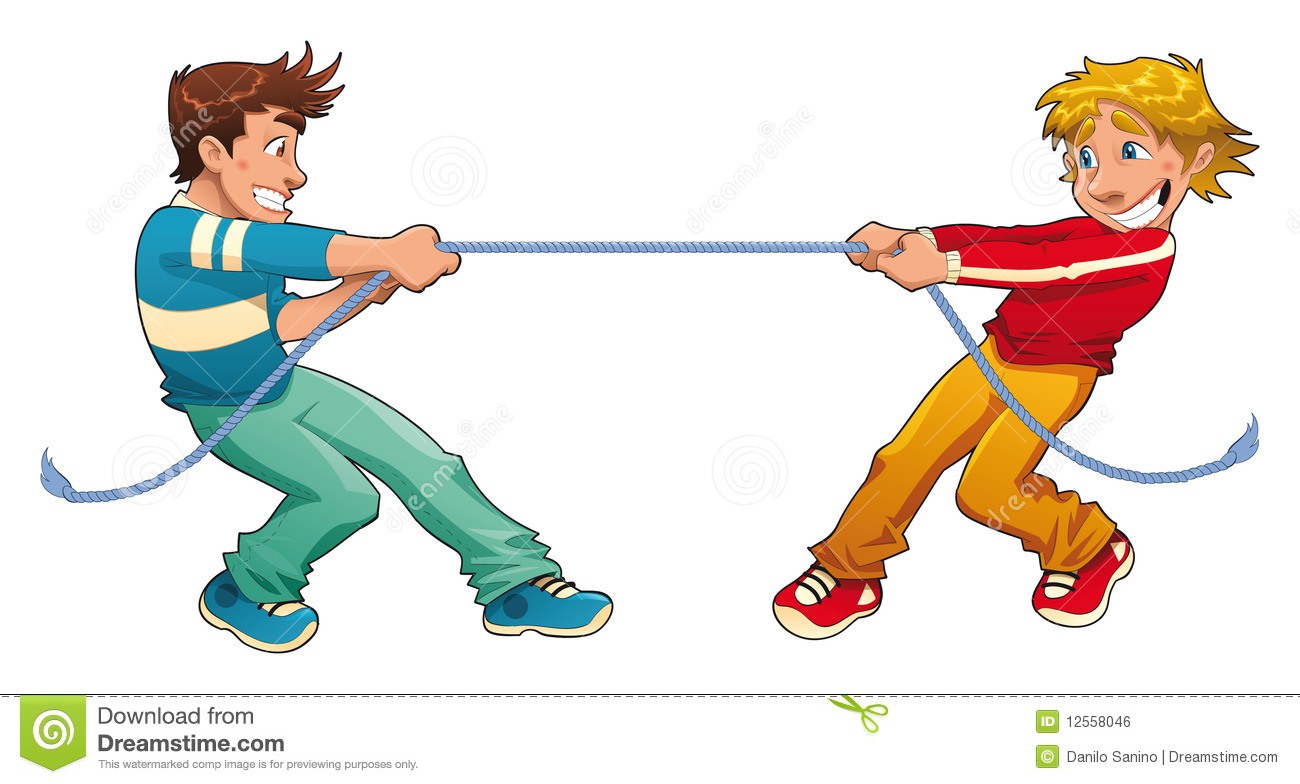
68.
If these boys are pulling with the same amount of force.  What will happen?
a)
The boy in blue will win.
b)
They will not move at all.
c)
The boy in red will win.
d)
Both will fall down.
69.
What pulls a ball back to earth?
a)
Gas
b)
Gravity
c)
Friction
d)
Molecules
70.

An automobile you are riding in suddenly stops, why does your body continue to go forward?

a)

An object in motion stays in motion.

b)

Gravity pulls your body towards the earth.

c)

Friction makes your body slow down.

71.

If you push a tennis ball, a bowling ball, and a basketball with the same amount of force, which one will go farthest?

a)

bowling ball

b)

tennis ball

c)

basketball

72.

It is much more difficult to move a dresser full of clothes than an empty dresser. Why?

a)

An object in motion stays in motion.

b)

It takes more force to move an object with more mass.

c)

It takes more friction to move the empty dresser.

73.
What is Newton's First Law
a)
F=ma
b)
Every action has an equal and opposite reaction
c)
An object at rest stays at rest, an object in motion stays in motion. 
d)
Friction 
74.

Pushing a child on a swing is harder than pushing an adult on the same swing.

a)

True

b)

False

75.

If there was no friction, objects in motion would stay in motion forever.

a)

true

b)

false

76.
A change in velocity over time is
a)
Scalar
b)
Speed
c)
Acceleration
d)
Motion
77.
A change in velocity over time is
a)
Scalar
b)
Speed
c)
Acceleration
d)
Motion
78.

A quantity that needs both magnitude and direction to be fully described.

a)

Vector

b)

Scalar

79.

A quantity described by magnitude and does not need direction

a)

Vector

b)

Scalar

80.
What is magnitude?
a)
The direction that describes a quantity.
b)
A numerical value
c)
A unit of force
81.
Wind blowing at 20 mph.Vector or scalar?
a)
Scalar
b)
Vector
82.
30 m/sec, East. Scalar or Vector
a)
Scalar
b)
Vector
c)
Neither
83.
5 mi., North. Scalar or Vector
a)
Scalar
b)
Vector
c)
Neither
84.

A cat walks 3 meters west toward a laser, then jumps 5 meters due south of the laser when it sees a thing. What is the total distance the cat has traveled (to the nearest tenth)?

a)

3.0m

b)

5.0m

c)

8.0m

d)

5.8m

85.
Scott travels north 5 miles and then goes west 3 miles before coming straight back south 2 miles. What is his distance?
a)
10
b)
7
c)
8
d)
6
86.
Distance and direction of an object's change in position from a starting point
a)
displacement
b)
distance
c)
motion
d)
reference point
87.
 Jermaine runs exactly 2 laps around a 400 meter track. What is the displacement?
a)
800
b)
400
c)
0
d)
200
88.
David walks 3 km north, and then turns east and walks 4 km. What is the distance?
a)
7 km
b)
3 km
c)
4 km
d)
1 km
89.
Bill runs 400 meters to Andy's house, turns around, and runs 400 meters back home.  What is Bill's distance?
a)
0 meters
b)
400 meters
c)
800 meters
d)
1600 meters
90.
If you slow down on your bicycle, you accelerate.
a)
TRUE
b)
FALSE
91.
Changing the speed and changing the direction of your bicycle are both examples of acceleration.
a)
TRUE
b)
FALSE
92.
You are riding your bike at 9 km/h. Ten minutes later, your speed is 6 km/h.
a)
Acceleration occurred because speed increased.
b)
Acceleration occurred because speed decreased.
c)
Acceleration occurred because you changed directions.
93.
You ride your bike in a straight line at a constant speed of 10 km/h.
a)
Acceleration occurred because speed increased.
b)
Acceleration did not occur because neither speed nor direction changed.
c)
Acceleration occurred because you changed directions.
d)
Acceleration occurred because speed decreased.
94.
A dog runs on the sidewalk 9 mi/hr.
a)
Speed
b)
Acceleration
c)
Velocity
95.
Describe the speed of the object from
2-5 seconds using the speed vs. time graph.
a)
Increasing speed
b)
Not moving
c)
Decreasing speed
d)
Constant speed
96.
Describe the speed of the object from
5-6 seconds using the speed vs. time graph

a)
Speeding up
b)
Slowing down
c)
Not moving
d)
Constant speed
97.
The momentum of an object depends upon the object's ___________&_____________.  
a)
size and shape
b)
mass and speed
c)
mass and veloctiy
d)
mass and energy
98.
The equation to calculate momentum is
a)
p=mv
b)
p=1/2mv2
c)
p=mgh
d)
p=mg
99.
Which has more momentum: a car stopped at a red light or a bike moving at 15 mph?
a)
car
b)
bike
c)
they are equal
d)
cannot determine using the info provided
100.
Determine the momentum of 1000-kg car moving southward at 20 m/s......... 
a)
20000 N
b)
20000 Joules
c)
20000 Kg * m/s south
d)
10000 kg * m/s south
101.
The impulse is ______ the change in momentum
a)
Greater than
b)
Equal to
c)
less than
d)
always double
102.
When the speed of an object is doubled, its momentum
a)
remains unchanged in accord with the conservation of momentum.
b)
doubles
c)
quadruples
d)
decreases
103.
What is the unit for velocity?
a)
m/sec
b)
kg/sec
c)
kg/m
d)
kg m/sec